












This website uses cookies to help improve your user experience
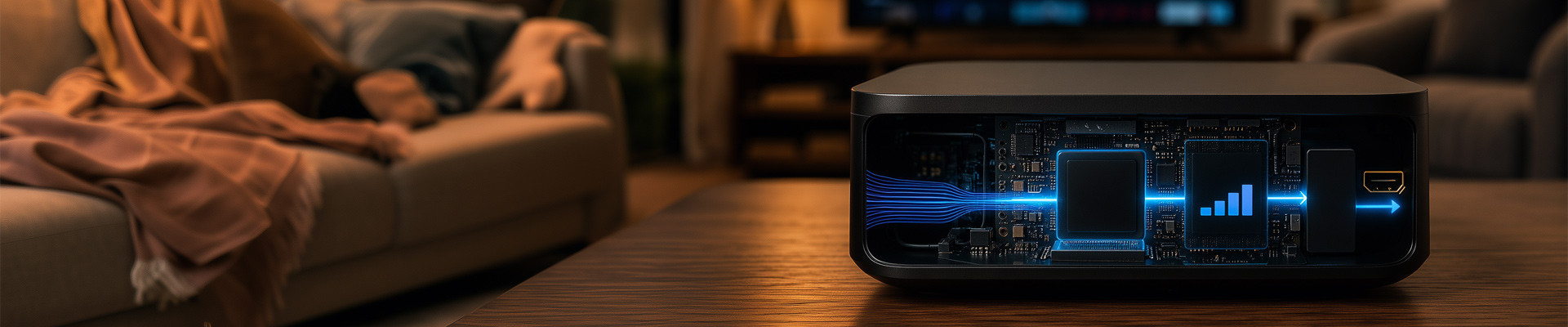

Somewhere behind a television that has not been unplugged in three years, a black plastic box the size of a paperback book is making thousands of small decisions a second.
It is parsing a manifest. It is deciding whether the network can hold 4K or should drop to 1080p before the picture stutters. It is asking a license server, in milliseconds and without a sound, whether it has the right to decrypt the next two seconds of a film.
Nobody in the room notices any of this, and nobody has ever once thanked it for the effort. That invisibility is exactly why that box, an OTT box, is harder to build well than most product roadmaps admit.
Every year, someone predicts that this object is finished and will be replaced by a Smart TV, phone screen, or stick that costs less than a dinner out. Yet every year, the operators who run pay-TV platforms continue to ship them, and the reason comes down to profit, not sentiment.
Dataintelo’s most recent findings predict the OTT box market will reach $38.2 billion USD by 20341. Lucintel, writing for Research and Markets, estimates the market to be worth a more modest $20.7 billion by 20352. This difference is significant enough to prove that any single dollar figure is merely directional.
A box is still the only device in the home that an operator fully controls: boot screen, ad insertion, and the exact codec it decodes. That control is worth more to a telecom company than nostalgia ever could be.
This guide explains where OTT boxes fit inside the broader OTT technologies matrix, how they work end to end, and when they still make strategic sense for a product or platform team deciding what to build next.
Key takeaways:
Over-the-top delivery means video and audio travel over the public internet, bypassing traditional cable or satellite distribution entirely. An OTT box is the playback endpoint for that delivery: compact hardware that decodes the incoming stream and renders apps on a television.
An OTT TV box and an OTT set top box refer to the same category of device, and an OTT TV box 4K adds the decoding power and HDMI bandwidth needed for ultra-high-definition output. Everything worth knowing about this category happens after the box powers on, and that’s the rest of this guide.
An OTT box runs the same signal path on every playback session, whether it’s streaming a soccer match or a rerun:

Each stage exists because something specific goes wrong without it, and each one is a place where a poorly engineered box loses viewers.
The box requests an HLS or MPEG-DASH manifest that lists every available bitrate and where to fetch each segment. A malformed or slow parse is invisible in a demo and brutal during a live sports spike, when thousands of boxes hit the same file inside the same second.
Modern codecs, AV1, HEVC, H.264, all trade compression efficiency against decoding cost. Hardware-accelerated decoding has to keep pace with the ABR ladder in real time or the result is dropped frames during exactly the moments viewers care about, a goal, a plot twist, a season finale.
Playback engineering earns its reputation for being unglamorous and unforgiving right here, and it is the layer Oxagile spends the most engineering hours tuning across client deployments. Startup latency and buffering reduction get shaped here too, alongside CDN behavior, manifest fetch time, DRM license acquisition, and player startup logic, several steps before anyone touches the UI.
DRM, Widevine Modular, Microsoft PlayReady, Apple FairPlay, decrypt the stream at the hardware level to satisfy the licensing terms studios require before they release premium content to any platform. Multi-DRM support is mandatory for anyone carrying licensed film or TV content, and a mistake here surfaces as a blocked catalog long before anyone files a bug ticket.
The mechanics behind license acquisition, key rotation, and output protection get detailed treatment in how DRM actually works in OTT, and the short version for a box specifically is that certification has to happen per chipset, not just per platform.
A Widevine L1 certification on one Amlogic SoC does not carry over to the next chip revision automatically, which is a scheduling problem as much as a technical one, and it has a habit of surfacing about two weeks before launch, never earlier.
The decoded frame reaches the screen, and every session quietly reports back startup time, rebuffering events, and bitrate switches. An operator pulling that data can point to the exact session where a subscriber gave up and went to watch something else.
A viewer who just wants the show to start never sees any of this, and that is the whole point of building it well.
Apple TV and a telco’s branded set-top box get compared constantly, mostly because both plug into an HDMI port and both stream, but business-wise the two sit nowhere near each other. You might as well compare a rental car to a company fleet vehicle because they’ve both got four wheels.
The real split maps onto a decision every engineering leader already recognizes from infrastructure choices: buy into someone else’s platform and accept their rules, or own the stack and carry the operational weight yourself.
Retail devices like Apple TV, Amazon Fire TV, Roku, or Chromecast work well for media brands launching a standalone direct-to-consumer app. And the consumer, not the operator, is the one picking the hardware, usually based on whatever was cheapest at the till on a random Tuesday. The platform owner (Apple, Amazon, Google, Roku) controls distribution, discovery, and update cycles, and the app publisher lives inside those rules.
Operator-tier and white-label STBs work in the opposite direction. A telco or ISP owns the box, the branding, the boot sequence, and the customer relationship end to end. That ownership comes with responsibility for provisioning, subscriber management, remote updates, monetization, and support, all of which used to be someone else’s problem in the retail model.
Apple TV versus telco-STB isn’t the whole picture either. Dongles, pucks, hybrid boxes with built-in tuners, and gaming-console side channels all compete for the same HDMI port, and most people couldn’t tell you how many they’ve got plugged in until they move house and find three.
A full survey of what counts as an OTT device today shows how blurry the retail category alone has become. That blur rarely reaches into the operator tier, where procurement cycles, certification requirements, and support contracts keep the category boundaries much sharper.
| Dimension | Retail/Consumer devices | Operator-tier and white-label STBs |
| Ownership | Platform vendor (Apple, Amazon, Google, Roku) | Operator |
| Branding | Vendor’s ecosystem, app is a guest | Fully operator-branded, boot to home screen |
| Updates | Controlled by the vendor’s release cycle | Operator-managed OTA, on the operator’s schedule |
| Monetization | Vendor takes a cut of in-app and ad revenue | The operator keeps full control of ad insertion and billing |
| Deployment | Consumer buys retail, self-installs | The operator provisions and ships as part of a subscription |
| Customer support | Vendor’s support desk | Operator’s support desk, tied to the wider service |
| Lifecycle | 3 to 5 years, vendor-driven refresh | Operator-controlled, often tied to contract terms |
| Business goal | Reach and app distribution | Full control of the living room and the customer relationship |
An operator’s hardware is just the visible tip of something much bigger. Open it up, and you’ll find a chipset, some RAM, nothing that explains why the whole thing runs at all.
Credit for that belongs somewhere less photogenic: a billing platform quietly deciding who gets to watch, and a support desk picking up when the answer turns out to be nobody.
Smart TVs already reach most households. The real question is whether a dedicated box still earns its cost when a Smart TV app could do the same job. For most operators, it’s both, running as one coordinated platform instead of two competing ones, which is a less satisfying answer than “pick one” but a more honest one.

Smart TV apps still matter. Operators that treat Smart TV, mobile, web, and the operator box as one ecosystem, sharing the same subscriber identity and business logic, don’t end up rebuilding the same subscription and entitlement logic four times over, once for every screen someone in product management got excited about.
Every OTT box RFP reads like a features checklist: decoding, DRM, remote pairing. The things that determine whether a deployment ships on schedule or slips two quarters live somewhere else entirely.
A box has to activate itself, tie to a subscriber account, and pick up the right entitlements the moment it’s plugged in, before anyone at the operator has heard about it.
Billing, subscriber management, CRM, and authentication systems rarely speak the same protocol the box’s app layer expects. Wiring an OTT client into that stack becomes the single largest line item on the project more often than anyone plans for, and it usually gets discovered around the time the invoice does.
Chipsets, firmware versions, and remote controls shift across every hardware batch an operator ships, sometimes within the same product line a year apart. Testing that by hand means re-running the same regression pass across dozens of device profiles every release cycle. This is the reason why automated testing for OTT playback and UI exists in the first place.
Certification with each DRM vendor takes real lead time, and remote firmware updates need to be safe enough to push to tens of thousands of boxes overnight without stranding a subscriber halfway through. Every operator engineering team has its own story about the night a push went out at 2 am and left a chunk of the fleet frozen on an update screen.
Codec support, memory, and decoding power cap what a box can do three years into its deployment, long after the people who picked the chipset have moved on to another project. Remote diagnostics end up carrying most of that weight, since sending a technician to a subscriber’s home for a three-year-old box rarely makes financial sense. That box is still someone’s problem to support.

Provisioning, DRM certification, BSS/OSS integration, device fragmentation, any one of these can quietly become the line item that blows the estimate. Talk to the team that’s shipped this before the invoice does.
Once the strategy is set, the sourcing question splits into three real paths, and each one carries a different engineering commitment.
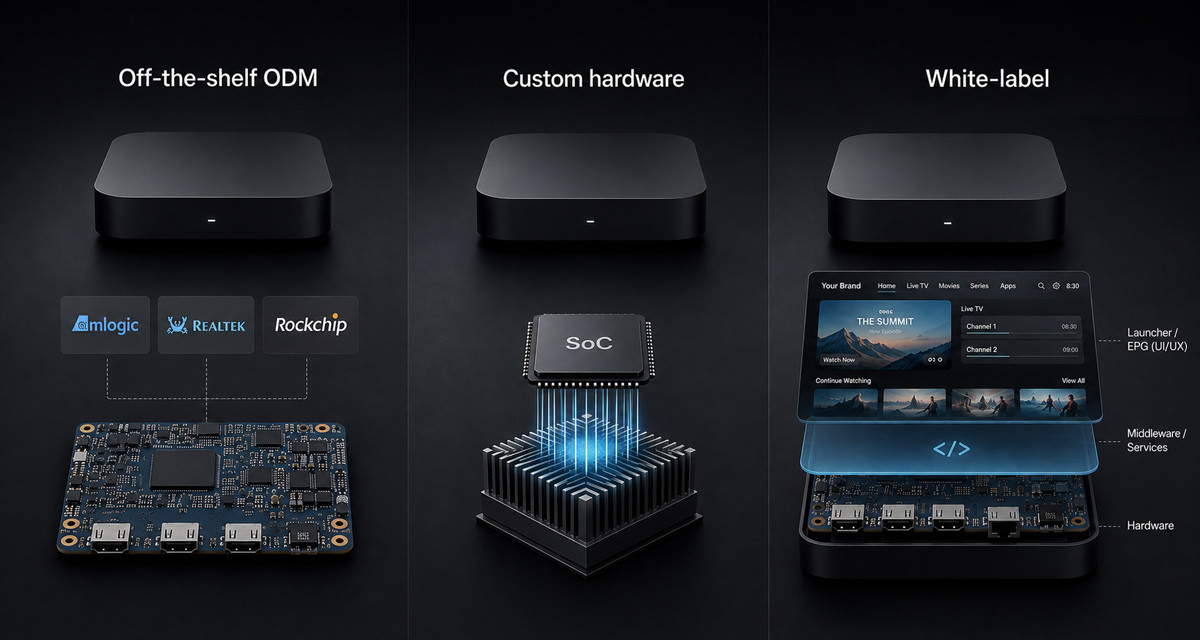
This is the fastest route to a working OTT TV box. A reference design from Amlogic, Realtek, or a similar chipset vendor comes with a known BOM, existing DRM certifications, and a firmware base an operator’s team layers a launcher on top of.
The compromise is limited control over the industrial design and a shared chipset roadmap with every other operator using the same reference board, which caps how differentiated the hardware itself can be. Open the back of three competitors’ set-top boxes, and there’s a decent chance you’ll find the same board wearing three different logos.
Such an option buys back that differentiation, and it charges you for every inch of it. Chipset selection, thermal design, remote control pairing, and DRM certification stop being a vendor’s problem and become the operator’s own, along with the invoices that come with owning them.
Custom set-top box development covers what changes in more depth, but the short version is that custom hardware makes sense once volume is high enough to justify the non-recurring engineering cost, and rarely a unit before that.
White-label with a custom app layer splits the difference, and it’s the path most mid-size operators actually take, less a bold strategic choice than the one that lets them sleep at night.
The hardware ships from an ODM largely unmodified, and the differentiation happens entirely in software: the launcher, the EPG, the recommendation surface, the way live and on-demand content sit next to each other on the home screen.
Building that layer well on constrained set-top hardware is its own discipline, distinct from building a mobile or web app. Operators choosing this route usually lean on dedicated set-top box app development to get it right.
Memory budgets are tighter, input handling has to account for a remote instead of a mouse or touchscreen, and every animation gets tested against a chipset that, by the time the app ships, is already a generation or two behind whatever a developer is coding on. It’s the hardware equivalent of running a marathon in wellies.
Some industries never stopped needing dedicated hardware, and it’s rarely for the same reason twice.
Telecom and pay-TV operators are mid-transition from legacy IPTV and DVB infrastructure to Android TV Operator Tier deployments. That’s a swap of proprietary Linux stacks for a platform with a larger developer ecosystem behind it and faster app delivery, or, in plainer terms, nobody wanted to keep maintaining homegrown middleware from 2011.
Hotels and hospitals in particular, need OTT boxes that integrate with a property management system and wipe every credential clean the moment a guest or patient checks out. A retail streaming device that remembers the previous guest’s Netflix session turns into a liability the moment the next one checks in.
Launching standalone retail apps in this case means low-latency streaming that holds up during a live event, where a few seconds of extra buffer is the difference between a broadcast and a spoiler delivered by someone’s group chat, usually from the neighbour who was watching on satellite.
Getting glass-to-glass latency down into the single digits changes the ABR ladder, the segment duration, and often the protocol choice entirely, tradeoffs covered in more detail in OTT sport streaming. None of that latency work matters if the box on the other end can’t decode fast enough to use it, and that’s exactly why sports deployments tend to specify hardware more tightly than a general entertainment catalog would.
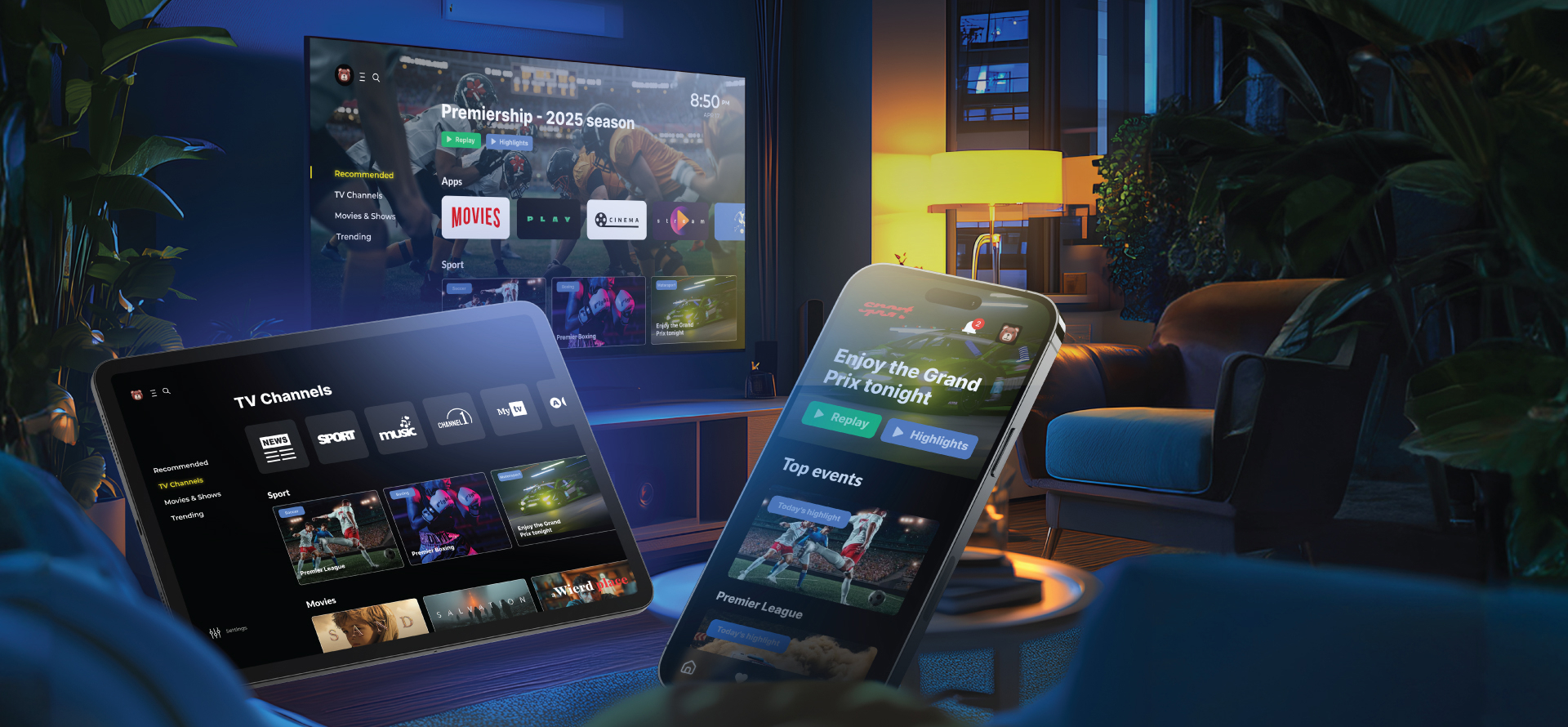
An operator needed Android TV, Android TV Operator Tier set-top boxes, Apple TV, mobile, and web running off the same subscriber logic instead of five separate builds.
Oxagile designed the business logic layer once and reused it across every screen, so adding the next hardware line, brand, or market never meant starting over.
An OTT box will keep looking like a commodity from the outside, a small plastic object retailing for less than a decent pair of headphones. Everything that decides whether it works (provisioning, DRM, fragmentation, BSS/OSS integration) sits underneath it, invisible to the subscriber and expensive the moment any of it breaks, usually at 2 am and usually on a Friday.
Plenty of boxes play video well enough for a demo and buckle the first weekend real subscribers show up in numbers, because somebody shipped the box as the whole product and stopped there.
The ones still running fine five years on got treated as one endpoint inside something much bigger from day one, the same platform thinking behind Oxagile’s broader OTT development work.
Provisioning, DRM certification, BSS/OSS integration, hardware sourcing, none of it prices itself the way a spec sheet suggests. Check the real numbers before committing to a build.
1. OTT Box Market Research Report 2034 — Dataintelo
2. OTT Set Top Box Market Report: Trends, Forecast and Competitive Analysis to 2035 — Research and Markets
Yes, functionally. Apple TV decodes and plays streamed content over the internet, which puts it in the OTT TV box category. Commercially, it sits firmly in the retail tier, controlled by Apple’s ecosystem, not by any single content owner or operator. Try pitching Apple on operator-style ad insertion into someone else’s home screen and see how far that meeting gets.
Yes. Amazon Firestick decodes and streams content over the internet, which puts it in the OTT box category alongside Apple TV, Roku, and Chromecast. Commercially it’s a retail device: a consumer buys it, plugs it in, and manages it themselves, entirely separate from any pay-TV provider’s platform or subscription.
An IPTV box typically operates on a managed, closed network run by a single telecom provider, with guaranteed bandwidth and quality of service.
An OTT box streams over the open public internet with no such guarantee, and that gap is exactly what makes adaptive bitrate streaming and buffering resilience so critical in OTT engineering.
Often, within limits set by the hardware’s decoding power and available memory. A conversion project usually means adding OTT app support and modern codec handling on top of the existing set-top box, without replacing the hardware outright. The ceiling on what’s possible is set by the chipset the box already shipped with.

