









This website uses cookies to help improve your user experience

Most retail AI runs on machine learning that has been in production for years, which makes the results predictable and the risk knowable. Generative AI use cases in retail need a language model, and those run through GenAI development.






Forecasting runs on statistical modeling over sales history, seasonality, and the promotional calendar. No language model is involved. The accuracy ceiling is set by the data, so the work starts with reconciling stock and sales records across locations.
AI in retail personalization is machine learning applied to behavior, basket, and catalog data. Oxagile has delivered a recommendation platform for an eCommerce client, with a statistics module exposing what shoppers actually chose. Uplift gets measured against a holdout group.
Pricing models weigh demand signals, competitor moves, and margin floors. The modeling is well understood. The design time goes into the guardrails that stop a model from discounting into a loss.
Oxagile’s computer vision work is delivered, not theoretical. One production deployment detects and tracks people in real time on Nvidia Jetson edge hardware at 15 milliseconds per face, running up to seven cameras per device with no ceiling on devices per site. The same detection and tracking stack carries onto a shop floor.
AI in retail supply chain covers routing, allocation, and returns prediction. These are optimization problems with decades of literature behind them. The value comes from connecting the model to live inventory and carrier data instead of a monthly export.
Segmentation, churn scoring, and customer lifetime value prediction are standard modeling problems, and Oxagile has delivered them. Fraud scoring runs with the team that builds payment infrastructure for fintech clients, where latency inside the payment path is a hard constraint.
Our retail software development covers the commerce platforms, point of sale,
warehouse, and enterprise systems these models read from.
AI adoption in retail stalls on data more often than on models. When records disagree, the model inherits the disagreement. Our services take the enterprise data practice from AI development.
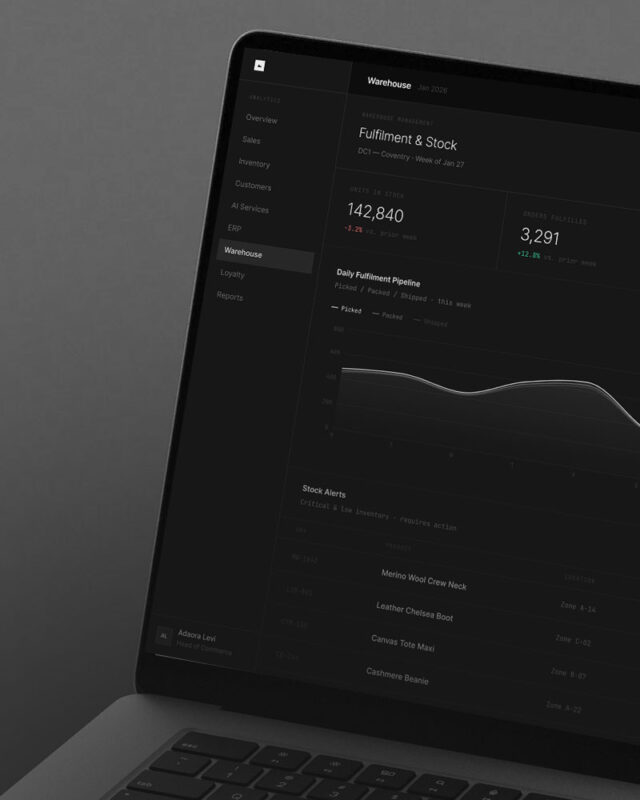

Point of sale, eCommerce, enterprise resource planning, warehouse, and loyalty systems each hold a partial view of the same customer and the same SKU.
Oxagile builds the pipelines and cross-system mapping that resolve them into one record, in batch, or streaming depending on what the use case needs.


A model needs to know that a SKU in the point of sale export and a product ID in the catalog are the same object. The semantic layer encodes those definitions once, so every downstream model and dashboard agrees on what a unit, a return, and a margin mean.
Agentic AI in retail depends on this layer above all, since an agent without shared definitions answers confidently and wrongly.
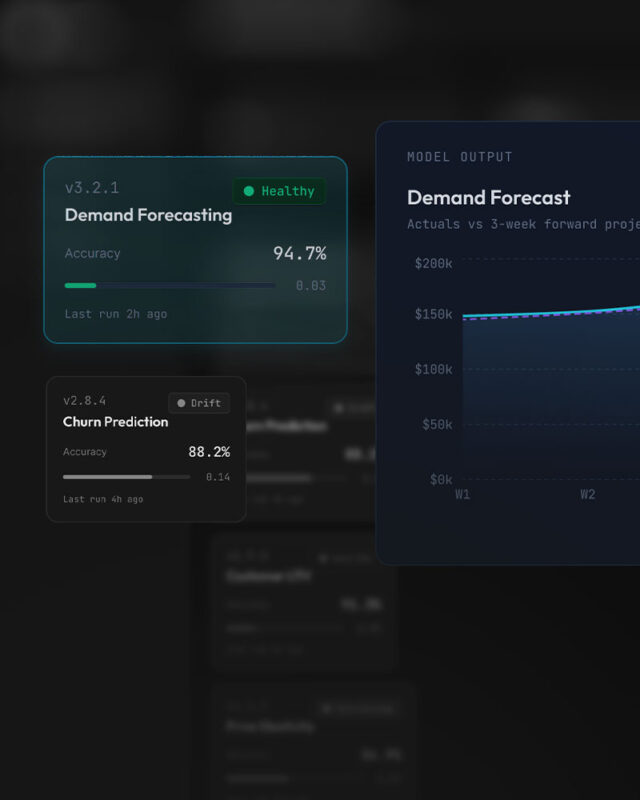
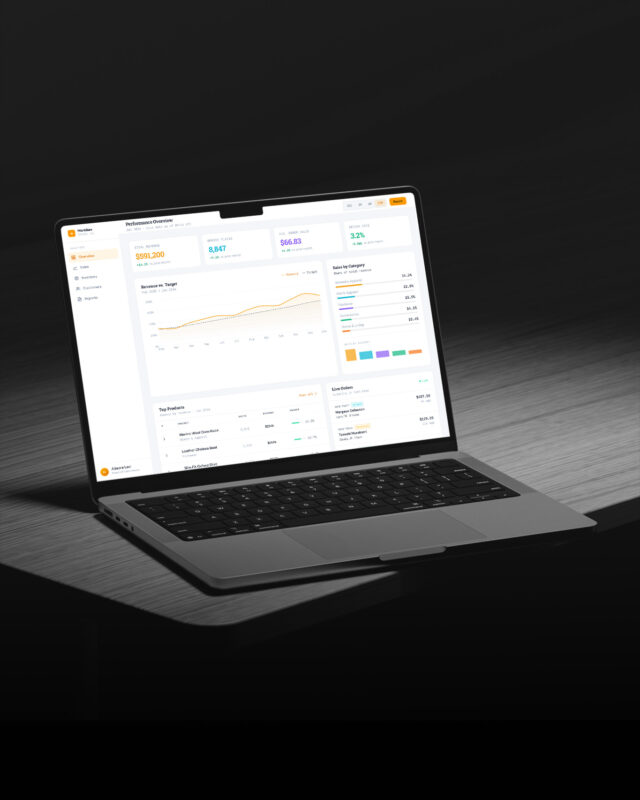
Forecasting, churn, lifetime value, and elasticity models built on the unified data, with retraining and drift monitoring set up in the same engagement.
Model selection comes after the data audit.
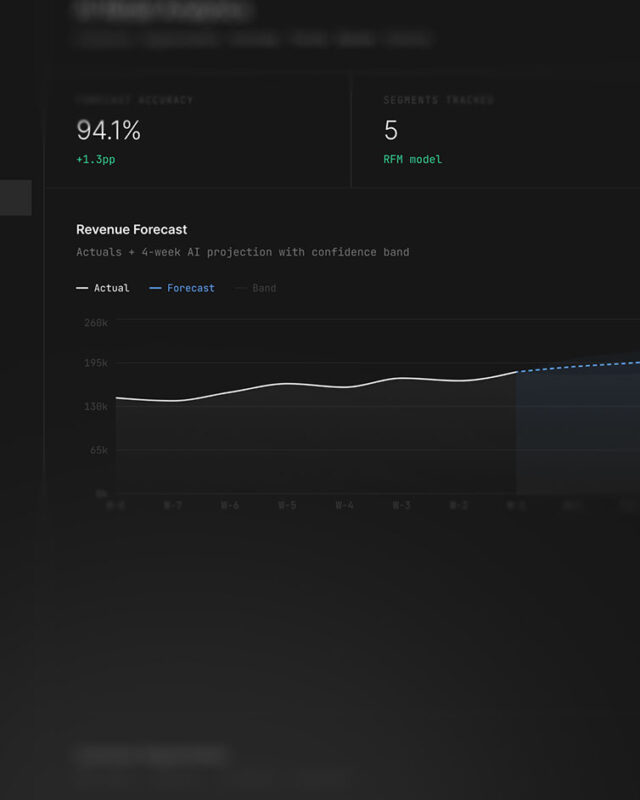
Real-time and batch reporting that reconciles against source systems.
Margin, stock turn, basket composition, and cohort behavior land in one model, so the figure in the board pack matches the figure in the warehouse.

Retail data is personal data. Oxagile builds pipelines with personally identifiable information redaction, tokenization, and access controls in place from the start, so a model can work on customer behavior without exposing customer identity.
GDPR and regional requirements get designed before an assessor asks.
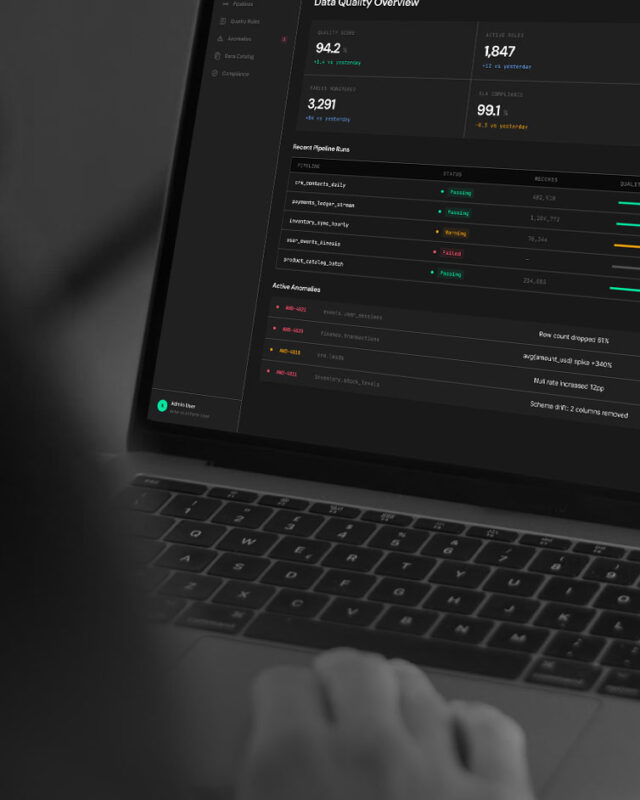
Validation, lineage, and monitoring across the pipeline. Bad data caught at ingestion costs nothing.
The same problem found inside a forecast three months later costs a season.
Data and use case audit
Systems, data quality, and access get assessed against the shortlisted use cases before anything is scoped.
ROI hypothesis
Each candidate gets a measurable target and a cost estimate, so the go decision rests on a number.
Prototype
A demo version runs on your data within two weeks, which turns a scope discussion into a review of something real.
Build and integrate
Delivery runs in short cycles, with the model tested against live systems and validated on a holdout.
Deploy and retrain
Monitoring, drift alerts, and a retraining schedule ship with the model.
The benefits of AI in the retail industry land unevenly, and the difference is almost always the data underneath.


PyTorch • TensorFlow • scikit-learn • XGBoost • LightGBM • Prophet
OpenCV • YOLO family • Nvidia Jetson • DeepStream • ONNX • C++ inference
OpenAI GPT • Anthropic Claude • Google Gemini • Llama • LangChain • LlamaIndex • Vector databases
Snowflake • Redshift • BigQuery • Kafka • Spark • dbt • Airflow
AWS SageMaker • Azure ML • Google Vertex AI • Docker • Kubernetes • MLflow
Adobe Commerce • Shopify • Salesforce • SAP • Odoo • Microsoft Dynamics 365
Oxagile prices retail AI on data readiness first and model complexity second. A single-workflow pilot covering setup, integration, and an evaluation harness runs weeks of engineering time.
Multi-use-case deployments scale with the number of systems integrated and the state of the data. Oxagile replaces that range with a number specific to your stack after a data audit.
Oxagile delivers a working demo on your data in just two weeks. A production-ready model takes longer, because validation on a holdout and integration into the ordering or pricing path set the pace.
Oxagile starts most retail AI work from sales history, a product catalog, and one identifier that ties a customer across channels. This cover most use cases of AI in the retail industry. Forecasting needs at least a full seasonal cycle. Personalization needs behavioral events. The audit in step 1 tells you what is missing before any commitment.
Yes. Oxagile has certified point of sale terminals across 40+ payment providers and connected storefronts to enterprise resource planning and customer relationship management systems, including custom ones. Model output lands back in the system that acts on it, whether that is replenishment, pricing, or the storefront.

