
Not sure which system to fix first?
An audit puts the constraint, the cost, and the sequence on one page before anything gets committed.

Retail traffic arrives in spikes, so the customer layer gets sized for the campaign day and costs less in between. This front end carries:

Stock, orders, and fulfillment usually sit in separate systems holding separate answers. The gap surfaces as an oversell. A single record enforces:
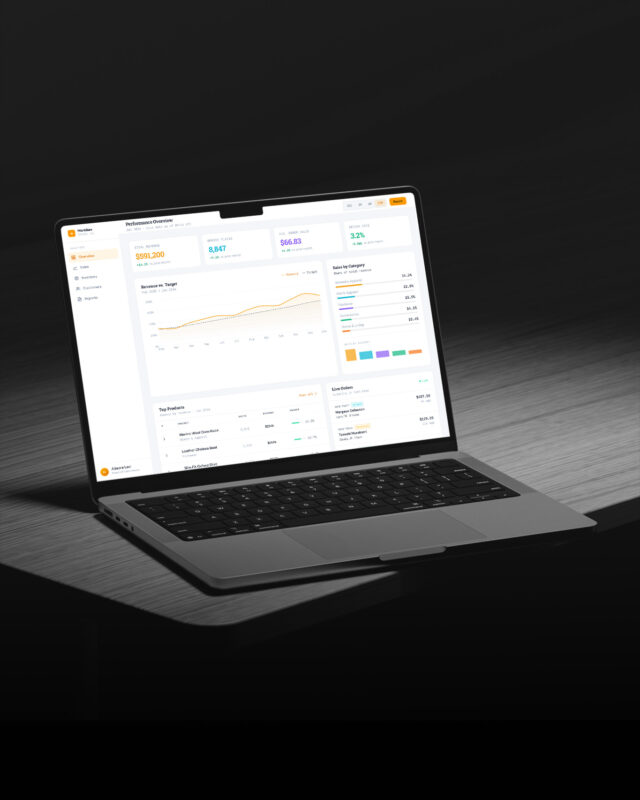
Finance, customers, and stock each keep their own version of the truth, so leadership ends up reviewing three of them. One shared model delivers:
Our online store development services
cover new builds, replatforming, and checkout work.
A short engagement that maps the stack before anything gets committed:
Custom retail software development for the parts no packaged product fits:
Connections between the storefront and everything sitting behind it:
Legacy retail systems rebuilt on a current stack without pausing trade:
Platform-to-platform and content management system moves with data intact:
Ownership after launch, including the weeks that actually matter:
Software development for retail changes less by segment than most briefs assume. The differences are in a few specific places.
An audit puts the constraint, the cost, and the sequence on one page before anything gets committed.
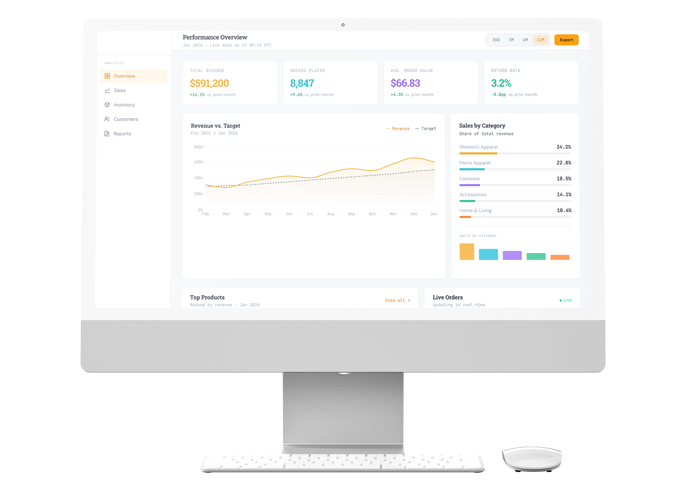
Most retail AI projects start with the data. The capabilities below are the ones Oxagile delivers today, each built on that groundwork.
Product, stock, and order data are typically present in three systems that disagree.
Oxagile builds the data store and semantic layer that AI systems read from, so a model works off one set of records. The same work delivers clean reporting even with no model on top.
Forecasting is statistical modeling applied to sales history, seasonality, and the promotional calendar.
Oxagile’s team treats it as a data engineering problem first, because a forecast is only ever as good as the history feeding it.
Recommendation engines run on machine learning, and they are judged on measured uplift.
The engineers at Oxagile have built targeting and prediction systems that ran against live traffic and returned a response in under 120 milliseconds.
Oxagile’s computer vision work covers object detection, tracking, and image analysis, delivered across video, public safety, and industrial settings.
Shelf monitoring and loss prevention build on the same engineering.
Choosing a retail software development company comes down to what it can put a number against. These three are on record.


Oxagile has been a pivotal partner in Panasonic Connect North America’s Product & Solution development, providing high-quality, efficient solutions with their skilled team of architects and developers. We highly recommend their dedicated and flexible service.
 Magento
 The right call when catalog complexity and custom checkout logic have outgrown a hosted platform and the team wants to own the code.
 Shopify
 Worth it when speed to market outranks control, with custom logic layered around a platform you do not modify.
 Salesforce
 A fit where the customer record is the center of gravity and commerce has to be next to service and marketing data.
 SAP Commerce
 Makes sense for large catalogs already anchored to SAP finance and supply chain, where a separate commerce stack doubles the reconciliation work.
 Odoo
Odoo Earns its place when ERP, inventory, and commerce belong in one system, on one license, with no integration layer between them.
 Dynamics 365
 Suits retailers already standardized on Microsoft, with ERP, CRM, and POS running on a single license and identity model.
System audit
The current stack, its constraints, and the actual bottleneck get documented before anything is scoped.
Architecture and estimation
Integration points, data model, and load profile are designed, then priced against a defined scope.
Prototype
A working first version lands in two to three weeks, so the plan gets reviewed against running software.
Build and integrate
Delivery runs in short cycles, with the integration layer tested against your live systems.
Launch and run
Cutover is planned around the trading calendar, with monitoring and peak-season capacity in place from day one.
Java • PHP • Python • Node.js • .NET
React • Angular • TypeScript • JavaScript • HTML/CSS
Swift • Kotlin • React Native
PostgreSQL • MySQL • MongoDB • DynamoDB • Redshift • Power BI • Tableau
AWS (EC2, Lambda, RDS, S3, SQS, SNS, CloudWatch) • Kubernetes • Horizontal Pod Autoscaler • Docker • Terraform
REST • GraphQL • Swagger • Webhooks • Stripe • PayPal • Apple Pay • Checkout.com • Contentstack
Selenium • Jenkins • CircleCI • GitHub Actions
Cost tracks scope and how much of the existing stack has to be touched. A prototype is a matter of weeks of engineering time.
Delivered projects in Oxagile’s portfolio range from 10 man-months for a targeted platform build to 720 man-months for a multi-year retail ecosystem. A system audit replaces the range with a number specific to your systems.
Oxagile delivers a working prototype in two to three weeks. A focused platform reaches production in about four months. A marketplace with payments and vendor logic needs roughly twelve months. POS and ERP work runs longer, because certification and reconciliation set the pace.
When the workarounds cost more than the license. A packaged platform stays the right answer for standard commerce. Custom becomes justified when the process is genuinely specific to the business, or when platform limits cap revenue. Oxagile settles the question with a system audit in a few weeks, and most engagements end up as custom logic around the platform you already run.
Yes. Oxagile has certified POS terminals across 40+ payment providers and connected a single storefront to a large set of CRM systems, including custom and undocumented ones. Legacy integration usually starts with an audit, because the constraint is almost always in the older system.
Oxagile designs load capacity into the architecture from the start. One commerce platform absorbs launch-day spikes on microservices, a database per service, and horizontal pod autoscaling on AWS, which keeps cost down between peaks. Another retail platform runs at over 100,000 users. Peak readiness work needs 2-3 weeks of lead time before the season.
Yes, and the first step is usually the data rather than the model. Forecasting and recommendations are machine learning applied to your history, and both fail on fragmented data. Oxagile builds the data layer first, then the model on top of it.