












This website uses cookies to help improve your user experience



In 1833, the New York Sun dropped its cover price to a penny, a fraction of what other papers charged. Within two years, it was the most widely read newspaper in the United States. But ”widely read” had a hard boundary: the edges of Manhattan, roughly, and wherever the delivery boy could reach before the ink dried.
A paper printed in one city reached one city’s readers, and that was the ceiling regardless of how good the journalism was. National reach required presses in more cities running the same content, and the publishers who understood that early enough built institutions. The ones who treated distribution as someone else’s problem stayed local.
Streaming businesses in 2026 are running the same logic. OTT devices are the press network now. And every platform you do not support is a city you never printed in, meaning viewers who found someone else on the newsstand and never looked back.
The complication, as it was for newspaper publishers a century and a half ago, is that expanding distribution is not free and not simple. Each new platform brings its own operating system, hardware constraints, and certification process. Get the architecture wrong early, and you will feel it on every release after: slower shipping, more bugs, more of the team’s attention going to maintenance instead of product.
When the architecture is right from the start, the second platform costs less than the first, and the third less than the second. That is what this guide to OTT development is about.
Key takeaways:
An OTT (over-the-top) device is any hardware that delivers streaming content directly over an internet connection, bypassing cable or satellite infrastructure. Smart TVs, streaming sticks and boxes, gaming consoles, and mobile devices all qualify. When businesses ask what OTT devices are from a strategic standpoint, the answer matters less than what each device represents for their specific audience.
The more useful way to think about them is as distribution points. Each supported platform is an entry into your product for a specific viewer in a specific context. Someone watching on a Smart TV in the living room is in a different session from someone on a Fire TV Stick, who is in a different session again from someone on a phone during a commute.
The screen is just the surface. Underneath it are different viewing habits, different discovery patterns, and different monetization dynamics.
Supporting more platforms means reaching more of those contexts, and more contexts, handled well, means more subscribers and stronger lifetime value across the base.
Not all screens are equal from a business perspective, and the differences matter more than most device roadmaps acknowledge.
| Category | Key platforms | Market signal | Business role |
| Smart TVs | Tizen, WebOS, Android TV | ~65% of OTT viewing globally | Retention, long sessions |
| Streaming sticks | Roku OS, Fire OS, tvOS, Google TV | Dominant in North America | Acquisition, scale |
| Gaming consoles | PlayStation, Xbox | Niche, highly engaged | Premium, live content |
| Mobile and tablets | iOS, Android | Discovery + second screen | Reach, LTV extension |
Smart TVs account for the largest share of OTT consumption, with around 65% of streaming viewers using them for long-form content. The living room context drives longer sessions and more deliberate content choices: someone who sits down in front of a Smart TV has usually decided what kind of evening they are having.
The dominant platforms are Samsung’s Tizen, LG’s WebOS, and Android TV, which runs across Sony, Philips, and a range of other manufacturers. For services targeting European or global markets, Smart TV support is table stakes.
Roku, Amazon Fire TV, Apple TV, and Chromecast with Google TV represent the fastest-growing connected TV segment, with Roku holding a commanding share of the North American market. A viewer who buys a streaming stick and sets it up has already committed to using it as a primary viewing device, so the intent is baked into the purchase.
For services focused on subscriber acquisition in North America, Roku and Fire TV are typically where the roadmap should start.
PlayStation and Xbox reach a smaller slice of OTT viewers, but that audience skews younger, watches more, and is already accustomed to paying for content. Consoles rarely make sense as a launch priority, but they earn their place once the core platforms are stable, particularly for services with sports or live programming.
Mobile is where viewers discover content, follow live events from a second screen, and squeeze in viewing time outside the home. It rarely replaces the TV experience, but it extends it in ways that show up in retention and lifetime value.
Supporting mobile is a given. The only real question is where it belongs in the build sequence.
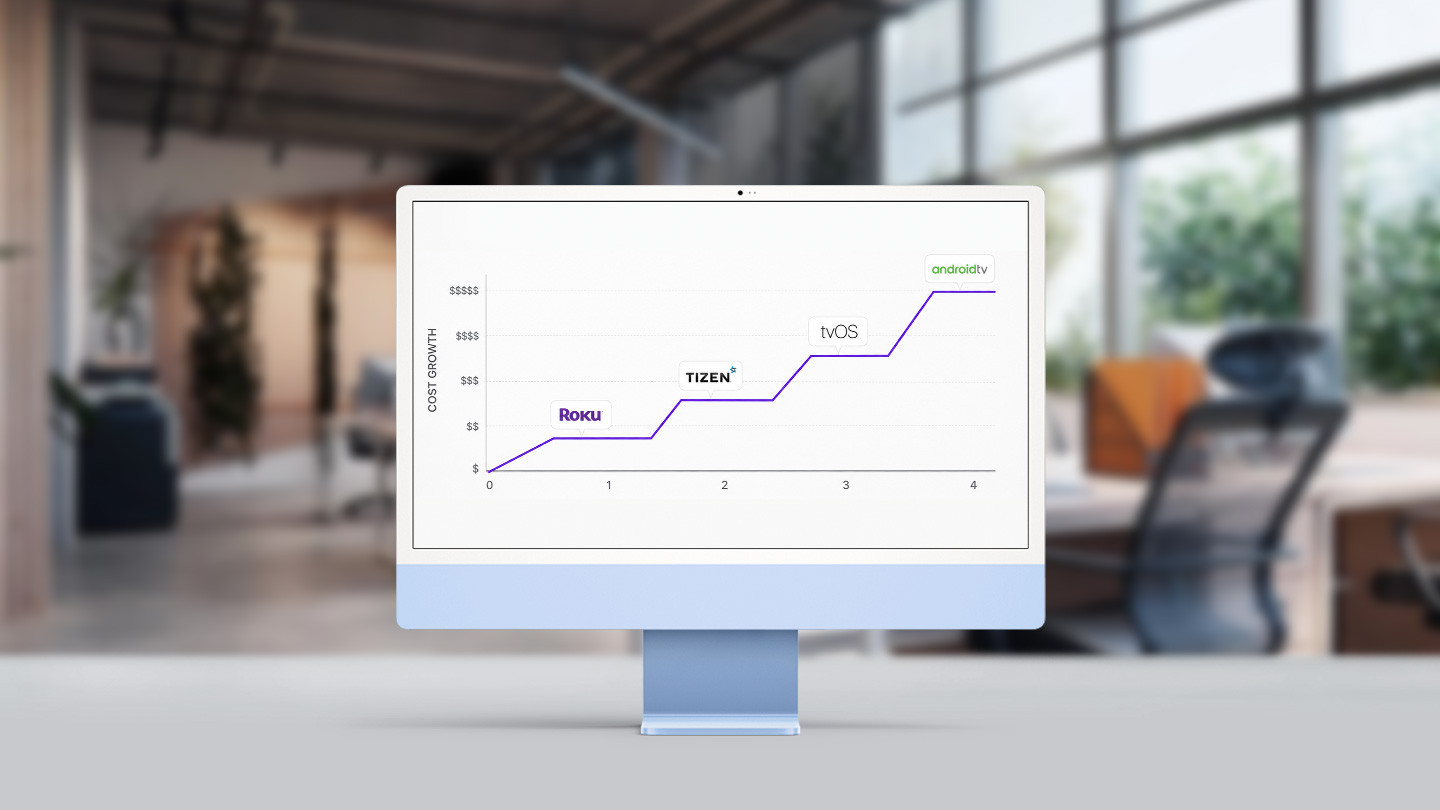
Adding platforms is easy to plan but may be expensive to do if you build natively for each system. Each one comes with its own operating system, hardware constraints, certification requirements, and interaction model.
| Where it happens | What it costs |
| Each OS (Tizen, WebOS, tvOS, Android TV, Roku OS) has its own development environment and certification process. Clearing one tells you nothing about the next. | Every feature and bug fix gets built multiple times. A two-platform product already doubles most development work. |
| Hardware varies significantly across device generations. An app that runs cleanly on a high-end Samsung TV can struggle on an entry-level Android TV stick. | QA cannot be shared. A release that takes two weeks on one platform can take six across five. |
| Remote-first D-pad navigation requires a different UI architecture than touch. Focus management shapes the entire front-end from the ground up. | UX consistency suffers when platforms are maintained separately. The viewers who notice most are typically your highest-LTV users. |
| Platform requirements and certification timelines differ across every major store. | OS updates from Samsung, LG, Roku, and Apple arrive on different schedules and regularly break things. |
The fragmentation problem has a known solution, and it comes down to one architectural decision made early: do you build a native application for each platform, or do you build once and deploy across many?
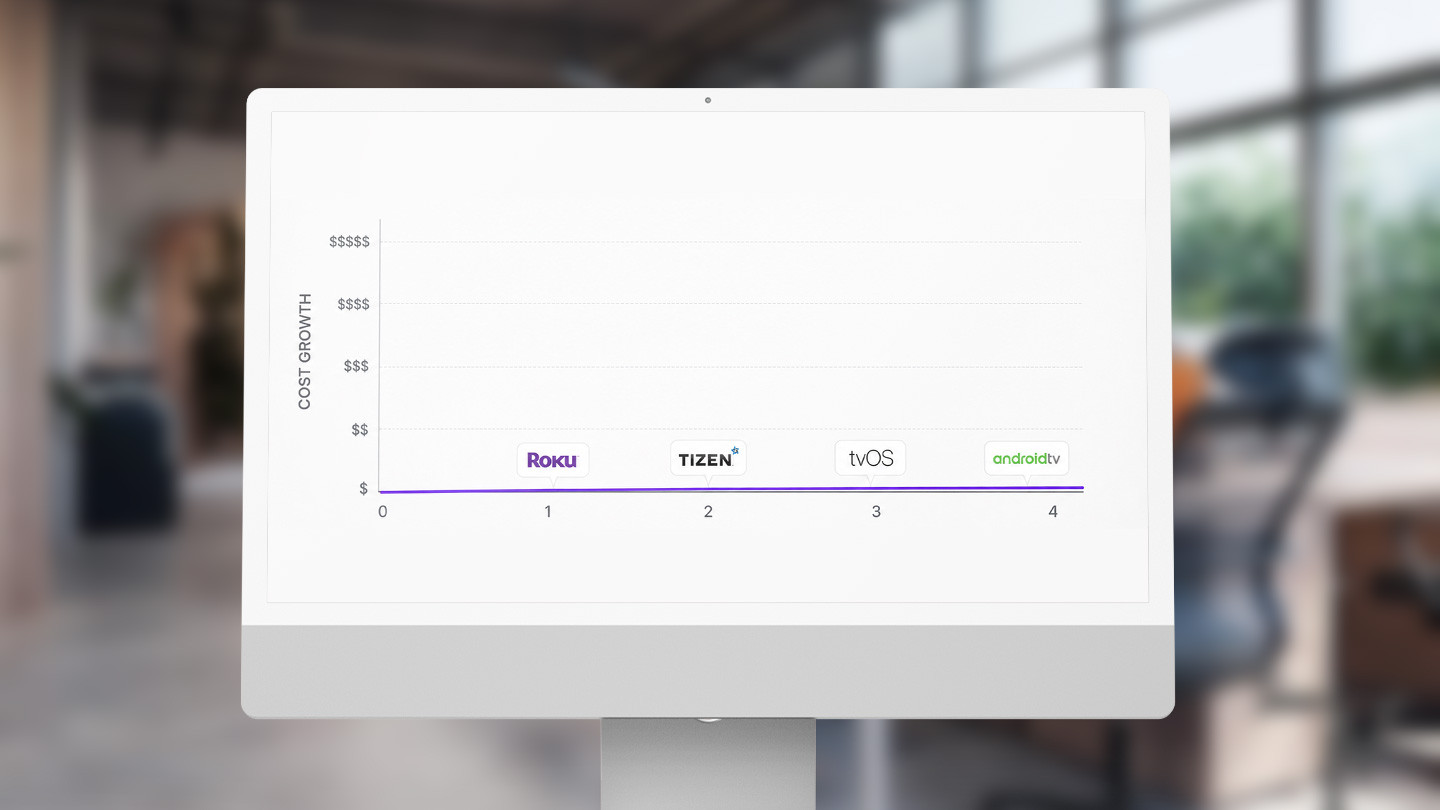
Native per platform gives you full control over platform-specific behavior, but it also means every platform is its own product with its own codebase, its own release cycle, and its own team. That model holds at one or two platforms, and starts breaking down by the third or fourth, when engineering capacity that should be going into product is going into maintenance, and every release takes longer than the one before it.
Each new platform you add extends what already exists. With React Native as the primary framework, business logic is written once at the OTT platform level and shared across devices, and UI adjustments for each target happen at the edges without touching what is already working

Sergey Glyzdov, a JavaScript engineer at Oxagile who works across multi-platform OTT projects, describes what this looks like on a real project:
“As a rule, we build cross-platform applications so they can support both Samsung and LG simultaneously. Nobody actually wants to build a separate application for every platform because it is extremely expensive.
We had a project where we built classic apps for LG and Samsung, and then the client wanted an additional version for Philips, Titan OS. Everything worked without any major intervention. We only fixed a small UI bug, and the app immediately ran on the third platform as well.”
The third platform required a UI fix and nothing more. On a native-per-platform build, that same expansion would have been a new project. Oxagile builds primarily in React Native for OTT, with Kotlin Multiplatform for shared business logic across mobile and TV targets, structured so that scaling the platform portfolio does not mean scaling the team at the same rate.
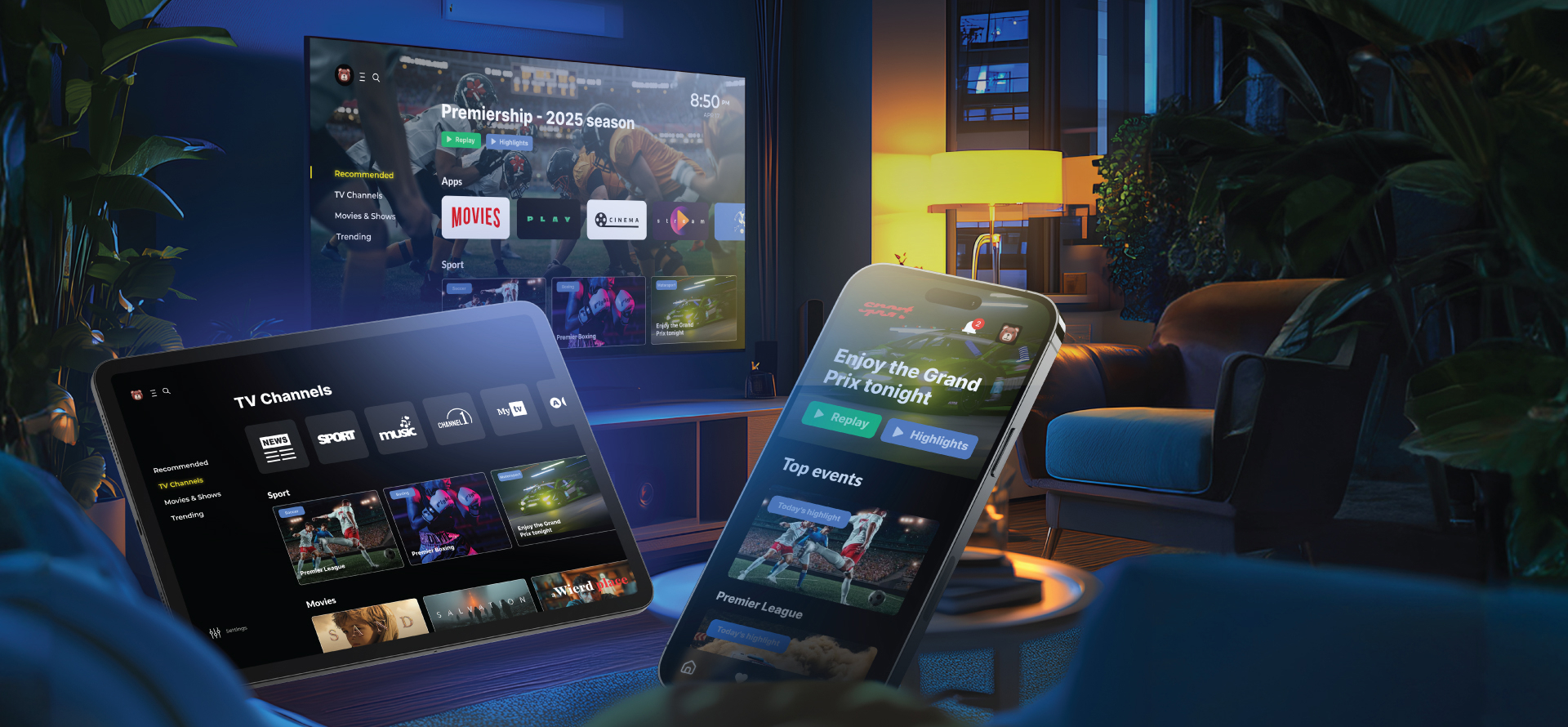
A white-label OTT platform built for telco clients needed to scale across 13 platforms and 25 devices without rebuilding for each new customer. We designed the architecture around a single shared business logic, so that every new telco configuration could go live quickly without touching the core. The solution is already live in two European countries, with three more in the pipeline.
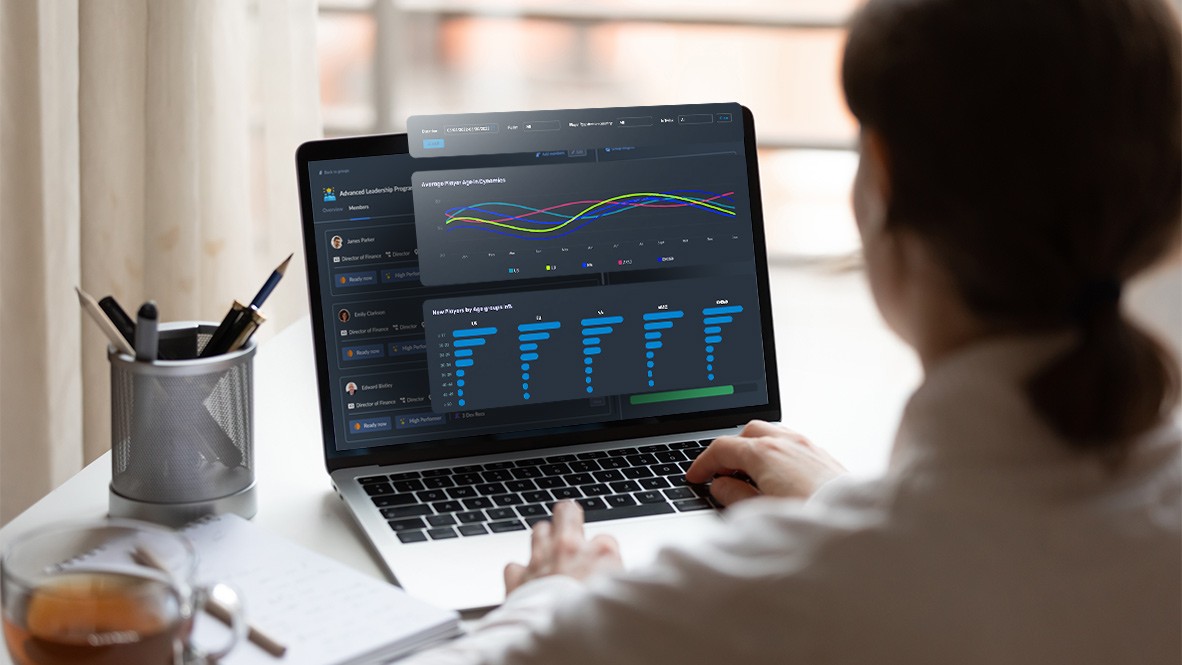
A leading European telecom operator needed a unified frontend across Smart TVs, mobile, web, and Apple TV, all connected to Kaltura’s backend. Our team built six platform-specific apps on a shared foundation, delivering consistent UX across low-end and high-end devices.
The result: over 100,000 downloads on iOS and Android each, and a subscriber base exceeding 80 million.
The order matters more than most roadmaps account for. These six steps walk through the decisions in the sequence they should actually be made.
Before picking platforms, know where your audience watches. A North American subscriber base points to Roku and Fire TV. A European one points to Smart TVs, primarily Tizen and WebOS. A global one is more complicated, but Android TV and mobile cover the most ground across emerging markets.
Geography does not give you the full answer, but it narrows the list fast and tells you where spending the first engineering budget actually makes sense.
The right starting platform also depends on what the business needs most right now. Subscriber growth points to the platforms with the broadest reach in your target geography. Smart TVs and Apple TV tend to deliver stronger revenue per subscriber, where sessions run longer and viewers are more accustomed to paying for content. Living room devices in general correlate with lower churn – viewers who watch primarily on a TV tend to be more habitual and harder to lose. The monetization model also determines which OTT features matter most on each platform.
Start with the 2-3 platforms where your audience and your business objective overlap most directly. That short list should come naturally from the first two steps. Adding more platforms to the initial launch rarely helps as engineering attention gets divided before anything has had time to prove its value.
Adding a fourth platform to a native-per-platform codebase is a different kind of project than adding it to a cross-platform one. In the first case, it means a new build. In the second, it means extending something that already works.
By the time that gap becomes obvious, there are already three separate codebases in play and the fourth platform sitting in the backlog waiting for a migration that nobody budgeted for. The decisions that lead there start with OTT architecture, and they are easier to get right early than to untangle later.
A competitor announcing a new platform is not a reason to add it to the roadmap. Each expansion should clear a basic business case first: estimated audience reach, expected conversion, development cost, and ongoing maintenance. A platform that cannot make that case can wait, whatever the competition is doing.
Set up device-level reporting from the start: engagement, retention, revenue contribution. Review it quarterly and move the budget toward what the data shows, not toward what made sense at launch.
Oxagile React-native ecosystem approach allows to build once and deploy everywhere. Select the platforms you want to support and get an instant high-level estimate. No forms, no calls, just numbers.
The partner you choose for multi-platform OTT will either make the complexity manageable or add to it. A few things worth asking before you commit:

We’ve been building OTT products for over 20 years across Smart TVs, streaming sticks, gaming consoles, and mobile. If you want to see how our team approaches multi-platform delivery in practice, the full picture is on our OTT app development services page.
The New York Sun did not stay the most widely read paper in America for long. Competitors who invested in distribution infrastructure, presses in Boston, Philadelphia, and Chicago, eventually built audiences the Sun could not reach from Manhattan. The advantage was never in the newsroom. It was in how many cities woke up to that paper on the doorstep.
Streaming businesses are running the same race now. The services pulling ahead got their apps onto the devices their viewers already owned, before someone else did. Multi-platform support is the distribution network, and the companies that built it on the right architecture are the ones still adding platforms without the costs compounding against them.
If you are mapping out your OTT device roadmap and want a team that has shipped across all of them, Oxagile can help you get the architecture right from the start.
OTT (over-the-top) refers to the delivery method: streaming content directly over an internet connection, bypassing traditional broadcast infrastructure. CTV (connected TV) refers specifically to television screens connected to the internet, whether via a Smart TV, a streaming stick, or a gaming console.
All CTV is OTT, but not all OTT is CTV. Mobile and laptop streaming is OTT but not CTV. For advertising and analytics purposes, the distinction matters because CTV inventory commands premium rates and delivers different audience measurement than mobile OTT.
No. A correctly architected OTT platform uses a single backend, content delivery infrastructure, and analytics layer serving all devices. The platform-specific work is in the client applications, not the backend.
This is one of the main advantages of separating backend OTT platform development from front-end device development: the content management, transcoding, DRM, and user account logic are built once and accessed by every device client through standardized APIs.
The timeline depends on platform count, feature scope, and whether the development approach is native-per-platform or cross-platform. A single-platform OTT app with core streaming functionality typically takes 3-5 months.
Expanding to a second and third platform using a cross-platform architecture adds weeks to that timeline, not months, since business logic is shared.
Native-per-platform builds scale linearly with platform count, and each new target means starting a new build from scratch.
Content protection requires DRM implementation specific to each platform:
A multi-key licensing server handles all three systems from a single backend, so protection logic does not have to be rebuilt per device. Any streaming service handling premium content needs this layer in place before it scales across platforms.
Each major platform (Roku, Fire TV, Apple TV, Samsung, LG, and Google Play) has its own submission process, technical review criteria, and certification timeline. Submission timelines range from a few days on Roku to several weeks on Apple.
OS updates from platform vendors periodically break existing functionality and require targeted fixes. Managing this across multiple platforms requires a continuous maintenance commitment, not just launch-time effort. Oxagile handles certification, submission, and post-launch OS compatibility maintenance as part of its long-term engagement model.

