













This website uses cookies to help improve your user experience
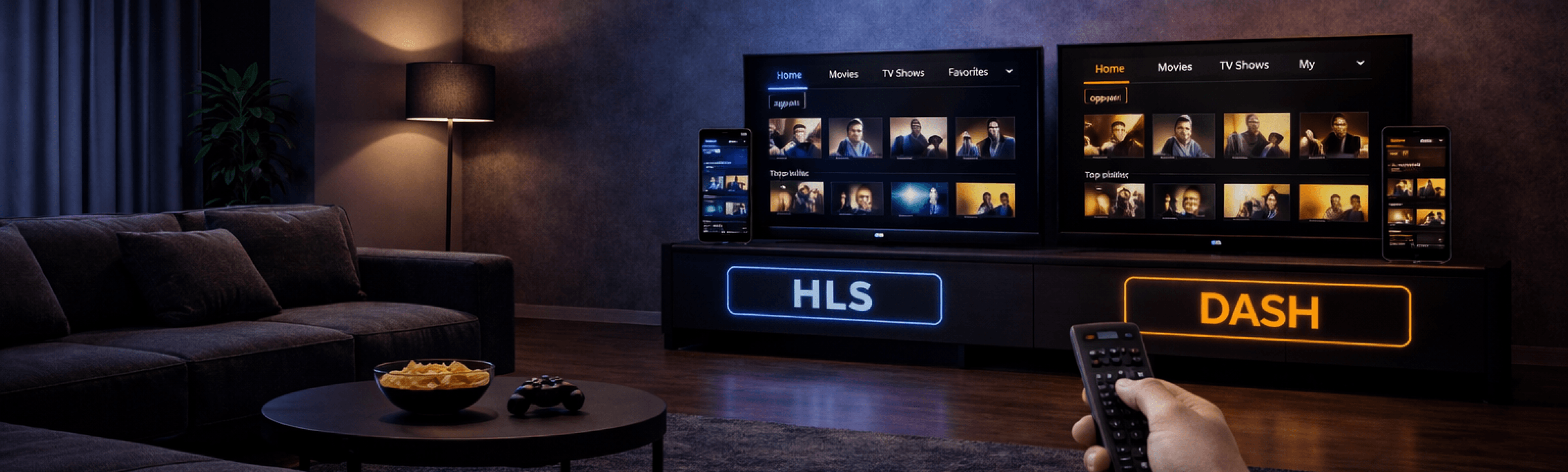



Streaming quality is shaped long before video reaches the screen. It depends on how content is prepared, packaged, and delivered, with the streaming protocol playing a central role in this chain.
HLS (HTTP Live Streaming) and MPEG-DASH (Dynamic Adaptive Streaming over HTTP) define the ways in which video is segmented, adaptive bitrate works, and playback responds to changing network conditions. These mechanisms directly affect startup time, playback stability, and latency — all of which influence engagement, retention, and monetization. These same factors are central to building effective multi-screen solutions.
Both protocols are mature and widely adopted. In many cases, they coexist within the same delivery infrastructure. The right choice is defined by the alignment between your device landscape, content strategy, and latency requirements.
We will look at how HLS and DASH behave in different scenarios and what factors should guide the choice between them.

To add a practical perspective, we asked for input from Alexander Sheyko, Android TV Engineer at Oxagile, who shares insights on how streaming protocols behave in real-world environments and what actually drives protocol decisions in production systems.
Key takeaways:
Every streaming platform is shaped by a chain of decisions, from encoding and packaging to CDN delivery and playback. The streaming protocol sits inside this chain, quietly defining the interaction between these layers and the way video ultimately reaches the viewer. These decisions directly influence startup time, playback stability, and latency, forming the foundation of scalable streaming solutions across devices and environments.
When looking at HLS vs DASH, the differences emerge not in isolation, but in the behavior of the entire system under real conditions. The protocol influences startup speed, player adaptation to changing bandwidth, and the efficiency of content delivery across the network. Over time, these mechanics shape the overall stability and responsiveness the experience feels.
Expert comment:
“Protocol selection is not a binary choice. In most systems, several delivery formats are supported at once, and the real decision is how to configure them for a specific use case.”
The impact of this choice becomes most visible in a few key areas.
Latency becomes a defining factor in live streaming scenarios. The way segments are generated, delivered, and buffered directly affects how close playback is to real time. For sports, betting, and similar use cases, a well-designed live streaming app needs to minimize delay without compromising playback stability.
Adaptive bitrate logic, segment handling, and retry behavior all depend on the protocol. These mechanisms define how the player responds to network fluctuations, whether it maintains a steady stream or interrupts playback. At scale, even small differences in this behavior affect session duration and overall user retention.
Protocol support varies across platforms. Apple devices are closely aligned with HLS, while Android, web players, and many Smart TV environments offer stronger support for DASH and greater flexibility in codec usage. As a result, protocol choice shapes not only playback behavior but also how consistently content can be delivered across the audience.
From a business perspective, these technical decisions accumulate into measurable outcomes. Faster startup reduces early drop-off. Stable playback supports longer sessions. Lower latency improves engagement in live scenarios. Together, these factors influence retention, ad performance, and subscription revenue.

Delivering video across iOS, Android, Smart TVs, and web platforms requires more than just choosing a protocol. It involves aligning delivery logic, player behavior, and performance optimization across the entire ecosystem.
Before going deeper into how MPEG-DASH vs HLS perform in different scenarios, it helps to step back and look at what each protocol represents.

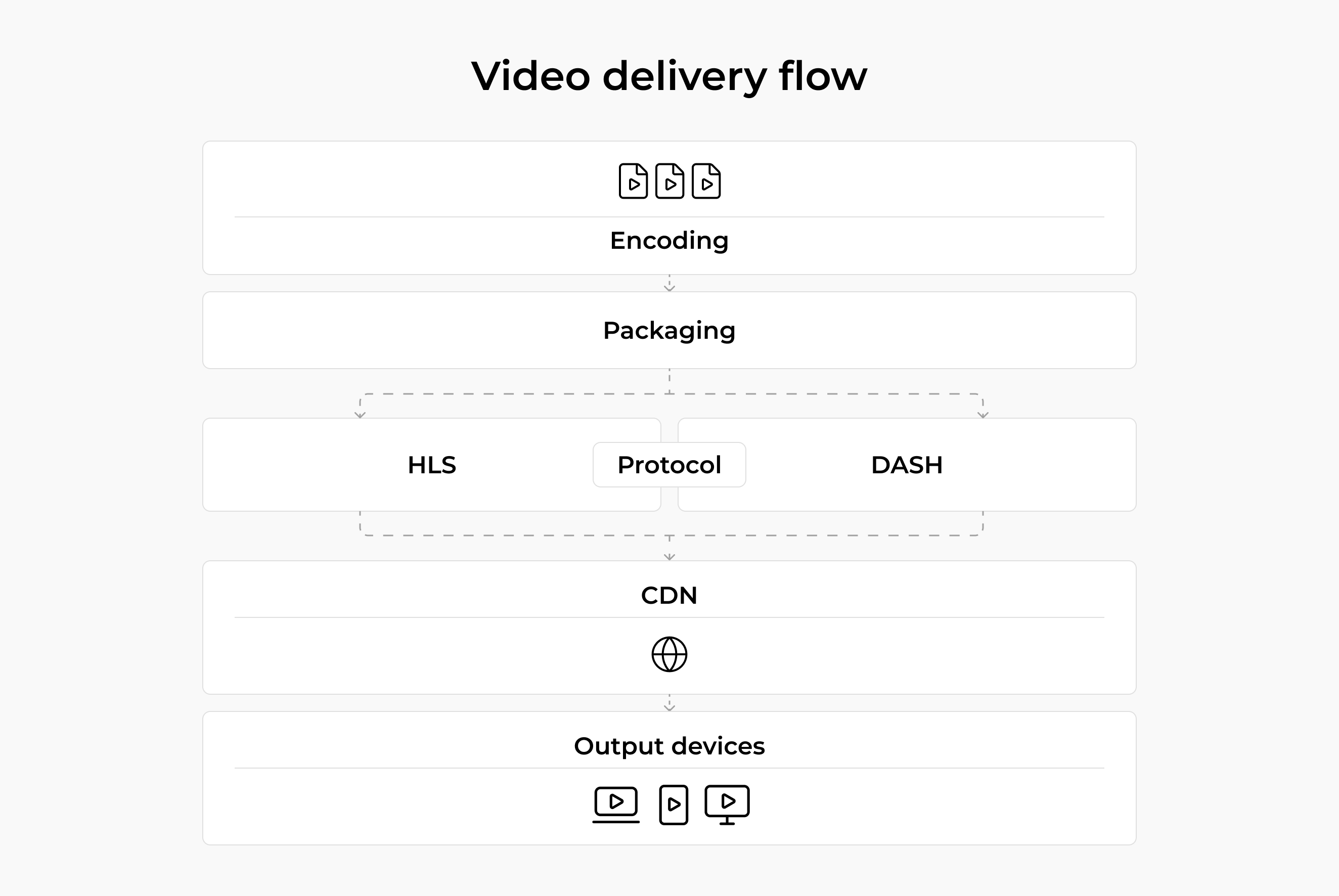
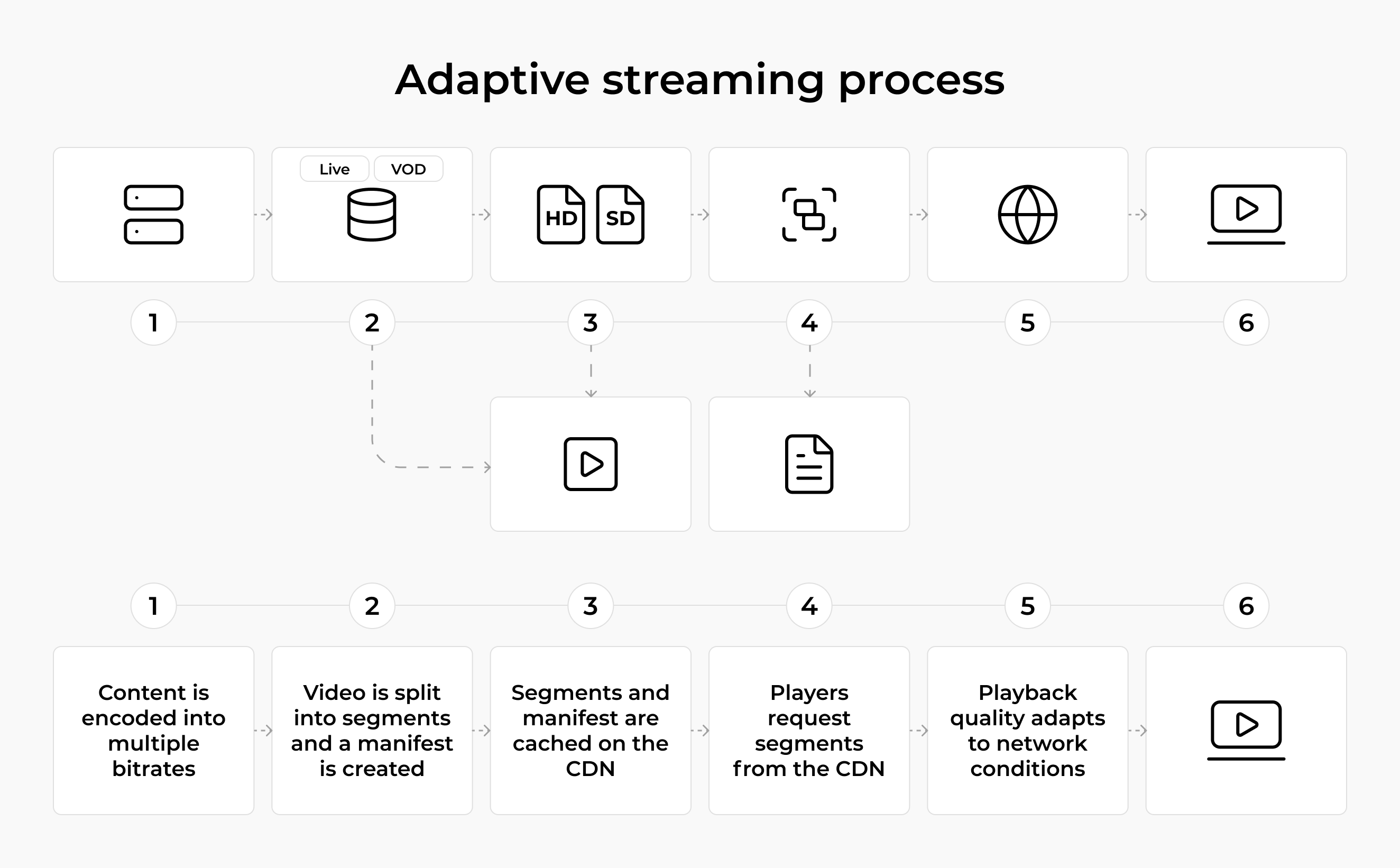
Both protocols rely on the same core principle. Video is divided into small segments, and the player adjusts quality in real time based on network conditions. Continuous adaptation helps maintain playback even as bandwidth fluctuates.
Differences emerge in how that logic is implemented. Manifest structure, segment description, and the degree of control over streaming behavior vary between HLS and DASH. These variations influence the interaction between streams and CDN caching, the way the player handles switching between quality levels, and the efficiency of introducing advanced features, such as multi-codec delivery or low-latency streaming.
Alexander explains:
“From a technical perspective, supporting multiple protocols is not the hard part. The real challenge is choosing how to configure delivery for a specific use case — depending on devices, latency requirements, and the type of content.”
In practical terms, each protocol defines its own framework for building and optimizing streaming delivery. Alignment with target devices, infrastructure constraints, and performance expectations becomes the deciding factor at this stage.
HLS and DASH follow a similar delivery model at a high level. The differences show up in how the stream is managed and described behind the scenes.
These differences shape how the system reacts to real conditions. Update frequency, bitrate switching logic, and request patterns influence CDN load, latency, and how quickly playback adapts to network changes.
In practical terms, one approach emphasizes predictability and consistency. The other enables deeper control over streaming behavior, which becomes valuable in more complex or performance-sensitive environments.
Alexander notes:
“Working with DASH usually means dealing with more configuration. You have more parameters to define, and that gives you flexibility, but it also requires a deeper understanding of how the player and delivery pipeline interact.”
At this point, the differences between HLS and DASH stop being abstract and start influencing concrete decisions.
The choice doesn’t come down to a single factor. It emerges from a combination of constraints.
As Alexander puts it:
“In most projects, you don’t choose a protocol in isolation. You define the requirements first, and the protocol follows from that. What also matters is how protocol fits the delivery pipeline you’re building.”
Taken together, these factors form a decision framework. The next step is to map them to typical scenarios and see which protocol aligns better with each case.
The differences between the protocols become clearer when mapped to typical product and delivery decisions.
| Scenario or priority | HLS | DASH |
| Apple-first audience | Native support enables stable playback across devices | Requires additional handling for full compatibility |
| Android and Smart TV focus | Works reliably, with more standardized behavior | Better integration and broader codec support |
| Web-based platforms | Widely supported and predictable | Greater control over playback logic |
| Live streaming at scale | Easier to stabilize and scale delivery | Requires more tuning to achieve consistent results |
| Low-latency streaming | LL-HLS works well within Apple environments | LL-DASH offers flexibility across web and Android |
| CDN behavior and caching | Straightforward and predictable | More configurable, depends on setup |
| Adaptive bitrate strategy | Consistent and standardized | More granular control |
| Multi-codec delivery | Supported, with some limitations | Easier to extend and optimize |
| Implementation effort | Faster to deploy and maintain | Requires deeper configuration and expertise |
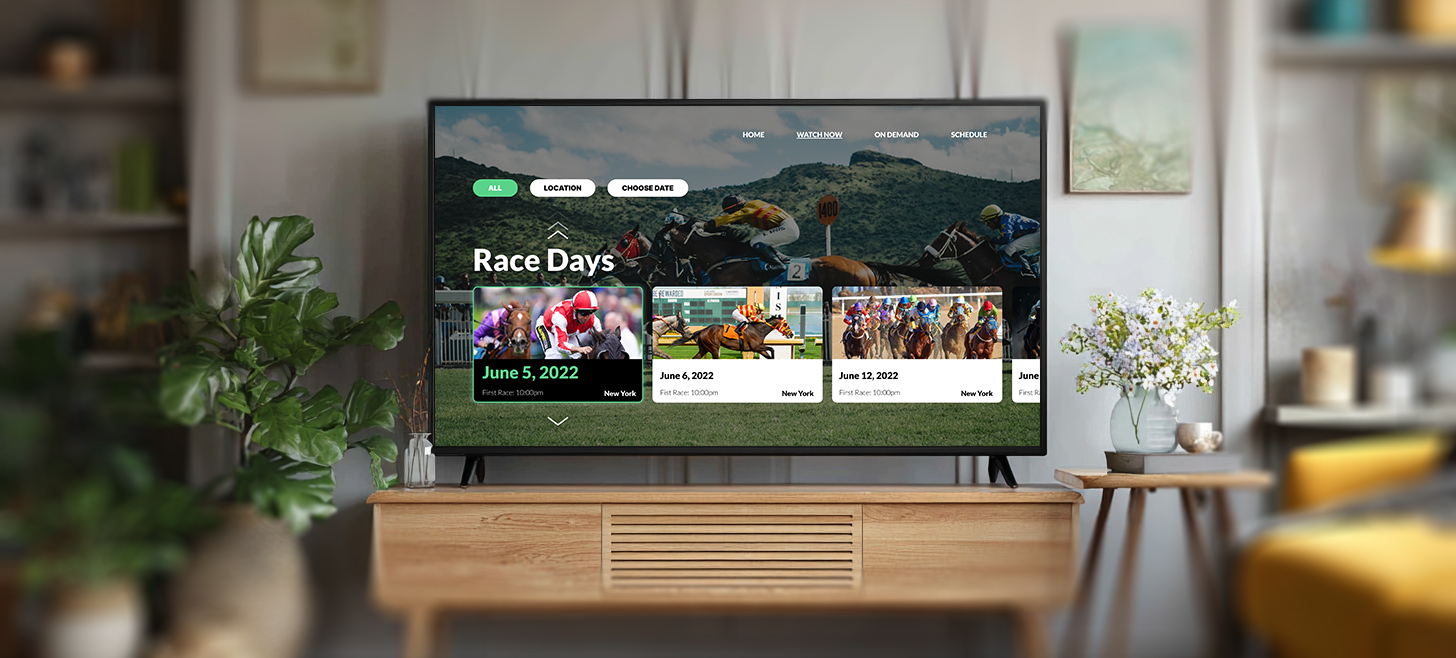
Delivering live sports content at scale requires a setup that can handle traffic spikes without disrupting playback. In this project, the platform had to support real-time horse racing broadcasts alongside on-demand content, maintaining consistent performance across devices and network conditions.
HLS was selected as the primary streaming protocol due to its predictable delivery model and strong alignment with CDN caching. This made it easier to stabilize playback under load and maintain a consistent viewing experience during peak usage.
The solution focused on:
We help teams design and optimize streaming solutions across the full delivery pipeline. If you are building a new platform or improving an existing one, we can help you define and implement a setup that fits your product, audience, and performance goals.
HLS is generally easier to operate at scale due to its more standardized delivery model and predictable CDN behavior. DASH can offer more flexibility, but it requires more careful configuration and ongoing monitoring to maintain the same level of stability.
MPEG DASH typically supports a wider range of modern codecs, including AV1 and advanced CMAF-based workflows. This makes it a better fit for platforms that rely on multi-codec strategies or need to optimize video quality and bandwidth usage across diverse devices.
DASH is a strong choice when your platform requires fine control over playback behavior, supports a wide range of devices beyond Apple, or needs advanced streaming configurations such as custom bitrate ladders or multi-codec delivery.
MPEG DASH is an open standard designed to deliver adaptive video over HTTP. It is widely used because it is not tied to a specific ecosystem and allows streaming platforms to build flexible and scalable delivery pipelines across different devices.
DASH Dynamic Adaptive Streaming allows the player to adjust video quality in real time based on network conditions. This helps maintain continuous playback, reduces buffering, and improves overall viewing quality, especially in unstable network environments.

