





This website uses cookies to help improve your user experience

AI-native engineering flips the traditional development model. Engineers define the architecture, constraints, and quality gates. AI handles implementation. The result: faster delivery cycles, fewer handoff bottlenecks, and a codebase that stays accountable to a human-verified specification, not the other way around.

20+ years in engineering
90% senior engineers on every engagement
PhD-level research and applied expertise
50+ production systems delivered across industries


“AI native software engineering gives developers a new kind of superpower, not just to write code, but to evaluate, specify, and shape systems end to end. At the same time, it raises the bar: success depends less on syntax and more on architectural thinking, judgment, and collaboration. That level of maturity is what we bring. Not just tools, but the expertise to use them well.”
President, Oxagile

Our AI engineering principles are powered by experienced specialists who design, validate, and oversee every step of AI integration.

Alexey Karankevich
AI Innovation Lead
An MITx MicroMasters graduate in Data Science, Alexey leads R&D with hands-on AI expertise. He has driven key innovations, including a social media analytics startup and a $10M health AI project heading to EU clinical trials.

Yariv Z. Levy
AI Strategy Advisor
With a PhD in AI from UMass Amherst and a Master’s in Computer Science from EPFL, Yariv bridges AI and business impact. He has collaborated with global leaders like Nestlé and Roche and founded his own AI consultancy boutique.
Senior specialists who design, validate, and oversee AI integration
AI-native engineering goes beyond accelerating code. Simply producing more lines doesn’t make projects faster or more sophisticated.
True impact comes from structured workflows, clear requirements, and coordinated teams.

Your project gets the right AI tool for the job — Claude Code, local inference, or hybrid — not whatever we standardized on last quarter.

Your project never runs on autopilot. Senior engineers guide, validate, and take responsibility for every AI-generated output and architectural decision.

Every decision, workflow, and requirement is a formal artifact. Your team gets full traceability, not a chat log nobody can audit six weeks later.

Work runs in isolated, controlled contexts so iterations stay fast without introducing systemic risk into your codebase or infrastructure.

Feedback loops and evolving standards mean practices improve across projects — the work we do for you benefits from every engagement before it.

Our consultants help you identify where AI fits into your workflows and how to apply it in a controlled way.

Early in our AI journey, we found that ad hoc prompts and isolated tools fail to deliver predictable results. Structured workflows, verification layers, rigorous research protocols and documented intent made AI a repeatable, reliable part of the engineering lifecycle.
Ad hoc prompts
Simple experimentation is inconsistent and dependent on individual habits
Structured planning artifacts
Formalized requirements, constraints, and decision records reduce rework — teams report 30%+ cycle time improvement within 90 days
Tool access
Having AI tools alone cannot define how or when to use them
Methodical workflows
Workflows integrate AI with governance and guardrails, creating repeatable, scalable processes
Speed without control
Fast code generation without oversight increases risk and instability
Controlled execution contexts
Isolated execution contexts let teams iterate quickly while keeping quality gates intact — 40%+ cycle time gains reported at six months
Automation without accountability
AI-generated suggestions on their own can lead to inconsistent results and hidden errors
Human oversight
Senior engineers guide and validate AI outputs, maintaining code quality, reducing technical debt, and supporting scalable velocity
Experimentation
Pilots and isolated tests do not translate to organization-wide reliability
Operational maturity
AI is systematically embedded in planning, review, and documentation, enabling predictable and measurable outcomes

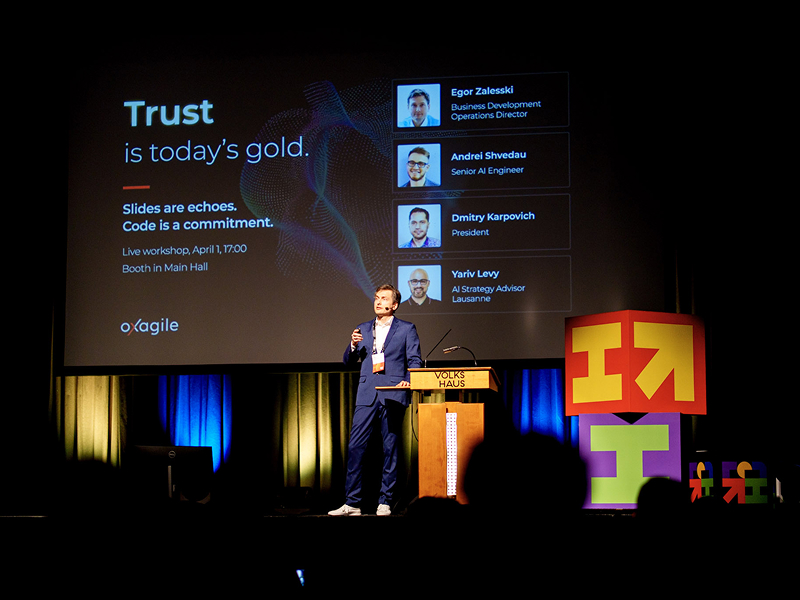
Our experts speak at industry events, run hands-on workshops, and bring that same depth to every conversation, in person or online. Connect and see how AI-native methods apply to your projects.
Austra Nova and Voiager are designed the way our approach describes. Both run live today, ready to point at your workflows.


Embedding AI goes beyond boosting developer efficiency. With solid AI native software development practices in each step, teams achieve outcomes they can count on.


Traditional focus
Requirements captured manually, scattered across tools and conversations.

New approach
Spec-driven development formalizes intent, constraints, and assumptions as structured artifacts. AI assists with context, edge cases, and option generation.

Impact
Fewer rework cycles and more predictable timelines. Teams report 30%+ cycle time improvement within 90 days of adopting structured AI planning practices.
Traditional focus
Architects work in isolation, without immediate feedback or shared context.
New approach
AI supports scenario exploration while parallel sub-agents analyze alternatives and surface trade-offs in real time.
Impact
Faster ideation and earlier identification of technical risk — design debt caught here costs a fraction of what it costs in review or production.
Traditional focus
Engineers implement features manually, relying on templates without shared context.
New approach
Agent teams generate scaffolding and repetitive code patterns, executing in parallel and sharing context across tasks.
Impact
AI-native build phases deliver 2–3x feature throughput compared to traditional approaches, without compromising maintainability.
Traditional focus
Manual test creation with inconsistent coverage and validation.
New approach
AI agents generate tests, validate coverage, and run continuous checks alongside development in a coordinated workflow.
Impact
Higher test coverage and fewer defects at release. Automated validation catches coverage gaps that manual review routinely misses.
Traditional focus
Peer reviews are time-consuming and inconsistently applied across teams.
New approach
Multiple code review agents analyze outputs for quality, standards, and consistency before human validation.
Impact
Faster reviews and lower technical debt accumulation. Human reviewers focus on judgment calls, not pattern-matching.
Traditional focus
Documentation is incomplete, outdated, or fragmented across teams.
New approach
AI captures decisions, architecture, and workflows in real time, preserving context and maintaining up-to-date artifacts.
Impact
Faster onboarding, smoother team transitions, and audit-ready knowledge bases — without documentation sprints at the end of every release cycle.
Traditional focus
Deployment and monitoring rely on manual checks, with fixes applied reactively.
New approach
AI supports predictive monitoring, anomaly detection, and environment validation with context-aware agents tracking system behavior.
Impact
Fewer production incidents and faster resolution. Reactive firefighting shifts to proactive detection before users are affected.
End-to-end impact:

Our AI native development processes are governed by structured workflows, controlled execution contexts, and senior engineer oversight. AI suggestions are validated and integrated under rigorous review, providing consistent and predictable results.
No. Oxagile’s team brings deep AI native software development expertise. We handle integration, workflow design, and verification, keeping your teams fully informed of decisions and outcomes.
As an AI native consulting firm, we implement controlled environments, scoped access, and strict data handling policies, so sensitive information stays within your systems and AI outputs remain fully auditable. This AI-native engineering approach works whether deployed on-premises or via service providers. We adapt to the tools you prefer, including Claude Code or local inference solutions.
Yes. Our AI native approach is model-agnostic and process-compatible. AI is embedded into existing planning, build, test, and deployment practices without disrupting your team’s operations.
While benefits vary by project, structured AI adoption typically accelerates prototyping, test generation, and documentation within weeks, delivering measurable improvements in efficiency and predictability.
With our AI native software engineering, we take a model-agnostic approach, adapting tooling to your needs. Our engineers evaluate and integrate the right models, maintaining governance, oversight, and traceability.
Continuous learning is built into our methodology. Internal experimentation, feedback loops, and evolving standards keep practices aligned with technology and project needs, and our AI experts stay available to guide, advise, or intervene whenever it’s needed.

