











This website uses cookies to help improve your user experience




It’s the final Sunday of the Premier League season. Two clubs are level on points heading into the last 90 minutes, one in Manchester, one in London, both kicking off at 4 p.m. Whichever team finishes the day a goal ahead lifts the trophy. The other watches it slip away. Every viewer on the platform is watching one match and refreshing the score of the other.
Sports streaming is the only OTT platform category where a single buffering icon can ruin years of brand work. The same 90 minutes that prove your platform’s value can expose every shortcut taken in your architecture two years ago. When Netflix streamed the Tyson vs. Paul fight in November 20241, roughly 60 million households tuned in and thousands experienced buffering, outages, and degraded video quality, turning the platform’s biggest live sports debut into a cautionary tale that trended on social media for all the wrong reasons.
This article walks through that final Sunday from the operator’s side: pre-match, kickoff, halftime, the second half, and the long tail that follows. At each stage, engineering decisions determine whether your platform comes out of the day with more subscribers or more refund requests.
Key takeaways:
By two o’clock, the platform’s already nervous. Lineups have dropped, the pundits are arguing about whether the manager really starts that left-back, betting markets are moving every 15 seconds, and somewhere in a group chat, your viewer is being told by a friend who’s been to the stadium that the away end looks half-empty. None of this is the match itself, but all of it runs on your CDN, and it is the warm-up lap for a system that has to absorb millions of people landing on the same two streams at four o’clock sharp.
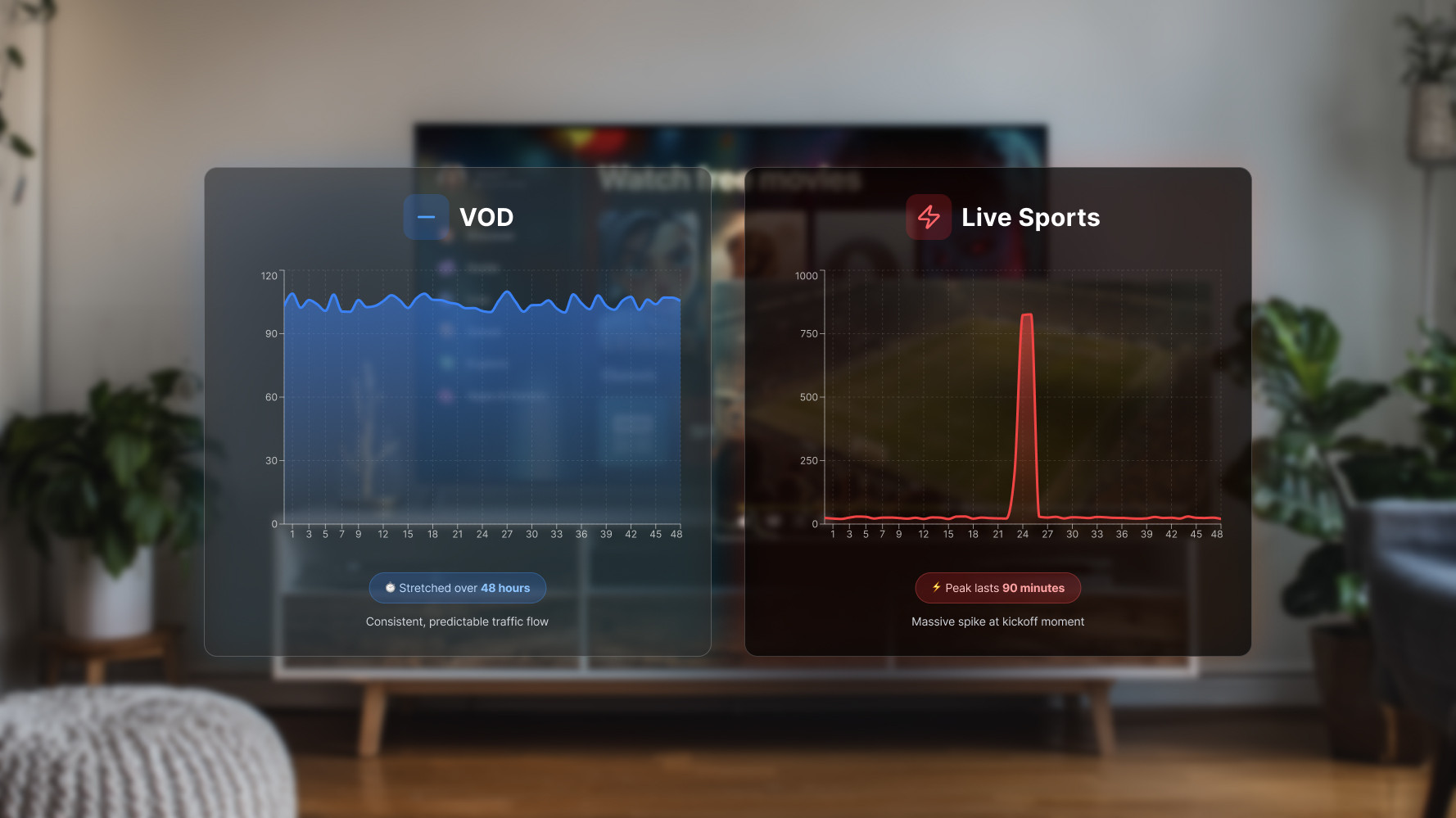
A film catalog doesn’t have a clock. People drift into a Tuesday-night thriller across 48 hours, the cache stays warm, and the bandwidth curve looks like a gentle hill. Sports has a whistle. When it blows, 90% of your audience arrives in the same 15 minutes, and on the final day of a title race, they arrive in two places at once: one stadium in Manchester, one in London, both kicking off at four, both being watched by the same fans who can’t decide which screen to keep their eyes on.
The numbers give you a sense of how thin the margin really is. Akamai counted 18.7 million concurrent streams during UEFA Euro 20242. About one in five of those viewers ended up watching at a lower quality than they paid for because the edge servers nearest to them ran out of space.
Live events of that size usually exceed their planned capacity by 50% in the first few minutes. This means that the platform was designed for X, X showed up, and then another 50% of X arrived shortly after, only to find that the video was already buffering.
The pressure on a title-race Sunday doesn’t simply double. You’re now feeding two simultaneous matches along with the live table itself. On afternoons like this, the live table becomes the most refreshed object across the entire product.
With kickoff two hours away, the real work has already begun. Capacity is warming up, edge nodes are being preloaded, and failover paths are being checked to make sure that nothing has broken since last weekend. The best platforms approach this stage like a Formula 1 formation lap: carefully, deliberately, and with control. The rest rely on the hope that their old autoscaling rules will survive one more Sunday. Usually, they do. Until the Sunday that matters most.
A few things separate the platforms that survive kickoff from the ones that don’t:

When the system works, the viewer notices nothing. The picture comes on, the picture stays on, the goal happens, the celebration happens, the picture stays on. That invisibility is the entire deliverable.
The whistles blow, both stadiums at the same time. Somewhere between the two camera positions, three hundred miles apart, and the screen in the viewer’s living room, two parallel digital relay races are underway. Your platform is competing for attention against every other channel the fan has open: broadcasters, score apps, group chats, social feeds, and the other match’s stream itself.
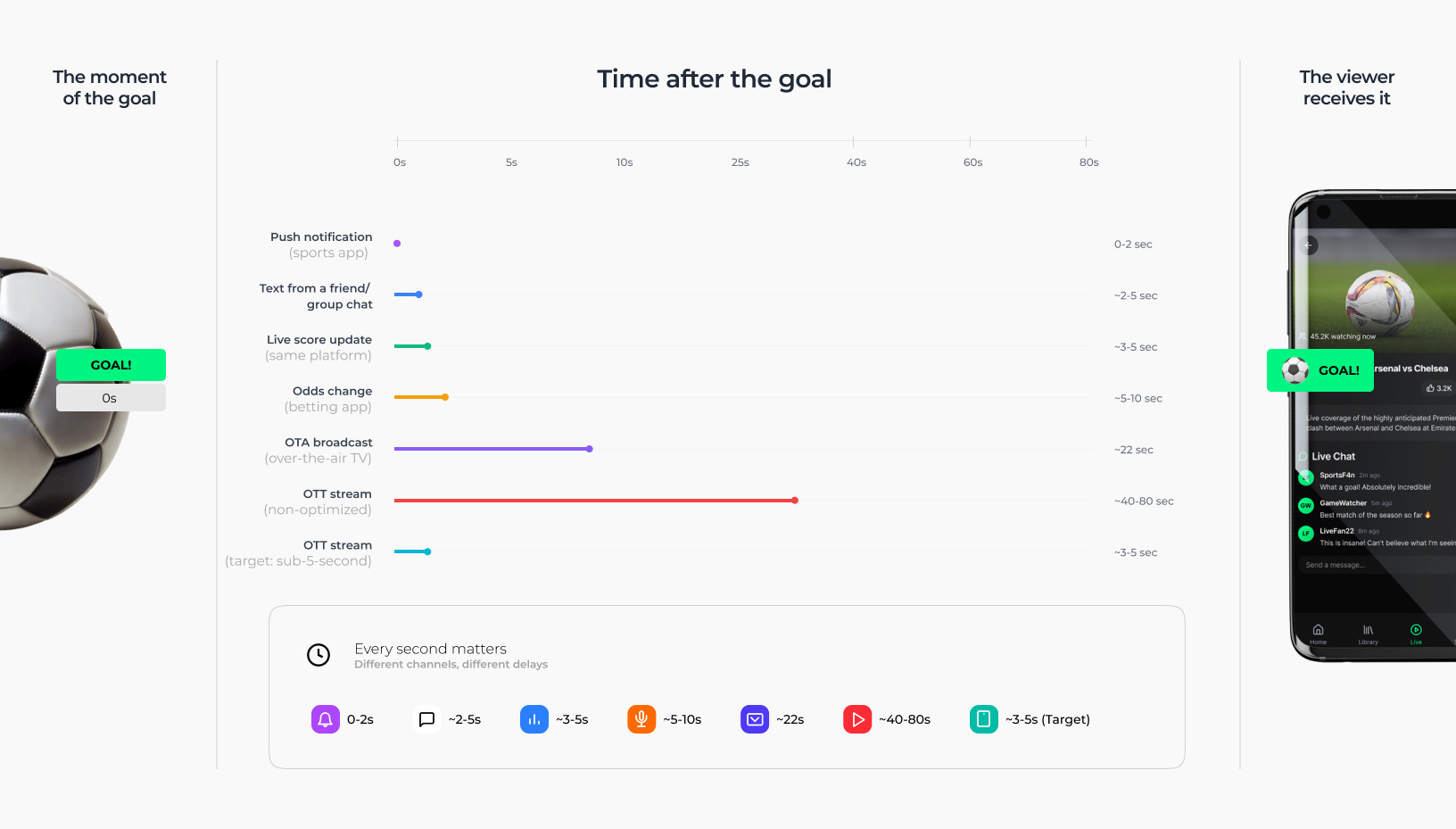
Latency in sports streaming has stopped being a technical metric and has become a competitive position. Traditional over-the-air broadcast delivers footage about 22 seconds after the live action. The streaming journey adds encoding, transcoding, CDN routing, edge caching, and player buffering to that path, with average latency landing anywhere from 40 to over 80 seconds behind the action, depending on the service and the viewer’s connection.
Latency on a title-race day does something stranger than just being slow. A fan in London is watching the home match on the big screen, and your platform’s live table is open on their phone. A goal goes in at the Manchester end, and over the next few seconds, the phone updates, a friend’s text arrives, the betting odds in the corner shift, the live table refreshes, and the broadcast on the actual television does precisely nothing. 40 seconds later, the goal finally appears on screen, by which point the moment has been over for half a minute. Viewers are watching a replay disguised as live, and your platform has spoiled its own broadcast. The score widget arrived first, the video arrived last, and everything in between belonged to someone else.
The bar for what counts as acceptable has been shifting for a while. Sub-five-second glass-to-glass is now the working target across sports platforms, and sub-second is achievable on the better-funded ones. It isn’t standard yet, but it stopped being a research project a couple of years ago.
Operators care about that number because it’s about money. Latency sits between the platform and the parts of the business that pay for rights deals.
In-play betting is the most exposed. A bet on the next minute is worthless if the next minute already happened 40 seconds ago on somebody else’s screen, and with two title-race matches in motion, the markets move twice as fast anyway.
The same tight window matters for everything interactive. Polls, synchronized watch parties, and second-screen overlays where the phone shows stats matching what’s on the TV. None of them works when viewers are spread across 40 seconds of latency.
Retention is the slow one. A viewer who keeps finding out about goals from their phone, a friend, or the league table on the same app before they see them on the actual stream is being trained match by match to treat the stream as the slowest source in the room.
A sports streaming provider needed to make live broadcasts feel more real-time without rebuilding the platform around ultra-low latency delivery. The team focused on optimizing the existing streaming setup:
Result: A more “live” viewing experience achieved through targeted platform optimizations instead of a full infrastructure overhaul.
By the twenty-minute mark, both crowds have settled, and the platform’s traffic curve has flattened out at peak. Viewers are split roughly evenly between the two feeds, with a steady minority flipping between them every few minutes. From the audience’s side of the screen, this is the dull stretch of the afternoon, but from the operator’s side, it’s the most informative part of the day, because this is when things start quietly going wrong.
CDN behavior during a major event is decided by the worst-performing edge node, not the average one. Traffic concentrates geographically on a Sunday like this: Manchester for the fans of one team, London for the other, the rest of the country distributed across regions, and international viewers clustered wherever the Premier League sells well. The servers closest to the most engaged audiences end up doing the most work, and they’re the first to start throttling.
When that happens, the platform doesn’t go down. The video quality drops. Adaptive bit-rate kicks in, the picture becomes less sharp, and the viewer who paid for HD spends the next 15 minutes watching a softer version of the match. The fix lives upstream of the bandwidth question. It’s about multi-CDN routing that can switch providers in real time, edge capacity that can be expanded during the event, and origin shielding that prevents a single overloaded location from cascading back through the rest of the system.
Every device wants a different version of the stream. A phone on cellular pulls a low-bitrate version, a tablet on Wi-Fi pulls something heavier, a 4K smart TV pulls the full feed, and a Chromecast pulls 1080p. The transcoding pipeline produces all of them in parallel, in real time, and on a final Sunday, it produces them for two matches at once. When demand for one format spikes faster than the transcoders can keep up, that version alone starts drifting behind the others.
The viewer doesn’t notice until they switch devices. The tablet is fine, but the mobile stream of the other match is now 30 seconds behind the one they just left. By the time they’ve worked out what’s wrong, the goal has already happened.
Live-stream players spend their development life on an engineer’s laptop, on a fast home connection, with the engineer watching closely. The players spend their actual life on a phone in someone’s pocket on a moving train, sharing Wi-Fi with three roommates, getting flipped between two matches every few minutes. What the player does when the connection becomes unstable is what the platform looks like to the viewer.
Building one that holds up under those conditions is a real engineering effort. The bit-rate ladder has to step down gracefully when the connection narrows. Pre-buffering must be tuned for live content, where buffering too aggressively pushes the viewer further behind real time. Feed-switching should keep cached segments of the match the viewer just left, so flipping back doesn’t restart the buffering cycle. And recovery logic is supposed to do more than just drop the viewer back to the home screen when a single segment fails to arrive.
These problems are invisible during a Tuesday afternoon load test, but they do surface in the 31st minute of a title-deciding Sunday.

We’ve spent the last decade engineering live video systems for sports broadcasts at peak load: low-latency pipelines, multi-CDN routing, resilient players, all proven over real matches.
The whistles blow for half-time. Both matches stop at the same moment, and from the engineering side, the next 15 minutes are quietly more demanding than the match was.
The ad break is the part most teams plan for. Server-side ad insertion is the standard now because client-side ads fall apart under the network conditions sports viewers actually encounter, and SSAI stitches ads into the stream at the origin.
That means halftime is a coordinated handoff between the ad decisioning system, the manifest generator, and the edge cache, running across both matches simultaneously. When the handoff misfires, the failure modes are predictable and embarrassing. Some viewers see the same ad three times in a row. Some see a black screen for the entire break. Some see an ad meant for a different country’s audience.
The harder part is the part that doesn’t look like a load. A meaningful share of viewers leave the primary stream entirely during halftime and migrate to whatever else the platform offers. Fantasy stats, halftime betting, first-half clips, the live league table, goal-difference scenarios for the title race. For the fans who play fantasy football, half-time is when most of their decisions get made, and on a final matchday of the year, the goal-difference math matters across half the league at once, not just the title. The platform that holds the viewer’s attention through those 15 minutes holds them for the rest of the season. The platform that loses them hands them to whatever app feels more useful in the gap.
Halftime is its own product. The only platforms that handle it well are those built that way on purpose.
By the time the second halves kick off, the platform has been under a heavy load for nearly 2 hours. Whatever was built well, nobody notices. Whatever was built quickly, in a sprint, on a deadline, at the end of a quarter, is starting to creak.
And the audience has never been more dialed in. A buffering wheel in the eleventh minute of a quiet Tuesday night fixture vanishes into the noise of a normal week. The same wheel at five-thirty on the final day of the season is the line every fan repeats on Monday morning. That’s the asymmetry that makes the second half so unforgiving.
Three OTT sports streaming failures tend to surface during this stretch.
Most of the audience watching at home is on a connected TV, and engineering effort doesn’t go there. The hardware is lean, the OS is often a few generations behind whatever phone is on the coffee table, and the app has been running continuously for over an hour with the viewer flipping between two live feeds.
Things start to slow down. Replays load a beat later than they used to, frames drop on fast camera pans, and the picture occasionally freezes on a still image while the commentary keeps going.
None of this looks like a crash, which is part of why it’s hard to catch. The work that prevents it is unglamorous: tight memory management, conservative texture handling in the player UI, and stubborn QA coverage across the long tail of TV operating systems people still actually use.
Whoever was watching what at kickoff isn’t watching the same thing at minute seventy. The fans of a team that’s just gone a goal down start drifting away, the supporters of the team going up dig in harder, and the neutrals migrate toward whichever match has more going on.
The geographic distribution that the CDN was tuned for two hours ago is now wrong, and the routing system has to figure out where the audience has actually gone. On a Sunday where the load was already concentrated in two cities, the margin for that adjustment is much narrower than it would be on a normal weekend.
Live stats overlays, multi-angle cameras, picture-in-picture, watch-party chat — each was tested separately, on a stable connection, with a polite latency budget, with one match active. None of those tests looks anything like five-thirty on the final Sunday, when every feature is open at the same time, the network is degraded for a meaningful slice of users, the latency budget is nonexistent, and there are two live matches feeding everything. This is the combination that almost no platform has actually rehearsed.
The platforms that handle these 90 minutes well are the ones built for the few minutes inside them when the audience is biggest, and the margin for error is smallest. Most of the engineering that makes that possible was done eighteen months earlier, in decisions nobody outside the team saw.
Both final whistles go within a minute of each other. Most of the audience leaves the platform within ten minutes — friends to message, restaurants to get to, kids to feed. A smaller and more valuable group stays, and a real share of the day’s revenue depends on what those people do next.
Highlights are the first thing the audience reaches for after the final whistle. The platforms that have built clip generation into the live pipeline itself can put the title-winning goal on the home screen within seconds of it happening, ready to be shared. On the final matchday, the platform publishes two of those clips at once. The platforms that haven’t built it this way spend Monday morning watching someone else’s clip of the day get shared more than their own.
The platform also publishes full replays, condensed versions, and key moments cuts in the hours after the final whistle. All of that content keeps getting watched for years, especially in markets where the live broadcast went out at three in the morning local time.
The catch is that the platform isn’t the only one publishing its content that night. Within hours of the final whistle, the same match is running on dozens of pirate streams. And because sports rights make their money inside a narrow window, a takedown that arrives on Wednesday has already missed it.
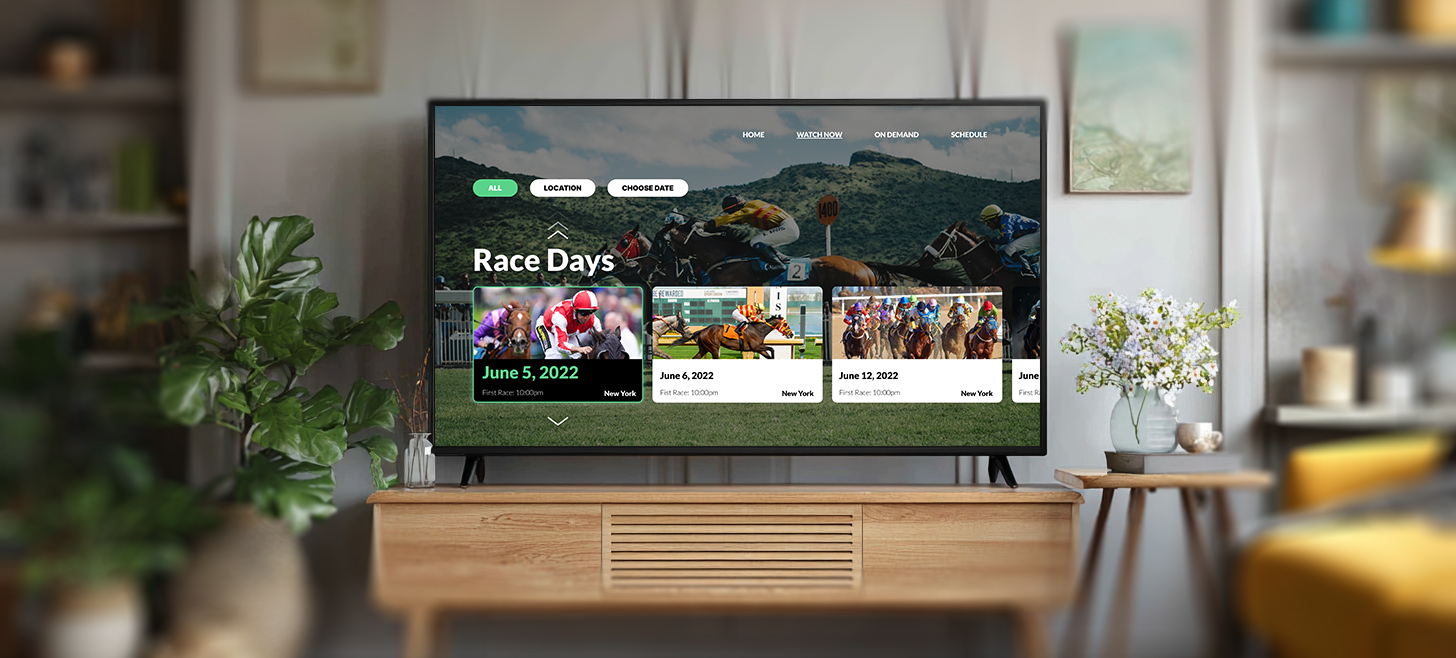
A horse racing broadcasting client needed to deliver both live and on-demand content across Roku, Apple TV, and Amazon Fire TV through a single video distribution platform, on a tight deadline.
Oxagile built a simulcasting solution using AWS Elemental Live for stream encoding, Akamai CDN with Streamroot for intelligent load balancing and traffic routing, and custom AWS Lambda functions for on-the-fly media processing. The platform handles simultaneous live broadcasts alongside a growing VOD catalog, with content protection and multi-device delivery built in from the start.
A live sports broadcast attracts paying viewers and pirates simultaneously. The audience peaks during the live window, and so does the piracy. A film has months of legitimate release to recoup its budget. A live football match lasts roughly 2 hours, and anything that leaks during that time costs the rights holder money straight out of the deal.
The technical defense runs in four layers, and all of them matter at once:
None of this works without the operational layer underneath. Rights enforcement during a live event needs real-time monitoring, the ability to kill a session mid-stream, and a takedown workflow that runs as fast as the broadcast itself. The piracy that gets stopped is the piracy that gets caught while the match is still on.
Every serious sports streaming platform now ships the same feature set. The differentiation has moved entirely to how well each piece works under pressure.
Running all six of these features together on a final Sunday is where most of the real engineering work shows up. The load is at its peak, the audience is paying close attention, and a single weak feature can make the whole platform feel slow.
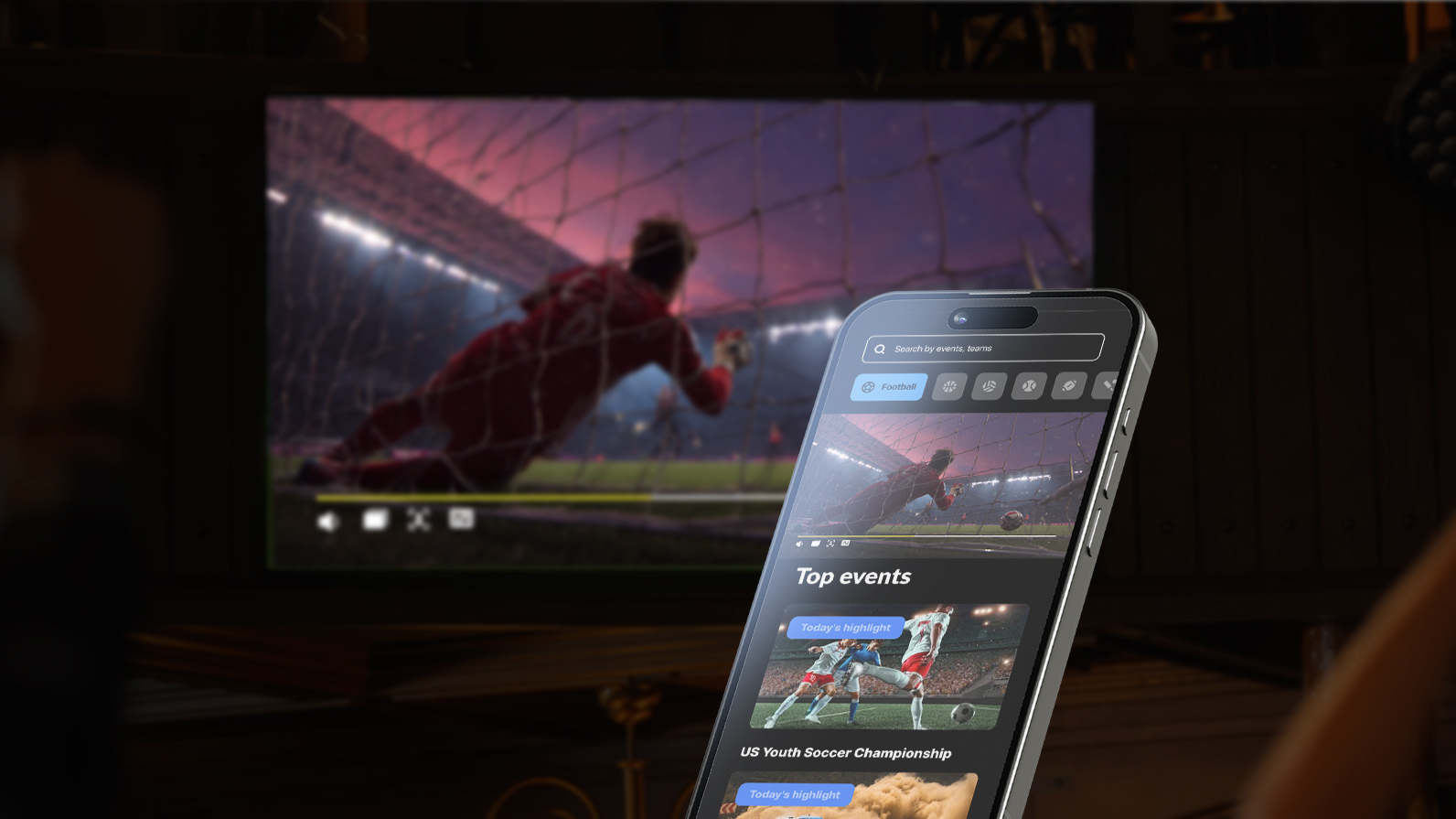
A national satellite TV provider needed an interactive second-screen experience for live soccer broadcasts. Oxagile built a cross-platform app for iOS and Android that lets fans make real-time predictions during matches, with accurate calls rewarded through sponsored prizes.
The system handles up to 500,000 simultaneous bets with seamless synchronization between the TV broadcast and in-app feeds, keeping engagement tight to the live action without competing with the main screen.
From the outside, a film platform and a live-sports platform are barely distinguishable. Same cloud, same components, same billing. The differences are underneath, and they only show up when something at scale goes wrong.
A film catalog is a forgiving workload. Even this week’s most-watched title is being streamed by people in ones and twos over two whole days, giving the architecture time to absorb the demand at its own pace. The cache stays warm because the traffic itself keeps it warm. The CDN handles the volume comfortably. The origin servers see traffic but rarely approach their capacity.
Live sports is a different problem. The audience for a live match arrives in a 15-minute window around kickoff and stays for the full ninety. The CDN has to absorb millions of users at roughly the same time. The origin server that was running at low load on the VOD product is suddenly the bottleneck for the entire broadcast.
If you try to run live sports streaming on a platform built for films, you usually discover the difference across three or four matches. The first match ships, and the picture is fine for most viewers and noticeably worse for a slice. The second has a partial outage somewhere in the chain. The third goes down properly. By the fourth, the conversation has shifted from how to patch it to whether the whole thing needs rebuilding.
Fixing it usually starts with a serious look at what the original architecture took for granted. The platforms that come out the other side run two separate pipelines: a VOD pipeline doing what it always did, and a live pipeline running alongside it with its own team and its own assumptions.
Clients usually come to us at one of three points in their platform’s lifecycle:
Across all three, the principle is the same: a platform that handles a quiet Tuesday fixture is necessary, but one that handles 5:46 pm on the final Sunday of the season, when both matches are level, and the title hangs in the next ten minutes, is the actual deliverable.
Our portfolio in sports software covers full live-streaming platforms, motorsport media products combining live and VOD, and second-screen builds running alongside the main broadcast. What links them is the same set of habits: latency budgets that nobody negotiated away, CDN strategies built around the worst case, and player implementations proven match by match in production.
White-label sports streaming platforms can be a solid option for operators whose sports offering sits within a broader content portfolio. Providers like Muvi, Kaltura, Dacast, and Vimeo OTT cover much of that space, along with several sport-focused vendors.
The trade-off is straightforward: white-label gets a platform live faster and cheaper, but it makes the platform indistinguishable from every other white-label deployment underneath the branding. That’s fine if speed matters more than differentiation. It’s a problem when the platform is the brand, when the audience is there primarily for the sport, or when the rights deals are big enough that a percentage of revenue going to a third-party platform starts to matter.
Most of the clients we work with land somewhere in the middle. The white-label product handles infrastructure and distribution, and custom development handles the parts that need to feel different: the player, live features, second-screen experience, and DRM. We work across the major white-label products and can give a straight read on which one fits a brief, including the briefs where the answer is to build the whole thing from scratch instead.
Sports streaming is the part of OTT where platform quality becomes visible. A platform’s average performance is invisible to the audience, but its worst three minutes never are.
A fan watching their team go up in Manchester remembers the picture that didn’t buffer. A fan watching their team’s title slip away in London remembers the picture that did. Those two fans are on the same platform that afternoon, sharing the same CDN, origin servers, and player implementation. If the platform holds, both viewers walk away with their experience intact, even if only one of them got the result they wanted. If the platform breaks, it breaks for both of them at once, and the next subscription decision they make will likely be the same.
A single bad 90 minutes touches every fan watching the broadcast. The wins are shared across the audience, and so are the failures. There’s no such thing as a slightly bad sports streaming platform. You’re either the one who delivered the moment, or the one who took it from people.
The work is harder than VOD, and the audience is more demanding than in any other streaming category. The loyalty it produces, in turn, is the most durable thing in modern media.
Sports streaming has rules that don’t transfer from VOD, and most of them are only obvious in hindsight. We’ve spent the last two decades building these platforms across real broadcasts and know the peculiarities inside out. Tell us what you’re building.
1. 60 Million Households Tuned in Live for Jake Paul vs. Mike Tyson — Netflix
2. IPTV Statistics 2026 and Beyond: Market Size, Growth, and Key Trends — Apprupt

An OTT sports platform competes with phones, score apps, and group chats for the moment a goal happens. Broadcast runs about 22 seconds behind the live action. Unoptimized streaming runs 40 to 80 seconds behind, which is enough for a fan to learn the result from a notification before seeing it on screen. Sub-5-second glass-to-glass is the current target for serious sports streaming, with sub-second achievable on better-funded deployments.
Traditional broadcasting sends a single signal through a controlled distribution path with a predictable delay. OTT sports streaming sends a personalized stream through the open internet, where every viewer’s path runs through encoding, transcoding, CDN routing, edge caching, and player buffering before reaching the screen. The result is a more flexible product with more interactive features and viewer data, in exchange for a much harder engineering problem.
OTT sports platforms handle viewership spikes through three coordinated layers. Capacity planning is anchored on peak concurrent users in the first three to five minutes of an event. A multi-CDN setup spreads traffic in real time when any single provider starts to saturate. Edge pre-warming prepares cache layers ahead of audience arrival instead of reacting once traffic has already hit.
Yes, often more than the major rights holders. OTT sports streaming removes the two constraints that historically excluded niche sports from traditional broadcasting: a geographically scattered audience and an audience too small to justify a national TV slot. A second-tier league or regional tournament can reach its fanbase directly through subscriptions, ad-supported tiers, or microtransactions, with revenue paths that broadcasting couldn’t offer.

