













This website uses cookies to help improve your user experience




In the streaming economy, few acronyms carry as much weight as DRM. Short for Digital Rights Management, it’s the invisible scaffolding that keeps the video content you take the obligation to stream from becoming just another torrent download. It governs who gets to decrypt video, under what conditions playback is allowed, and how long access survives once a session starts.
The demand for that protection layer follows the same logic as a vault: the more valuable what’s inside, the heavier the door. According to Grand View Research, the digital rights management market in media and entertainment is already measured in the multi-billion dollar range and is projected to grow to USD 6.7 billion by 20331.
But piracy has kept pace as well. Today it doesn’t occupy the margins of the internet with degraded reuploads and niche forums. Today it operates like a shadow distribution layer, one that mirrors the architecture of legitimate platforms. Content surfaces on the same release cadence. It tracks audience demand and scales through familiar delivery mechanics. The only difference is where the money goes. Piracy tends to exploit the seams, like timing gaps between global premieres and local rollouts, regional licensing restrictions, the lag between when audiences want something and when they’re allowed to have it.
That pressure shapes every serious conversation we have with studios, broadcasters, and platform operators. The questions rarely start with UI design or recommendation logic. They start here:
Among the many ways to protect OTT content, DRM sits as one of the foundational controls.
However, it wouldn’t deserve a dedicated page if it were a single switch or a universal standard. Apple, Google, Microsoft, and other major players each have their own proprietary systems, certifications, and idiosyncrasies. What passes compliance in one ecosystem might be rejected in another.
So if you’re an operator or distributor in the middle of it all, juggling strong security requirements, wide device support, and tight licensing constraints, this article will help you make sense of DRM and build a solid foundation for its’ practical implementation.
Key takeaways:

Digital Rights Management refers to technologies and strategies used to protect digital content from unauthorized access, copying, or distribution. For end users, DRM remains largely invisible, as it doesn’t alter picture or sound quality. Yet for rightsholders, it’s a vital business tool to guarantee that only authorized users can access content and enforce restrictions on how it can be used. For example, DRM can limit the number of devices on which a purchased movie can be played or prevent the copying of a digital book.
OTT DRM systems employ a precise combination of technologies to protect content, each serving a distinct role.
DRM protected video is secured using advanced encryption standards, such as AES-128 or AES-256, transforming media into an unreadable cipher. Only users with a decryption key, delivered via secure protocols like HTTPS, can access the content.
DRM implements granular restrictions, such as limiting playback to five devices per account, disabling screen captures through HDCP (High-bandwidth Digital Content Protection), or restricting streams to approved platforms like specific browser versions or apps. This is comparable to a tailored access badge, granting entry only under strict conditions.
Advanced watermarking embeds imperceptible identifiers into audio or video streams, using techniques like session-based or user-specific forensic markers. These act like a digital serial number etched into content, letting distributors trace pirated copies to their source, down to the individual account or device.
OTT video protection uses license management to create dynamic, adaptable usage agreements between content providers and users. These licenses define specific terms of use, for example, allowing a movie to be watched for 48 hours after purchase or restricting playback to a single registered device. Each license is typically linked to either a user account or a unique hardware ID, sucuring that only authorized individuals or devices can access the content.
When your platform streams DRM protected video, the media isn’t just decrypted by the app or player. That would be too easy to compromise. Instead, modern DRM systems rely on what’s known as a Trusted Execution Environment (TEE). This is a secure part of the device’s hardware, completely isolated from the rest of the operating system.
Inside this secure zone, the encryption keys decrypt the content, and the resulting video is rendered directly to a protected display surface. It never passes through regular system memory or software layers, which means even users with full control over their device can’t extract or duplicate the content.
This hardware-level enforcement is critical. That’s why most DRM certifications require devices to support things like TEE or HDCP. Without this level of integration, your content remains vulnerable, no matter how secure your app may seem.
Take a familiar scenario: if a user tries to share their screen during playback over Teams, they’ll typically see a black rectangle where the video should be. That’s DRM doing exactly what it’s supposed to: blocking unapproved output paths.

At the heart of DRM in streaming are three dominant players:
These aren’t open-source technologies or interchangeable tools. They’re proprietary systems, each with its own APIs, certifications, legal frameworks, and device compatibility. In essence, every DRM is a black box that is built to protect content. And though each does that effectively, being deliberately closed creates genuine complexity for developers and content owners operating across more than one.
Now, the ground is shifting beneath one of those systems.
The most concrete signal of OTT DRM replacement came from Roku, which announced a gradual phase-out of Microsoft PlayReady support in certain parts of its ecosystem, particularly for new app development in some regions and distribution flows. Developers were encouraged to migrate toward Google’s Widevine DRM, which had already become the dominant choice across most Roku streaming applications.
The rationale was practical: Widevine is widely supported across devices, is frequently updated, and does not involve per-device licensing fees in the way some legacy DRM integrations do.
However, the picture that emerges is not full replacement or consolidation around a single DRM. PlayReady remains actively used across multiple major platforms, especially in the environments where it is tightly integrated with device certification, hardware roots of trust, and legacy deployments.
So rather than displacement, the industry is better described as a multi-DRM coexistence model, where Widevine, PlayReady, and FairPlay continue to coexist depending on device type and platform requirements.
When US trade restrictions cut off Huawei’s access to Google Mobile Services, the company needed its own DRM path. WisePlay was built specifically to address the limitations Huawei faces with US-based technology, with the China DRM standard at its core.
Technically it holds up as it supports MPEG-DASH, HLS, and CMAF, delivers hardware-backed security for 4K and HDR content, and integrates cleanly with multi-DRM environments, which means existing Widevine or PlayReady-encrypted libraries don’t need repackaging.
The device footprint, however, is geographically concentrated. Huawei reclaimed the top spot in mainland China’s smartphone market, but outside China, its presence remains limited.
That context defines WisePlay’s relevance precisely. For Huawei devices, it’s the only path to hardware-secured premium content delivery with no alternative. For operators whose audiences sit in Western markets, it sits outside the core three-system stack entirely. It doesn’t replace anything, but it covers a device segment nothing else reaches.

As we said, there is no universal DRM, and this is precisely what defines OTT platforms DRM challenges across devices. Each ecosystem enforces its own: Apple requires FairPlay, Android devices demand Widevine, and Smart TVs rely on PlayReady. These silos make multi-platform delivery a logistical puzzle.
The antidote lies in architectural agility. A system designed with adaptability at its core can pivot to accommodate new DRM requirements without necessitating a ground-up rebuild.
As outlined in our comprehensive OTT platform development guide, prioritizing scalability and early DRM integration is critical for crafting robust, future-ready streaming solutions. This strategic foresight makes sure platforms remain nimble, ready to embrace evolving standards without sacrificing performance or user experience.
Obtaining access to a DRM system isn’t as simple as signing a licensing agreement. It’s a formal and often expensive process that requires:
The bar is intentionally high. Vendors like Apple, Google, and Microsoft are protecting the trust that studios place in their ecosystems.
So ideally, DRM is considered from the start. A well-designed architecture makes it easier to support multiple encryption schemes, meet platform-specific requirements, and scale without needing to rebuild key parts of the system. But even if a streaming platform has been running for years, introducing proper DRM is still very much possible.
The first step is usually a technical audit. This helps identify where the current setup falls short: outdated components, lack of scalability, or difficulty integrating new protection layers.
Even if DRM wasn’t part of the original plan, a reasonably modular architecture can often accommodate it. New components, like DRM systems, key management tools, player-level protections, can be introduced without tearing everything down. In some cases, this may require refactoring parts of the system to improve flexibility and prepare for expansion.
Equally important is understanding the expectations of content owners. Studios typically require formal certification, secure playback environments, and compliance with industry standards. And that starts with a system ready to adapt.
Building your own protection scheme may seem cheaper and more flexible. But to rights holders, a custom OTT rights management solution often signals one thing: risk.
Major studios typically won’t license content unless they see the familiar logos of these OTT DRM solutions: Widevine, FairPlay, PlayReady. These systems come with not just encryption, but legal assurances, hardware-level integration, and a vendor reputation that stands behind the promise of security. So even robust proprietary solutions struggle to pass studio audits.

Certifications, platform quirks, and device compatibility are minefields. One misstep and you risk losing trust and your hard-earned content.
20+ years and hundreds of implementations have given us a precise map of this territory. We know what it takes to get it right, and we’ll make sure you do too.
Based on our years of OTT apps development, one of the most common and costly mistakes is optimizing a DRM strategy for a single platform (such as Apple TV), only to encounter major hurdles when expanding to Android or Smart TVs.
Streaming platforms need architectural flexibility from day one. Adding support for MPEG-DASH, Widevine licensing, or integrating new DRM APIs mid-flight is no small task, that’s why scaling shouldn’t require rethinking the entire backend.
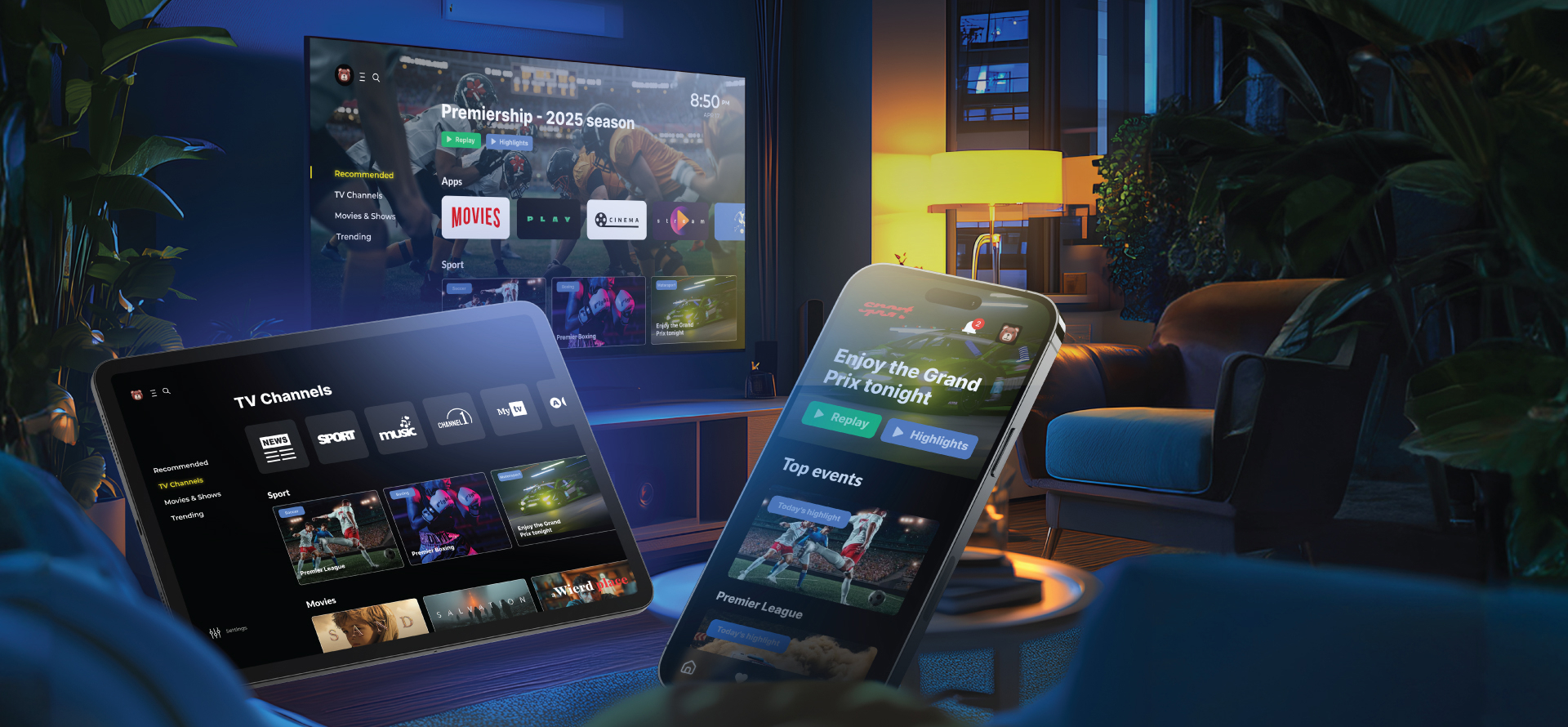
One of the core challenges in developing a highly configurable white-label OTT front-end application was fast adaptation to the specific content protection requirements of different distributors and regions, each operating under its own compliance standards and technical constraints.
Within this platform, the team:
As a result, the platform was able to scale efficiently and launch securely in new markets with minimal time to deployment.
Taking advantage of OTT DRM services requires aligning with industry standards, adapting to platform-specific constraints, and designing infrastructure that can grow without losing compliance or breaking compatibility.
If you’re launching a video service, one of the first strategic decisions should be: which DRM system will we adopt first, is our infrastructure ready to support it, and how can we scale across platforms without rebuilding from the ground up?
Because the future doesn’t just favor content distributors with great content. It rewards those equipped to protect it.
We’ve perfected the art (and science) of seamless multi-platform access, intuitive UI, and rock-solid DRM. Whether you’re looking to boost performance or scale effortlessly, we’ve got the expertise to make it happen.
1. Digital Rights Management in Media & Entertainment Market Summary — Grand View Research

OTT DRM protected video is secured using AES encryption, making it unreadable without a decryption key. This ensures only authorized users can access content while preventing copying or unauthorized distribution across devices and platforms.
Hardware-level enforcement in OTT DRM (Digital Rights Management) relies on Trusted Execution Environments (TEE) and High-bandwidth Digital Content Protection (HDCP). These technologies decrypt and display content securely while blocking unauthorized extraction or screen capture, ensuring streaming security even on user-controlled devices.
Custom OTT DRM solutions lack industry certification, hardware-level integration, and legal assurances. This increases risk for content owners, who may refuse licensing, making proprietary DRM harder to scale, maintain, and trust across platforms.
OTT DRM services provide certified, multi-platform protection, maintain rights holder trust, and ensure secure streaming. They allow scalable content delivery while meeting industry standards and preventing piracy without compromising the viewer experience.

