
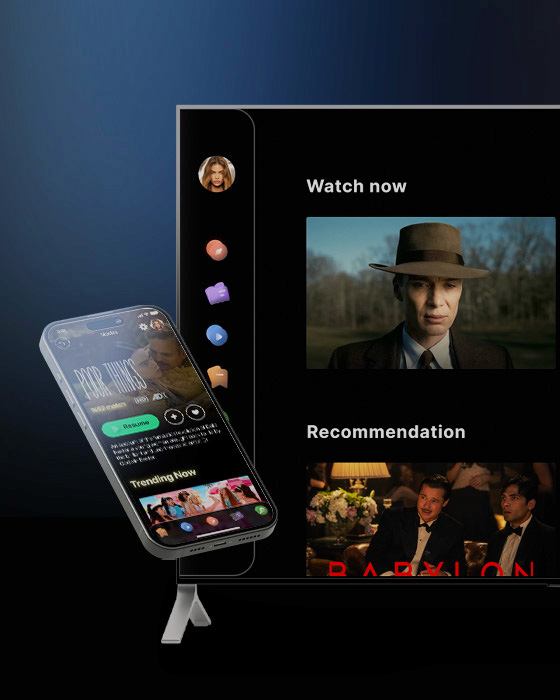
Your Titan OS app success rests on three fundamentals

Algorithmic visibility, clarity-led interaction, and utter resilience.

Our Titan OS application development will power the first through enriched metadata pipelines, validated deep linking, and clean content mapping.

The second will be built through remote-first UX, deterministic focus, shallow navigation, readable-at-distance interfaces, and fast transitions.

The third will always be in place with cloud-coordinated updates, device-resilient architecture, fault-tolerant layers, and cold starts optimized to milliseconds.

Always seen. Always smooth. Always reliable.

How we make every Titan OS logic flow work for you

With 20+ years of expertise in media streaming development, we won’t let your app be just another icon on the screen. We’ll guide it through every twist, trap, and hidden door of the Titan OS labyrinth, so your app emerges polished and irresistible to every user scroll.

Content discoverability

Titan OS doesn’t automatically recommend your app’s content. If not properly configured, it remains isolated, missing out on recommendations, “Continue Watching”, and global search visibility.

Oxagile’s approach:

  • Structured feed architecture: We build robust content feeds that translate your library to Titan OS’s required schema.
  • Metadata normalization: Our engineers enrich data fields to feed the OS algorithms the high-quality signals for accurate ranking.
  • Deep linking: We use resilient deep link logic so users land directly on the video player, even from a cold start.
  • Event syncing: We sync precise playback events to keep the “Continue Watching” row accurate and reliable.
Ecosystem compliance

Titan OS aggregates OTT, linear TV, and FAST content into a single graph. Misaligned identifiers, inconsistent content versions, or stale availability data can break cross-service aggregation and global search.

Oxagile’s approach:

  • Global ID mapping: We use external identifiers so Titan OS correctly matches your assets in the global content map.
  • Granular version modeling: We clearly define cuts, versions, and dubs to avoid metadata conflicts.
  • Live availability: We enable fast status sync to prevent users from seeing expired or geo-blocked content.
  • Source handling: Our logic manages the transition when a user chooses your service from a comparison card, optimizing the hand-off for speed and reliability.
Cloud-coordination

Titan OS operates on a hybrid model where the cloud dictates the rules, but the device executes them. This creates a synchronization gap: if the cloud configuration updates while the local app is mid-session, or if the network stutters, the application can crash or display inconsistent behavior.

Oxagile’s approach:

  • Device-resilient logic: We architect apps to work even during backend outages, avoiding frozen screens.
  • Backward-compatible API design: We decouple the app’s core from the cloud configuration, so OS updates don’t break installed apps.
  • Safe feature flagging: We use circuit breakers so remote feature toggles don’t cause local failures.
  • Smart cache invalidation: Our systems clear outdated paths only when the cloud update is fully verified and stable.
Advertising integration

Titan OS controls ad logic independently from Google or Apple. Developers often struggle when their internal ad logic clashes with the platform’s OEM-controlled advertising, or when they find they cannot simply “plug and play” the usual third-party SDKs.

Oxagile’s approach:

  • Ad-API alignment: We integrate directly with Titan OS proprietary SDKs for pre-roll and mid-roll.
  • FAST/Linear signal processing: We handle SCTE markers for smooth server-side or client-side ad insertion.
  • Consent management: We build transparent consent flows that pass the correct signals to the ad infrastructure without compromising UX.
  • Viewability and reporting sync: We align your analytics with platform requirements, so every impression is accurately tracked.

What you should expect from our Titan OS app development

Select any JVC and Philips Smart TV app development service that meets your needs and goals.

Full-cycle app creation
We deliver Titan OS TV applications built on a hardened streaming architecture with Widevine, FairPlay, and PlayReady DRM support, production-ready catalog systems, and complete Partner Portal submission management through final platform approval.

Ecosystem integration
To provide accurate content surfacing across recommendations, global search, and “Continue Watching”, we integrate structured feeds, normalized metadata, resilient deep links, real-time availability signals, and cross-service ID matching within Titan OS’s unified discovery layer.

Performance optimization
Applications are optimized at the system level, including reduced cold-start times, efficient media loading, robust caching strategies, and cloud-coordinated updates. We also tune it to maintain playback stability and responsiveness across diverse hardware tiers and network conditions.

Adaptive UI/UX design
We implement flexible, dynamic layouts that follow the Titan OS Philips or JVC home-screen logic, deliver predictable remote-control focus behavior, and support deep-link navigation. Interfaces remain stable across personalized entry points, featured blocks, and varying resolutions.

Monetization and ad integration
Titan OS advertising SDKs are integrated to support AVOD and FAST ad-break orchestration, platform-compliant impression and quartile reporting, and revenue-sharing models. All monetization features are implemented without compromising stability or user experience.

Cross-platform scaling
The application can be extended to other TV ecosystems without fragmenting codebases or increasing maintenance overhead. By leveraging cross-platform frameworks and reusing core components, we guarantee faster feature rollouts, easier expansion, keeping UX consistent.

Extend your presence across all major platforms

By building on the core architecture of the existing codebase, we strip away development drag and overhead.

With this path, you’ll get a unified, high-performance experience minus the friction and the wait across every platform your audience chooses — whether it’s Android TV, webOS, Tizen, VIDAA, Roku TV, or others.

No filters. No marketing spin.

See what AI knows about Oxagile

Explore what leading AI assistants can tell you about Oxagile's Smart TV app development
experience based on publicly available information.

We rely on the latest technology stack for Tizen app development

Frontend & UI

HTML5 • CSS3 • JavaScript (ES6+) • TypeScript • React (Web) • LightningJS • Spatial Navigation • Redux • Storybook

Media & Streaming

HLS • MPEG-DASH • MSE • EME • Widevine DRM • PlayReady DRM • Shaka Player • Bitmovin • THEOplayer

Testing & CI/CD

Jest • React Testing Library • Playwright / Cypress • GitHub Actions / GitLab CI / Jenkins • SonarQube

Dev Tools & Monitoring

Chrome DevTools • Lighthouse • Sentry (Web) • LogRocket • Google Analytics • CDN & TLS Configuration
FAQ

How to choose the right Titan OS app development company?

Look for a partner that understands system-level discovery, not just playback. On Titan OS, visibility depends on structured content feeds, metadata normalization, deep linking, and playback event signaling. A qualified team should also be experienced with QA intake processes, unified content ecosystem requirements, and performance tuning across different TV hardware profiles. Without that expertise, your app risks becoming just another isolated icon.

What are the requirements for a Titan OS app to appear in recommendations?

Your app must provide a structured content feed, rich and normalized metadata, stable deep links that support cold start, and real-time availability data. Playback events such as start, pause, and completion must be transmitted to support Continue Watching and personalization. Integration accuracy directly affects discoverability and ranking within the Titan OS ecosystem.
How does Titan OS application development differ from Android TV or other platforms?

Unlike Android TV, Titan OS operates around a unified content graph where OTT, FAST, and linear TV coexist in a single discovery layer. This requires content matching readiness using external IDs, consistent version modeling, and precise availability updates. The system also uses cloud-coordinated configurations, meaning applications must remain resilient to remote changes and network variability.

What are specific challenges when launching on Titan OS?
Smart TV App Performance vs Stability: Why You Can’t Afford to Treat Them Separately

Launching on Titan OS involves strict QA validation, including intake tests for playback, navigation, and deep linking. The platform supports HTML5 apps only, requires testing on real devices due to the lack of an emulator, and may behave differently across hardware models. In addition, cloud-coordinated updates can introduce configuration or API changes that affect app behavior.

Therefore, during Titan OS development, it is essential to build for resilience, validate on real devices early, optimize performance for varying hardware, and prepare for evolving platform configurations to avoid delays at submission.

Accelerate your Titan OS app development with us

Tell us more about your aspirations and enjoy an application where every detail is a reflection of your intent.

Talk to the team