











Solutions for solid identity decisions

You’re not looking for another demo that works in perfect conditions. You need a system that holds up in the messiness of real environments.

We’ll bring years of computer vision knowledge and image analysis expertise into building exactly that. A solution that handles the full chain of quick face detection and person identification in a way that is stable, measurable, and ready for production.

Face recognition that travels across use cases

Safety

Safety

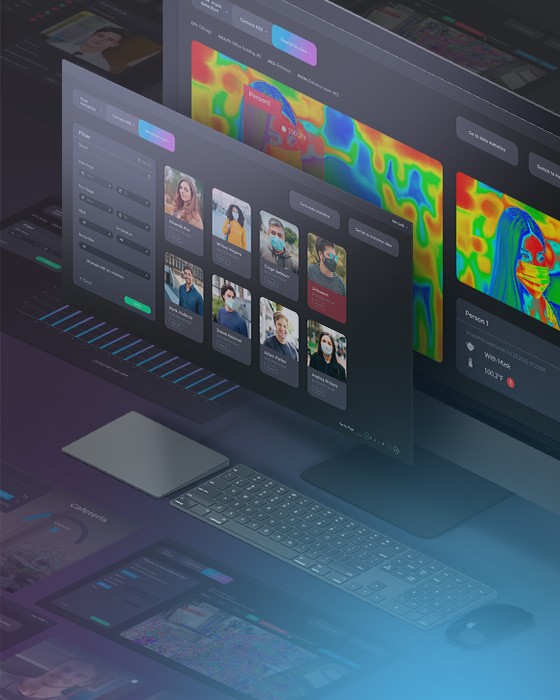
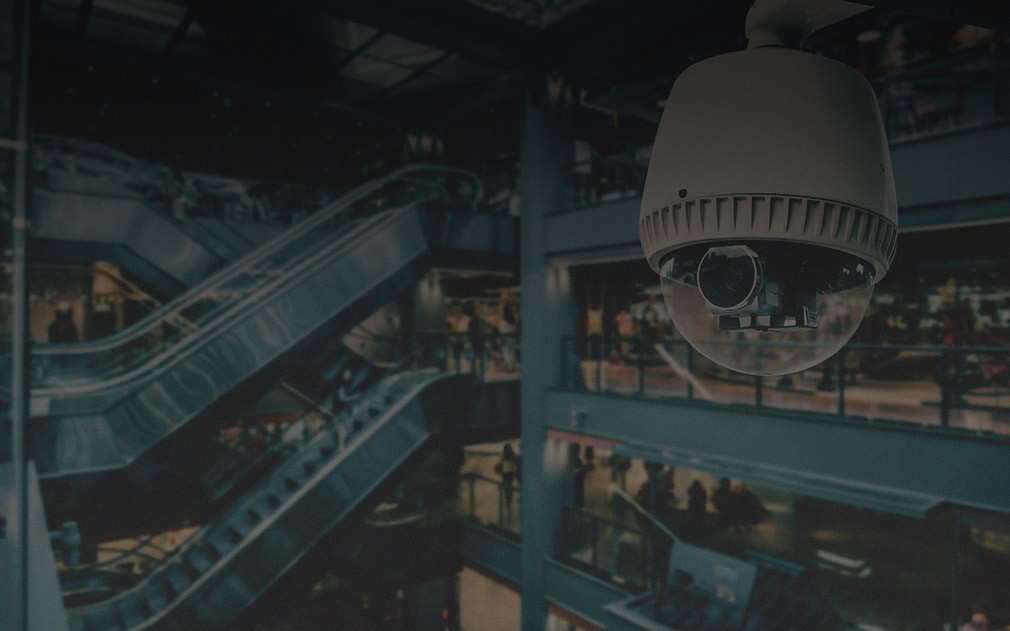
Turn live surveillance into a continuous recognition layer across your environment, or support public safety through real-time tracking of persons of interest. Follow individuals across zones and surface alerts tied to location, time, and movement patterns across camera networks.

Proctoring

Proctoring

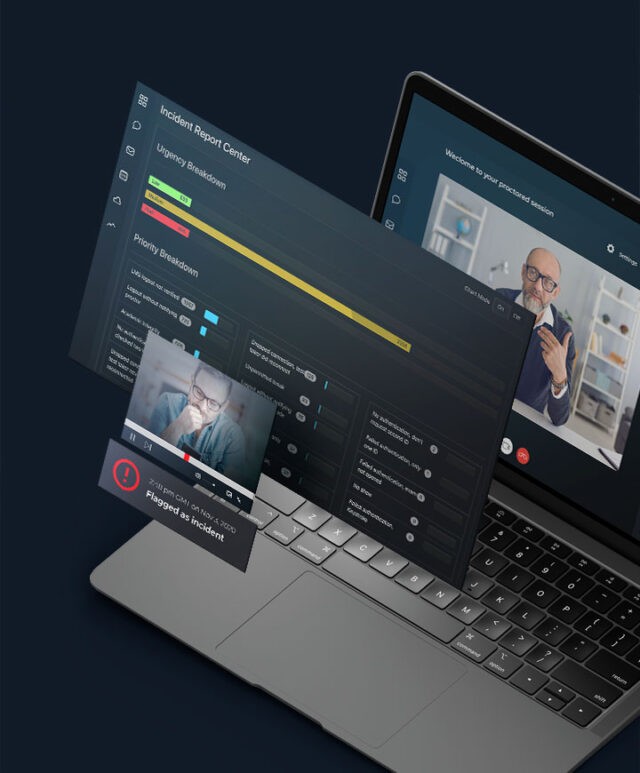
Transform exam rooms, classrooms, and remote sessions into verifiable presence environments. Use periodic biometric checks to map identity continuity over time, detect substitutions or shared access, and reconstruct attendance with precise temporal anchors.

Engagement

Engagement

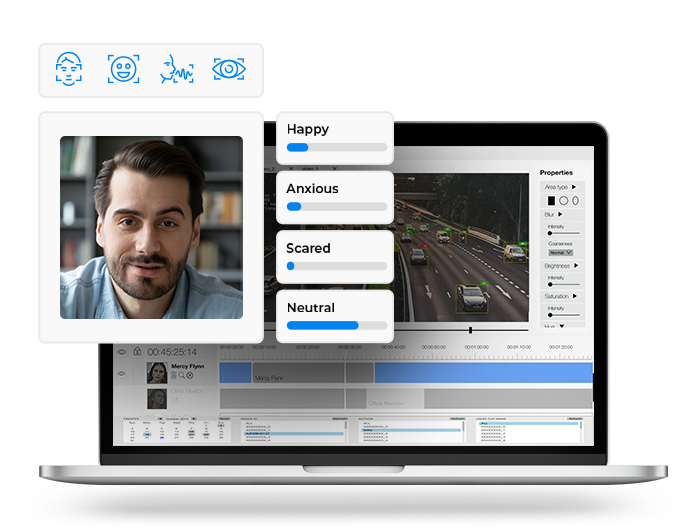
Convert event video into structured behavioral insight by linking face reappearances to specific moments in content to understand where individuals stayed or disengaged. Measure engagement across sessions with emotion recognition.

Marketing

Marketing

Recognize returning visitors as they enter physical spaces and connect them to historical engagement patterns. Build audience profiles grounded in actual visit behavior, dwell time, and repetition across campaigns, locations, and events.

Verification

Verification

Build onboarding and authentication flows where live face capture is continuously compared against stored identity references or document photos. Match live captures against stored references or documents and filter out replay attacks, synthetic faces, and non-live inputs.

Authorization

Authorization

Replace manual entry points with identity-driven access decisions executed at the edge. Match faces in real time at doors or checkpoints, trigger instant authorization, and maintain structured logs for audit, compliance, and incident review.

Put our facial recognition engineering to work for

Enrollment

Identity profiles are built from multiple high-quality captures, then carefully aligned and normalized into stable representations that remain reliable over time and across conditions.

Liveness detection

Subtle motion, texture, and temporal signals are used to distinguish a real person from replayed, printed, or synthetic inputs, reinforcing trust before recognition even begins.

Face detection

Faces are consistently followed across frames, brief occlusions, and camera transitions, preserving identity continuity even when visibility is imperfect.

Embeddings

Each face is translated into a compact numerical signature designed to remain stable despite lighting changes, device differences, compression, or natural aging.

Similarity search

Identity matching operates quickly and reliably, even across large datasets, thanks to efficient indexing and comparison of facial signatures rather than raw images.

Decision orchestration

Recognition results are interpreted in context, with adaptive thresholds guiding whether to accept, reject, or escalate based on confidence and risk.

Adversarial resistance

We use subtle inconsistencies in motion patterns, surface texture, and spatial structure to expose deepfakes, masks, and manipulated inputs.

System integration

Solutions are engineered for deployment across edge, cloud, and hybrid environments, with seamless integration into existing infrastructure.

Model adaptation

Accuracy is sustained over time through continuous monitoring, retraining, and calibration as environments, hardware, and user behavior evolve.

Oxagile’s edge in face recognition software development

Our skills and mechanisms let us tackle the most complicated business constraints around face recognition.

Degraded footage recovery

Recognition despite shaky, blurred, low-light footage or off-angle shots.

The pipeline cleans up the signal before matching, so identity can still be read from video that looks rough to a human operator.

Accuracy-latency balance

Accuracy and latency are tuned together through load tests.

The system is checked against real footage and live load, so speed gains do not quietly drag recognition quality down.

Cross-camera identity

Identity carries across camera switches, gaps, and weak visibility.

Separate sightings are stitched into one trace, which gives operators a clearer view of movement, presence, and reappearance across the full environment.

Video and AI expertise

20+ years in streaming and modern CV/ML expertise in one stack.

That mix helps shape systems that fit real video stacks, work within latency limits, and slot into production without awkward rewiring.

Need more computer vision solutions? Pick any

Image and video analysis

Processing visual data across images and video analysis pipelines to extract structured signals from raw input. Covers content classification, scene understanding, anomaly detection, and behavior analysis.

Object detection and tracking

Detection, segmentation, and tracking of objects across frames and camera feeds. Supports multi-object scenarios, maintains continuity under occlusion, and enables real-time monitoring in environments with dense or fast-moving visual data.

Text extraction

Extraction of structured data from images and video using OCR and scene text recognition. Includes document parsing, license plate recognition, signage detection, and automated capture of operational data directly from visual sources.

Our facial recognition development stack

Core frameworks

PyTorch • TensorFlow • Keras • ONNX Runtime

Computer vision libraries

OpenCV • Dlib • MediaPipe • InsightFace

Face recognition models

ArcFace • FaceNet • RetinaFace • MobileFaceNet

Model optimization and deployment

TensorRT • OpenVINO • ONNX • CUDA

Data processing and pipelines

NumPy • Pandas • Apache Kafka • FFmpeg

Search and indexing

FAISS • Milvus • Elasticsearch

Infrastructure and integration

Docker • Kubernetes • REST APIs • gRPC

ML competencies

Supervised & self-supervised • Metric & contrastive learning • Domain adaptation • Multimodal processing

FAQ

What is the difference between facial detection, facial verification (1:1), and facial identification (1:N)?

Facial detection answers “is there a face in the frame and where is it”. Facial verification (1:1) checks whether a person matches a claimed identity, like comparing a selfie to an ID photo. Facial identification (1:N) searches a face against a database to find a possible match. Each step adds complexity and requires different accuracy and latency trade-offs.

What are the most common business use cases for facial recognition?

Identity verification during onboarding and login, access control for offices and restricted areas, exam proctoring, fraud prevention, and video analytics in retail, events, and security. The value usually comes from linking identity to real-time actions or historical behavior.

Can the facial recognition software run locally on edge devices, or does it require the cloud?

Both options are used depending on constraints. Edge deployment supports low latency and data privacy by processing video directly on cameras or local servers. Cloud setups handle heavier workloads, centralized analytics, and large-scale storage. Many systems combine both.

How do you address AI bias and ensure fairness across different demographics?

Fairness is handled through dataset selection, continuous evaluation, and threshold tuning. Models are tested across demographic groups, and performance gaps are monitored over time. Adjustments are made at both model and decision levels to keep outcomes consistent across populations.

Can you integrate facial recognition into our existing hardware (e.g., standard IP cameras, mobile apps, or access gates)?

Yes. Most modern systems are designed to work with standard IP cameras, mobile devices, and access control hardware. Integration typically involves connecting video streams, embedding recognition modules, and aligning outputs with existing workflows and security systems using the most optimal facial recognition development tools.

Do you build custom facial recognition models from scratch, or do you use third-party APIs (like AWS Rekognition or Azure Face)?

Both approaches are used depending on the project. A face recognition software development company may rely on third-party APIs for faster rollout or build custom models when higher control, performance tuning, or data sensitivity is required. Often, hybrid approaches are used.

Identity shouldn’t be an approximation

Tap into our facial recognition services for systems that hold up on real footage and real workloads.

Discuss your case