













This website uses cookies to help improve your user experience




You’re running an OTT platform, and on the surface, everything still works. Streams are live, content is available, and users are watching.
At the same time, the system starts behaving differently than it used to. Release times slow down, simple features take weeks instead of days, and costs keep growing without a clear explanation.
Peak events put visible pressure on streaming quality. Expanding to new regions or adding new monetization models requires more effort than expected. Over time, it becomes clear that the current architecture is starting to hold the platform back.
What comes next?
For many providers, the next step is a structured OTT migration strategy. This usually includes a combination of modernization, replatforming, and data migration across content, metadata, user data, and core services. The goal is to support growth without interrupting the business.
Migration affects more than the technical layer. It influences user experience, revenue, and retention. With a clear plan and realistic OTT migration goals and timeline, it becomes a controlled step toward stronger scalability, more flexible monetization, and stable performance under load. But migration requires architectural expertise and a strong understanding of the business behind the platform.
In this guide, we’ll cover how to recognize when migration is needed, plan it, consider the risks, and evaluate post-migration OTT platform performance after the transition.

Along the way, we’ll include a few insights from Andrey Gordeev, Solution Architect at Oxagile, who shares observations from real projects, including managing peak loads and designing architectures that scale over time.
Key takeaways:
When the idea of migration comes up, it often sounds like a major disruption. A full rebuild, long timelines, a large budget, and a period of instability that the business has to go through.
In real OTT projects, migration usually looks different. Teams focus on the areas that create the most pressure on the product and the business. One part of the backend is reworked, a specific service is moved to a new environment, or a piece of infrastructure is replaced. The platform continues to operate, users stay active, and changes are introduced step by step.
Content, user data, and core services are rolled out in phases. Each step is tested, validated, and adjusted based on real system behavior. This gives teams more control over the process and helps maintain a stable user experience throughout the transition. At the same time, performance, cost structure, and platform capabilities can be improved as the system evolves.
Migration becomes part of the platform’s growth cycle, integrated into ongoing product development and business scaling.
At some point, these terms start appearing in discussions, often in parallel and without a clear distinction. It creates confusion at the planning stage and makes it harder to define the actual scope of work.
In the context of an OTT migration strategy, the difference becomes clearer when you look at what changes inside the platform.

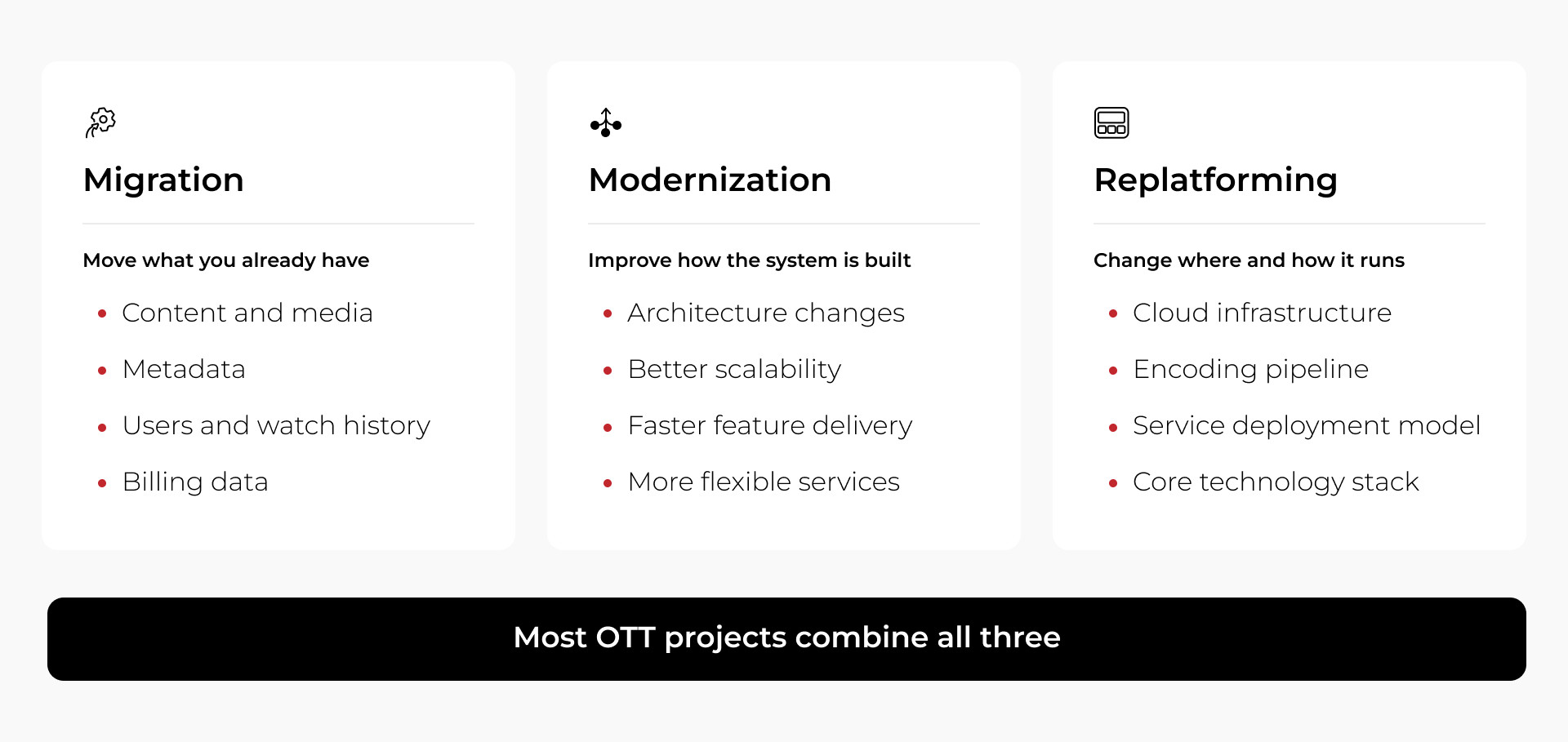
These directions are closely connected. Teams move data, update architecture decisions, and change infrastructure within the same initiative. A clear OTT migration strategy lets you structure this process, define priorities, and connect technical changes to business goals.
The need for migration does not come as a single clear decision point. It builds over time, through a set of changes that start affecting both the product and the business.
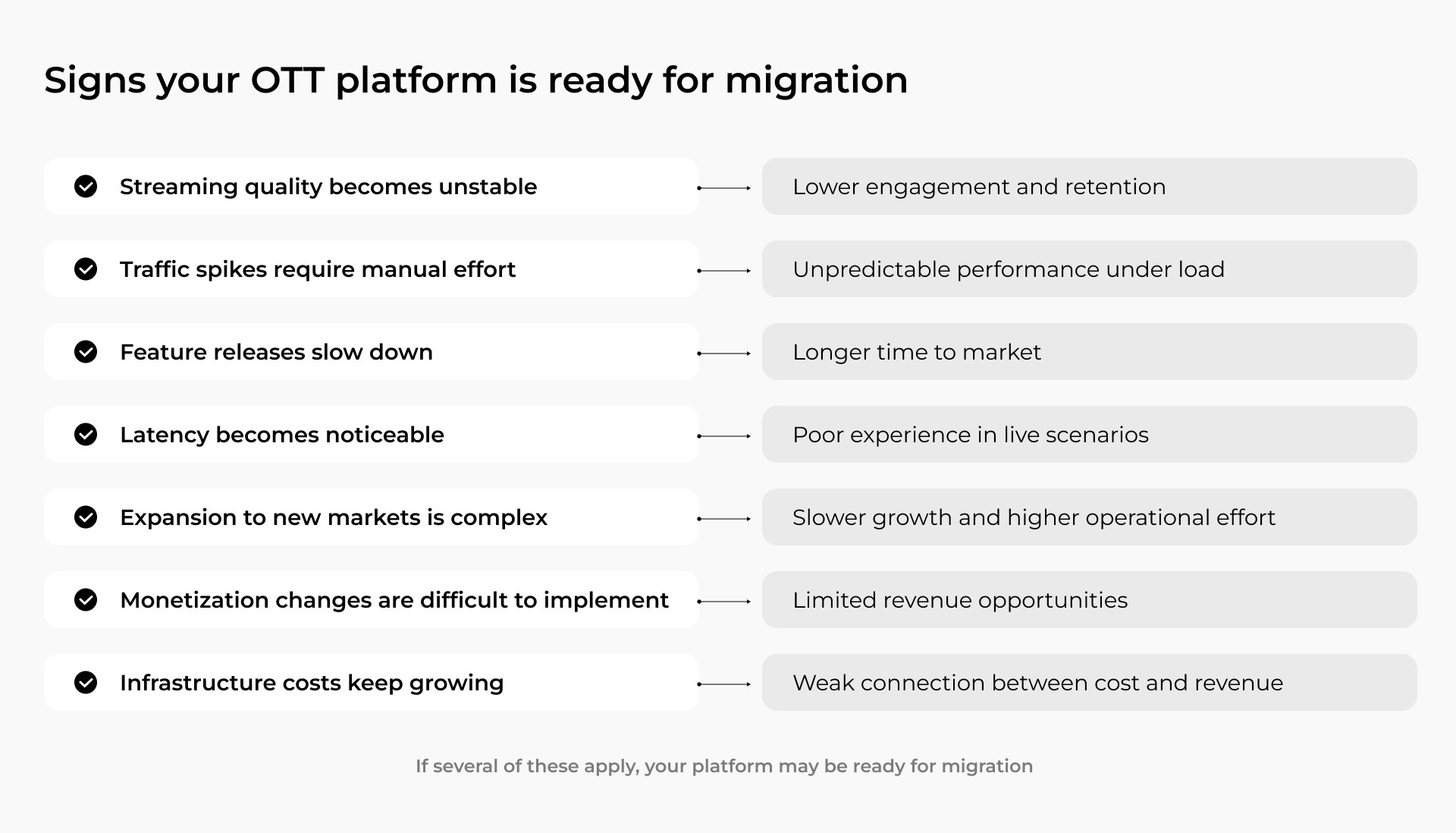
Startup time increases, buffering becomes more frequent, and playback feels less stable during peak events. Engagement drops, session duration shortens, and retention becomes harder to predict. In live scenarios such as sports or betting, even small delays begin to affect user experience in a noticeable way.
Traffic spikes tied to major releases or live events require more effort to handle. Teams spend more time preparing for load, adjusting infrastructure, and reacting to performance issues.
Expert comment:
“Cloud allows you to scale up and down depending on demand. During peak events, you may need a large number of instances, while during quieter periods, the system can run on a much smaller footprint. This flexibility is critical for platforms that experience sharp traffic spikes.”
Releases take longer, dependencies grow, and even small updates require coordination across multiple parts of the system. Time-to-market increases, and product teams start to feel limited in what they can launch.
Delays become more visible as the platform evolves, especially in real-time and near-real-time use cases. Delivery pipelines, CDN configuration, and bitrate adaptation directly influence how responsive the experience feels.
Andrey explains:
“CDN and adaptive bitrate are two of the main factors that help reduce latency. Video is split into small segments, and the player adjusts quality based on connection speed, which helps avoid interruptions and keep playback stable.”
Content delivery, localization, and infrastructure distribution require more coordination. This is especially noticeable when the platform was not designed for multi-region growth from the start.
Introducing new models, integrating advertising, or adapting billing logic requires significant effort. Such changes often expose limitations in the existing architecture.
Costs grow alongside platform usage. Without clear optimization across storage, encoding, and delivery, expenses increase and become harder to connect to revenue outcomes.
When several of these patterns appear at the same time, it signals that the platform has reached a stage where structural changes are required. A well-put migration strategy makes the whole process way more controlled and predictable.
Migration affects core parts of the OTT platform, including delivery, data, monetization, and infrastructure. Each of these areas introduces specific risks and, at the same time, opens up opportunities for improvement. Knowing what you’re dealing with upfront makes it easier to plan the move.
| Risk | Description |
| Service instability during transition | Changes in infrastructure and service interactions can affect streaming quality, especially during partial rollouts and under real traffic conditions |
| Data inconsistencies across systems | During OTT data migration, mismatches in content, metadata, user profiles, or billing states can lead to playback errors and incorrect user experience |
| Subscriber churn | Any visible change in performance or behavior can impact engagement and retention, particularly during high-traffic periods |
| Scope expansion and timeline drift | Hidden dependencies and legacy constraints can extend the scope of work and delay delivery without clearly defined OTT migration goals and timeline |
| Cost growth during migration | Running parallel environments, additional infrastructure, and extended testing increases operational costs during the transition phase |
| Benefit | Description |
| Predictable scalability | A revised architecture supports load distribution and handles traffic spikes with less manual intervention |
| Improved streaming performance | Optimized delivery pipelines, CDN configuration, and bitrate adaptation improve QoE across devices and network conditions |
| Faster feature delivery | Reduced coupling between services allows teams to release updates more frequently and with fewer dependencies |
| Greater monetization flexibility | A modular architecture makes it easier to introduce new revenue models, including advertising and hybrid approaches |
| Better cost transparency | Infrastructure and delivery can be aligned with actual usage, making it easier to connect operational costs to business outcomes |
Migration introduces a controlled level of risk, but it also creates a foundation for long-term growth. The outcome depends on how well the process is planned and executed.
Most of the impact of a migration is estimated before any changes begin. Decisions at this stage shape the level of risk, the pace of rollout, and the rate at which the platform reaches stable performance.
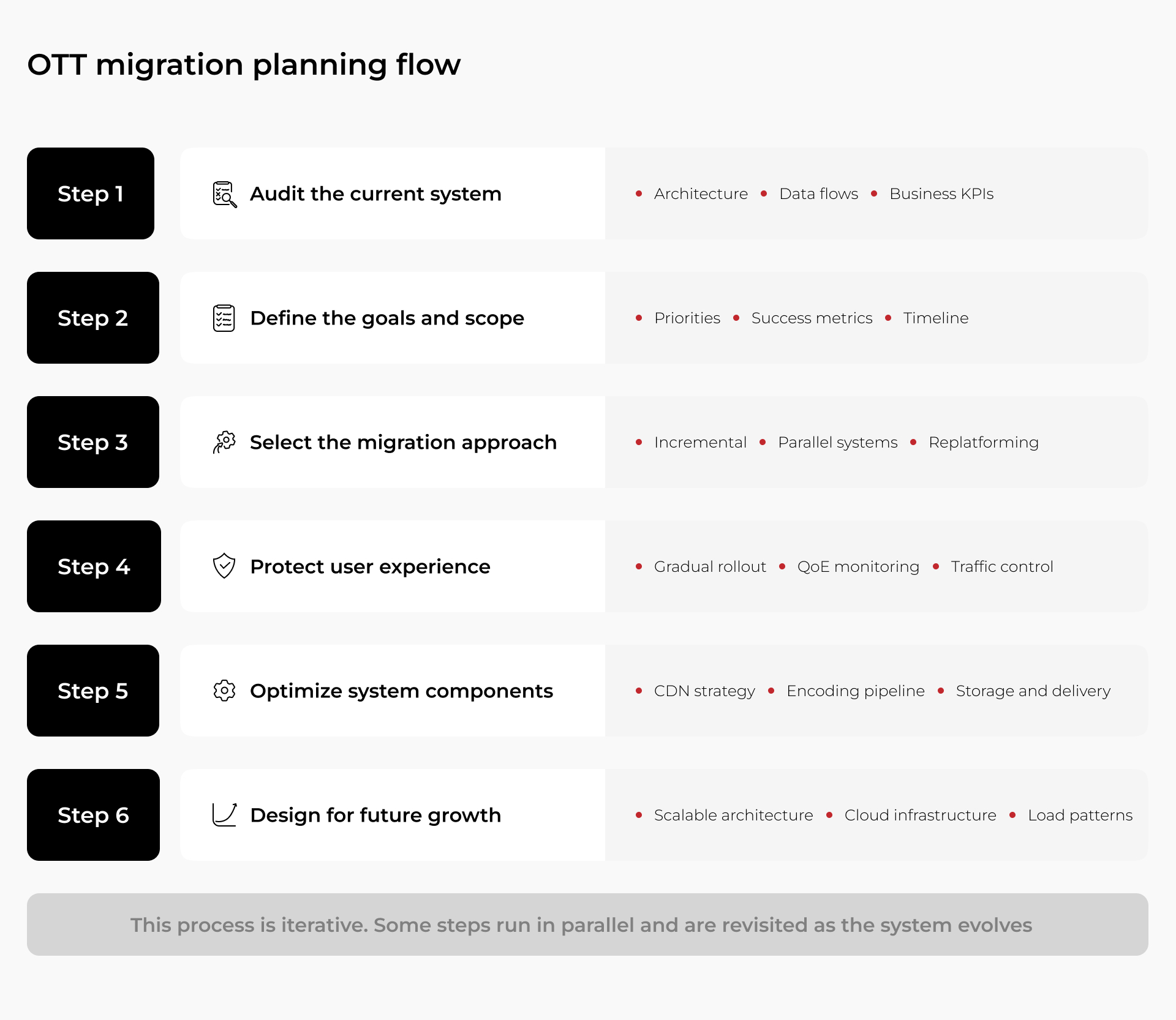
The first step is to establish a clear picture of the current system and its constraints. This includes delivery pipelines, infrastructure setup, data flows, and service dependencies. Bottlenecks often surface in encoding workflows, CDN configuration, and tightly coupled components that affect scalability.
The same stage includes a business view. Engagement, retention, monetization efficiency, and cost structure help determine which parts of the system require attention first. Migration priorities follow an expected impact on these metrics.
Migration requires a clear scope and sequencing. Teams define what will be migrated, in what order, and what outcome each step should deliver. This includes identifying critical components, setting milestones, and linking technical steps to business goals. A structured goals-and-timeline framework keeps the process measurable and easier to manage.
Migration can follow several paths depending on architecture, risk tolerance, OTT business models, and priorities. Teams may replace components step by step, run parallel systems and move users or content in controlled groups, or redesign larger parts of the platform and deploy them together.
Each option should support validation under real traffic and provide rollback options to keep the process observable and manageable at every stage.
User experience remains a key focus throughout the process. Even small disruptions affect engagement and retention.
Teams use gradual rollouts, traffic splitting, and continuous monitoring of QoE metrics. Canary releases and percentage-based traffic shifts help detect issues early. Streaming should remain stable from the user perspective during every stage of the transition.
Migration creates a window to improve how the platform operates. CDN strategy, encoding pipelines, storage management, and service orchestration can be reviewed and adjusted as part of the process. These decisions influence performance and cost structure and shape how the platform behaves under changing demand.
Architecture decisions made during migration define how the platform will scale over time. Modular design, service separation, and cloud-based infrastructure support growth and allow teams to adapt to changing demand.
Traffic patterns, seasonal spikes, and expansion plans should be taken into account when designing the target architecture to maintain stability as the platform grows.

A well-planned migration requires architectural expertise and a deep understanding of business models. Oxagile’s OTT app development services help design and execute migration strategies that keep platforms stable and ready for growth.
Once the migration approach is defined, the focus shifts to execution. At this point, the main challenge is coordinating changes across multiple system layers without disrupting the platform. Oxagile supports this process by combining architectural expertise with hands-on experience in OTT systems.
Migration plans are translated into a sequence of steps that can be validated under real traffic. Each stage is introduced gradually, with clear checkpoints and rollback options. The goal is to keep the process predictable and reduce the risk of unexpected behavior in production.

Before starting large-scale changes, the Oxagile team conducted a focused audit of an OTT platform with growing performance and cost challenges. The goal was to identify bottlenecks that limited scalability and affected overall efficiency.
The analysis highlighted issues in database performance and infrastructure usage. Based on these findings, the team introduced targeted optimizations that improved system stability and reduced operational overhead, creating a stronger foundation for further platform evolution.
Migration is executed under live conditions, where system behavior cannot be fully simulated. Gradual rollouts, traffic control, and continuous monitoring help detect issues early and keep user experience stable.
Instead of treating migration as a one-time transfer, Oxagile adjusts system architecture during execution. We improve service boundaries, refine data flows, and remove constraints that limit scalability.
Each decision is evaluated in terms of its effect on user experience, revenue, and operational efficiency to keep the migration focused on outcomes.
After rollout, the platform is monitored under real usage conditions. Post migration OTT platform performance is analyzed continuously, with adjustments introduced to improve stability, scalability, and cost efficiency.
Migration marks a shift in how the platform is built and how it supports the business. Architecture decisions, delivery performance, and system flexibility contribute to how efficiently the platform can grow.
A structured migration strategy brings clarity to this process. It defines scope, aligns technical changes with business priorities, and helps manage risk at each step. The result is a platform that handles load more predictably, supports faster product development, and maintains a stable user experience under changing conditions. With the right approach, migration becomes part of long-term OTT platform development and a foundation for future improvements.
If you’re evaluating your next steps or need support with migration planning and execution, you can count on Oxagile’s expert team. We’ve been doing this for over 20 years and will be glad to help.

The choice depends on the importance of system stability during the transition and the complexity of the current architecture. Platforms with high traffic or live content often prioritize gradual migration approaches to reduce risk, while smaller systems may allow for more consolidated changes. The key is to balance speed with control over user experience.
The main risk is losing consistency between systems. Even when data is successfully transferred, mismatches in metadata, user states, or billing logic can affect platform behavior. Careful validation and staged rollout let you make sure that users do not experience disruptions.
Yes, but it requires careful planning. Most modern OTT migration strategies rely on phased rollouts, parallel environments, and traffic splitting, which allows teams to introduce changes gradually and monitor system behavior under real conditions.
Prioritization is usually based on business impact. Components that affect user experience, revenue, or system stability are addressed first. Less critical parts can be migrated later without affecting overall platform performance.
Well-planned migrations include rollback mechanisms to maintain user continuity. If an issue appears, traffic can be redirected back to the previous version while the problem is resolved.
No. Most platforms move in stages, replacing or upgrading specific components over time. Such an approach keeps the system stable and makes it possible for teams to validate each step before moving further.

