




Project overview

Client

MAM platform serving media organizations

Challenge

Integrating a MAM platform into a content distributor’s media ecosystem amid legacy workflows, data migration constraints, and limited technical documentation

Oxagile’s role

System integrator and tech partner

The solution delivered

Oxagile became a trusted partner throughout the migration from Sony Navigator X to the client’s new MAM.

We took the time to understand the complexity of the media assets and metadata, designed a reliable migration strategy, and delivered a solution that maintained data integrity with no disruption to day-to-day operations.

Key expertise demonstrated

  • Enterprise MAM integration
  • Legacy modernization
  • Reverse engineering
  • XML processing
  • Media workflows
  • Data migration planning
  • Proof-of-concept development
  • Engineering consulting

The main goals we set out to achieve

Tasked with integrating a MAM platform into a complex media distribution ecosystem, we launched the project with a clear set of requirements that shaped our approach:

Seamlessly migrate the client’s media ecosystem from the legacy Sony Navigator MAM and preserve existing scripts and workflows
Integrate with the existing content processing and storage systems, including EVS, Sony Ci, AWS S3, DIVA, Vantage, Signiant, and others
Support high-volume media operations, managing a repository of 5–10 million media assets with low search latency and reliable performance
Enable live content to ingest from multiple simultaneous broadcast feeds delivered via satellite and Signiant
Integrate metadata workflows by parsing EVS-generated XML and incorporating metadata from third-party sports data providers
Support modern production workflows, including the transition from Avid-based editing to Adobe Premiere Pro environments
Provide scalable infrastructure by combining on-premises deployments and cloud bursting to accommodate peak workloads
Enhance content discoverability through improved search capabilities, metadata management, and AI-assisted content tagging

How we supported the software vendor

Tech consulting

Oxagile’s tech experts conducted technical discovery.

They investigated undocumented legacy systems, validated integration assumptions, analyzed complex dependencies, and reduced implementation risks through PoC activities and engineering assessments.

Migration planning

The team developed a migration strategy for transitioning from the legacy MAM environment.

They assessed existing workflows, reverse-engineered data mappings, identified migration risks, and defined an approach for modernizing the content management ecosystem.

System integration

We integrated the MAM platform into the customer’s enterprise media ecosystem.

The team achieved interoperability with legacy workflows, third-party media systems, and existing content processing pipelines to minimize business operation disruption.

Building the media ingest connector

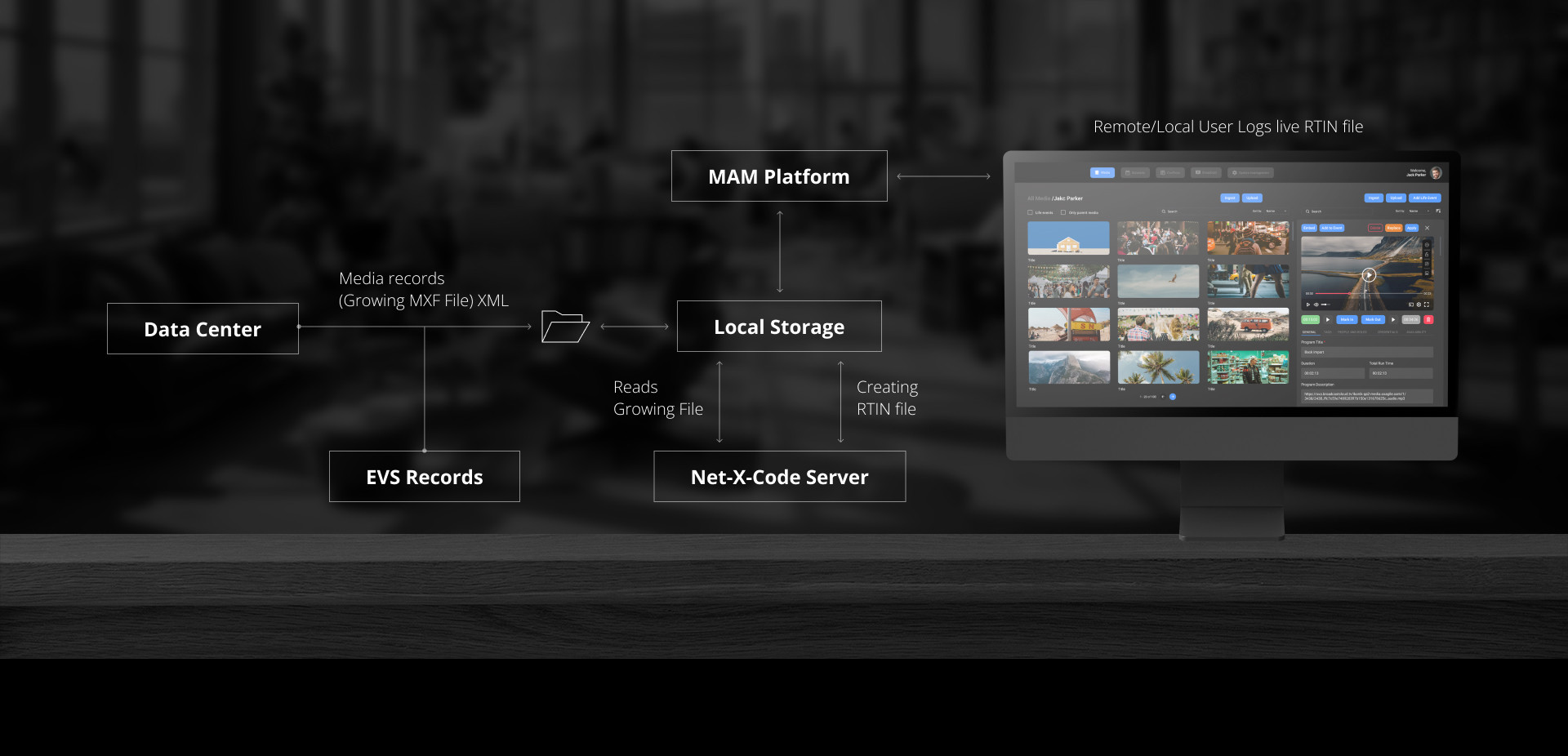
For a seamless media ingest, Oxagile developed an EVS connector that automated metadata transformation between the two systems.

The solution monitors an EVS watch folder, detects newly exported media and XML files, parses EVS metadata, and transforms it into the XML schema required by media distributor. The generated XML is placed into a dedicated watch folder, where the platform’s native ingestion service automatically imports the metadata and associated media into the MAM workflow.

As part of the implementation, Oxagile also developed an EVS XML parser to accurately extract and map metadata into the target MAM structure for compatibility with existing on-premises media workflows, supporting subsequent media processing, storage, and cloud distribution.
Designing a data migration strategy

We delivered a robust, low-risk data migration strategy for moving the client’s media assets to the target MAM platform without disrupting ongoing operations.

The solution follows an index-first approach: asset metadata, editorial structure, markers, and storage references are extracted from the legal system, transformed into the new data model, and loaded through REST APIs. Still, media remains in its original storage until access is required.

This allows legacy and new platforms to operate in parallel, preserves critical editorial context, minimizes migration risk, and provides a controlled path for restoring archived or offline content as needed.

Tackling ambiguous engineering challenges

EVS XML parser


Proprietary XML integration

Understand the EVS XML structure and deliver seamless compatibility with existing MAM workflows.

Solution: Analysis and validation

We analyzed the XML parser, investigated its integration with the MAM platform, and validated the implementation against real-world workflows.

Sony Navigator migration


Migrating a legacy platform

Migrate Sony Navigator despite missing documentation, unknown mappings, and legacy architecture.

Solution: Reverse engineering

We reverse-engineered the legacy system, investigated the underlying database, and validated migration assumptions through proof-of-concept testing. This approach helped us to uncover critical system knowledge and establish a reliable migration strategy.

Tech stack

.NET 8

ASP.NET MVC

ASP.NET Web API

Planning your MAM project?

If you're looking for expert support with data migration and media asset management integration, our team is here to help.

Talk to Oxagile