














This website uses cookies to help improve your user experience


If you are sizing up the payment gateway development cost, the first thing you should keep in mind is this: most companies don’t even need to build their own solution. It might just be an overkill.
For many businesses out there, integrating an existing payment provider like Stripe, PayPal, or Braintree is by far the fastest and most cost-effective route to accepting payments from customers. The advantages of a payment gateway integration are obvious: you don’t need to worry about infrastructure, compliance, or security, and can go live literally within a matter of days or weeks.
But there are situations where that approach just doesn’t fit the bill.
If you’re a large business processing high daily volumes of transactions, operating across multiple regions, and using complex, non-standard payment flows, the limitations of third-party providers may become frustratingly apparent very soon.
At this point, companies like yours start looking for a way to create a payment gateway precisely tailored to their specific business needs.
In the custom-built gateway scenario, expect the investment to be significant. A typical payment gateway development cost ranges from $50,000 to $300,000+, depending on the system’s complexity, security requirements, and the number of integrations under the hood.
Moreover, this range can expand very quickly. While basic implementation with limited functionality will be closer to the lower end, a full-scale, end-to-end payment gateway development project (that checks all the boxes, including PCI DSS compliance, robust fraud detection, and multi-currency support) can easily go well beyond the upper bracket.
Before committing to such an expensive initiative, it’s useful to understand what drives those costs and whether building a custom solution is truly the right move for you.
Key takeaways:
In the broad sense of the term, a payment gateway is a system that securely captures, encrypts, and transmits payment data from a customer to the payment processor and, subsequently, the issuing bank. The primary purpose of a payment gateway is to authorize or decline transactions automatically in real time.
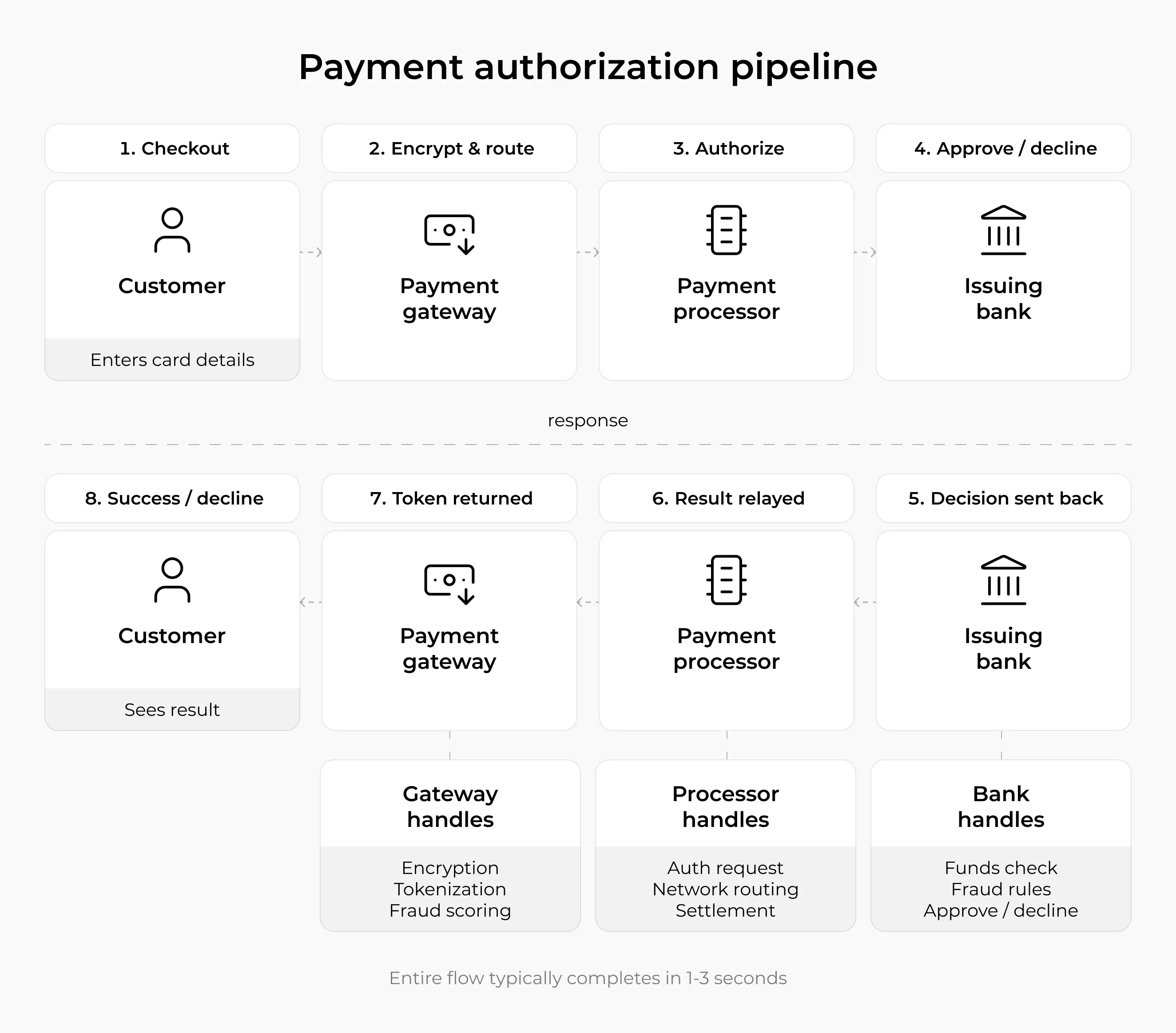
Think of it as a layer between your checkout workflow and the financial system that actually holds and moves the money.
However, modern gateways do much more than just pass data along and fetch responses. Depending on the complexity of a given system, they can also handle:
These extra capabilities are what turn a basic payment flow into a fully controlled payment pipeline. They play a major role in defining both the functional scope and the overall payment gateway development cost.
As we mentioned previously, not every business needs to build a payment gateway from the ground up. In fact, most fall into one of the categories below, each with dramatically different cost implications.
| Gateway type | Description | Cost range |
| Third-party integration | Basic payment integrations with minimal customizations based on the workflow and UI provided by services like Stripe or PayPal. | $5,000 —$20,000 |
| White-label gateway | Pre-built solutions customized to your brand’s design and workflows. You get more flexibility, yet without full ownership of the payment pipeline. | $20,000 —$80,000 |
| Custom payment gateway | A 100% proprietary system developed from scratch, fully adapted to your needs, infrastructure, and tech stack. | $50,000 —$300,000+ |
| Enterprise-grade gateway | A highly complex system built to withstand high loads. Supports order payments and features advanced routing, redundancy, and built-in compliance mechanisms. | $200,000 —$500,000+ |
In most cases, the decision on payment software development boils down to the level of control you want to have vs. the technical complexity you are willing to pay for.
If your primary goal is simply to set up a payment gateway quickly and start receiving payments, third-party providers are the best low-cost, low-risk option. But if payments are the backbone of your business, investing in payment gateway development can bring long-term advantages in flexibility, cost efficiency, and scalability (along with a stream of revenue that generic third-party providers simply can’t unlock).
The cost of payment gateway development isn’t defined by a single central feature or requirement. It depends on a combination of architectural decisions, the overall product scope, and long-term business goals.
At a high level, the biggest cost drivers fall into a few key categories.
The way you design the gateway has a direct impact on both initial and future costs.
A simple, minimally scoped system with little to no abstraction is the fastest to build. In contrast, modular solutions supporting multiple payment processors, extensibility, and enterprise-level fault tolerance call for significantly more engineering efforts. The bright side is remarkably higher flexibility as you grow your business.
Every payment gateway is built for a specific purpose.
In the most basic scenario, the gateway may only handle transaction authorization and settlement. More complex systems support features like recurring billing, split payments (instalments), internal wallets, payout flows (if you share revenue with third parties), and more. All of this adds extra layers of complexity to your payment gateway development project.
Security and compliance are a central theme for any project involving payments, and default expectations in this space are very high.
No matter if you minimize data exposure through tokenization or assume full responsibility for the PCI DSS scope, the level of compliance you aim for has a major effect on development practices and standards, infrastructure readiness, and ongoing monitoring and maintenance expenses.
The more your system is connected to the outside world and external systems, the more you have to spend on development, testing, and maintenance. This includes integrations with payment processors, banks, fraud-detection tools, and third-party services of any sort.
The payment experience isn’t just the final chord in the user’s journey across your website. It’s a conversion tool that ultimately defines whether people end up hitting that pay button.
Elegant, smooth, reversible checkout flows, proper localization, deep mobile optimization, and seamless UX take significant efforts to design and implement, especially if you’re shooting for higher approval rates or reduced churn in an existing system.
Building a payment solution that will withstand much higher transaction volumes in the future is not the same thing as accommodating your current bandwidth with a little extra just to be on the safe side.
If your custom payment gateway is reasonably expected to handle a much higher number of concurrent transactions, work across multiple regions, and remain up and running with no downtime during traffic surges, you may want to invest in a more robust infrastructure, monitoring tools, and failover mechanisms.
It’s not just about what you build, but also who builds it for you and how they do it.
In-house teams, specialized fintech software development vendors, and or a mix of both will all come with different price tags, team velocities, administrative overhead, and levels of domain expertise.

We can break down your options and give a practical estimate with the most time- and money-saving option to create a payment gateway from scratch or extend an existing setup based on your goals.
These are just a few factors affecting the development budget. In reality, payment gateway development costs can vary within a very broad range, spanning from relatively easy-to-grasp projects with a reasonably limited functional scope to extremely complex, multi-layered systems designed for ultimate stability, security, and scale.
As is often the case, precise estimates only become possible after the completion of a thorough analysis phase that involves detailed project discovery sessions with key stakeholders and product owners. And even then, complex payment systems may require PoC work halfway into the project to validate critical assumptions.
Where the budget actually goes depends on two things: the features you include and the architectural decisions behind them.
Each additional gateway capability increases both the development scope and long-term maintenance costs, but not all features carry the same weight.
| Feature subset | Function and scope | Cost impact |
| Core payment processing | This is the foundation of the system (includes authorization, settlement, and error handling flows). This is where most backend logic and reliability requirements are concentrated. | High |
| Tokenization and encryption | Protects sensitive data and reduces your PCI scope. Adds complexity to data handling, storage, and compliance alignment. | Medium/high |
| Multi-currency and localization | The subsystem that handles currencies, formats, and regional nuances. Introduces testing edge cases and conversion logic. | Medium/high |
| Recurring billing | Includes subscriptions, retries, and billing cycles. Based on state management and significantly more backend logic. | Medium/high |
| Fraud detection subsystems | Rule-based systems or third-party integrations. It’s relatively quick to integrate, but requires ongoing updates, optimization, and monitoring. | Medium |
| Admin tools and reporting | Includes dashboards, analytics, and reconciliation tools. Less critical compared to core processing, but still requires full-stack development. | Medium |
In most payment integration or development projects, the core processing layer and payment logic tend to carry the heaviest engineering load, while advanced security and multi-currency support start gaining weight only when you scale up your geographic and compliance scope.
There is no rule of thumb when it comes to cost distribution in payment gateway development projects, but the collective experience of multiple fintech implementations allows us to outline a typical breakdown of where time and budget tend to go.
| Stage | Stage scope | Share of overall cost |
| Discovery | Requirements and architecture design | 10 — 15% |
| Infrastructure configuration | Cloud setup, development environments, DevOps processes | 10 — 20% |
| Core development | Payment logic and APIs | 30 — 40% |
| Integrations | Processors and external services | 10 — 20% |
| Security | Encryption and compliance layers | 10 — 15% |
| Testing | Functional and security testing | 10 — 15% |
| Deployment and support | Release activities and ongoing monitoring | 5 — 10% |
In most cases, the bulk of the budget ends up in infrastructure, core logic, integrations, and security.
In case you’re planning to create a payment gateway, setting realistic scope boundaries, managing expectations, and controlling scope from the get-go are the most effective ways to keep costs at bay. Here are a few tips to optimize your payment gateway development budget so you don’t overplan and keep the budget in check:

Finally, remember: even seemingly small architectural decisions made early in the project can have a disproportionate impact (both positive and negative) on the total cost later down the road.
Your investment in developing a payment gateway of your own should be based on how much control, flexibility, and scalability your business needs today and will objectively need in the future.
For some companies, a lightweight integration is more than enough to set up a payment gateway quickly to start receiving money. For others, building a custom solution will be more of a strategic infrastructural investment capable of expanding margins, generating more revenue, improving approval rates, and supporting more sophisticated business models going forward.
Overplanning and overbuilding lead to unnecessary spending, whereas underbuilding can hamper future growth. As life has it, the optimal point is somewhere in the middle.
Figuring out how to set up a payment gateway for the first time or planning to build a custom solution from scratch starts with clarity on goals and execution.
Reach out to us to learn about the optimal way of addressing your challenges and get your project estimated by our experts.

The average payment gateway development cost in 2026 ranges from $50,000 to $300,000+, depending on complexity, security, and integration scope.
Create a payment gateway and go custom only if you need full control over payment flows, lower transaction fees at scale, or support for complex, multi-region operations. Otherwise, providers are usually sufficient.
The biggest cost drivers are:
White-label solutions are cheaper upfront ($20K–$80K), while custom gateways start at $50K+. However, custom solutions can reduce fees and offer more control at scale.
Timelines depend on features, integrations, and compliance scope, but:
Yes. Common hidden costs include compliance audits, infrastructure scaling, third-party service fees, and ongoing security updates.
Maintenance typically costs 15–25% of the initial build per year, covering infrastructure, monitoring, updates, and compliance.

