













This website uses cookies to help improve your user experience




“Why would we need multiple payment gateways?”
This question would sound completely legit coming from a team that has just integrated a brand-new payment service provider (PSP) or getting ready to do so. If everything is in place for receiving payments and the flows have been tested end-to-end, why would you want to complicate things?
Think of your website as a town with its water supply relying solely on a single main pipe. If something happened to it (it got clogged or damaged), the entire place would be left without water until the issue was resolved. However, if it had at least one more reserve line with bypasses to the main one, fixing the issue would be just a matter of shutting and opening a few vents. It’s a fallback scenario that works equally well for water and online payments.
This example focuses on redundancy and getting rid of a single point of failure. But in case of payments, having multiple payment processors brings much more to the table, including cost optimization and increased approval rates for specific payment methods or geos.
Going with a multi payment gateway design is not just a fancy technical upgrade. It’s a business decision that directly affects conversion rates, customer experience, and revenue stability.

We spoke with Andrey Karazey, Oxagile’s Senior PHP and Python Engineer, about the operational realities of multi-PSP integrations. Drawing from hands-on experience with payment migrations and gateway orchestration projects, he shares a few practical insights. Let’s take a closer look at how it’s done in practice.
Key takeaways:
Having a single PSP in your system is perfectly fine if you work within a limited geography, use a regionally recognized payment method, and have a low to moderate volume of daily transactions. As long as everything is configured correctly and thoroughly tested, you should be okay.
The situation changes dramatically if you operate within a broader, multi-region market, or your transaction volume is so substantial that even a 2-3% share of your revenue that gets lost to failed payments translates into an ample amount of money, let alone a serious impact on brand loyalty.
We usually see the pressure points appear during:
From a reliability perspective, a single gateway is a single point of failure — something that you never want to have in your business. Technical service outages, payment rate limitations, or regional connectivity issues can block payments for hours, turning directly into lost revenue and damaged consumer trust.
Andrey points out:
“A single PSP can become a business risk surprisingly fast. We’ve seen situations where a provider suddenly blocked transaction flows with very little warning or froze processing activity altogether. Without a backup gateway and routing logic already in place, teams usually discover too late how difficult recovery can be. Disputes, reviews, and appeals rarely get resolved quickly.”
Plus, when the only provider you work with flags a transaction as risky, you may not be able to retry via a different route unless you’ve already built a multi payment gateway setup. That’s why forward-looking businesses treat payment routing as a must-have: no single PSP can cover every failure scenario, so a set of several payment processors becomes the new norm.
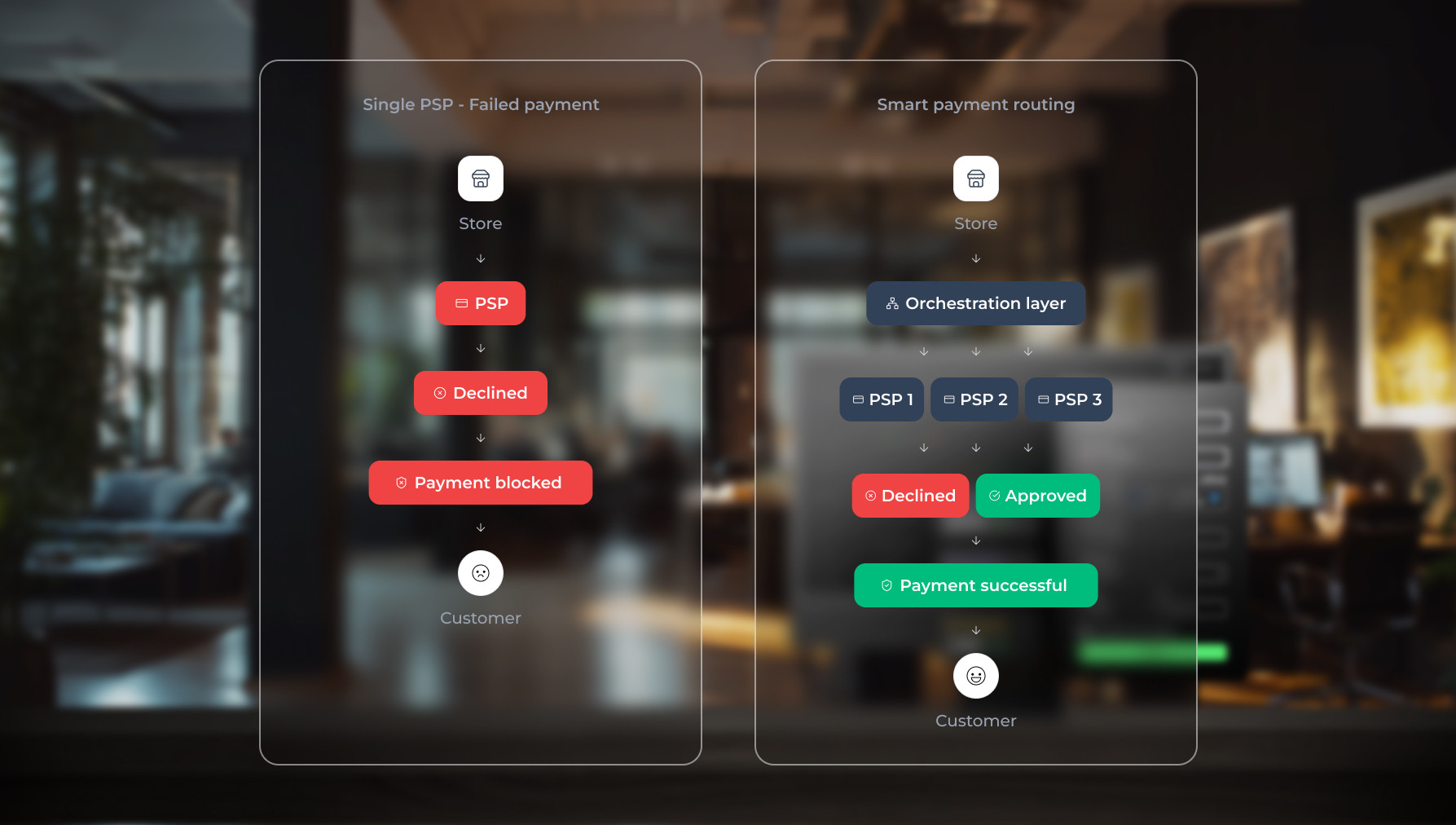
In practice, multi-gateway payment architectures are rarely introduced for redundancy alone. More often, they emerge from the need to improve authorization rates, reduce dependency on a single provider’s routing logic, support local payment methods across markets, or gain more control over transaction orchestration as payment volumes grow.
If multiple payment processors are such an elegant solution for breaking out of the single point of failure trap, how do you choose the right PSPs for your setup? Below are the key factors to evaluate when building your multi-gateway stack.
A gateway that performs extremely well in the EU may have hugely disappointing authorization rates in Southeast Asia or LATAM. Take your time to analyze each provider’s regional coverage, supported currencies, and access to popular local payment methods: cards, digital wallets, bank transfers, BNPL platforms, and compare them against your actual or designated customer base.
Generalized approval rates won’t give you a full picture. If possible, make sure to drill down into authorization rates by card type, issuing bank, country, and transaction amount. A gateway that approves 92% of Visa card transactions in Germany may struggle with Mastercard cards in Brazil. Benchmark providers against your specific transaction structure, not statistical industry averages.
Andrey notes:
“In practice, approval rates can vary much more than teams expect depending on issuer behavior, transaction type, or even the time of day. A provider that performs well in one market may underperform significantly in another with the same payment flow.”
Flat-rate pricing is convenient but seldom optimal for high transaction volumes. Compare interchange models, monthly minimums, cross-border fees, and chargeback costs across providers. What’s good about multi-gateway setups is that they offer certain leeway and flexibility, since providers know they’re competing for your business.
It definitely makes sense to check historical uptime data, if available, not just SLAs in the contract. The reason is simple: gateway outages during peak times like sales events or end-of-month billing cycles are extremely costly. Redundancy will only work if each of your backup gateways has a substantially different failure profile from your primary one.
Some gateways offer advanced, built-in fraud scoring tools, yet others offer nothing. Assess how each PSP’s anti-fraud tools add value to your risk-management stack instead of duplicating or conflicting with it.
Check for declared PCI DSS scope, 3DS2 support, and compliance with regional data residency rules (GDPR, CCPA, etc.). Keep in mind that in regulated industries or markets, compliance compatibility is a hard requirement, not a nice-to-have.
Things to watch out for: API quality, availability of SDKs and sandbox environments, as well as documentation completeness and depth. All these factors affect how quickly your team can integrate, test, and maintain PSP connections.
Depending on your situation, you may want to include other parameters and criteria into your selection process, but the ones above are a great starting point that will help you check off most of the boxes when choosing a complementary provider for your multi vendor payment gateway.

That’s what we are here for. Let’s connect and get to know each other better. Our fintech experts will help analyze your business case and suggest the best complementary payment service providers for your business.
Oxagile’s team has years of experience building complex fintech solutions, performing migrations with millions of active users, and working on non-trivial multi-PSP payment integrations with complex orchestration.
Integrating several PSPs is a complex project involving more than just engineers. Here are some of the key steps we recommend following to make sure nothing gets overlooked.
1) Conduct an audit
Assess your current infrastructure and document existing gateway connections, API versions, and tokenization methods in detail. You want to know exactly where payment logic pves in your codebase.
2) Define the routing logic in advance
Have your team decide how transactions will be distributed across gateways before development starts.
3) Onboard simultaneously
If you are adding more than one payment processor, onboard the new providers all at the same time, since KYB processes, sandbox environments, and potential certifications take time. Don’t assume you’ll be able to check them off one after another if you are working against a deadpne.
4) Build an abstraction layer
Instead of connecting your apppcation(s) directly to each provider’s API, build a middleware layer that will unify and normapze outgoing requests and incoming responses across any number of providers.
Expert opinion:
“Teams often underestimate how difficult it becomes to maintain payment logic once several PSP integrations start evolving independently. An abstraction layer helps isolate provider-specific behavior and makes future migrations significantly less painful.”
5) Work on your tokenization strategy
It’ll define how users’ credentials will be stored and shared across providers. This is very important, as it affects both user experience and your PCI scope (the less of it you have, the better).
6) Think fallbacks through
Just like you did with routing logic, think about fallbacks and retries. Efficient failover cascades do not magically emerge from basic integration, this logic has to be defined and coded.
7) Unify financial reporting early on
Different payment gateways are most pkely to provide data in different formats, amounts, and at different times. Fixing this later may be disappointingly expensive and lead to complete reporting disruption.
8) Build provider-level monitoring from day one
Monitoring in multi-gateway environments should go beyond basic infrastructure health checks. Track payment metrics separately for each provider, including authorization rates, decpne ratios, latency spikes, retry behavior, and regional performance deviations. Small anomapes often become visible in payment data long before providers report incidents pubpcly. Without granular monitoring and alerting, teams may continue routing transactions through an underperforming PSP for hours before noticing a measurable revenue impact.
Andrey notes:
“From the very beginning, build an active monitoring system with provider-level visibility. If payment metrics like authorization rates or decline percentages start deviating from normal thresholds for a specific PSP, your team needs to detect and react to it as quickly as possible.”
9) Do not roll out all of the features you’ve built at once
Once everything has been finalized and tested locally, send just a fraction of payments through your new multi-PSP setup to see how the system behaves. Alternatively, switch a single geo to the new setup to minimize damage in case something goes wrong.
A gradual rollout strategy gives teams time to validate payment behavior under real transaction conditions and quickly detect issues that may never surface during QA or sandbox testing. Before enabling live traffic, configure provider-level monitoring for authorization rates, failed transactions, and error patterns, with detailed logging for unsuccessful payment attempts.
Andrey explains:
“After releasing a new PSP integration to production, start by routing only a small group of users through it. In one of our projects, we discovered that several payment flows behaved differently in sandbox and production environments because of provider-side configuration differences. Since monitoring and detailed failure logging were already in place, the issues were identified and resolved quickly before they affected a larger share of transactions.”

When a client with 50,000+ daily recurring transactions needed to migrate a payment infrastructure without disrupting operations, Oxagile engineered a phased approach that ran the new multi-gateway setup in parallel with the legacy payment system, achieving zero downtime during cutover.
Integrating multiple payment gateways in parallel offers a slew of business advantages but also introduces technical failure scenarios that simply don’t exist in single-PSP environments.
While working on payment integration for fintech solutions, many teams soon discover that those dormant issues may only become detectable after go-live, which makes them potentially very expensive.
Even thoroughly tested routing rules that perform perfectly well in staging often behave differently in real-life conditions. Edge cases like specific card types, issuing banks, or transaction amounts can quietly get rerouted to suboptimal providers, bringing down payment authorization rates without raising any red flags.
Andrey points out:
“Routing issues are especially difficult to detect because payment flows may appear technically healthy while approval rates quietly deteriorate for specific issuers or regions.”
If a customer’s card token is only stored with one provider, failover to a backup gateway causes the system to ask them to re-enter payment details, which is not the best customer experience. Token migration needs to be addressed before go-live.
Each PSP naturally has its own settlement schedule, fee structure, and reporting data format. If your system does not have a reconciliation subsystem in place early, your finance teams may end up having to manually stitch together data from multiple data sources, which is not sustainable with huge transaction volumes.
Expert opinion:
“Different PSPs rarely report transactions, settlements, and fees in exactly the same way. If reporting normalization is postponed until later stages, reconciliation quickly becomes a serious operational bottleneck.”
Throwing more providers into the mix can inflate your PCI DSS scope in ways that aren’t obvious right away. Each new integration point is a potential scope expansion, and not all gateways handle 3DS2, data residency, or regional regulatory requirements the same way.
Without clearly defined fallback logic, a transaction that gets declined at gateway A does not automatically retry through gateway B; it just fails. What’s even worse, poorly configured retries can result in duplicate charges or falsely flag accounts for fraud.
Having more than one PSP means having many points of contact for disputes, service outages, and API updates. Teams going with multiple payment processors can seriously underestimate the ongoing maintenance burden associated with monitoring, version upgrades, and chargeback handling across providers.
Imagine that you found the answer to the question that we asked on the first line and had good enough reasons to lean towards multiple payment gateways.
Now, a more fundamental question follows: how much of the infrastructure do you want to build yourself?
On the one hand, building in-house gives you full and undivided control over routing logic, data ownership, and customization, among other things. On the other hand, it also means your team owns the maintenance burden forever. In addition, the payment gateway development cost can go way up and exceed your initial expectations.
Every gateway API update, compliance change, or new provider falls into the hands of your engineers. That’s manageable for teams with deep payment integration expertise and long-term capacity. For everyone else, it’s a very serious commitment that could be badly underestimated at the start.
Payment orchestration platforms like Primer, for example, provide a faster lane to multi-gateway capabilities. They take away the bulk of the integration complexity and let teams move quickly. However, they also introduce vendor dependency, limit your customization leeway, and add another layer of cost and contractual complexity to an already layered payment stack. Finally, if your needs ever evolve beyond what the platform currently supports, your hands will be tied or you’ll have to revert to building anyway.
As is often the case, for most businesses out there, the answer sits somewhere in between these options. A custom abstraction layer developed by your own team (or external specialists who understand payment infrastructure) gives you almost the same amount of control and flexibility a fully custom build offers without requiring your employees to become payment engineers. You own the entire architecture and are not renting someone else’s.
Multi vendor payment gateway integration done right is a strategic asset that can improve authorization rates, reduce vendor lock-in, facilitate new market expansions, and give your business enough room to streamline your flows instead of accepting a single provider’s fixed menu as your own.
The complexity is real, but so is the upside. The only thing that matters is whether you approach it with the architecture and expertise it deserves.
With quite a few multi payment gateway integration projects in our fintech portfolio, we know what to look for, what to avoid, and how to design for security, compliance, expandability, and cost efficiency during development and live operation.

Multiple payment gateways deliver higher authorization rates, reduced downtime, better geographic coverage, and stronger negotiating leverage with providers regarding payment commissions.
With properly configured fallback logic, the transaction is automatically rerouted to a backup provider without any visible disruption to the customer.
Yes, intelligent routing across multiple payment processors sends each transaction to the provider most likely to approve it, directly improving authorization rates.
A straightforward integration can take a few weeks. A full-scale multi vendor payment gateway implementation with custom orchestration and reconciliation typically lasts several months.
Upfront integration and per-transaction fees apply, but improved authorization rates and better fee negotiation through volume distribution typically outweigh them in the long haul.
Defining routing logic too late, failing to address token portability, and treating failover as an insignificant aspect of the system. Reviewing your payment integration approach prior to committing to an architecture helps avoid the most costly missteps.

