











This website uses cookies to help improve your user experience


Streaming audiences increasingly experience platforms through the TV screen. Smart TVs are now present in more than 80% of U.S. households1, while the global Smart TV market is projected to surpass $670 billion by 20332.
Long-form viewing sessions, premium subscriptions, ad-supported streaming, and family viewing habits continue shifting toward connected TV ecosystems. For many OTT providers, Smart TV applications shape the overall perception of the product more directly than mobile or desktop experiences.
Viewer expectations across Smart TV platforms continue rising alongside that shift. Fast navigation, stable playback, responsive interfaces, and consistent performance across Samsung Tizen, LG webOS, Android TV, Roku, Fire TV, and Apple tvOS have become baseline requirements, not just differentiators. At the same time, fragmentation across operating systems, devices, hardware capabilities, and certification standards keeps Smart TV engineering highly specialized.
Companies leading the market combine native platform expertise, deep OTT and streaming knowledge, scalable architecture decisions, and mature QA practices built around real-device testing for modern Smart TV app development services.
The list of vendors below is selected based on visible Smart TV and OTT engineering expertise, platform coverage, connected TV delivery experience, and practical involvement in multi-platform streaming ecosystems. Instead of focusing on generic software vendors, we aimed at highlighting several of the best smart TV app development companies working in OTT and connected TV delivery today.
Key takeaways:
Choosing a Smart TV vendor often looks deceptively straightforward at the beginning of a project. Many software companies list connected TV development among their services, show polished interfaces in portfolios, and claim support for every major platform. Production delivery reveals a far more complicated reality.
Smart TV ecosystems operate under very different technical conditions from mobile or traditional web environments. Platform-specific certification rules, playback behavior, hardware limitations, memory constraints, remote-control navigation logic, and many other Smart TV app development challenges create separate engineering requirements across ecosystems.
For OTT providers, those differences directly affect release timelines, playback stability, QA complexity, scalability, long-term maintenance costs, and overall Smart TV app development cost. Teams without deep platform-specific expertise often encounter critical issues late in delivery: during certification, large-scale testing, or post-launch scaling.
So what should you look for in a Smart TV development partner? As each Smart TV platform introduces its own engineering challenges, development workflows, and optimization requirements, understanding those differences becomes one of the clearest indicators of whether a vendor truly operates within connected TV ecosystems or simply offers Smart TV development as an adjacent service.
Tizen places heavy pressure on memory management, playback optimization, and interface responsiveness across different TV generations. Lower-end Samsung devices expose performance bottlenecks quickly in content-heavy OTT products, especially during navigation-heavy flows or long viewing sessions.
Experienced teams building Samsung Tizen applications account for player behavior, application lifecycle handling, remote-control UX logic, and certification preparation from the earliest delivery stages.
LG webOS ecosystems revolve around a very different interaction model shaped around Magic Remote navigation and pointer-driven UX. Interface patterns copied directly from mobile environments often create awkward navigation behavior on TV screens viewed from a distance.
Production-ready LG webOS app development requires careful alignment with certification standards, playback consistency requirements, and interface responsiveness across device generations.
Android TV ecosystems provide broad device coverage across global markets, though hardware fragmentation creates major differences in playback behavior, performance stability, and application responsiveness between manufacturers and device tiers.
Teams working on scalable Android TV app development rely on extensive device testing, playback profiling, and optimization workflows across multiple hardware environments.
Fire TV introduces additional adaptation challenges across fragmented Android-based hardware ecosystems. Playback consistency, performance optimization, and device-level QA become especially important across varying Fire TV device generations and hardware tiers.
Teams working on scalable Fire TV app development usually account for ecosystem fragmentation, playback optimization, and platform-specific integration requirements early in delivery planning.
Roku ecosystems rely on highly platform-specific development centered around BrightScript and SceneGraph. Playback behavior, UI responsiveness, memory handling, and certification preparation all require platform-level expertise that differs significantly from Android-based Smart TVs.
Streaming services targeting North American audiences often prioritize Roku app development because of its strong connected TV market presence across the region.
Platforms such as Vidaa, Titan OS, and Vega OS add another layer of fragmentation for OTT providers expanding across international markets. Smaller developer ecosystems, evolving certification processes, and limited tooling maturity create additional delivery complexity compared to larger Smart TVs.
Smart TV delivery challenges become much easier to evaluate once platform complexity enters the picture. Vendors with deep connected TV expertise usually expose their engineering maturity very differently from companies approaching Smart TV development as an additional service line.
Some signals become visible immediately during technical discussions, architecture planning, delivery scoping, or platform conversations. Others surface through QA methodology, certification readiness, playback expertise, and the level of detail teams provide when discussing production environments.
The comparison below highlights several practical indicators that help distinguish experienced Smart TV engineering vendors from more generic software development providers.
| Evaluation area | Signals of generic vendors | Signals of experienced Smart TV companies |
| Platform coverage | Lists many platforms without specifics | Explains platform-specific delivery challenges and workflows |
| OTT expertise | Focuses mostly on UI and features | Discusses playback, DRM, ABR, monetization, and streaming architecture |
| Device testing | Relies heavily on emulators | Uses real-device QA across multiple hardware environments |
| Certification | Mentions certification in general terms | Explains release pipelines, approval workflows, and platform requirements |
| Architecture | Uses one delivery approach everywhere | Adapts architecture to ecosystem complexity and scaling goals |
| Post-launch support | Focuses mainly on launch delivery | Plans for long-term ecosystem maintenance and platform evolution |

Oxagile delivers cross-platform Smart TV applications backed by 20+ years of video streaming expertise, senior-level engineering teams, and hands-on experience across Tizen, webOS, Roku, Android TV, Fire TV, Apple tvOS, and emerging TV ecosystems. Real-device QA, scalable OTT architecture, and production-grade playback optimization remain central to every delivery stage.
The following Smart TV engineering companies were selected based on visible Smart TV and OTT engineering expertise, platform coverage, connected TV delivery experience, streaming specialization, and practical involvement in multi-platform OTT ecosystems. Instead of focusing on generic software vendors, this list prioritizes teams with established experience across Smart TV, CTV, and video streaming environments.
Best for: Large-scale OTT and Smart TV ecosystems with complex multi-platform delivery requirements
Strongest angle: 20+ years in video streaming, deep OTT architecture expertise, broad Smart TV platform coverage, senior-heavy engineering teams, real-device QA
Potential fit consideration: Strongest alignment with companies looking for long-term OTT ecosystem expertise rather than lightweight MVP-only delivery
Oxagile stands out as one of the strongest engineering-focused vendors in the Smart TV and OTT space, particularly for streaming platforms operating across fragmented connected TV ecosystems. More than two decades of work in video streaming shaped the company’s approach to Smart TV delivery around playback stability, scalability, architecture resilience, and long-term platform support.
Another major differentiator comes from Oxagile’s React-based cross-platform delivery approach, where core application logic and UI foundations are shared across Smart TV ecosystems while platform-specific optimization remains tailored for each. That structure allows OTT teams to scale across additional platforms faster without rebuilding the entire application architecture from scratch. Platform adaptation, playback optimization, and the practical principles behind successful Smart TV app development remain embedded into development processes across fragmented connected TV ecosystems.
The engineering depth behind those projects also becomes visible in operational areas that many vendors barely discuss publicly. Oxagile emphasizes:
The company’s Smart TV expertise extends beyond pure development delivery into broader OTT ecosystem consulting. Teams work across backend streaming infrastructure, multiscreen platform architecture, playback optimization, content delivery workflows, advertising integrations, and long-term scaling strategy for media products operating across multiple devices.
Oxagile also maintains strong visibility inside the streaming and connected TV industry itself through active participation in major ecosystem events, including NAB Show, IBC, StreamTV Show, and other media technology conferences focused on OTT, broadcasting, monetization, and Smart TV platform trends.
Those searching for a scalable Smart TV app development company with deep OTT engineering expertise, broad platform coverage, and mature delivery processes will likely find Oxagile particularly well positioned for large-scale streaming.
Cut multi-platform development costs with a team that has spent 20+ years building for video.
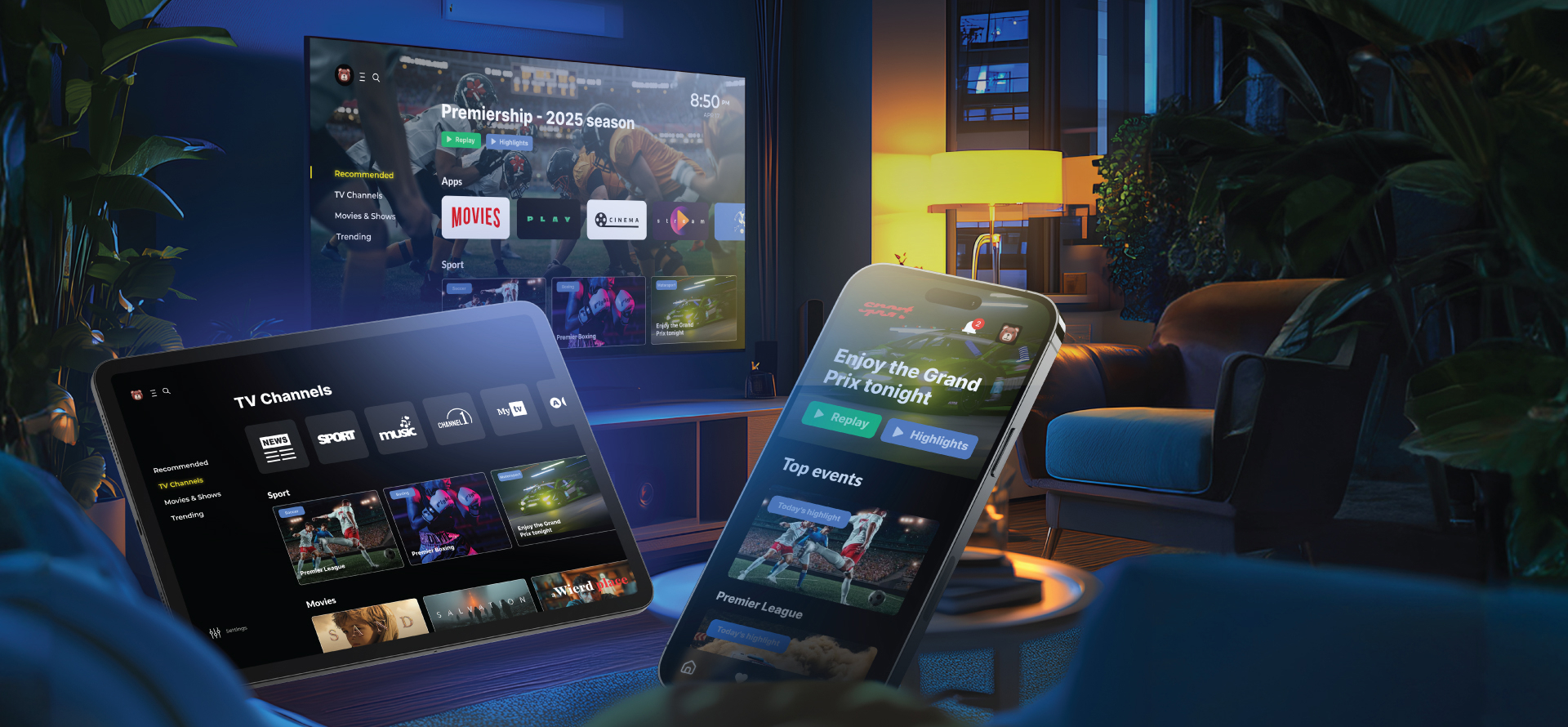
One of Oxagile’s OTT projects focused on building a modular streaming ecosystem designed for long-term Smart TV scalability and multiscreen expansion across connected TV platforms. The delivery included:
Best for: Broadcasters and OTT providers building multiscreen streaming ecosystems
Strongest angle: Long-standing OTT specialization, broad connected TV coverage, strong multiscreen delivery focus
Potential fit consideration: Smaller engineering scale compared to larger enterprise-focused Smart TV vendors
Mautilus built a strong reputation around multiscreen OTT delivery long before Smart TV development became a crowded service category. The company focuses on connected TV ecosystems, media applications, and video platform engineering, giving it a noticeably more specialized positioning than many broader software vendors entering the Smart TV market.
A large part of Mautilus’ delivery portfolio revolves around OTT applications distributed across Samsung Tizen, LG webOS, Android TV, Apple tvOS, Roku, Fire TV, and HbbTV ecosystems. The company also demonstrates visible experience in operator and broadcaster environments where platform consistency, playback reliability, and multiscreen synchronization play a major role in product delivery.
Another notable strength lies in ecosystem breadth. Alongside frontend Smart TV applications, Mautilus works with video platform integrations, streaming workflows, content distribution, and OTT-focused product ecosystems that extend across mobile, TV, and web experiences.
The company appears particularly well positioned for broadcasters, media providers, and streaming businesses looking for a vendor with visible multiscreen OTT specialization and long-term Smart TV delivery experience.
Best for: Telecom operators, broadcasters, and enterprise OTT ecosystems
Strongest angle: Connected TV UX architecture, operator-focused Smart TV delivery, multiscreen ecosystem support
Potential fit consideration: Strongest alignment with large ecosystem deployments, not smaller standalone OTT applications
3SS works across Smart TV engineering, connected TV UX, and operator ecosystems. The company is known for projects involving telecom operators, broadcasters, and media platforms building large connected TV products across European and international markets.
Its delivery includes projects across major Smart TV, connected TV ecosystems, and pay TV platforms. Long-term platform maintenance, interface consistency across devices, and TV-oriented navigation architecture play a major role in many of the company’s projects.
A noticeable part of 3SS’s approach centers around TV-first user experience design. Content discovery flows, remote-control interaction logic, multiscreen continuity, and interface orchestration receive significant attention in products designed for large viewing audiences and complex device ecosystems.
3SS aligns well with telecom operators, broadcasters, and enterprise streaming platforms looking for connected TV ecosystem development across multiple Smart TVs.
Best for: Broadcasters, HbbTV ecosystems, and hybrid TV platforms
Strongest angle: Broadcast-focused Smart TV delivery, HbbTV expertise, connected TV integration experience
Potential fit consideration: Main expertise centers around broadcaster and hybrid TV ecosystems with a strong European market focus
Sofia Digital built its reputation around broadcast technology, HbbTV ecosystems, and connected TV delivery for media companies operating across European markets. The company works in areas where traditional broadcasting infrastructure intersects with modern OTT distribution, creating a specialization profile centered around broadcasters, hybrid TV environments, and multiscreen media ecosystems.
The company’s Smart TV work spans Samsung Tizen, LG webOS, Android TV, HbbTV, and multiscreen media connected to broadcasters and TV operators. Projects often involve platform adaptation across regional ecosystems, certification alignment, and integration with broadcast-oriented delivery infrastructure.
Sofia Digital also demonstrates strong experience in hybrid TV environments where linear broadcasting, OTT streaming, interactive TV services, and multiscreen experiences operate inside the same product ecosystem. That combination requires close attention to playback synchronization, device compatibility, and TV-specific interface behavior across fragmented hardware.
The company fits well for broadcasters, media providers, and hybrid TV platforms looking for Smart TV expertise connected to broadcast and HbbTV ecosystems.
Best for: Media companies, OTT providers, and multiscreen streaming ecosystems
Strongest angle: Connected TV delivery combined with broader media engineering expertise
Potential fit consideration: Best aligned with large media ecosystems requiring ongoing platform support
Spyrosoft BSG operates across media engineering, connected TV delivery, and OTT platform development for broadcasters, telecom providers, and streaming businesses. The company combines Smart TV application delivery with broader media technology expertise tied to video distribution, multiscreen ecosystems, and platform operations.
Its Smart TV portfolio includes Fire TV, Roku, Android TV deployments, and connected TVs linked to larger OTT and pay TV ecosystems. Projects often involve multiscreen synchronization, playback optimization, platform integration, and long-term maintenance across distributed device environments.
The company also places visible emphasis on operational continuity and ecosystem scalability. Media workflows, backend integrations, analytics support, and platform evolution appear closely connected to its Smart TV delivery approach, especially in products expected to scale across multiple regions and device categories.
Spyrosoft BSG aligns well with media companies and streaming platforms looking for Smart TV expertise combined with broader OTT ecosystem engineering capabilities.
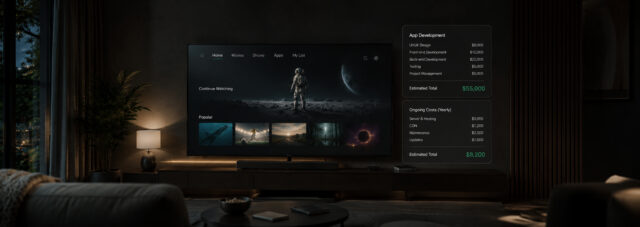
Use Oxagile’s OTT calculator to estimate delivery scope across many platforms in just a few clicks.
Smart TV development vendors usually don’t operate with the same delivery model, platform focus, or ecosystem expertise. Some teams specialize in broadcaster and HbbTVs, others concentrate on operator ecosystems, multiscreen OTT delivery, or connected TV UX architecture. Project requirements usually determine which type of vendor becomes the strongest fit.
The companies included in this list approach Smart TV engineering from different angles, though all of them demonstrate visible experience across connected TV and OTTs. Choosing the right partner depends heavily on platform scope, ecosystem complexity, long-term scaling plans, and the operational demands surrounding the product after launch.
Every streaming platform comes with a different mix of platform requirements, scaling goals, playback challenges, and ecosystem constraints. If you’d like to discuss your project in more detail, Oxagile’s team can help evaluate your Smart TV delivery needs and explore the most suitable technical approach for your product.
1. Smart TV Penetration Yet to Plateau — Marketing Charts
2. Smart TV Market Size & Trends Report — Grand View Research
Smart TV development costs depend heavily on platform scope, OTT architecture complexity, playback requirements, QA coverage, and the number of ecosystems involved in delivery. Products targeting Tizen, webOS, Android TV, Roku, Fire TV, and additional Smart TV environments usually require platform-specific optimization, certification preparation, and real-device testing workflows that directly affect delivery effort and timelines.
Cross-platform engineering approaches can help reduce those costs significantly when core application logic and UI foundations are shared across ecosystems. Vendors using architecture models similar to Oxagile’s React-based Smart TV delivery approach can usually scale across additional platforms faster, reducing duplicated engineering effort.
Most large OTT products use a shared application foundation across Smart TV platforms instead of building every app separately from scratch. That approach helps launch on additional ecosystems faster, simplifies long-term maintenance, and reduces duplicated engineering costs.
At the same time, Smart TV environments still require platform-specific optimization around playback behavior, remote-control navigation, certification, and performance constraints across different devices.
Platform prioritization usually depends on audience geography, monetization strategy, device usage patterns, and OTT distribution goals. Streaming services targeting North American audiences often prioritize Roku, Fire TV, and Samsung Tizen environments, while international OTT ecosystems frequently expand first across Tizen, webOS, and Android TV because of their broad global reach.
Platform strategy also depends on product maturity, available engineering resources, certification timelines, and long-term ecosystem expansion plans across connected TV environments.

