














This website uses cookies to help improve your user experience


Payment integration development and payment gateway migration are often placed in the same category in terms of technical complexity, especially by those with limited fintech experience. In real-life projects, switching payment providers is associated with considerably more risk and requires much better planning and careful execution.
Before we go into details, let’s look at the key drivers behind the decision to swap one payment provider for another. It’s rarely a single pain point but a combination of factors that make businesses realize that the long-term risk of NOT migrating outweighs the reluctance to start a complex project:
When your need to scale and diversify is completely out of sync with your payment service provider’s technical capabilities, it’s time to act before payments become the weakest link in your entire operation.
So how is migrating to a new payment gateway different from integrating one from scratch?

We talked to Andrey Karazey, Oxagile’s Senior PHP and Python Engineer, about the challenges of migrating payment systems without causing downtime. He explains the key architectural considerations, highlights hidden risks, and shares a few thoughts on handling the obstacles that often arise during the process.
Key takeaways:
The most fundamental difference is that every payment system migration is a live operation. On the contrary, new integrations can be developed, tested, and deployed within the risk-free confines of a staging environment, then safely pushed to production.
With migrations, you cannot afford to shut everything down for days or weeks to be on the safe side. Figuratively speaking, you have to change your tires while the vehicle is still in motion and yet keep your eyes on the road ahead.
With a new integration, you’re adding a layer on top of what you already have; with a migration, you’re replacing almost every element of your live payment system. That means meticulously recreating rounding rules, edge-case handling, retry logic, partial charges, reversals, and much more.
Compared to a new integration, migration usually comes with substantial legacy impact, a loosely defined scope with unpredictable edge cases, mandatory rollback paths, and significantly higher business risk.
And what about the purely technical issues that developers face while working on payment platform migration? They come in plenty.
Despite the temptation to move everything to the new payment platform in one fell swoop, big‑bang migrations are dangerous. A well‑planned migration runs in controlled phases, with payments gradually routed from the old payment service provider (PSP) to the new one and performance monitored after each step.

The goal here is to detect anomalies as early as possible and reverse the migration process before any damage is done.
Remember, you cannot pause revenue while migrating gateways. Therefore, your migration strategy must assume continuous traffic.
Learn how Oxagile migrated card payments for 1.5+ million active users for a major food delivery platform. This resulted in improved security, conversions, and overall financial observability.
Parallel operation of the original and target payment systems is crucial for maintaining payment continuity and collecting metrics as migration moves forward.
Implementing it correctly requires well‑thought‑out routing and real‑time monitoring as the volume of transactions with the new provider grows. It’s not limited to one‑time payments as recurring payments, refunds, and edge cases must be included as well.
Expert opinion
“Parallel operation of two PSPs isn’t just a formality. This is how you learn whether the new PSP behaves correctly under real traffic with payments coming from real users. Until you see payments, refunds, and recurring charges running cleanly with no issues, you’re not ready to pull the plug on the original payment gateway.”
Any system architect will confirm that data is king. It shapes not only reporting detail, but also which features are feasible and how the system performs: from storage format to the database you use.
You may discover that the cloud database that works fine for day‑to‑day operations is completely inefficient for large‑scale manipulations and bulk updates because of architectural or API constraints.
In this case, you may find yourself in a situation where you’ll have to get creative and do something about it. For example, write and launch hundreds of instances of custom scripts that will update and validate data records fast enough to meet migration timelines.
Keep in mind that PSP APIs are predictable and well‑documented, but your own data layer may not be (and you may not realize that until migration starts).
Expert opinion
“Data architecture sets the real limits of a payment migration. APIs are documented, but legacy data behavior is something you only truly understand under pressure while halfway into the project — and your team must be ready to deal with it.”
Different payment providers are likely to have different settlement and reconciliation rules and policies. In practice, settlement discrepancies affect the time it takes for funds to appear in your bank account, and some PSPs may take longer than others.
On top of that, during the migration period, it’s not uncommon for same-day payments to appear in different batches. For example, some may be processed by the old payment service provider and some by the new one.
At the same time, settlement issues are often accompanied by reconciliation challenges. Payment processor migration may cause temporary misalignment between your transaction logs, logs on the PSP’s end, and your bank statements.
These edge cases can disrupt reporting and forecasting, so they must be anticipated and clearly communicated to your finance team.
Despite the apparent complexity, zero-downtime payment gateway replacement is real and achievable with a solid action plan and a gradual, phased switchover approach with clear checkpoints.
Expert opinion
“A good way of thinking about new payment service provider integrations is to treat them as regular software development projects backed by detailed documentation and following a happy path. Migrations, on the other hand, are much more demanding and combine software engineering, data management, sometimes changes in operations, as well as very serious risk management efforts.”
While every migration is a serious challenge for any organization, it’s also a great opportunity to lay the foundation for future expandability.
Introducing a unified payments interface between your applications and one or more providers both facilitates the migration and decouples your payments layer from the rest of the system. Later, you can connect additional PSPs by implementing provider‑specific connectors and updating routing logic, instead of making deep architectural changes and rewriting your application’s code.
Building an abstraction layer as part of payment service provider migration changes everything:
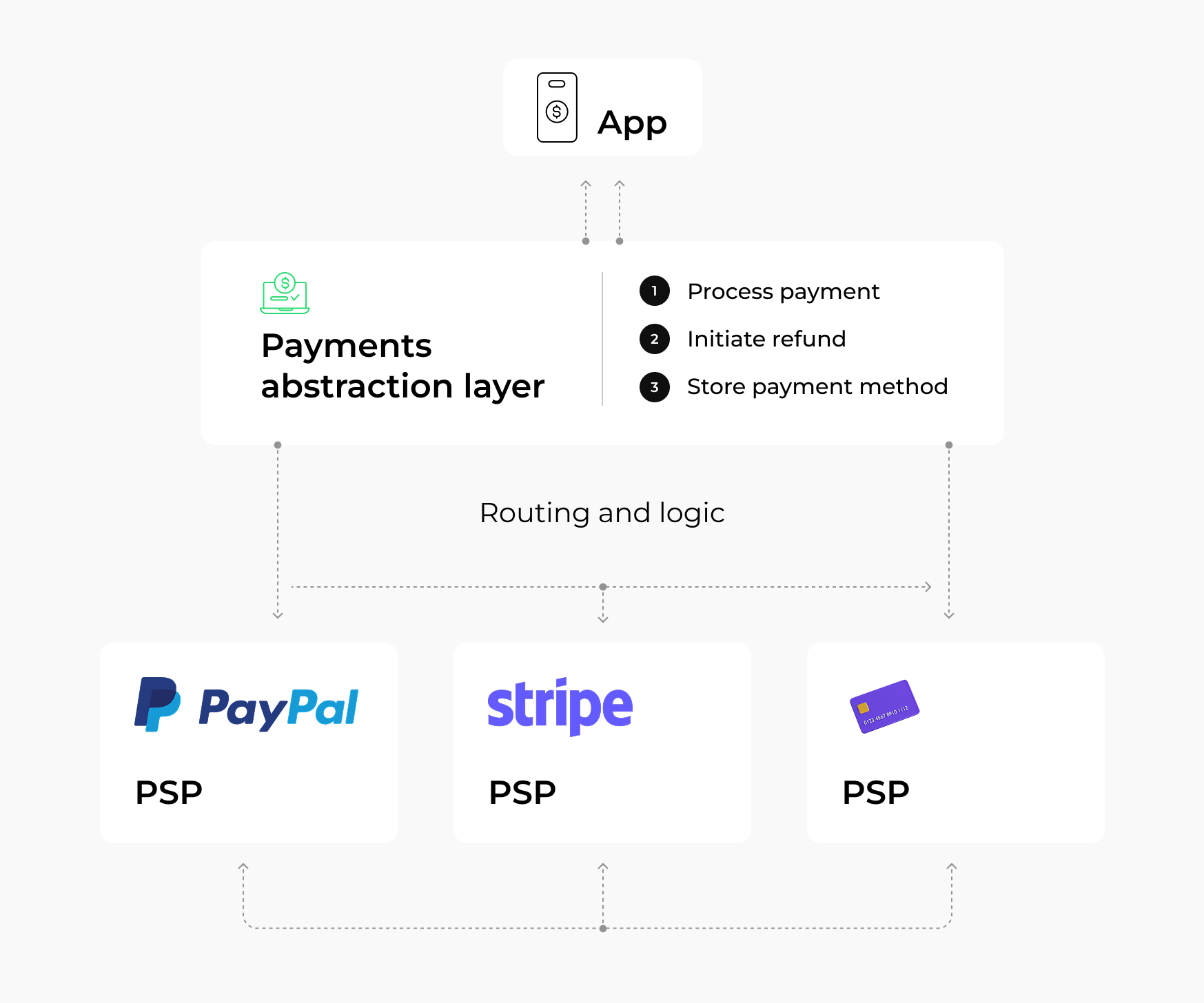
That is exactly why experienced teams treat payment gateway migration as a perfect moment to do away with their direct PSP coupling and replace it with an internal payment API.
Expert opinion
“From an architectural standpoint, payment systems should balance stability with adaptability to future changes. Achieving that requires experience, careful planning, and well-designed migration strategies when switching or adding gateways with minimal risk and no disruption to revenue.”
There is a twist about migrating to a new payment gateway: not everything depends solely on you. A typical live system doesn’t store payment card data to minimize PCI DSS scope and compliance burden. Instead, it’s held in the PSP’s PCI-compliant vault, and your system receives a token used for all payments.
When you migrate to a new payment provider, the issue of token portability becomes a crucial element of the project’s critical path. Its direct security and compliance implications can substantially delay the process or even bring it to a complete halt if not handled properly.
If the current payment provider can export your existing tokens directly in a format that is supported by the new PSP, it means you’ve hit the jackpot, and the rest of your project becomes significantly easier. You only need to make sure that both payment service providers verify each other’s compliance standards (including PCI DSS responsibilities and data ownership), transfer the tokens to a new vault, and give you a green light to use them for upcoming payments.
However, in the not-so-fortunate scenario, your existing payment service provider may:
In this case, you will be facing a complex dilemma and may be forced to either:
As you can see, token portability is absolutely mission-critical not only for migration timelines, but for security and regulatory impact as well. Therefore, you should have a clear vision of how your PSPs can handle this transition, if at all, right from day one.

With Oxagile’s experience in large-scale PSP integrations and migrations, you can move forward with confidence and keep revenue flowing throughout the transition.
If your business is subscription-based, migrating to a new payment gateway will inevitably impact subscriptions, and your primary goals are to keep recurring revenue flowing and make sure users don’t notice the switch.
Handling subscriptions is tricky: most billing logic lives on your side, but parts of it may be configured with the provider. If you don’t replicate it correctly, billing dates can shift or disappear, and subscription statuses can be saved incorrectly.
You may also encounter edge cases caused by billing schedules. For instance, at the very start of the migration process, some users will have been billed just recently, some will have their billing date coming right up, and some will be a long way from their scheduled payments.
In this case, it makes sense to impose a temporary “migration pause” for users with imminent payments and only move them after their next successful charge. The rest can be carried over to the new payment service provider, and this process can repeat until all users are transferred.
The bottom line is that constantly monitoring subscription status changes is vital. Ideally, treat payment platform migration as a one-time import plus a short period of “change data capture” before you finally say, “All right, the new payment service provider is now the single source of truth for billing, and the old one is completely off.”
Expert opinion
“Subscriptions don’t like being moved, especially mid-cycle. If you rush the transition, you’ll see duplicate charges, lost access, or angry customers. If you pace it and watch the data closely, users will never know anything has changed. It’s a win-win scenario that we always aim for.”
Payment gateway migration is rarely just about flipping providers. When executed the right way, it’s a smart investment in infrastructure and architecture that pays off long after the migration itself is done.
Businesses that approach it as a strategic initiative end up with solutions that can be quickly equipped with new payment options, brought into compliance with updated regulations, and even adapted to new business models without building from the ground up.
Good architectural choices made during a migration remain relevant and useful for years. Abstracted payment layers with clear APIs, intelligent routing, unified data models, and a minimized PCI DSS scope help companies stay flexible, competitive, and ready for things to come. With this solid foundation, they can keep optimizing for cost, reliability, and conversion instead of being locked into whatever terms their payment provider may unexpectedly set next.
Oxagile’s fintech team has got you covered across the board. Take full advantage of our professional payment gateway integration services and deep data migration expertise to confidently plan your next fintech project and see it through to completion with zero downtime or lost revenue.

Payment gateway migration becomes strategic when your current provider limits your ability to improve approval rates, expand into new geographic markets, or add modern payment methods without major rework.
The main risk in a payment service provider migration is tightly coupling application logic to a single PSP’s APIs instead of using an internal abstraction layer, which makes every future change equally painful.
Careful planning in PSP migration focuses on phased traffic rollout, rollback paths, and parallel monitoring, so you can detect issues early and prevent large‑scale revenue or UX disruptions.
Beyond fees, migrating to a new payment gateway should prioritize token portability, subscription continuity, fraud controls, and the opportunity to clean up legacy data and routing logic.
Seamless payment system migration is hard because you must keep authorizations, settlements, and reconciliations consistent across old and new rails while customers continue to transact in real time.

