










Project at a glance

Client

AI software product provider

Request

Launch a market-ready MVP to accelerate fundraising

Solution

AI streaming search agent for TV and mobile devices

Three key value metrics


Project delivery timeline

Successfully supported across mobile and TV ecosystems

Achieved through cross-platform code reuse

The use case: Video content discovery reimagined

“Imagine viewers searching for a movie or TV show and instantly getting ratings, critic reviews, age guidance, seasons, trailers in one place.

They don’t need to jump between multiple search results and content discovery apps. They reach the video and launch it directly in the streaming service where it's available, whether that's Netflix, Prime Video, Hulu, Disney+, or dozens of others.

We’d like to go beyond traditional search capabilities with AI to combine the viewers’ intent with personalized preferences and content boundaries. The goal is to make content discovery effortless, personalized, and consistent across both mobile devices and big-screen experiences.”

 —The client’s Product Manager


Accelerating MVP launch under tight constraints

Goal

Speed up the app release

Deliver an AI-driven content search agent on both big-screen and mobile platforms with enough functionality to validate the product vision, attract early adopters, and support crowdfunding efforts.

Challenge

Reduce delivery costs

Create a compelling cross-platform streaming discovery experience within a constrained budget and aggressive timeline, securing investor and community attractiveness.

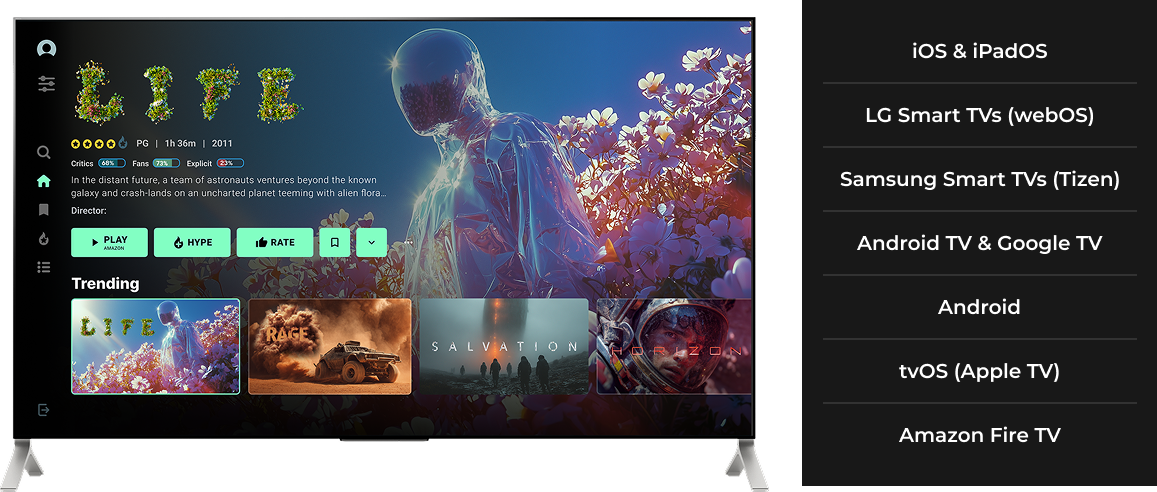
7 platforms

Cross-platform reuse to overcome the challenge

Our engineering strategy centered on a React Native architecture that maximizes code reuse across seven mobile and TV platforms.

By maintaining a single codebase, we significantly reduced development effort, accelerated time-to-market, and delivered a high-quality MVP within the project’s budget and schedule constraints.
Featuring key capabilities

  • Email/password authentication, password recovery, and social sign-in with Google, Facebook, X, and Apple ID
  • AI-powered, voice-enabled, and traditional search experiences
  • Personalized content discovery based on user preferences and behavior
  • Dynamic home screen with featured content, collections, and recommendation rails
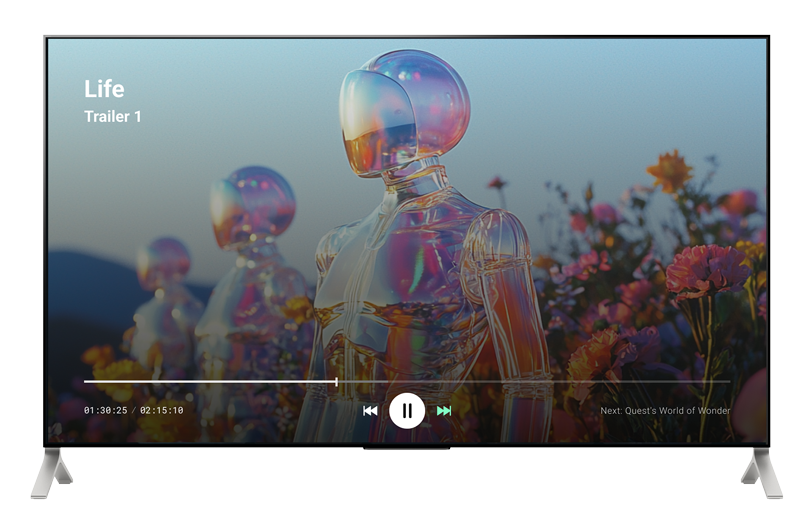
  • Detailed movie and TV show pages with rich metadata and engagement features
  • Custom watchlists and user-created hype lists
  • Multi-step onboarding and preference personalization flows
  • Content boundaries and parental control settings
  • User profile management, account settings, and password updates

How AI personalizes content discovery in the app

Intent-aware content search

AI-powered semantic search understands user intent and natural-language queries and delivers more relevant results.

Personalized recommendations

A recommendation engine combines user preferences, viewing behavior, and contextual signals to surface content tailored to each user.

Smart content controls

Intelligent content boundaries automatically align discovery results with age restrictions, sensitivity settings, and personal preferences.

Ongoing preference learning

The system continuously refines recommendations by learning from user interactions, engagement patterns, and feedback.

Multi-modal video discovery

Text and voice search capabilities make content discovery more accessible, intuitive, and engaging across user journeys.

Future-ready AI platform

A scalable AI architecture supports evolving recommendation models and lays the foundation for future generative AI innovations.

Tech challenges we tackled across platforms

How we solved them

After thoroughly investigating the challenges of each platform and validating our approach through multiple PoCs, we built a unified deep-linking API with platform-specific adapters to bridge the differences across mobile and TV ecosystems.

We overcame incompatible app-launch and store-navigation mechanisms, iOS URL-scheme restrictions, and provider-specific variations to deliver a reliable deep-linking experience on Android, iOS, tvOS, Tizen, webOS, and Fire TV with smooth fallback paths and support for real-world user journeys.

Cross-platform deep linking challenges

  • Different application launch mechanisms across Samsung Tizen, LG webOS, and mobile platforms
  • Platform-specific app store navigation and fallback requirements
  • iOS restrictions on detecting and launching external applications
  • Complex mobile app lifecycle handling across cold start, foreground, and background states
  • Inconsistent deep-link data structures and payloads from content providers
  • Reliable deep-link behavior across diverse platforms, providers, and real-world user journeys

Device-specific UI/UX challenges

  • Platform-specific app launch mechanisms across mobile and TV ecosystems
  • Different remote-control navigation and focus-management models on TV platforms
  • Varying app lifecycle behaviors, including launch, resume, and background states
  • App compatibility on diverse hardware capabilities and TV generations
How we solved them

TV platforms may share the same application codebase, but every device introduces its own constraints, including screen resolution, memory limitations, and manufacturer-specific settings and behaviors.

We applied reusable code with platform-specific customizations, extensive testing, and real-device debugging. We also expanded our device lab to reproduce and resolve hardware-specific issues, such as display optimization settings that caused image quality degradation on certain TV and streaming-device combinations.

How we solved them

A performance-first approach was needed to deliver a consistent experience on high-tier, mid-tier, and low-end TV devices.

We disabled non-essential animations to optimize UI for resource-constrained devices. Our dedicated Performance QA specialist conducted extensive testing on physical hardware to uncover issues that could not be reproduced in emulators.

This allowed us to balance performance, stability, and feature parity in a diverse ecosystem of Smart TVs and streaming devices.

Performance optimization challenges

  • Application performance tuning for low-end and legacy TV devices with limited memory and processing power
  • Hardware fragmentation across TV models and generations
  • Startup time and responsiveness on resource-constrained devices
  • Navigation and focus management optimization

Planning your project?

Our online video experts are ready to discuss your streaming app needs.

Talk to an expert