











This website uses cookies to help improve your user experience




You seek to broaden your content’s reach or attract partners wishing to establish dedicated channels within your application. And you’re thinking about Sony TV. Smart move.
While Sony may not dominate global television sales volume, it maintains a distinct, cultivated position in the premium segment. Recent Counterpoint Research data indicates that Sony holds 5% of the global high-end TV market, positioned behind Samsung (45%), LG (20%), TCL (11%), and Hisense (11%)1.
Yet this figure belies a deeper strategy: Sony eschews the mass market, focusing instead on a discerning audience. This commitment manifests in sustained investment in OLED and Mini LED technologies, renowned for delivering exceptional contrast and color fidelity. Its Cognitive Processor XR emulates human perception, refining picture and sound dynamically. Furthermore, Acoustic Surface Audio technology transforms the screen itself into a speaker, achieving remarkable audiovisual synchronization and immersion.
For content creators and brands, entering Sony’s ecosystem means finding an audience more likely to pay for premium content and stay loyal to brands that earn their trust.
In other words, every new viewer you reach here has real value, not just as a one-time impression, but as a potential subscriber, buyer, and long-term fan.
Especially assuming the app is executed right. Which is probably exactly why you’re here. Let’s jump into our guide to developing apps for Sony TVs.
Key takeaways:
Unlike Samsung’s Tizen or LG’s webOS, Sony doesn’t have a proprietary TV operating system. Instead, it runs on Google TV, which is basically a layer built on top of the Android TV OS.
What does that mean for your development team? Less fragmentation, faster delivery, and more reuse. You build a single app for Android TV, and it works across Sony TVs, Chromecast with Google TV, TCL, Hisense, and other Android TV-powered devices. In short, you don’t build “for Sony”, you build smart for an entire ecosystem.
But while the operating system is shared, the user experience is not. And that’s where things get interesting when you’re building apps for Sony Smart TVs.
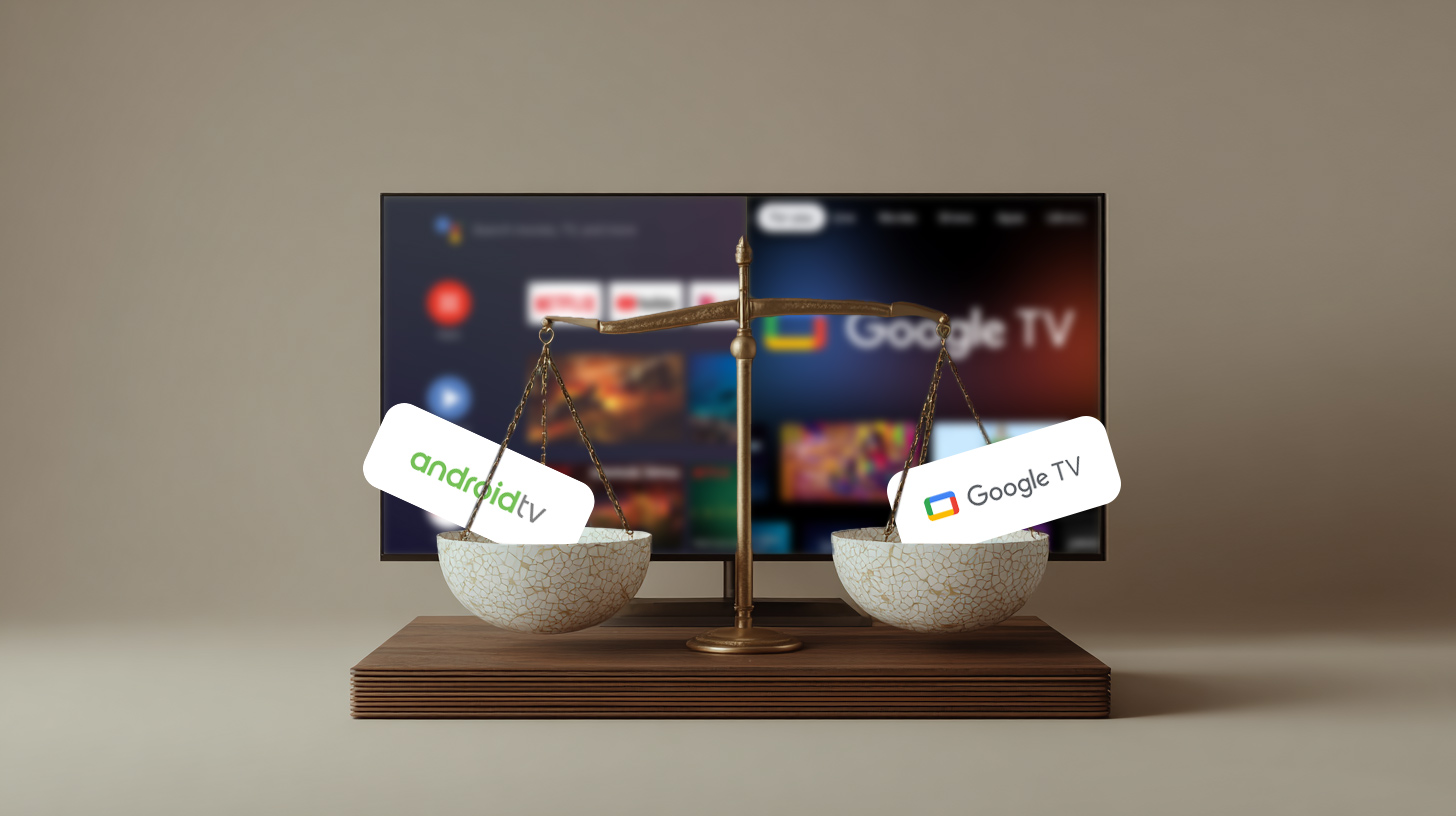
You can think of Android TV as the engine (the foundation that powers everything) and Google TV as the dashboard, the user-facing experience. While the underlying system remains the same, what users see and how they interact with content changes significantly.
This means that while both platforms support the same APIs, Google TV places greater emphasis on metadata, integration, and discoverability. It leverages Google’s Knowledge Graph and user behavior to personalize recommendations, manage universal watchlists, and even sync content suggestions across devices.
Since Sony TVs rely on Android TV at their core, you’ll use the same standard development tools and APIs during Sony Android TV app development.
But if you want your app to fully participate in the Google TV experience, which most Sony users now see, you’ll need to implement the proper content discovery APIs. This way, your catalog can be indexed, allowing Google TV to access, understand, and present your content effectively on the home screen.
You won’t control how Google surfaces your content because that’s part of the proprietary recommendation logic, but you can control what data you provide, and how clearly your app communicates what it offers. That’s the difference between simply being installed and actually being watched.

With proper content discovery API integration, your catalog won’t just live on the platform, it will surface in front of the right users at the right time.
While Sony TVs run on the familiar Google TV OS that’s often topped with the Google TV interface, a few under-the-hood quirks can throw a wrench into otherwise standard development workflows. To help you stay ahead of surprises (and not get tripped up mid-sprint), here’s a clear-cut breakdown of what holds steady and where you’ll want to keep your eyes peeled.
While Sony follows Android TV standards closely, real-device testing is critical during Sony TV application development to:
Sony TVs are strong adherents to Android TV specifications, meaning:
Sony’s Smart TV ecosystem offers fertile ground for high-quality OTT apps. But as with any worthwhile product, success lies in the process. Here’s a structured roadmap with clear steps to develop Sony TV apps to help you go from concept to living room-ready experience without missing the strategic forest for the technical trees.
Before a single pixel is designed, get clarity on:
This Google TV Sony app development step informs everything downstream: platform architecture, monetization logic, even remote control UX. If it feels abstract, good. That’s where strategy lives.
At the heart of every OTT app lies its backend infrastructure. And here, you have two paths: go custom or choose a ready-made solution. This decision will directly impact your app’s performance, time to market, and ability to scale effectively. No pressure, right?
You can either:
The right choice depends on your roadmap and how far your app needs to deviate from the standard.
Sony TVs aren’t tablets, they’re 55-inch portals viewed from across the room. Your design choices in the course of Sony Smart TV app development need to reflect that:
The UX/UI phase isn’t just about beauty. It’s about functional clarity in a lean-back context. This is where Sony’s Google TV also starts to matter — you’ll need to matter, since you’ll need to think in terms of content discoverability, not just static menus.
Here’s where the app comes to life. For Sony TVs, you’ll typically build using:
Backend APIs (from your OVP) will plug into the app here for authentication, payment logic, content delivery, analytics, and more. This is where a well-scoped architecture pays off during Sony app development.
Emulators are useful. But real-world testing on actual Sony TVs is non-negotiable.
You’ll want to validate:
Sony doesn’t require a custom SDK, but their premium audience will notice the smallest bugs. Don’t give them a reason to delete.
Sony apps are published through the Google Play Store for Android TV. You’ll need:
Once live, be ready to iterate. Data from real users (viewing time, engagement, conversion) will inform everything from monetization tweaks to content placement.
Let’s talk numbers. Or rather, why they’ll vary — a lot.
When it comes to launching an OTT app (for Sony Smart TV or any platform, really), one of the key variables that will shape your budget isn’t the device, the platform, or even your content. It’s your video backend, and whether you build it using a custom Online Video Platform (OVP) or go with a ready-made solution.
However, the truth is that there’s no universally “cheaper” option, only a better fit for your use case.
If you’re looking for full control (granular monetization logic, complex multi-tiered subscriptions, unique user analytics, branded interfaces, and custom workflows), then a custom-built OVP gives you the flexibility to scale your product exactly how you want. But that flexibility comes with increased cost and development time, as you’re not just buying a service, you’re building infrastructure.
On the other hand, off-the-shelf OVPs are faster to launch and easier to maintain. They’re ideal if your app logic is relatively standard and your goal is to get to market quickly without compromising on core OTT functionality like DRM, CDN integration, user management, and basic monetization tools.
Ultimately, it comes down to how far from the default you need to go. The more specialized your business logic and UX expectations, the more it makes sense to lean custom and budget accordingly.
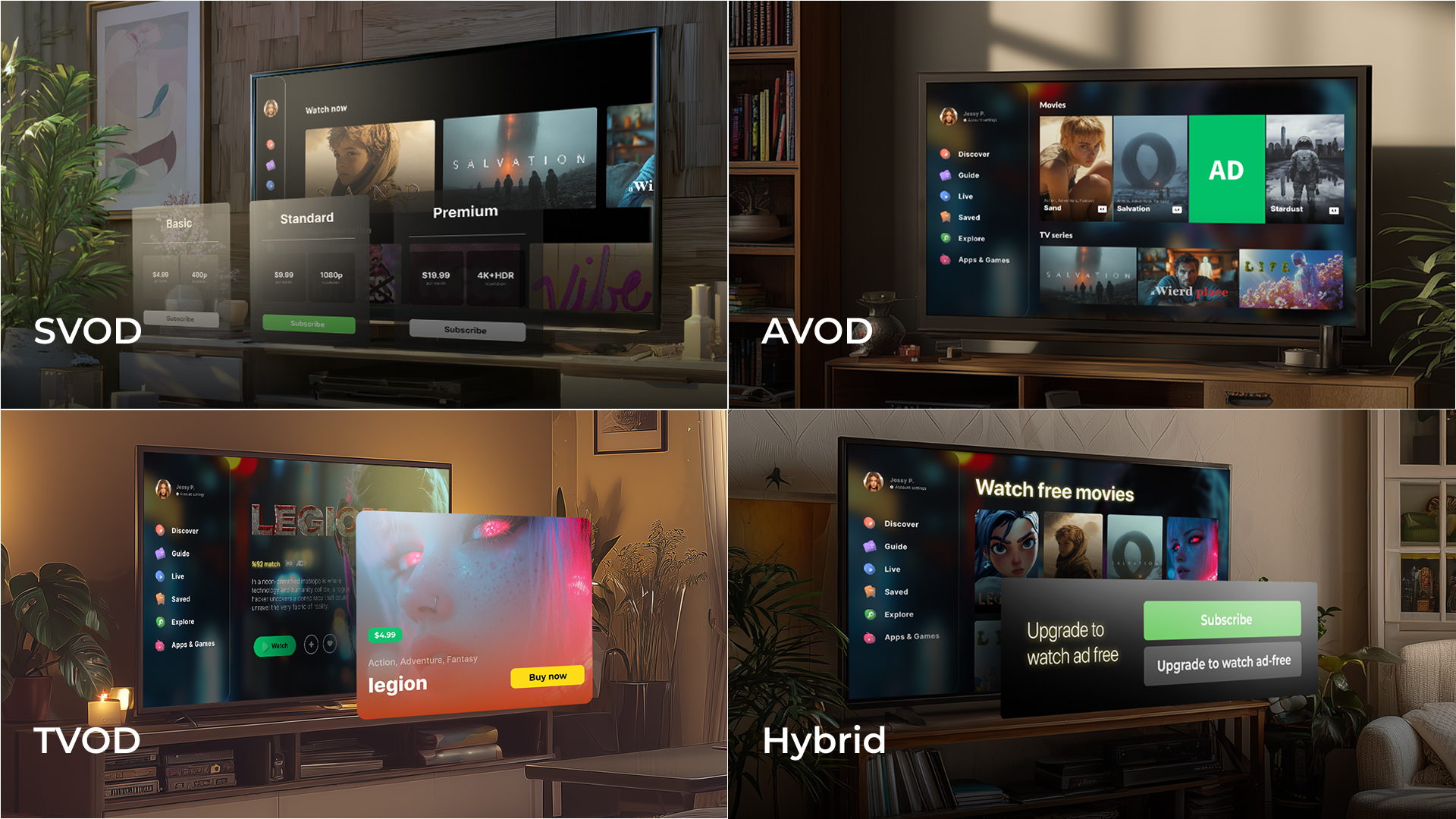
When developing an OTT application for Sony Smart TVs, monetization should be considered not as an afterthought, but as a strategic pillar from the start. Fortunately, Sony’s Google TV-based ecosystem supports the full spectrum of proven revenue models, allowing you to tailor monetization to both your content strategy and your target audience.
Subscription Video on Demand (SVOD) remains the most robust model for building recurring revenue and long-term customer value. Given Sony’s positioning in the premium market, its users often demonstrate a higher willingness to pay for quality, curated content experiences.
For broader reach, Advertising-Based Video on Demand (AVOD) offers an accessible entry point, particularly effective when paired with intelligent ad placement and seamless user experience. This model ensures content remains free to access while generating revenue through targeted ad delivery.
In cases where content is event-based or niche, Transactional Video on Demand (TVOD), where users purchase or rent individual pieces of content, provides flexibility and high-margin opportunities without requiring ongoing commitment from the viewer.
Finally, hybrid models are increasingly popular, combining elements of subscription, ad-supported, and transactional approaches. This offers a dynamic framework that can adapt to varied audience segments and content types, all within a single platform.
Sony Smart TVs, leveraging the Android/Google TV infrastructure, are fully compatible with these monetization strategies, giving content owners the infrastructure they need to build revenue confidently.
Smart TV app development isn’t just about porting your mobile app to a bigger screen, it’s about understanding the room you’re entering. And in the case of Sony, that room is clean, quiet, and fully furnished with premium expectations.
Sony Smart TVs run on Android TV OS, wrapped in the more modern, content-forward Google TV interface, meaning you’re not building for a niche walled garden, but for a scalable platform used across major OEMs. You develop once using standard Android tools and practices (Leanback UI, ExoPlayer, Watch Next API), and your app can run not just on Sony but also TCL, Hisense, Chromecast with Google TV, and others.
But while the foundation is familiar, Sony’s layer comes with nuances worth optimizing for. Its picture and sound technologies (like the Cognitive Processor XR or Acoustic Surface Audio) won’t require special APIs, but they will reward apps that deliver high-quality visuals, smart memory usage, and thoughtful UI pacing. Firmware differences, subtle UX behaviors, and remote control variations are small things, but on a 65-inch OLED screen, they become noticeable.
At the same time, if you’re planning for a multi-platform rollout, it’s crucial to acknowledge that not all smart TV ecosystems play by Android’s rules.
Take Samsung’s Tizen OS, for example. It’s a web-based platform with its own UI/UX logic and submission flow, and while it has huge reach, the development process is more bespoke. Navigation, media handling, even remote control inputs follow a different pattern.
Or consider Amazon Fire TV: Android at its core, but heavily customized and deeply embedded in Amazon’s ecosystem. Here, Alexa integration, placement in Amazon’s content layers, and voice search behavior make it its own animal.
And then there’s LG’s webOS with a completely different flavor. Think card-based UI, app prioritization via the Magic Remote, and an entirely different app lifecycle.
So where does Sony TV app development sit in all this?
Somewhere very strategic. It gives you the flexibility of Android TV, the discovery-driven benefits of Google TV, and the hardware polish of a premium device, all without the platform fragmentation that often makes smart TV development a pain. If you’re building with long-term growth in mind, including content monetization, brand alignment, cross-device strategy, Sony is a high-value screen that doesn’t ask for high overhead.
That’s what makes it smart. Not just as a TV, but as part of your platform strategy.
Whether you’re launching on Sony today or scaling across platforms tomorrow, we’ll help you build multi-screen apps that feel native, perform flawlessly wherever your audience hits play, and grow with your roadmap.
1. Sony holds 5% of the global high-end TV market — Counterpoint Research

Developers rely on Android TV and Google TV technologies when developing a Sony app. The process typically involves Android Studio, ExoPlayer for media playback, Google APIs like Watch Next and Assistant integration, and standard Leanback UI components. Since Sony TVs run on Google TV (built on Android TV OS), the same APIs and tools can be reused across multiple brands like TCL, Hisense, and Chromecast with Google TV.
Some of the best practices for developing Sony Smart TV apps include:
The process of developing Sony apps may be simpler than building for Tizen (Samsung) or webOS (LG), because Sony uses Android TV/Google TV, which reduces fragmentation and allows reuse across multiple devices. However, it differs in nuance: developers must optimize for Sony’s premium display and audio technologies, test firmware variations, and ensure polished UI pacing. In contrast, Tizen and webOS require unique development logic, different submission workflows, and navigation tailored to their custom remote systems.
It is generally less complex to develop apps for Sony Smart TV than for platforms like Samsung Tizen or LG webOS. Sony uses Android TV OS with the Google TV interface, allowing to reuse standard Android development tools and reduce fragmentation. The main complexity lies in optimization rather than platform differences.
The key focus areas include defining your audience and monetization model, choosing the right backend approach (custom OVP or ready-made), and building on Android TV with proper Google TV content discovery integration. Equal attention should be given to 10-foot UX design with D-pad navigation, performance optimization for smooth playback, and real-device testing on Sony TVs before publishing through Google Play for Android TV.

