












This website uses cookies to help improve your user experience

A World Rally Championship stage looks nothing like a Formula 1 circuit. The car is built to run on gravel, snow, tarmac, and mud in sequence, with each surface demanding a different setup, tire compound, and driving line. If the surface is not properly prepared, the gap to the leader will disappear before the next stage begins.
Smart TV development operates under the same logic, and the platforms exemplify this. Android TV, Tizen, webOS, Fire TV, Roku, and tvOS appear similar from the outside. Under the hood, however, they share almost nothing. This discrepancy between assumption and the reality of the final Smart TV application development cost is what eats project budgets.
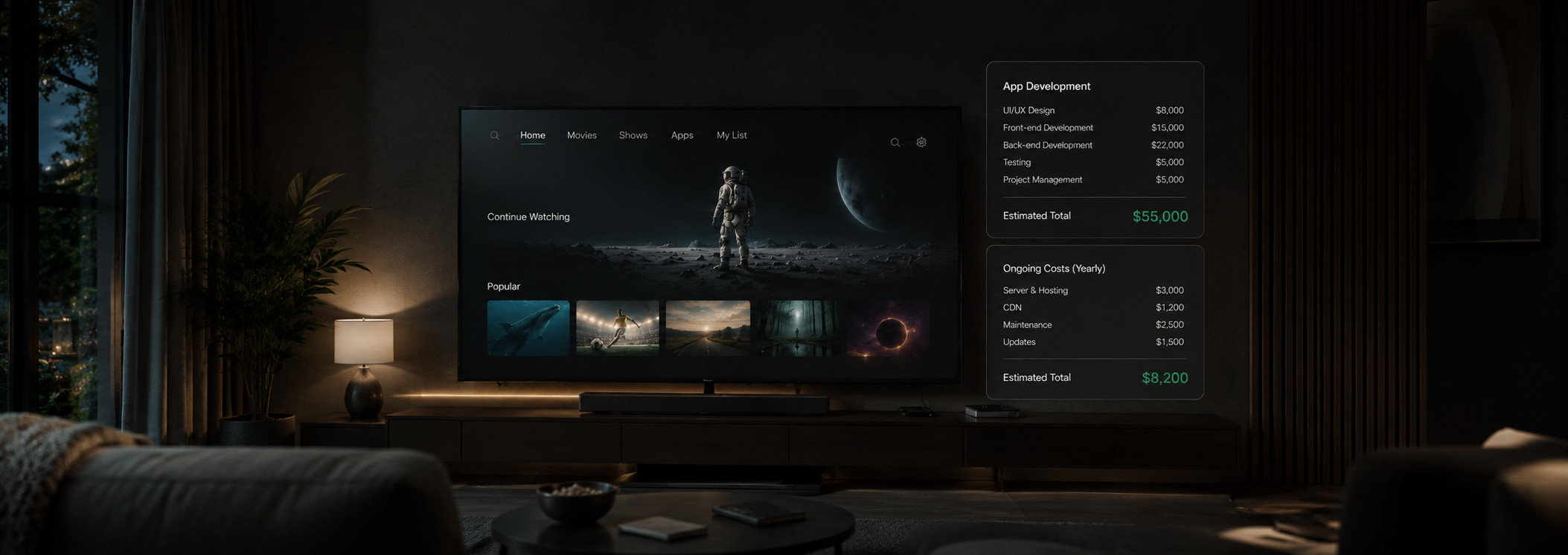
Before talking to any vendor, you need a number in mind. A basic, single-platform app costs around $8,000-$15,000. A full, multi-platform, over-the-top (OTT) build with live streaming and digital rights management (DRM) costs $80,000-$150,000+. Anything between these figures has a reason, and it’s usually one of three things.
Key takeaways:
| Tier | Budget range | What it includes |
| Basic single-platform VOD | $8k – $15k | One platform, pre-built player, minimal UI customization, no DRM |
| Standard SVOD with custom UI | $15k – $30k | Single platform, bespoke design system, subscription flows, basic analytics |
| Multi-platform OTT (2-3 platforms) | $35k – $80k | Android TV + one or two others, unified codebase where possible, cross-platform QA |
| Full multi-platform with live + DRM | $80k – $150k+ | Four or more platforms, live streaming, DVR, multi-DRM, device lab testing |
The jump from $15k to $150k comes from how many platforms the product needs to reach, how complex the streaming requirements are, and whether the team building it has actually done this before. Smart TV sits inside a wider picture, and our breakdown of the cost of OTT app development maps how these same drivers scale across mobile and web.
In theory, each Smart TV platform is a world of its own, with its own SDK, certification, and hardware quirks. The cost of expanding from one platform to four does not multiply by four in practice. A realistic expansion from Android TV to four platforms would cost roughly 2.5 times more than the original scope, but only if the architecture was designed to share code from the outset.
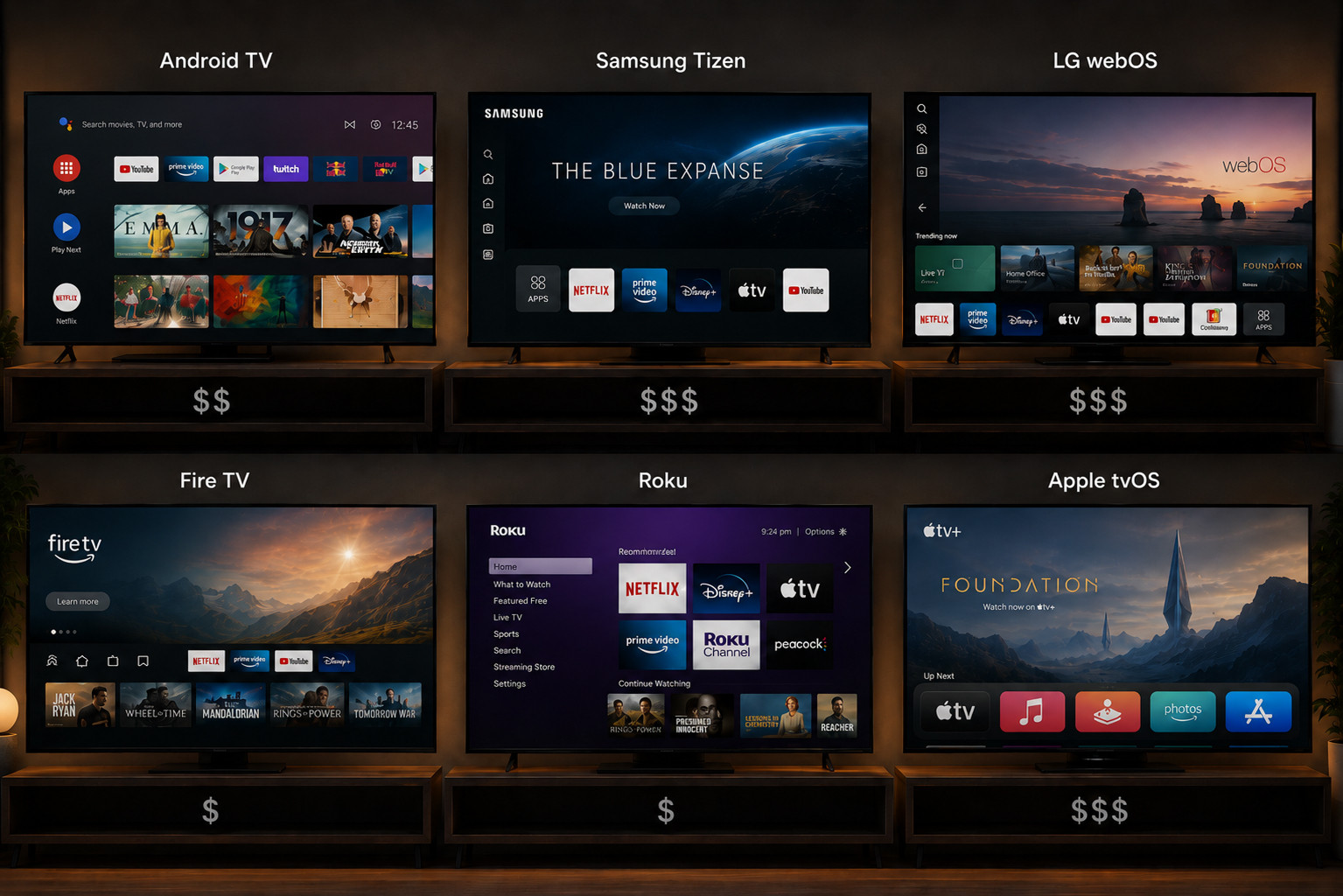
Before driving a gravel stage in Finland, a rally crew will walk it to note the surface, crest profiles, and braking points, then set the car up specifically for those conditions. Arriving at a Tizen build after shipping Android TV without that same preparation is how the budget gap opens. No understanding of the webOS submission pipeline, no accounting for Roku’s entirely separate language requirement, and platforms two and three arrive at delivery undercooked.
The platforms that incur the highest costs are also the most self-contained. For example:
Each platform has its own demands. And it is possible to scale to multiple OTT devices without exploding costs if you factor in the details before you scope.

Oxagile has shipped production apps across Android TV, Tizen, webOS, Fire TV, and tvOS. If you are scoping a project, our team provides Smart TV app development services and can help you figure out what it actually takes.
The choice of build approach is often treated as a technology preference, but it is actually an early budget decision that is difficult to reverse. Each of the three main approaches has a different cost profile:
| Approach | Best for | Tradeoffs | Cost profile |
| Native | Max performance, full platform API access | Separate codebase per platform |
|
| React Native for TV | Android TV + Fire TV from one codebase |
|
|
| HTML5/JS web app |
| Performance ceiling on heavy playback features |
|
Picking a build approach feels like a technical decision. It plays out as a financial one.
An all-native setup is like running the same car on every stage, regardless of the surface. It offers maximum control and maximum cost, as well as four certification pipelines that never quite sync. Most people are surprised by the five-year maintenance bill on that setup when they only looked at the initial estimate.
HTML5/JS is the opposite gamble: one setup for all surfaces that is fast to prepare and works well on tarmac but struggles on gravel. It works well enough for catalogs and navigation, but hits a ceiling the moment live streaming gets serious. Those who have gone this route and had to rebuild know exactly how much that ceiling costs.
The setup that works across the full Rally: use React Native for Android TV and Fire TV, native code for tvOS, and HTML5 for Tizen and webOS. Each platform receives what it needs. This combination runs 20-35% below full native performance and functions well across navigation, catalogs, and subscription flows.
The one stage that demands specific preparation is the player. Each platform handles Widevine L1 certification, hardware decoding, and HDR signaling differently, and a shared layer cannot absorb those differences.
Resolving these issues before the build starts is key to keeping the budget intact. Discovering these issues during QA is how budgets double quietly.
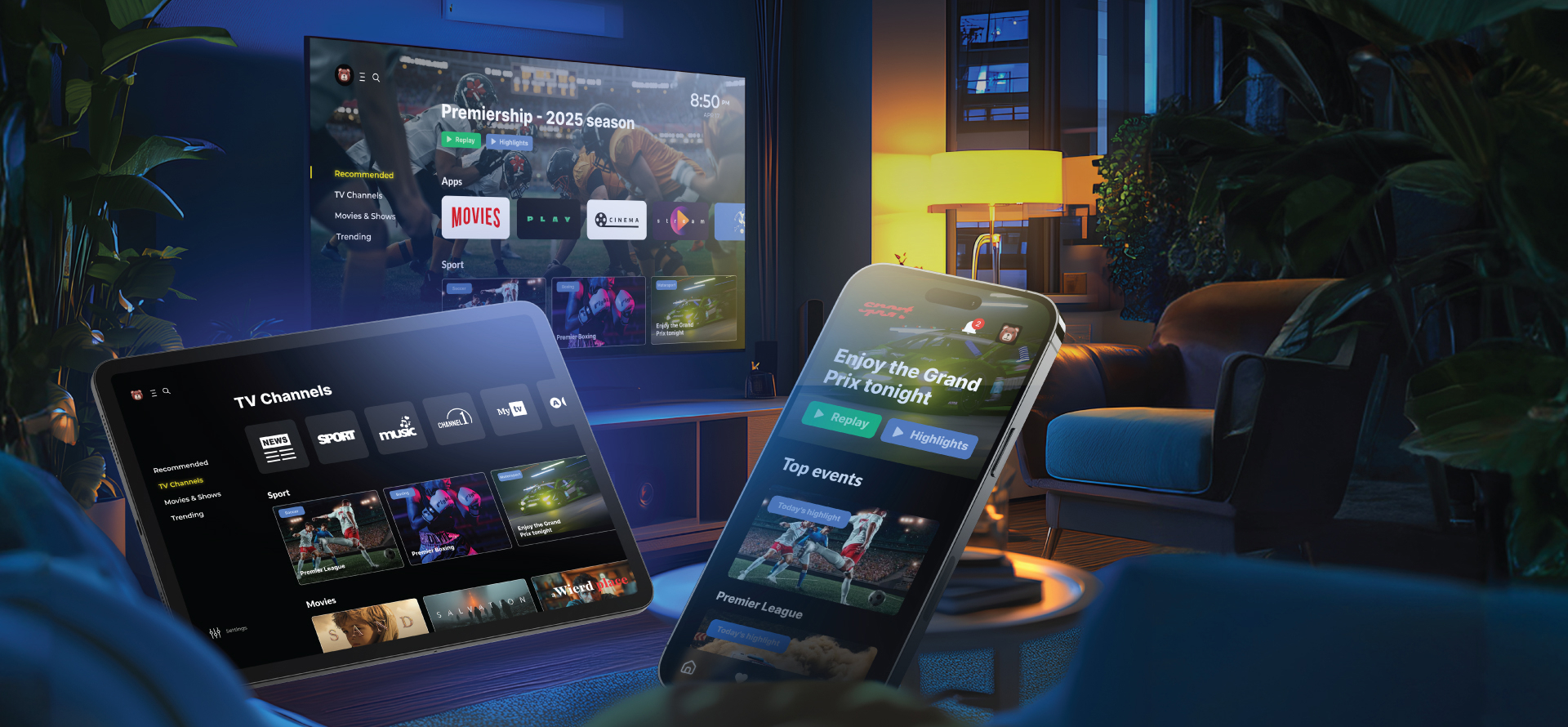
A network of telco clients needed a white-label OTT product that could be configured, branded, and launched per country without rebuilding from scratch each time. The target was 13 platforms and 25 devices. Rather than treating each platform as a separate project, Oxagile designed the architecture around a single shared business logic layer from day one.
It covered iOS, Android, Android TV, and Apple TV based on one codebase, and had an Android TV Operator Tier handling set-top boxes. Every telco got its own branding and feature set. No separate builds.
The platform went live in two European countries with three more queued, and the project has run to over 22,000 man-days without a fundamental architecture change.
Before tackling a new stage, a rally crew builds a pace note for every corner because the sequence matters, and missing an annotation can cost time. Feature scoping works the same way.
A VOD catalog with a pre-integrated player is like a known corner: fast and predictable. However, live streaming with DVR changes the character of the stage. It requires a different media pipeline and server infrastructure, as well as a seek layer that must behave consistently across devices with different buffering capabilities. Interactive features like polls, second-screen sync, and watch-along have no pace notes because no one has navigated those features before on most platforms.
Digital Rights Management (DRM) is the corner that looks easy on the map but catches crews off guard during the stage. There are three separate Widevine, PlayReady, and FairPlay integrations, and each platform validates the license server behavior according to its own rules.
These rules have different timeout tolerances and offline playback requirements. A build that passes Widevine L1 certification for Android TV can still fail Tizen certification for reasons unrelated to the license server.
Budget $15,000-$30,000 for it as its own workstream before production begins, not as an afterthought in player development.
Even though a mobile engineer working on a Smart TV project for the first time is not starting from scratch, it will take more time than most people think. The frameworks and debugging tools are different, and the input model is completely different.
On a phone, every interaction is a touch event on a known screen size. On a TV, however, everything comes through a directional remote, and the focus engine that determines which element is active behaves differently on every platform. Tizen, tvOS, and Roku each implement focus navigation in ways that share almost no common logic.
None of this information is included in design documents. These issues and Smart TV app development challenges arise in QA when a UI that appeared correct in a simulator fails to behave predictably when controlled by a physical remote.
So, here’s how that looks in practice:
1. A Tizen build is released and then rejected for certification due to a focus management issue that only affects certain Samsung models with older firmware
2. Fixing the issue takes a week, and resubmitting the build takes another week.
3. Then, Apple rejects the same build for an unrelated accessibility attribute.
4. Neither rejection was included in the original estimate.
5. An engineer who has worked on these platforms before covered the cost of the first rejection on a previous project, so they do not pay it again.
This discrepancy explains why one vendor, experienced with TVs, quotes $60,000 for the same scope while another vendor, experienced with mobile devices, quotes $45,000. The second number looks better until the invoice arrives.
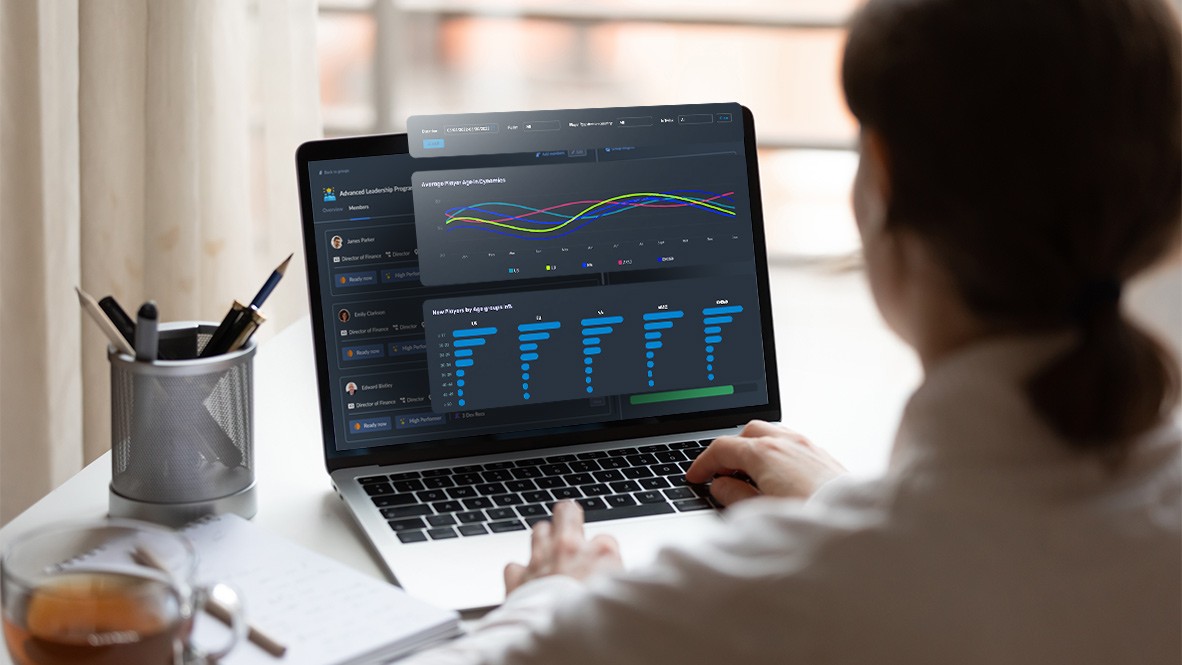
A leading European telecom needed a combined OTT and IPTV platform covering LG and Samsung Smart TVs, Android, iOS, Apple TV, and VIDAA TV OS, serving a market of over 80 million viewers.
We built the full frontend across all six platforms, including specialized TV packages, interactive EPGs for 200+ channels, multi-DRM support across PlayReady, Widevine, and FairPlay, and QA automation that runs 1,500 tests across mobile, API, and Smart TV in under 30 minutes. Each platform required its own approach.
The result was 60% automated QA coverage on Smart TVs and over 100,000 downloads on iOS and Android each.
Three cost lines appear late in every Smart TV project and lead to early regret.
Amazon, Samsung, and Apple all have review processes that can reject apps for reasons unrelated to their functionality. These reasons include accessibility attributes, metadata formatting, and icon specifications.
Each rejection adds one to three weeks, plus the time it takes the developer to fix and resubmit the app. For a project spanning four platforms, expect at least one rejection per platform and factor this into the budget from the beginning.
Emulators detect logic errors. Physical devices identify rendering issues, focus behavior problems, and remote control edge cases that emulators never encounter. A realistic lab has three to five devices per platform, covering different model generations and operating system (OS) versions.
For instance, Samsung’s 2026 TV lineup transitioned from GCC 9.2.0 to GCC 14.2.0. This means that binaries compiled for earlier models require a complete rebuild for 2026 hardware. This kind of difference only surfaces on physical devices.
Maintenance is a continuous workload, not a predictable annual event, because SDK updates, OS version changes, and store policy changes rarely land on a multi-platform product at the same time.
The standard estimate is 15-20% of the initial build cost per year. For a $60,000 project, for example, that amounts to $9,000-$12,000 annually before any feature work begins.
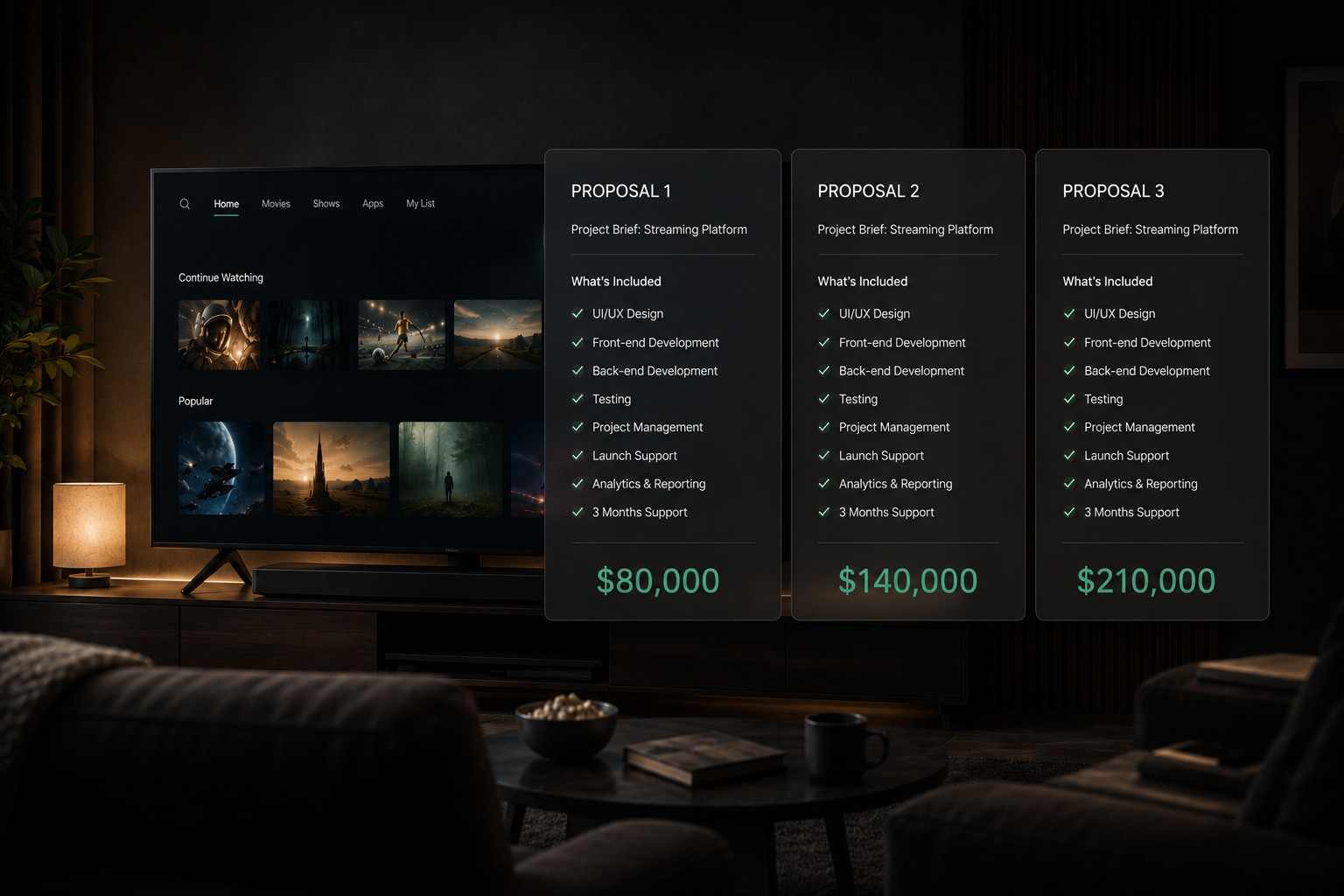
When three vendors are looking at the same four-platform brief, the quotes they provide often range from $80,000 to $210,000. This variance does not mean that two of them are incorrect.
Rather, it is because the brief was vague enough that each vendor interpreted it differently. The client bears the cost of that ambiguity, which shows up as a difference between the contracted number and the final invoice.
Decisions that eliminate ambiguity are not technical. In fact, they are editorial choices about which matters most and which can wait. The most significant of these choices is platform priority.
Take, for example, a brief that asks for coverage across Android TV, Tizen, webOS, Fire TV, Roku, Titan, and tvOS. Because the client has not made their preferences explicit, every vendor will scope it differently based on their own assumptions.
Deciding beforehand that Android TV and Fire TV will be included in Phase 1 and that Tizen and webOS will be included in Phase 2, if the audience justifies it, eliminates most of the variance at the scoping stage. Smart TV adoption in Europe exceeds 60% for Tizen and webOS combined, making those platforms essential for European launches but not necessarily for North American ones. The order is a business question with cost consequences.
The scope of Phase 1 is the second decision. Briefs that describe Phase 1 as foundational typically result in budgets that exceed the initial estimate by 30 to 50%. This occurs because the architectural decisions that should be made in Phase 1 are deferred to a subsequent phase for which a budget has not yet been established.
An Android TV app with core playback, a content catalog, and basic authentication can be released independently. It forces the architectural decisions that determine the cost of every subsequent platform. Skipping this step does not save money. Instead, the cost is shifted to a part of the project where it is more difficult to track and more expensive to address.
The third factor is the contract structure. A blended, four-platform estimate provides only a single number, which obscures where the cost is concentrated, which platform carries the most risk, and where the project could pause if priorities change.
Per-platform milestones reveal all three of these factors. They also transform the contract into a series of decisions instead of a one-time commitment. This structure reflects how Smart TV projects actually unfold.
Although it is the easiest to verify, it is often overlooked. Vendors who have not shipped on Tizen in the last 18 months will quote the work as if it were equivalent to Android development because they lack a point of reference for the cost of Tizen certification. The lower number reflects missing information, not better pricing.
Asking for information about shipped Smart TV apps by platform, along with timelines and certification dates, only requires one email and eliminates the largest source of estimation error in the comparison.
Making these four decisions before the project brief is finalized removes most of the variance from the budget. If these decisions are skipped at that stage, they will determine how the budget is spent during the project itself.
Use our cost calculator to get a directional estimate based on your platform targets and feature requirements.
A Smart TV budget can be off by 50% or more before a single line of code is written, and the reason is almost never engineering-related. It’s what was left undecided in the brief.
Three questions that take hours to answer and shape every cost line in the project are platform priority, phase 1 scope, and vendor delivery history. If you skip them, the variance will show up in the quotes you receive and then in the invoice you eventually pay.
The rally comparison is appropriate because it reflects how the work actually happens. Walking a stage before driving it does not eliminate risk. However, it makes the risk visible while there is still time to prepare the vehicle.
Smart TV projects work the same way. Platforms that appear identical from the outside behave differently the moment the build begins. And budgets that survive contact with that reality are those for which someone did a walk-through before the timer started.
Oxagile has been delivering production Smart TV apps across Android TV, Tizen, webOS, Fire TV, and tvOS for telcos, broadcasters, and OTT operators for over 20 years.
If you are scoping a project and want a realistic view of what your platform and feature mix will actually cost, we can help.
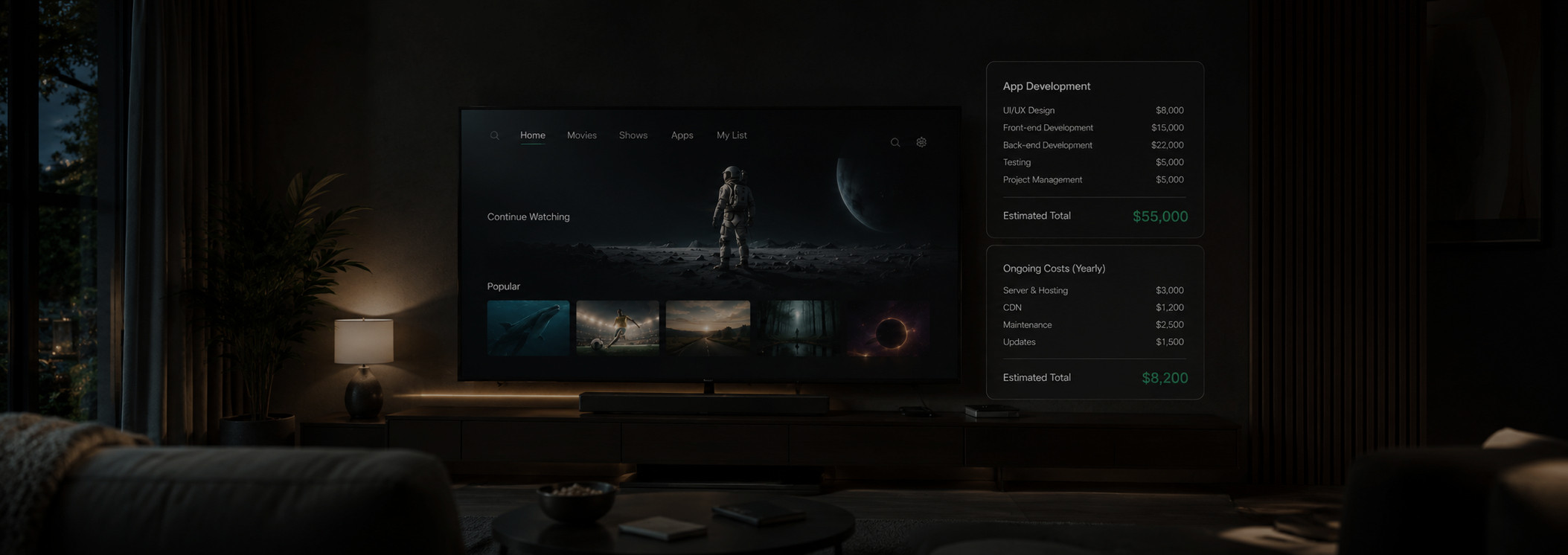
If the question “How much does it cost to build a Smart TV app?” keeps circling, here’s a rough estimate. For a single-platform, basic VOD app with a pre-integrated player and standard UI, the floor sits around $8,000-$15,000 with an experienced team. Below that number, you are typically looking at a white-label template with limited customization, not a purpose-built product, and anything under $8,000 almost always means cutting corners on QA, certification preparation, or both.
Most of the variation in Smart TV app development cost estimates comes down to three things.
Cross-platform is cheaper at the initial build stage when two or more platforms share meaningful architectural overlap, but it can become more expensive over time if the shared codebase grows complex enough that platform-specific workarounds accumulate faster than the savings compound.
For a single-platform build, native is almost always the cleaner choice. For two to four platforms with overlapping feature requirements, a well-designed cross-platform architecture delivers a better budget outcome, particularly when business logic and subscription flows are unified while the player layer stays native per platform.

