













This website uses cookies to help improve your user experience


Behind the gate, the water has been rising for months. It is held there on purpose, kept back from the valley until a date written down well in advance, and on that date, the gate lifts and everything built downstream finds out at once whether it was built well enough. A premium film release is that gate, and the premium in premium video on demand (PVOD) is a charge for time.
People pay it to watch the film everyone wants to see right now, weeks before it lands in a subscription they already pay for. And PVOD streaming is the business of pricing that impatience before the moment passes.
Households pay 25 dollars for a film still fresh from cinemas, and studios manage the height of that gate with real care. The hold ran roughly 90 days a decade ago, narrowed to near 37 to 39 days for wide releases across 2024 and 2025 by Omdia’s count1, and now the biggest titles are held back longer again on purpose, close to 60 days at Disney recently and a planned 45-day floor at Universal from 20272. Each of those numbers sets how high the water climbs before it is let go.
This article delves into the complexities of rights, packaging, entitlement, payment, anti-piracy, and the ability to handle a surge of traffic on a date known to the entire audience. For OTT product owners, broadcasters, and content distributors considering PVOD, defining it is the easy part. The real challenge lies in everything downstream, where the money and risk reside.
Key takeaways:
PVOD stands for premium video on demand. The PVOD meaning that matters to an operator is narrower than any dictionary version: a paid, single-title home release, priced above a standard rental, available earlier than the subscription window, usually as a time-limited rental or an outright purchase.
A premium VOD title rents at a clear markup over a standard release and lands on the living-room app, the web storefront, and mobile in the same release. In practice, that means a studio might open the PVOD window 45 days after the theatrical release, set the rental at $24.99 for 72 hours, and let the platform move the title to standard TVOD two weeks later, all on a schedule fixed in advance.
On a connected television, PVOD TV is simply that transaction in the living room. The household rents a fresh title, watches it on the big screen, and the entitlement follows the account from device to device.
What sets PVOD on demand apart from the rest of a platform’s catalog has nothing to do with the player or the codec. The difference is commercial: a title kept new on purpose, available only for a while, and priced well above its later rental for the short stretch the held window allows.
When the gate lifts, a delivery chain has to hold from end to end, and each link in it carries a business rule as much as a technical step. The reason “upload a movie and charge more” fails is that the value lives in constraints the platform has to enforce precisely, on the schedule the release date sets. What does it actually take to build and operate a successful PVOD service?
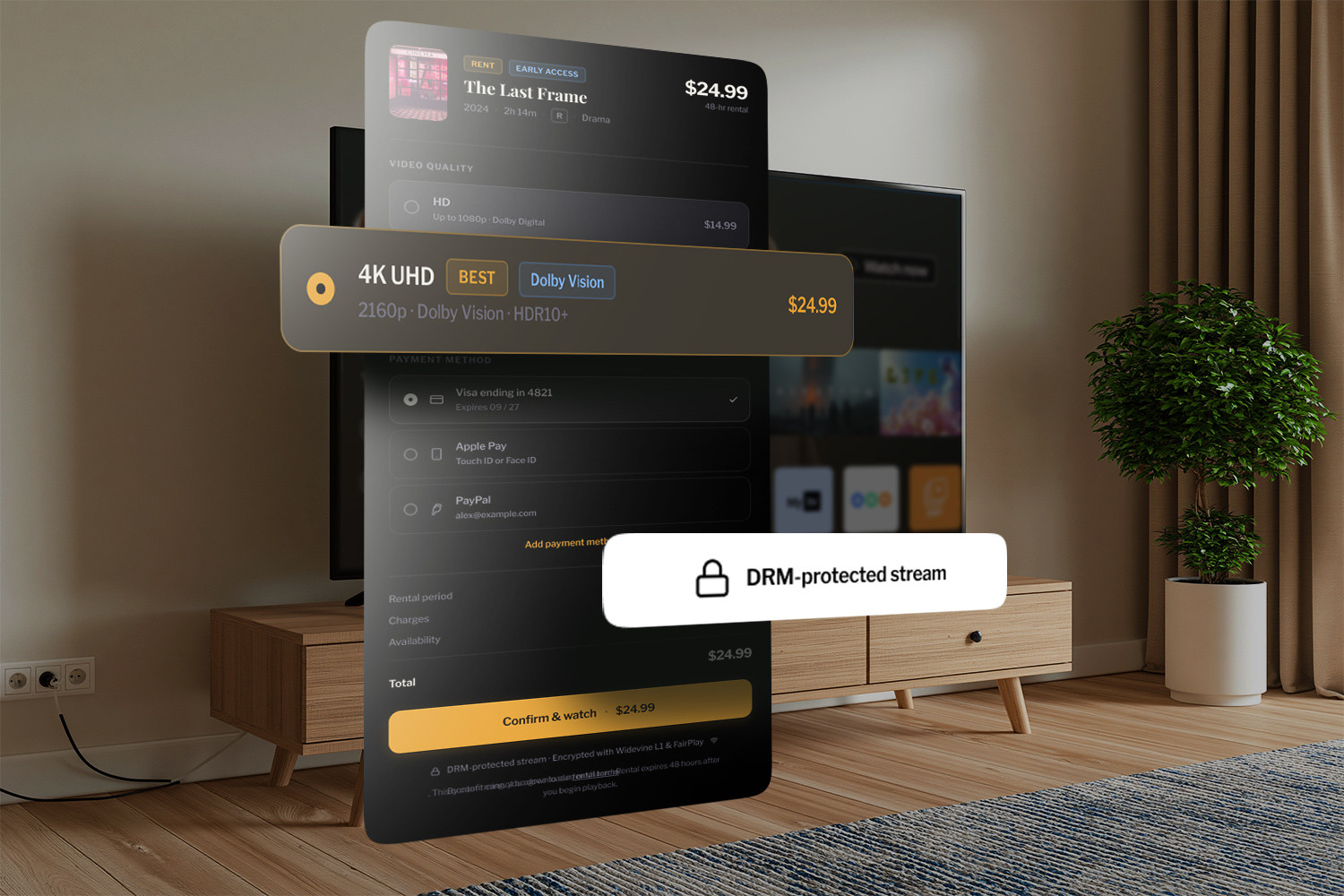
What is held behind the gate is, before anything else, metadata. Every title carries a set of rules that define its commercial reality: start and end datetimes for the premium window, the territories it can play in, the price tier, and the rules for moving it to a standard transactional price once the window closes.
A platform that handles this poorly either opens a title early in the wrong market or fails to drop the price on schedule. And both mistakes cost real money or trigger a licensing dispute.
The studio delivers a high-quality mezzanine file, and the platform transcodes it into adaptive bitrate ladders so playback holds up across connection speeds and screens. HDR and Dolby variants get built where the license allows, because a premium release that looks ordinary undercuts the premium price.
A license ties the title to a specific account and a specific transaction ID, with a short rental clock where the model calls for one. The platform tracks when the rental started, when it expires, and which devices may decrypt the stream.
Getting this wrong in either direction is painful: a viewer locked out of a film they paid for becomes a support escalation, and a license that leaks becomes a piracy problem at the exact point the title is most exposed. The mechanics of how this protection holds together are covered in our breakdown of how DRM works in OTT.
Checkout has to function on web, on the living-room app, and on mobile. And the receipt has to sync so a purchase on a phone is honored on the television ten minutes later.
Premium releases compress buying into a tight window, so a checkout that stutters under load does more than annoy. It bleeds revenue in the first minutes after the gate lifts, when the title is worth the most.
CDN delivery carries the stream, concurrency caps enforce how many devices can watch on one entitlement, and device-level DRM (Widevine, FairPlay, PlayReady) keeps the high-resolution path locked to certified hardware. The experience has to be quiet and instant, because a viewer who paid a premium has very little patience for buffering.
After the stream ends, the financial layer takes over: studio reporting, platform fee splits, chargeback handling, and the reconciliation that tells everyone who earned what. Settlement on a premium night runs tight and time-compressed, and a platform that cannot account for the transactions cleanly will struggle to keep studio partners.
Reading the chain from start to finish will help you understand why PVOD belongs to those with experience running real platforms. A premium release has no soft launch. Its window opens on a fixed date and runs for a set stretch, so every link in the chain has to be right at the same moment, with the busiest and most valuable traffic landing first.
The consumer upside is obvious and barely worth the ink. The business case is the part that decides whether a premium window happens at all.
They get a revenue bridge between the cinema run and the eventual subscription release, which recoups production costs faster and frees up cash. The premium window also captures the most motivated buyers at the price they will tolerate, a form of price discrimination that traditional rental never reached.
Evidence from several recent releases suggests that exhibitors had concerns that an early home release would reduce ticket sales, but that has not been the case. Drop-off rates in the weeks after a film hits premium video on demand have been similar to those in the weeks before.
Titles such as Universal’s The Wild Robot, Twisters, and The Fall Guy reportedly continued to play on thousands of screens after their premium release. Paramount’s Gladiator II even saw a box-office bump around its premium home launch over the holidays. Universal’s film chief has said that the studio would likely have greenlit fewer films without the income that PVOD now generates. This model now influences which films are made.
Streaming platforms and distributors earn far higher margins per transaction than a subscription view returns, and a premium release gives high-intent users a concrete reason to open the app on a specific night. Each transaction also produces clean willingness-to-pay data that sharpens pricing and merchandising for the next release.
A premium window is one of the highest-yield moves in VOD monetization, and it pays off most when it is planned as part of a platform’s wider OTT monetization strategy instead of bolted on for a single title.
For viewers, the main advantage is enjoying a new release at home without having to make a trip to the cinema. For households watching together, this is often cheaper than buying tickets and paying for parking. Although the convenience is real, it is the least interesting part of the equation for those building the platform.

We design and operate VOD platforms for premium releases: windowing and entitlement, DRM and forensic watermarking, payment orchestration, and the headroom to take a release-day surge without buckling.
The PVOD vs SVOD and TVOD comparison is usually framed as a price difference, which misses the point. The three models occupy three positions on a single timeline, each tuned to a different stage of a title’s commercial life, so they rarely compete for the same slot. A studio that understands the sequence earns more from the same film.
| Model | Payment | Content timing | Example |
| PVOD (premium video on demand) | One premium fee per title, rental, or purchase | Earliest paid home window, often a few weeks after cinema and before standard digital | A new theatrical release renting for $20 to $25 |
| TVOD (transactional) | Pay per title at standard price | After the premium window, once the title settles into regular rental and purchase | The same film at $4 to $6 a few weeks later |
| SVOD (subscription) | Flat recurring fee for a whole catalog | Latest, commonly three to four months after the cinema run | Netflix, Disney+, and Max libraries |
As you can see, PVOD is different from AVOD vs. SVOD vs. TVOD. It harvests the early, high-intent demand at the top of the curve.
A film can move through all three in turn, and the spacing between them is the whole monetization play, the heart of any OTT monetization plan worth running.
PVOD is no universal win. And the studios that use it best are the ones most honest about its limits.
A premium ask only works on films people feel they need to see now. Survey data has put most US adults’ willingness to pay for early access well under $10, against a premium price of $20 to $253, which means the model only clears for titles with genuine event demand.
A mid-budget comedy or a quiet drama rarely supports the premium. Forcing it produces weak numbers that read as a failure of the whole approach.
Exhibitors, franchise partners, and licensing counterparts all have a stake in the window, and a studio that collapses it too aggressively risks its relationship with the cinemas that still drive a film’s profile.
The evidence so far suggests an early home release has left ticket sales largely intact, but the argument is title-specific and far from settled, and it reopens with every release. The recent move back toward longer windows at the major studios is, in part, a negotiated peace with that side of the business.
A studio can bypass all this and simply wait for the subscription library release. PVOD only pays for added entitlement logic, payment orchestration, anti-piracy measures, and peak-load engineering if the premium demand for the title is high enough to cover these costs. Below that threshold, the simpler approach is preferable.
Piracy is the sharpest tension in the whole model, and it is, fittingly, a leak. Premium video on demand runs on scarcity, and scarcity pulls the audience together, including the part of it that will take a pristine free copy the instant one appears.
The damage peaks inside the held window, when demand is highest, and a single clean copy spreads fastest. That loads the security stack at the worst possible moment, on the one night the platform cannot afford a crack.
PVOD makes sense for event titles with real urgency, studios that can handle the extra work, and platforms with the technology to protect and expand dated releases.
It makes far less sense for:

When a race goes live, the audience arrives all at once, just like a premium release. Oxagile’s team developed the live streaming and VOD platform for a prominent motorsport media group to support it.
We provided DRM and secure content delivery, monetization, and multi-device access for the business, as well as infrastructure capable of handling surges in traffic when everyone presses play at the same time.
A premium window relies on these exact foundations and is only as good as the platform supporting it on the night it matters.
Anyone can name DRM and a CDN. The hard part of a premium release is everything that has to hold at the same time, under a spike that hits on schedule, and it splits into three fronts.
Session-level forensic watermarking stamps each stream with an invisible marker, so a leaked file traces back to the account and device it came from, and a source can be cut off in hours.
That holds only if the high-resolution HDR path is locked to DRM-certified hardware, which means keeping a tested matrix of phones, tablets, set-top boxes, and Smart TVs and tracking the security level of each. Concurrency limits round it out, capping how many streams one entitlement can open at once, a licensing rule, and a credential-sharing defense in one control.
Storefronts, app-store billing rules, regional tax, currency, and chargebacks all have to reconcile into one ledger. Since a premium release lands every transaction inside a few hours, a weak link there shows up as lost sales in real time.
The same window pulls in stolen cards, account takeovers, and entitlement abuse. That’s why fraud scoring runs live at checkout and at playback, sharp enough to stop the abuse and quick enough to let real buyers through in the same rush.
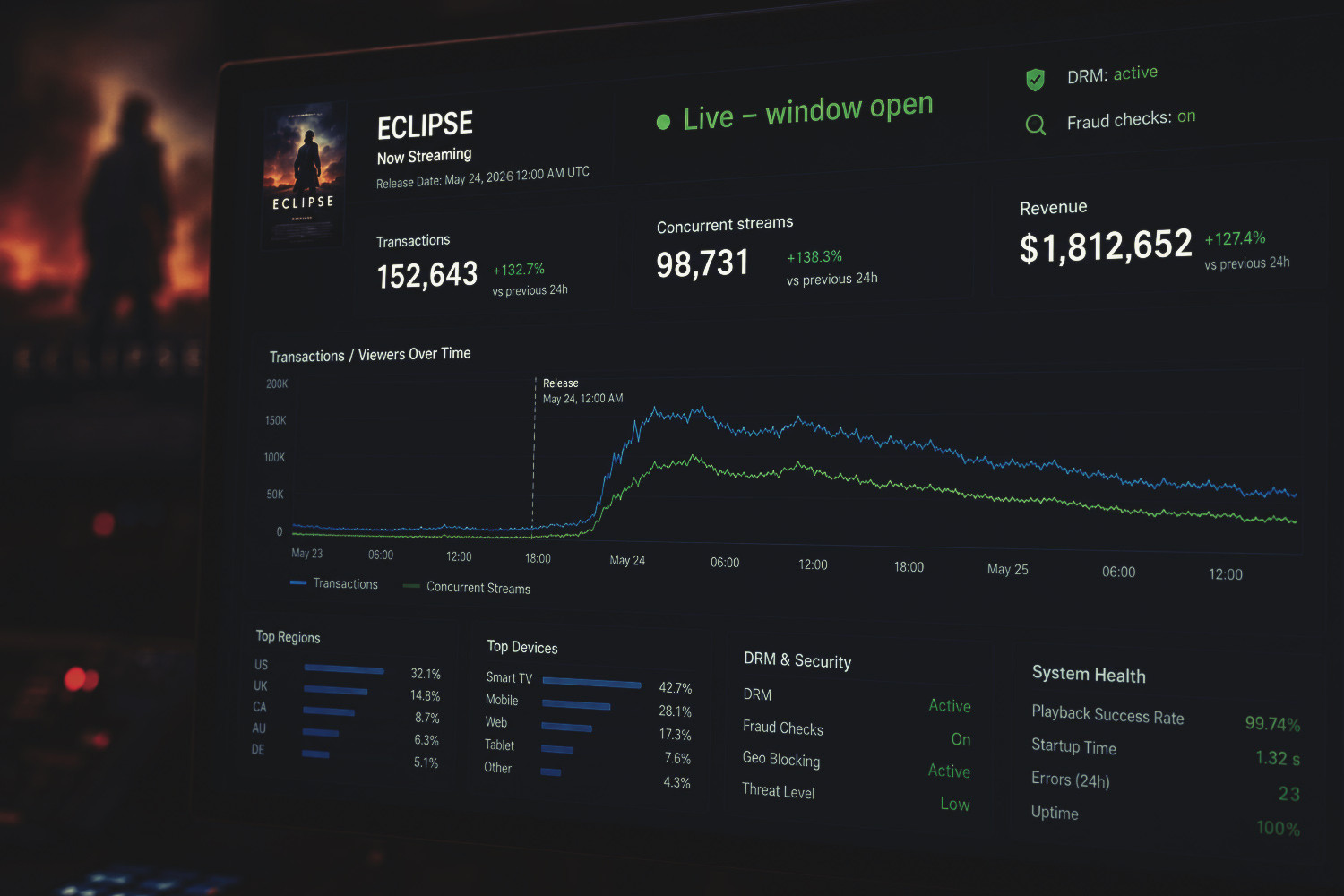
Demand shows up the moment the window opens, climbs hard, then drains away. This means the platform has to carry release-day capacity that sits idle the rest of the year. When it falls short, it falls short in a familiar pattern: checkout queues, entitlement lag, and CDN saturation, all in the first hour.
Feeding off the same surge, the analytics pipeline takes in a flood of events and reconciles them close to real time. The reason for that is that revenue share, fraud signals, and merchandising cannot wait on reporting that lags a day when the window is measured in weeks.
Run all of this as one system under a real launch, and the weak points surface fast, live, with everyone watching. These points need to be handled during a production build based on VOD app development best practices.
A studio uses the premium window again and again, several times a year, on every title big enough to earn it. That exact rhythm should shape any decision to invest in it.
A platform that carries one premium release cleanly has proven very little. The same release, run the same way for every tentpole across a year, each with its own dated surge and its own settlement to reconcile, is what turns PVOD from a stunt into a dependable line on the balance sheet.
That is the kind of build we take on. Oxagile’s expert team designs the premium release as a repeatable operation, hardened against the real conditions of a launch day and steady enough to run on every title that earns the window. If you are weighing PVOD, or any premium-content model, the conversation worth having early is about the operation you will run for years, before any single release date goes on the calendar.
We help streaming platforms, broadcasters, and content owners build and run premium and live releases that hold under real load. Bring us a date or an early idea, and we will map what it takes to run it cleanly, release after release.
1. Theatrical-to-PVOD window lengths average near 60 days (Omdia data) — Celluloid Junkie
2. Universal’s move to a 45-day theatrical window from 2027 — Deadline
3. PVOD Benefits Theatrical Releases & Cinemas? — Dark Horizons
PVOD stands for premium video on demand. It refers to a paid, single-title home release offered earlier than the subscription window and priced above a standard rental, usually as a time-limited rental or a digital purchase.
Yes, and more deliberately than during the pandemic. Studios now treat the premium home window as a standard revenue stage between the theatrical run and the subscription drop.
The trend has reversed from the early rush: studios are stretching the window back out for their biggest titles, holding the premium release roughly two months after the cinema debut, precisely because the premium depends on the title staying scarce for a while.
Premium VOD is more complex because the value is the timing, and the timing carries hard rules. A premium window has start and end datetimes, territory restrictions, a price tier, and a scheduled move to a lower transactional price, all of which the platform has to enforce automatically across every storefront.
A standard catalog title carries none of that pressure. A premium release also packs demand and piracy risk into a short, dated burst, which raises the stakes on every system at once.
The high-resolution, HDR path requires:
Studios typically require the full set before they license a title for a premium UHD window.
PVOD platforms typically have a layered defense:
No single control is enough on its own. The protection comes from operating all of them together, most intensively during the premium window, when the payoff from a stolen copy is highest.

