













This website uses cookies to help improve your user experience




Two OTT platforms launch at roughly the same time, licensing similar content, targeting the same audience, and operating in comparable markets. A year later, their results diverge: one platform steadily grows watch time, improves retention, and opens additional monetization paths, while the other faces churn, uneven engagement, and increasing delivery costs.
The difference comes down to how content is processed, delivered, and monetized. Today, AI application in OTT acts as an operational layer across the entire streaming stack, including content production, metadata generation, delivery optimization, and revenue management. The growing role of AI in OTT influences how streaming platforms scale, engage audiences, and generate value.
It shapes how quickly content reaches viewers, how relevant it feels at a granular level, and how stable playback remains under peak load. These factors directly influence engagement and overall platform performance.
In this article, we examine where AI creates tangible business value in OTT across content, delivery, and monetization.
Key takeaways:
AI is often described as a set of features like recommendations, automation, analytics. This framing misses the main point: impact becomes visible at the level of operations and economics, when AI changes how a platform performs at scale.
OTT artificial intelligence shapes the speed at which content is produced and prepared for distribution, whether it matches user intent precisely, and how efficiently platforms handle traffic, infrastructure, and monetization.
A more practical lens is to focus on outcomes — the areas where AI consistently translates into higher engagement, better cost control, and measurable revenue growth. Below are the parts of the OTT stack where that impact is the most tangible. The best use of AI in OTT typically appears in areas that directly affect engagement, cost efficiency, and monetization outcomes.
One of the most immediate areas of impact is content production. Video processing, tagging, and highlight creation traditionally require significant manual effort, which slows down time-to-market and increases operational costs.
With AI application in streaming, these workflows become faster, more consistent, and easier to scale. Platforms can automatically detect key moments, segment content, and generate ready-to-publish assets without relying on manual editing.

A machine learning model analyzes live matches and automatically generates highlights by identifying key events such as goals, fouls, and crowd reactions. The system combines computer vision, event detection, replay recognition, and object tracking to build structured video segments in real time.
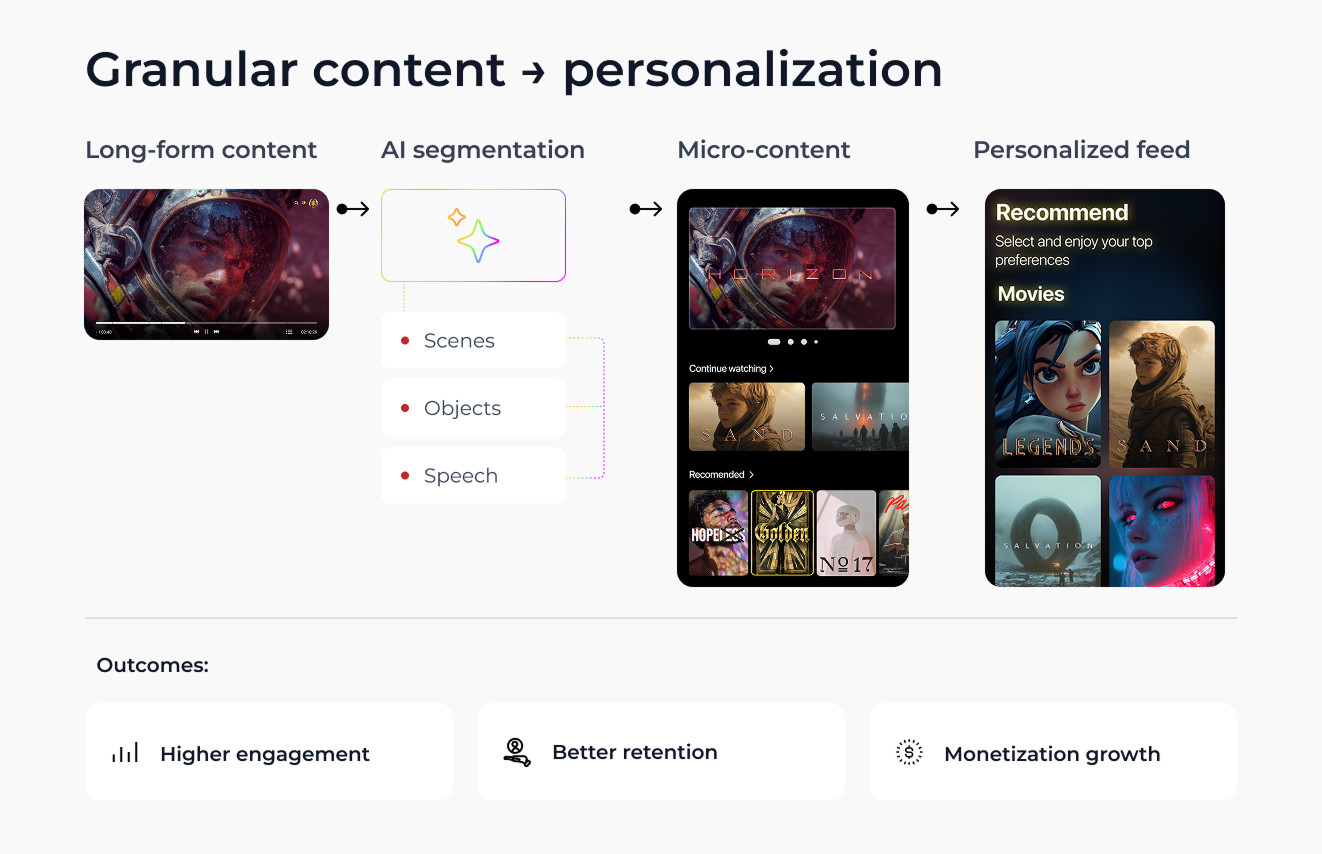
Personalization in streaming is often discussed at the level of recommendation engines, but its real effectiveness depends on how content is structured. The more granular the content, the more precise and relevant recommendations can become.
AI in OTT enables automatic segmentation of long-form video into smaller, context-rich units like highlights, scenes, or micro-moments. These units act as building blocks for deeper and more accurate personalization.
The same logic applies to the sports highlights case above. Once key moments are detected and structured, they support both faster publishing and more targeted distribution. Recommendations can focus on specific moments aligned with user preferences: a goal, a player’s performance, or a particular type of play.
Engagement increases as the gap between user intent and available content becomes smaller. Users spend less time searching and more time interacting with content that feels immediately relevant.
Over time, granular content combined with AI-driven recommendations leads to longer sessions, higher retention, and more opportunities for OTT monetization, especially in ad-supported and hybrid models.
Viewer engagement extends beyond passive playback. Streaming platforms move toward more dynamic formats where content is enriched with real-time data and interactive elements.
In this context, AI application in streaming provides experiences that go beyond watching. Computer vision and real-time analytics connect video with contextual data, turning a viewing session into a more immersive and informative experience.

Oxagile developed a computer vision solution that processes live basketball broadcasts and tracks players directly within the video stream. A connected mobile application allows users to point their device at the screen and instantly access player statistics and performance data.
The solution combines object detection, player tracking, and real-time data processing. Player coordinates are extracted from the video feed, transmitted to the backend, and enriched with analytics before being delivered to the user interface.
Search and discovery define how quickly users find relevant content and whether platforms monetize their libraries effectively or not. At scale, manual tagging and categorization limit both accuracy and speed, especially when content volumes grow.
In this layer, AI in OTT supports automated metadata generation and enrichment. Video streams can be analyzed frame by frame, with models detecting objects, scenes, faces, and spoken language. As a result, content becomes structured at a much deeper level, making it easier to search, recommend, and monetize.
Computer vision and speech recognition play a central role here. Object detection powers identification of visual elements within a scene, automated annotation adds contextual tags, and speech-to-text processing extracts meaning from audio tracks. These capabilities are typically implemented as part of video analysis solutions, forming a foundation for scalable metadata pipelines.
Better metadata directly improves discovery. Users receive more relevant search results, recommendations align more closely with intent, and content libraries remain easy to navigate as they grow.
At the same time, this layer supports monetization. Advertisers gain more precise targeting options, while platforms can package and distribute content in ways that better match audience segments.
Streaming performance directly affects user experience and cost structure. Playback stability, startup time, and buffering behavior shape engagement, whereas encoding efficiency and traffic distribution define infrastructure spend.
In this layer, AI application in streaming supports more adaptive and resource-efficient delivery pipelines. Content-aware encoding analyzes each frame and adjusts compression based on scene complexity, reducing bandwidth usage without compromising perceived quality.
Machine learning also improves traffic handling. Predictive models help anticipate peak loads and adjust CDN routing in advance, lowering the risk of outages during high-demand events. In parallel, anomaly detection identifies playback issues such as black screens, glitches, or bitrate drops, allowing teams to respond before they affect large portions of the audience.
Another important direction is user behavior analysis. By tracking viewing patterns, session length, and interaction signals, models can identify early indicators of churn and trigger retention actions, such as personalized recommendations or targeted offers.
The combined effect is measurable on both sides of the business. Users experience smoother playback and faster start times, and platforms reduce delivery costs and maintain performance under load.
Individual use cases show only part of the picture. Real impact emerges when AI becomes embedded into platform architecture and operates across multiple layers within an OTT platform.
At the data layer, platforms collect signals from multiple sources, including video streams, user interactions, CDN logs, and backend systems. These inputs form the foundation for training and updating machine learning models.
ML pipelines process and transform this data, supporting tasks such as content analysis, recommendation generation, anomaly detection, and user behavior prediction. Continuous updates allow systems to adapt to changing content and audience patterns.
Integration spans several key areas. Recommendation engines use model outputs to personalize content feeds, encoding pipelines adjust video delivery based on content characteristics, and analytics systems convert raw data into actionable insights for business and operations teams.
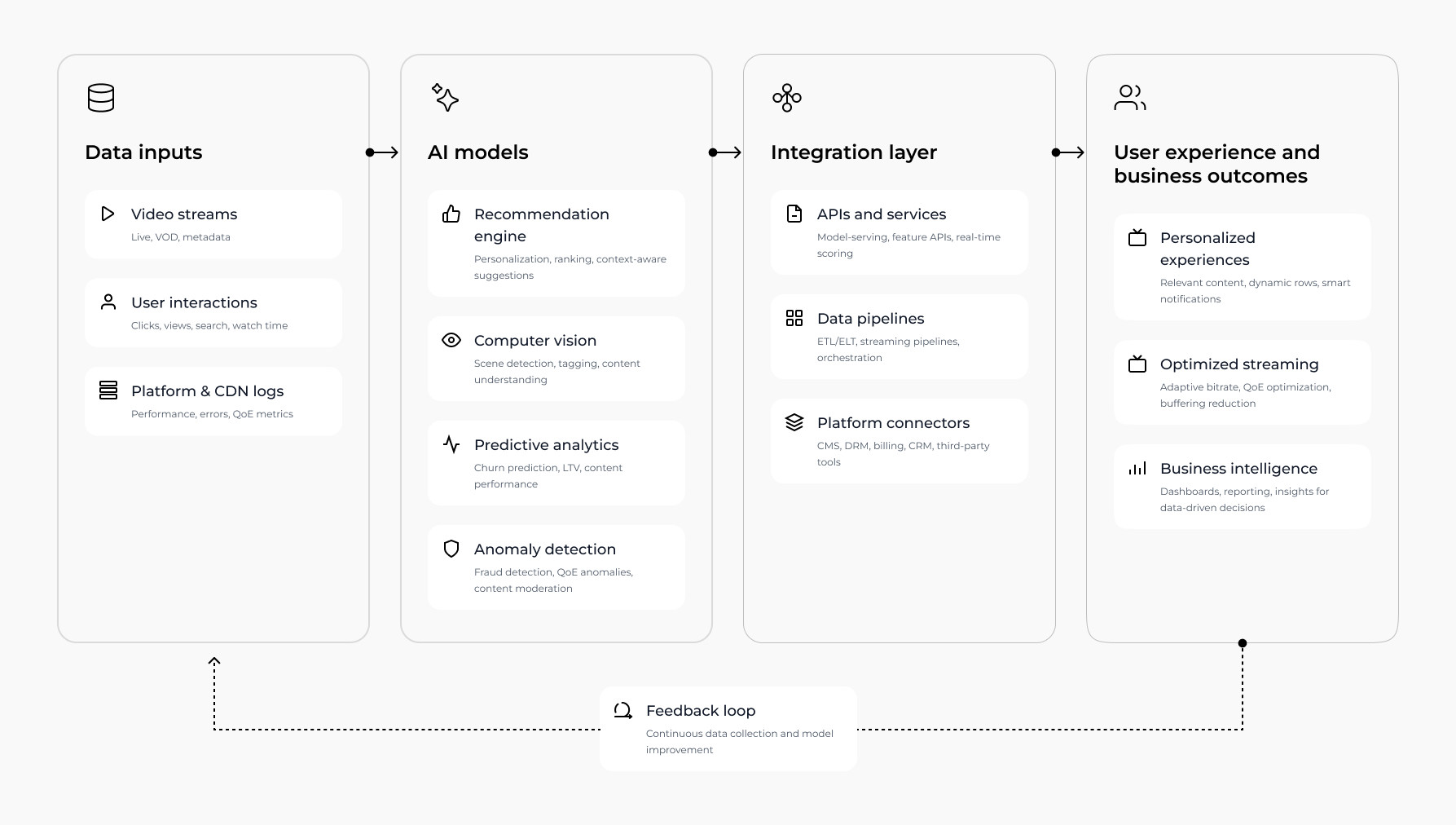
This layered approach allows AI to influence multiple aspects of the platform simultaneously (from what users see to how well content is delivered and monetized).
Many AI initiatives in streaming lose momentum before reaching production. The issue usually lies outside the models: in data, architecture, and how use cases are defined.

The use of AI in streaming tends to either stay at the level of isolated pilots or become part of how the platform operates day to day. The difference comes from how early business goals, data, and architecture are aligned. Oxagile approaches OTT artificial intelligence as a system with a clear path from idea to production.
Work starts with defining where AI can influence core metrics, for instance, retention, watch time, or delivery costs. This stage includes use case prioritization, ROI estimation, and data readiness assessment. The goal is to avoid building models that look promising but do not affect business outcomes.
Once priorities are clear, AI components are designed and integrated into the platform. This includes recommendation systems, personalization engines, analytics pipelines, and content processing workflows. Solutions are built with real production conditions in mind: large content libraries, live traffic, and continuously changing user behavior.
Many OTT platforms require adaptation before AI can operate effectively. Integration points, data accessibility, and pipeline flexibility become critical. Incremental modernization helps introduce these capabilities without disrupting existing services, allowing AI to function as part of the core system.
Leading streaming platforms have already embedded AI into their core operations. Netflix, Amazon Prime, and YouTube use it to shape recommendations, optimize delivery, and refine monetization strategies at scale. The direction is clear: AI defines how modern OTT platforms compete.
At the same time, results depend on execution. Data gaps, rigid architectures, and loosely defined use cases can limit the impact even when the technology is available. Strong outcomes appear when AI is aligned with business goals, supported by the right data, and integrated into production workflows.
For teams evaluating the next step, it helps to look at AI through the lens of platform strategy — how it connects to content, delivery, and revenue, and how it fits into the broader OTT platform architecture.

We help identify high-impact use cases and bring them into production with measurable results.

The most common application of AI in OTT is content personalization. Streaming platforms use behavioral data and viewing patterns to dynamically adjust what each user sees, increasing relevance and session depth without requiring manual curation.
Through AI application in streaming, platforms optimize video delivery in real time. Models adapt encoding parameters to content characteristics, anticipate traffic peaks, and improve CDN routing, resulting in more stable playback and fewer interruptions.
Retention strategies often rely on AI OTT models that detect early signals of disengagement. Changes in viewing frequency, shorter sessions, or reduced interaction can trigger automated responses such as tailored recommendations or targeted offers.
With OTT artificial intelligence, personalization is built on controlled data usage. Platforms combine anonymization, aggregated signals, and transparent data handling practices to deliver relevant experiences while maintaining compliance and user trust.

