











This website uses cookies to help improve your user experience




The verdict on OTT front end solutions from viewers comes fast today.
Sometimes in the glow of a 55-inch living room screen, sometimes on a phone in a subway tunnel. But it doesn’t take years for a user to decide whether this experience feels like theirs.
Content parity grows stronger: the same leagues, the same studio rights, the same release windows. So what is left to own is the feeling. The spark of recognition when the brand matches the user’s expectation, when “continue watching” aligns with the thumb’s natural path. Users now carry in their heads the muscle memory of many streaming interfaces, and if you break that muscle memory, the reaction might be instant. Gone are the days when switching providers meant returning a set-top box, calling customer support, and waiting for a technician. Today, the barrier is a few taps: “delete app”, “download a new one from the store”.
Bet here lies the first paradox carved into the stone:
Being familiar is essential. Yet being too familiar means disappearing into the white-label fog.
To survive… No, to rule the video streaming kingdom, an OTT service must now perform two miracles at once. First, keep up with the level of ritual consistency. Second, forge instant, unmistakable recognizability with a unique interaction that becomes a signature users associate with a specific brand rather than “just another app”.
And as if things were not complicated enough, a third curse arises: platform coverage. Even the most consistent and recognizable interface fails if it appears only on a few favored platforms.
This leaves us with three roads leading to a single destination: an application that is simultaneously unique, familiar, and present everywhere the viewer might appear.
For centuries (well, since 2000s, which in streaming years is forever) frontend developers, designers, and other shamans have whispered tales about what it takes to make all three cross and make an app so functional and beautiful that it can become the reason subscribers forget the password to the competition.

Today, Alexey Zaberezhniy, a video solutions system analyst at Oxagile who has successfully guided complex, production-grade frontends across a wide range of platforms and device families, emerges from the front lines of live projects to separate myth from truth.
Together, we will examine the real price and hidden power of custom frontend development and place it side by side with the fast-deploy white-label path. By the end, you gain a practical OTT front end tutorial to help you decide what to build, what to buy, and why.

They say it around the campfires of every OTT project kick-off: add luxury and you will sacrifice speed, chase speed and you will surrender advanced functionality, focus on familiar design and you will limit how far you can innovate.
Ten years ago this sounded almost practical. A functional streaming app was a modest affair: a few rails, fixed-size posters, a search icon, and a hope that the CDN would behave. For years the industry repeated a comforting story that a standard off-the-shelf frontend could save time, reduce risk, and ship a predictable experience.
Then the titans rewrote the liturgy. The moment Netflix, Disney, and Amazon began shaping new visual norms, a generic white-label skin stopped reading as neutral. It began reading as “we are too safe to stand out”.
The keeper of the OTT truths:
“Modern streaming products rely on distinct container types, hero modules, tailored navigation patterns, metadata-driven layouts, and platform-specific behavior. None of this comes ready to wear. A brand that wants to differentiate inevitably moves toward deeper customization.”
And customization today is not a coat of paint. It is richer UX logic at the edge of playback, enhanced carousels, dynamic hero modules, personalized flows, original typefaces, micro-interactions, parallax hero sections, animated gradients, shoppable videos, interactive layers, and more. Yet every flourish also carries a tax as well: a heavier render tree, more memory pressure, more complexity to optimize.
So, on paper the old triangle of choosing between “beautiful, fast, native” seems inevitable, right?
The keeper of the OTT truths:
“Many often mistake “original and beautiful” for “more features, more elements, more of everything”. Yet every extra element has a cost. On small TVs layouts bend out of shape. On older devices animations stumble. On some platforms an original transition suddenly loses its grace. The real task, therefore, is not to shy away from custom design, but to carry its weight so the user experiences nothing but a fluent, unified interface.
The danger is not beauty. The danger is excess.
Add too much functionality and you end up with eight buttons and fifteen hops to perform one simple action. Which is why a single thread runs through all our projects: balance. Enough capability to honor the brand, enough clarity to prevent fatigue, enough performance to keep the journey smooth.”
So when it comes to over the top front end, beauty, nativity, and speed are not isolated qualities. They form a single ecosystem where aesthetic strength is inseparable from how gracefully the interface adapts to different screens and honors native interaction patterns. So when a brand comes to Oxagile ready to pursue true customization, the old triangle does not disappear. It simply becomes our responsibility to solve it without surrendering any of its sides.
On the surface the myth sounds reasonable. Why wrestle with custom design and performance tuning when you can buy a ready-made solution, take a skilled front end OTT engineer, and launch it in weeks? If the plan is to serve a modest audience, complement a telecom bundle, or simply test a market, an out-of-the-box UI can get the job done. It works reliably because it barely changes and dares almost nothing visually. It launches quickly because it treats every customer the same.
But that sameness is exactly why white-label frontends stop working once the ambition grows.
The keeper of the OTT truths:
“A boxed solution has to serve hundreds of clients at once. When, for instance, one customer out of 500 asks for a new feature or a unique UX pattern, the vendor has to make absolutely sure it won’t break, or even slightly annoy, the other 499. A single innovation must be audited across dozens of device types, bundled into the next major release, synchronized with long-term product roadmaps, and coordinated with support teams before it can reach real users. And since white-label vendors prioritize stability and multi-client compatibility, feature velocity is really slow there. So in practice this means that market-shaping features appear first in custom-built products and, in the best-case scenario, only arrive in boxed solutions a year or two later.
With custom frontend development, the dynamic is the opposite. For instance, our teams working on custom frontend release frequently because the client owns the entire surface. We do not wait for global rollouts, backward-compatibility checks across dozens of clients, or synchronized release trains. We can ship every two weeks, sometimes faster, so the frontend evolves in step with the brand’s strategy rather than the vendor’s calendar.”
Support and maintenance tell the same story. Updating a white-label platform requires revalidating every change against every deployment in the vendor’s portfolio. If one customer updates and another delays, the vendor must support two versions simultaneously. This slows down all future delivery. In a custom setup, updates behave like they should: change their own codebase, test it once, and release it cleanly.
So white-label absolutely has its place. It is ideal for small operators, early experiments, pilot launches, or businesses where the streaming service is a side offering rather than a strategic core. But for large brands — the ones competing on identity, innovation, and user loyalty — a boxed frontend quickly becomes a ceiling.
The keeper of the OTT truths:
“This is why many of our clients choose custom OTT development from day one. Not because white-label is “bad”, but because it cannot keep pace with the level of differentiation they expect.”

Uneven navigation across devices, performance drops on legacy TVs, and feature work slowed down by fragmented code paths?
We’ve stopped these failures in real cross-platform rollouts and can give you a concrete roadmap to prevent them in yours.
The promise of “multi-screen” often sounds simpler than it is. A user grows familiar with how a brand feels on their phone: the gestures, the density of UI, the rhythm of tapping through content — and they expect that same intuition to follow them onto a tablet and on any Smart TV and vice versa.
But each device has its own rules. A small phone accepts only a limited number of UI elements, while a TV remote forces a completely different navigation logic. Layouts stretch, compress, or collide with hardware constraints. And yet, the user still expects the signature experience of that exact provider, the one they intentionally chose because the interface “feels right”.
The keeper of the OTT truths:
“Maintaining this sense of familiarity across such different environments is not a matter of copy-paste design. It’s high-precision work: carrying the recognizable style, navigation logic, and content-consumption patterns through every device and OS while keeping each version truly native.
When it’s impossible to replicate a behavior exactly, we craft equivalent mechanics that feel natural for that platform but still unmistakably belong to the same brand. Here engineering and design converge at their highest level — preserving continuity without forcing sameness, ensuring that a user moving from phone to TV immediately knows they are still home.”
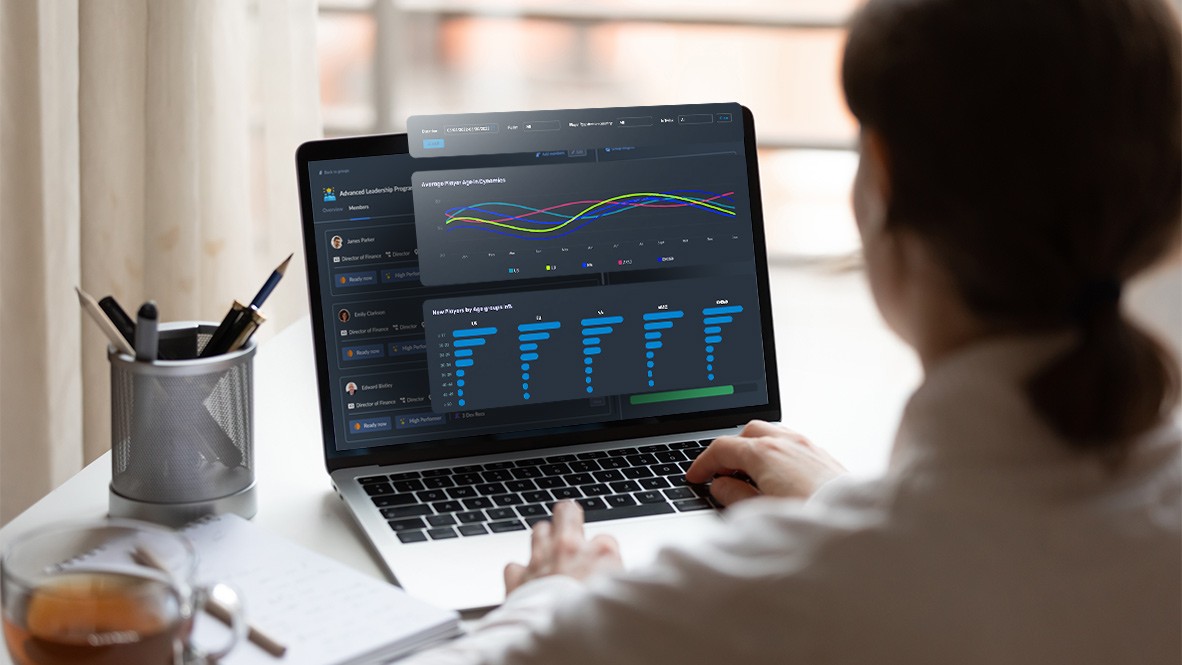
For a major European telecom operator, Oxagile delivered an enterprise-level OTT solution that ran smoothly across mobile, web and multiple Smart TV platforms. A single business-logic core powered everything, while each device received its own UI tailored to its capabilities.
The impact: one unified engine feeding four different frontends, faster updates, consistent features and a scalable user experience without rebuilding logic for every platform.

There is a comforting belief that tools like React Native, Flutter, Tauri or WebOS SDK finally deliver the holy grail of development. One codebase, universal behavior, flawless experience on every device. But the reality is a bit different.
The keeper of the OTT truths:
“We recently had a project where speed and universality were the priority, yet we still ended up writing native implementations for each platform, because this is simply how it works everywhere. Cross-platform tools can cover the basics, but the moment you need deeper system behavior, richer media logic or advanced device-specific features, the abstraction layer runs out of room.”
Cross-platform frameworks can abstract a lot, but they cannot abstract the entire DNA of an operating system. Android gives you a rich set of system calls, iOS exposes different ones, WebOS comes with its own constraints. A shared layer can’t cover all that diversity.
So you get the essentials, the “shared baseline”, which can still make the frontend feel smooth, responsive, and convenient, and yet the strongest results are achieved only through native development. That is why well-performing frontends always blend cross-platform speed with native power. The frameworks help you start faster, but the finishing touches still belong to the platform itself.
There is a common fear that custom development is a budget killer, because everything supposedly has to be built from the ground up. The truth is far more practical. Custom does not mean crafting every brick by hand. In many real-world Oxagile projects, the smartest move was to build a shared core that handles the business logic once and then feeds multiple platforms.
The keeper of the OTT truths:
“We saw this approach work beautifully in many of our clients’ ecosystems. They rely on a unified SDK that carries all business logic in one clean, consistent layer. The UIs are different across devices, sure, but the core stays the same. When a new feature requires new data, you raise it once in the SDK, and it becomes instantly available on every frontend.
A TV app might display only two fields while mobile shows six, but the backend logic remains intact and future-proof. When you change something in the core, all platforms automatically gain access to the updated logic. That is not expensive chaos, but rather efficient engineering.”
And even when the project sits under a white-label umbrella, the principle is the same. A business can save enormous amounts of time and cost by maintaining a single source of truth for the logic, while each platform expresses it through its own UI personality.
Custom development becomes expensive only when every platform reinvents the wheel. But when you build a unified, well-structured core and let each UI layer simply interpret it, you get the best of both worlds: consistency, flexibility, and cost efficiency.
And so, the tales of OTT frontend development reveal their true contours. The path to the viewer’s heart is neither linear nor simple, but as Oxagile’s project experience shows, it is crucial to know where to maintain familiar interactions and where to introduce unique elements so that the product remains recognizable while standing out from competitors.
No matter what storytellers of legends might claim, real-world experience is clear: an effective OTT frontend exists at the intersection of familiarity and distinctiveness. It must feel intuitive to users while carrying its own identity. And all of this must account for the fact that each platform imposes its own constraints, and what works naturally on a phone may need careful adaptation for a TV or a tablet. Cross-platform frameworks can handle the common layers but make sure when you hire front end OTT engineers that they still understand the nuances of interaction, performance, and presentation that often require platform-specific solutions.
At the same time, on every project we work on, we are guided by the most grounded fact of all: underlying architecture plays a decisive role. To keep a sane balance between speed, cost, and a visually strong product, the backend can remain unified — even boxed or mostly standardized — while the frontend has to be adapted per platform and screen. That split is what prevents budgets from inflating and, at the same time, avoids the “one-size-fits-none” UI problem that appears when a single frontend is stretched across phones, tablets, TVs, and everything in between.
We’ll pinpoint where the friction hides: in broken focus flows, delayed visual feedback, awkward remote navigation, overloaded screens, inconsistent transitions, or slow playback actions.
We know the behavioral limits of each platform and eliminate churn before it ever shows up in your reports.

OTT front end solutions define how viewers experience a streaming service across devices, from Smart TVs and mobile apps to web platforms. They combine UI, interaction logic, performance optimization, and platform-specific behavior. A well-designed OTT frontend directly influences retention, engagement, and how strongly users associate the experience with your brand rather than with the underlying platform.
A front end OTT engineer designs and builds user interfaces that work reliably across highly fragmented device ecosystems. This includes adapting layouts for different screen sizes, optimizing performance for constrained hardware, integrating playback and DRM flows, and ensuring that navigation feels native on each platform. The role sits at the intersection of UX, performance engineering, and platform-specific development.
This article is not a step-by-step coding tutorial, but it is designed as a practical, experience-based guide. It walks through real architectural choices, common misconceptions, and proven patterns used in production OTT frontends. The goal is to help decision-makers and technical teams understand what to build, what to customize, and where trade-offs truly exist.
You should hire a front end OTT engineer when your streaming product needs to scale across platforms without losing performance or identity. This is especially critical when white-label solutions begin to limit differentiation, when platform-specific issues impact user experience, or when feature delivery slows due to frontend complexity. An experienced OTT engineer helps avoid costly rewrites and ensures long-term flexibility.

