










This website uses cookies to help improve your user experience
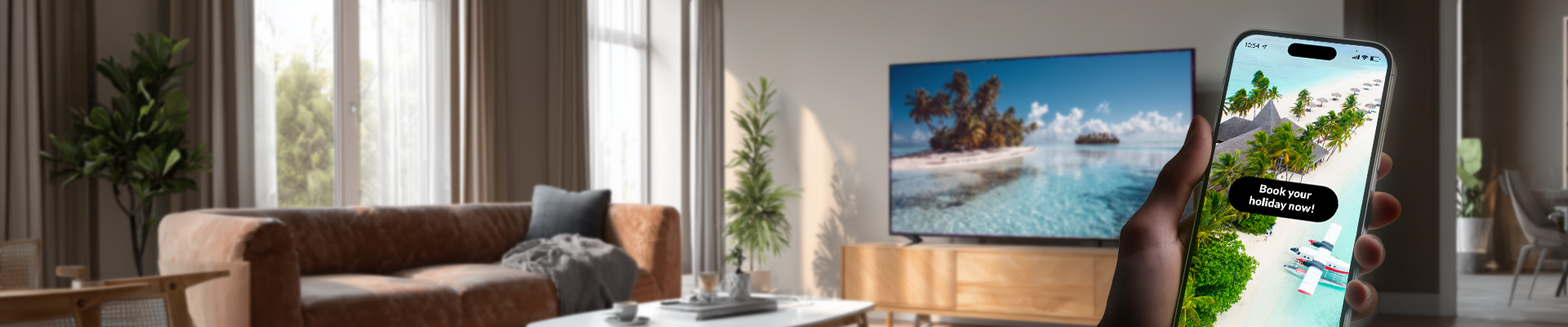



The line between watching a stream and scrolling on a smartphone, tablet, or laptop has never been thinner (if it still exists at all). And while television and streaming platforms continue to deliver vast reach, the modern audience’s attention is fractured, constantly shifting, and politely unwilling to linger in one place for long.
For brands, broadcasters, and ad agencies, this once-unsolvable dilemma has already found a clear answer: second screen advertising (SSA). Let’s dive in to see what it’s used for and why it deserves attention.
What is second screen advertising? Essentially, it is a strategy of linking the primary screen (TV or streaming content) with a companion device (smartphone, tablet, or laptop) to drive active engagement and tangible business outcomes.
Advertising the second screen basically means extending a campaign’s story beyond the main screen. It’s about turning distraction into engagement and a split focus into a shared experience.
The payoff is obvious: you create a synchronized moment where viewers can instantly act on what they see on TV, be it by engaging in polls exploring products, or claiming offers. With every interaction, participation deepens and revenue follows.
But though SSA is an idea that everyone seems to willingly nod along to, when budgets tighten even a bit or priorities wobble, it’s usually the first to be shelved as something complex, costly, and slow to prove its worth.
It doesn’t have to be that way.
As practitioners of a pragmatic approach to any kind of second screen development, we’ve proven many times that SSA’s strength lies not in technical novelty but in its ability to transform divided, fleeting attention into straightforward, incremental ROI.

You can count on our experts to build such solutions that capture attention where it matters most on various screens.
If you’re still thinking about delaying the adoption of second screen advertising, the numbers suggest you shouldn’t.
According to Nielsen, 88% of Americans use a second digital device while watching TV1, turning living rooms into multitasking ecosystems rather than single-screen spaces. MNTN Research adds that most TV viewers hold a mobile device, tablet, laptop, or e-reader in hand while watching, and 65% use that second screen to look up information or visit an advertiser’s site — often searching for actors, storylines, teams, or products they’ve just seen on TV2.
The behavior gets even more pronounced in live events. A study found that nearly half of football viewers use two or more screens simultaneously, and 69% reach for a phone or laptop right after seeing an ad to learn more about the product or service featured3.
This is one of the reasons why many broadcasters invest extra effort in creating magnetic second screen apps for sports fans: to make sure the action doesn’t stop at the TV but continues in their hands. The right development and feature choices can keep them hooked, not just watching the game but living it and taking action on every screen.
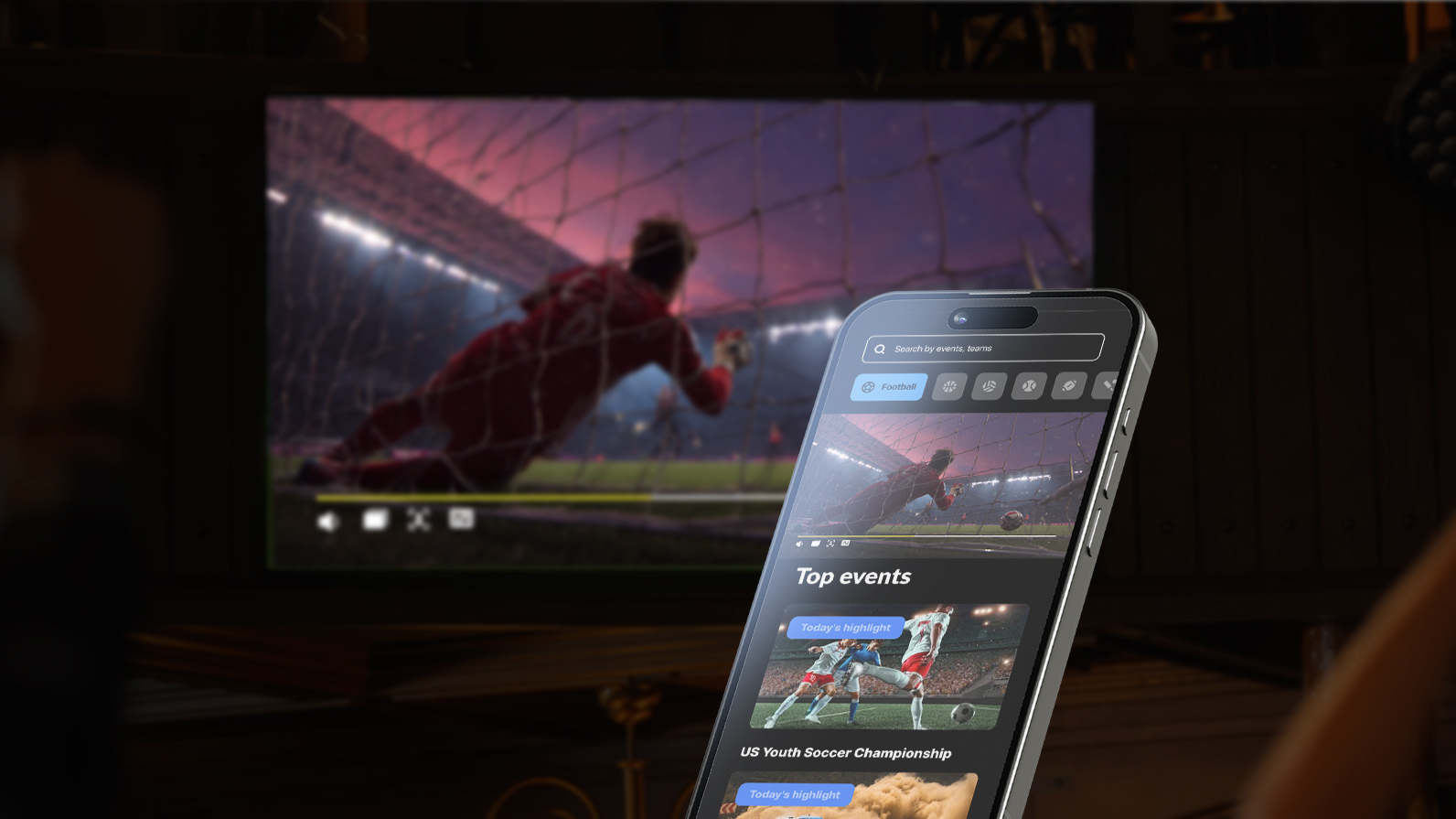
A national satellite TV provider turned to Oxagile to build a high-performing second-screen app for sports fans. The app lets fans make predictions, join live polls, and participate in real-time chats while watching the match on their big screen.
Behind the scenes:
What happens when the second screen becomes first in engagement?
Second screen mobile advertising is hardly just “let’s show a mobile ad on smartphones while the TV is on.” It’s a coordinated choreography of attention: when the viewer’s eyes are on another screen, the story simultaneously leaps to their device in a meaningful way. The magic happens when an ad on the main screen directly triggers, mirrors, or complements an experience on a companion device, turning fragmented attention into measurable action.
The core idea is synchronization. In milliseconds. A 30-second spot on TV can launch a mobile notification, app banner, or shoppable overlay at precisely the same moment as the viewer’s attention peaks. When done right, this doesn’t interrupt the viewer but completes the narrative.
Here are six mechanisms that SSA can use, followed by fresh evidence from our experience.
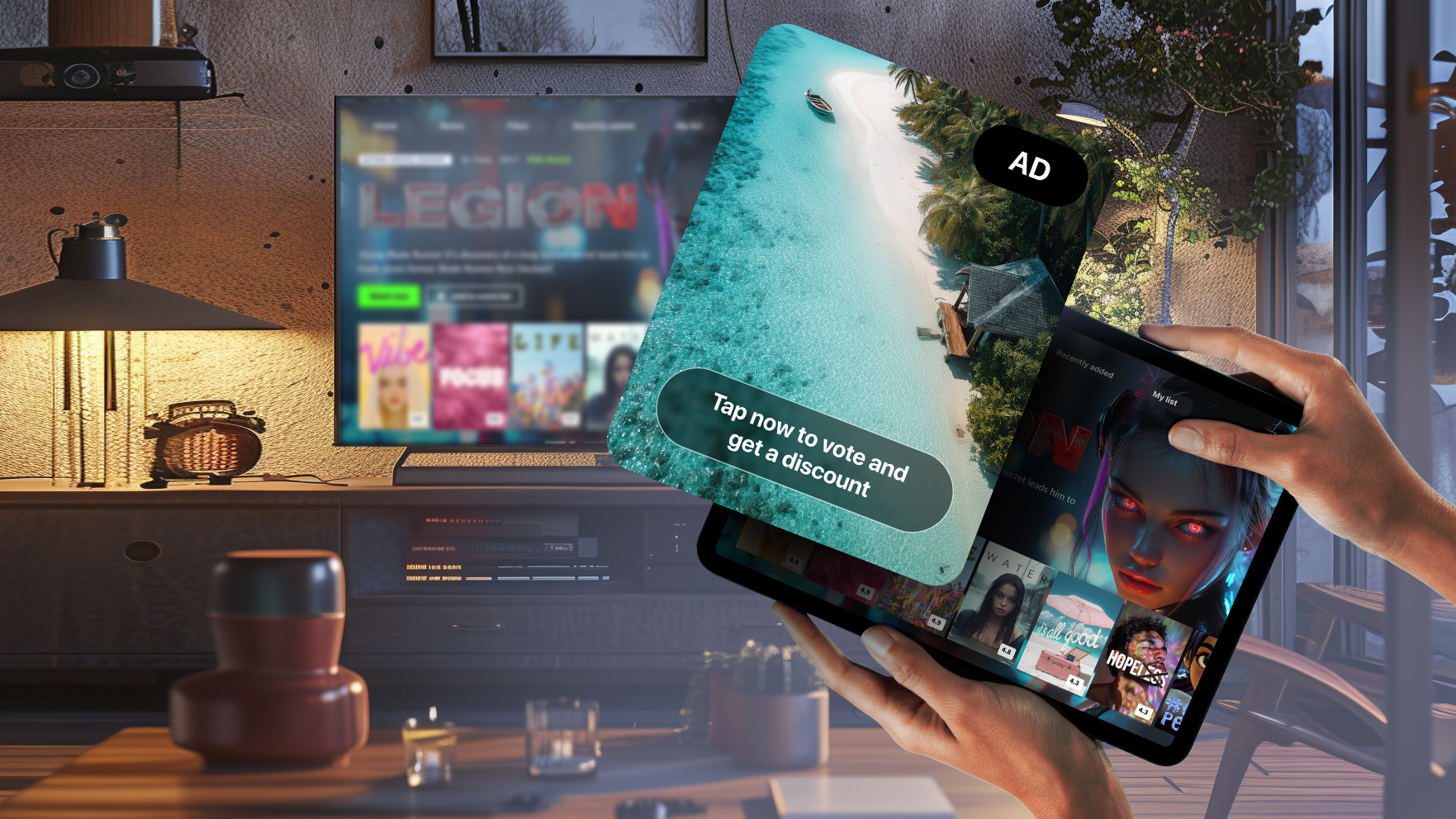
A viewer watches a live show or event on the big screen. At a key moment, a push notification arrives on their mobile/tablet: “Tap now to vote and get a discount”, “Claim this limited offer”, or “Get behind-the-scenes footage”. The app is synchronized with the broadcast.
Why it’s a win:
A timely prompt meets the viewer at the emotional or decision peak — while excitement, curiosity, or urgency are already elevated — so response rates and completion rates rise compared with untimed outreach.
While a TV spot runs or a streaming ad is playing, a mobile or tablet ad appears using the same visuals or message. It directs the viewer to interactive modules, a shoppable experience, a product page, promo landing pages, or content hub that complements the main TV message.
Why it’s a win:
It reinforces brand message across devices and moves viewers from “see and hear” to “click and act”. With just one swipe or click, the distance between impulse and action nearly disappears — shortening the funnel, lifting conversions, and reclaiming the attention that usually drifts into background scrolling.
A campaign runs CTV ads to achieve scaled reach on the big screen and then, immediately or shortly after, serves the same audience with mobile second screen ads or web display ads informed by that TV exposure — effectively linking TV to mobile and keeping the journey continuous.
Why it’s a win:
This approach bridges broadcast investment with digital attribution, turning broad awareness into measurable action. It enables advertisers to directly track and optimize outcomes.
During a live broadcast — a big game, an awards show, or a series finale — the companion device turns interactive: quizzes, polls, fan voting, and live social feeds launch in sync with the action, triggered by the brand’s ad or sponsorship. This transforms passive viewing into active participation, amplifying engagement, creating memorable moments, and building stronger emotional connections between viewers and the brand.
Why it’s a win:
Participatory moments like voting, entering a contest, or unlocking exclusive content turn ephemeral viewing into memorable experiences that stick with people and strengthen brand recall. A recent Swedish study of second‑screen apps found that social features and interactive elements were central motivators for 20-40 year‑olds using companion devices, confirming that real‑time interactivity is a powerful engagement driver4.
The main screen sets the narrative, the brand sparks desire, and the companion device turns that interest into action. Second screen advertising examples often include interactive prompts such as “Swipe to buy”, “Tap to reserve”, or “Scan to redeem”. For instance, while a footwear ad runs on TV, a synchronized mobile ad can surface a one‑click purchase button or “see inventory” option, so the viewer can complete the transaction in the same viewing session.
Why it’s a win:
This approach converts awareness into immediate commerce, shortening the path from inspiration to purchase and capturing intent while it’s hot. A new study from LG Ad Solutions found that 53% of connected TV (CTV) users wish all TV ads had a quick option to buy the product, and 63% wish they could see store/brand inventory from their TV5.
After the TV ad or broadcast ends, the companion device becomes the follow-up channel: it serves supplementary content, targeted messages tailored to what viewers watched, and retargeting for households that may have missed the spot or were multitasking.
For example, mobile ads or in‑app prompts can be triggered only to households that were logged as “tuned‑in” during the broadcast, delivering reminders, extended creatives, or special offers that continue the conversation.
Why it’s a win:
This tactic extends the value of the broadcast by recapturing split attention, reaching viewers who didn’t fully see the ad, and amplifying the original message. The result is a higher return on the TV investment through incremental reach, improved message frequency, and clearer measurement of downstream actions.
By breaking down SSA into these distinct mechanisms, brands and agencies can see how to operationalize it — instead of treating second-screen as a vague “nice to have”. By aligning each mechanism with a business objective (engagement, conversion, attribution, retention) and a technical execution (push notification, synced banner, interactive app) and acknowledging that when people watch, they also hold another device — their job becomes less about fighting distraction and more about utilizing companion behavior.
The message is clear from many sides — across advertisers, publishers, and brands — you can’t own attention if you’re not where it moves. And SSA doesn’t just meet the audience where they are. It keeps them there, engaged, responsive, and measurable.
At Oxagile, we keep ourselves accountable to the same rule we’ve been preaching here — attention must translate into action. So if you want to turn second-screen potential into sustained audience value, we’ll help you connect the creative, commercial, and technical dots that make engagement measurable and growth inevitable.
Because the audience isn’t waiting. They’re already tapping.
As a trusted AdTech partner, Oxagile powers the infrastructure behind smarter advertising — helping you turn data into results that matter.
1. 88% of Americans use a second screen while watching TV — Ars Technica
2. An Exploration of Second-Screen Use by TV Viewers — MNTN Research
3. Advocado Survey Finds 49% of Viewers Use Multiple Screens to Follow the Big Game — PR Newswire
4. Enhancing User Engagement Through Second Screen Apps — “A study on Sveriges Television AB and the companion app Duo” by Isabella Viksten
5. The Shoppable TV Report: 2024 and Beyond by LG Ad Solutions — LG

Second screen advertising (SSA) is a method of synchronizing ads on a companion device like a smartphone, tablet, or laptop, with content playing on a primary screen, like TV or connected TV (CTV).
Instead of passive viewing, SSA transforms audiences into active participants by triggering interactive experiences, shoppable overlays, or contextual prompts that can be tracked, measured, and optimized in real time. This creates a direct link between storytelling and measurable performance, making each ad moment accountable.
Advertising the second screen involves integrating companion-device activations into your media mix. Brands, agencies, and broadcasters can use timecode triggers, watermarking, or audio recognition to launch synchronized ads, push notifications, or in-app interactions. The key is to extend the narrative from the main screen to the second device in a way that complements the viewer’s experience.
Second screen advertising examples cut across industries, turning passive viewers into active participants.
These scenarios highlight how SSA transforms fleeting attention into trackable engagement, seamlessly linking storytelling to commerce in ways traditional TV cannot. By synchronizing the moment with the device in hand, brands, agencies, and broadcasters can capture both emotion and intent in real time.
Second screen mobile advertising targets devices that are always within reach, turning distraction into opportunity. Mobile companion ads, including in-app banners, push notifications, or interactive video cards, can capture instant responses, shorten the path from impulse to conversion, and generate first-party data without relying on invasive tracking.
Contextual micro-personalization based on the viewers’ real-time main-screen activity ensures higher engagement, lower drop-off, and more measurable ROI than standard dynamic creative alone.

