












This website uses cookies to help improve your user experience




If attention is the currency of modern marketing, then every brand, broadcaster, and advertising agency is battling a kind of inflation: the more screens we have, the less value any single one can hold. Yet ironically, it’s these very players who stand to gain the most from second screen advertising (SSA).
Each plays a distinct role in the media food chain, but all share the same tension of the times: audiences are watching everything, everywhere, all at once, and no one’s attention stays still long enough to bill for it.
What follows are three industry perspectives — from brands, broadcasters, and advertising agencies — on the benefits of second screen advertising for each of them and how they can convert fragmented attention into a significant growth engine.
Such campaigns don’t unfold in a vacuum, they live inside a tangled network of interests, incentives, and experiments. Every player in the media chain is testing how far this format can stretch: can it drive measurable impact, justify creative risks, or finally sync the rhythm between broadcast and digital?
We’ve collaborated with all corners of this ecosystem:
Across projects, one truth emerged: every stakeholder approaches SSA with its own anxieties, ambitions, and KPI-shaped dreams.
So we listened. We collected the most recurring concerns and the questions echoing in every client briefing, and unpacked how second screen ads can turn each of those challenges into a springboard for deeper engagement, tangible ROI, and sustainable growth.

“Brand building and creative glory are fine — until report time. Then every client asks the same thing: what did it do for sales?”
When a TV or CTV spot syncs with a companion-device activation — a shoppable mobile overlay, a push notification, or an interactive in-app card — every viewer interaction becomes traceable. SSA platforms use timecode-based triggers, audio fingerprinting, or first-party app signals to match the exact broadcast moment with digital behavior, in real time and without breaching user privacy.
That means agencies can now map a clear cause-and-effect chain:
Engagement is logged as deterministic, timestamped data that integrates seamlessly with analytics dashboards, turning what used to be “brand impact” into verifiable KPIs.
Agencies that adopt this model gain a distinct competitive edge: the ability to show real-time proof of performance and regulatory compliance.
So, SSA doesn’t make TV redundant, but rather it makes it accountable.
“We already do dynamic creative and personalization. What makes SSA special?”
Standard dynamic creative optimization (DCO) personalizes by who the audience is. SSA personalizes by when and what they’re experiencing. Through ACR, watermarking, or timecode synchronization, a second-screen ad platform can detect exactly what’s on the primary screen in real time — and match the creative to that context within milliseconds.
That means personalization isn’t based on a static segment or a past behavior, but on the live moment of engagement. During a cooking show, a grocery brand can trigger a “Buy the ingredients now” banner the second a recipe airs. During a live match, a sports retailer can surface “Shop the gear they’re wearing right now.” During a drama premiere, a streaming service can prompt “Add the soundtrack to your playlist.”
Technically, this is event-driven creative delivery rather than user-driven, powered by synchronized triggers instead of cookie profiles. And because these triggers are deterministic (tied to broadcast metadata or ACR signatures), every impression and interaction is timestamped and measurable without relying on personal identifiers.
“Our media mix is fragmented: CTV, social, search, CRM. How does SSA fit into this?”
SSA is the connective tissue that turns those silos into a continuous customer journey.
Television supplies the storytelling and emotional pull; SSA captures that momentum and turns it into immediate interaction and data capture on companion devices, and CRM closes the loop with targeted retargeting, follow‑up offers, and loyalty activations. Together, they create a seamless flow from awareness to action, rather than a set of disconnected touchpoints.
For example, Quaker ran a TV‑based campaign with a second‑screen overlay that served mobile ads to viewers who were multitasking. When the TV spot aired, companion ads appeared on mobile, directing users to an online recipe hub. Those interactions were captured and fed back into the CRM, enabling targeted follow-ups. The result was that site traffic surged by 1,300%, and Oatmeal sales grew 7% year‑on‑year. This is SSA turning fragmented channels into a unified, measurable journey1.
So, as you can see, SSA effectively turns TV into an entry point for the omnichannel loop, linking awareness, engagement, and conversion within minutes, not days.

Our AdTech solutions give marketing agencies the backend muscle to prove value in real time — across every screen, format, and funnel.
“We’re not just fighting competitors anymore. We’re fighting every other screen in the room.”
That’s the quiet truth in most brand boardrooms today. The traditional top-of-funnel playbook — reach, awareness, recall — feels increasingly outdated when half of the audience’s attention is somewhere else.
Advertising on second screens doesn’t try to drag that attention back but simply finds it where it went. It gives brands the ability to enter the exact digital spaces audiences escape to and extend the storytelling moment from the big screen to the small one. A synced companion ad, quiz, or limited-time offer served while the main spot airs keep the brand present in both streams of attention.
For brands, that means relevance in real time. Instead of hoping the message lands, they can insert themselves into the multitasking habit, becoming part of what the viewer is already doing. That’s the difference between being ignored and engaging interaction.
“TV used to make us famous. Now it just makes noise.”
It’s a sentiment many established brands share, but second-screen activations give brands a way to modernize without abandoning the storytelling strength of television.
Imagine a brand using a live event as a shared cultural moment and extending it through real-time participation. During an award show, a beauty brand could prompt viewers to vote for their favorite red-carpet look and immediately shop the featured product through a companion app. For a sports sponsor, a synced trivia game during halftime can turn a logo on a jersey into a direct interaction.
The real advantage is emotional continuity. Brands can stay top-of-mind while creating measurable engagement that proves they still know how to earn attention, not just buy it.
Recent Frontiers in Communication research supports what practitioners already feel. According to it, synchronized ads shown within 30 seconds of a TV exposure increased unaided brand recall by 22%2. Another study on cross-screen behavior found that show-related second-screen interactions doubled the likelihood of repeat viewing3.
“We’ve built strong brands, but consumers don’t behave linearly anymore. How do we stay part of their journey?”
Consumers do really jump across channels, devices, and moods. Brands that cling to one-dimensional campaigns get left behind.
Second screen campaigns and strategies allow brands to design for that non-linear reality. A viewer might see a product in a TV drama, receive a companion link to explore it on mobile, and later be retargeted with social content that deepens the story.
This approach also helps brands collect the right kind of data: not just demographics, but moments of intent. When a user clicks, swipes, or saves during a synchronized ad, that signal becomes actionable insight for the next interaction. It’s the foundation for smarter personalization and loyalty programs built around shared experiences rather than cold targeting.
“We’re trying to build trust, not just transactions. But how do we connect in a way that feels human again?”
For many brands, the challenge is authenticity. Consumers are skeptical of anything that feels intrusive or opportunistic. However, second-screen experiences, when done right, can feel participatory instead of pushy.
A cause-driven campaign might invite viewers to pledge support through a companion site while watching a TV documentary. A lifestyle brand might use live voting to let audiences shape the next episode or unlock limited content. Each interaction feels like shared participation, not interruption.
That shift from advertising to interacting helps brands rebuild emotional capital while still delivering measurable actions.
“Viewers seem elusive. If we can’t lock them in during the streaming, we’ll hardly build stable value.”
SSA offers broadcasters a mechanism to convert one-off viewers into habitual returners. Research shows that when viewers engage with second-screen features related to the main content, their tendency to come back is significantly higher. According to a large-scale study of 1,702 US viewers across 2,755 shows, show-related second-screen use had a positive effect on both the viewer’s attitude toward the show and actual repeat watching4.
By providing a companion mobile or tablet experience during or immediately after broadcasting, you deepen the relationship with the viewer and make the next episode a “live again” event rather than just another slot.
Few industries demonstrate this potential as clearly as live sports. In sports streaming, second-screen engagement is a core part of the fan experience.
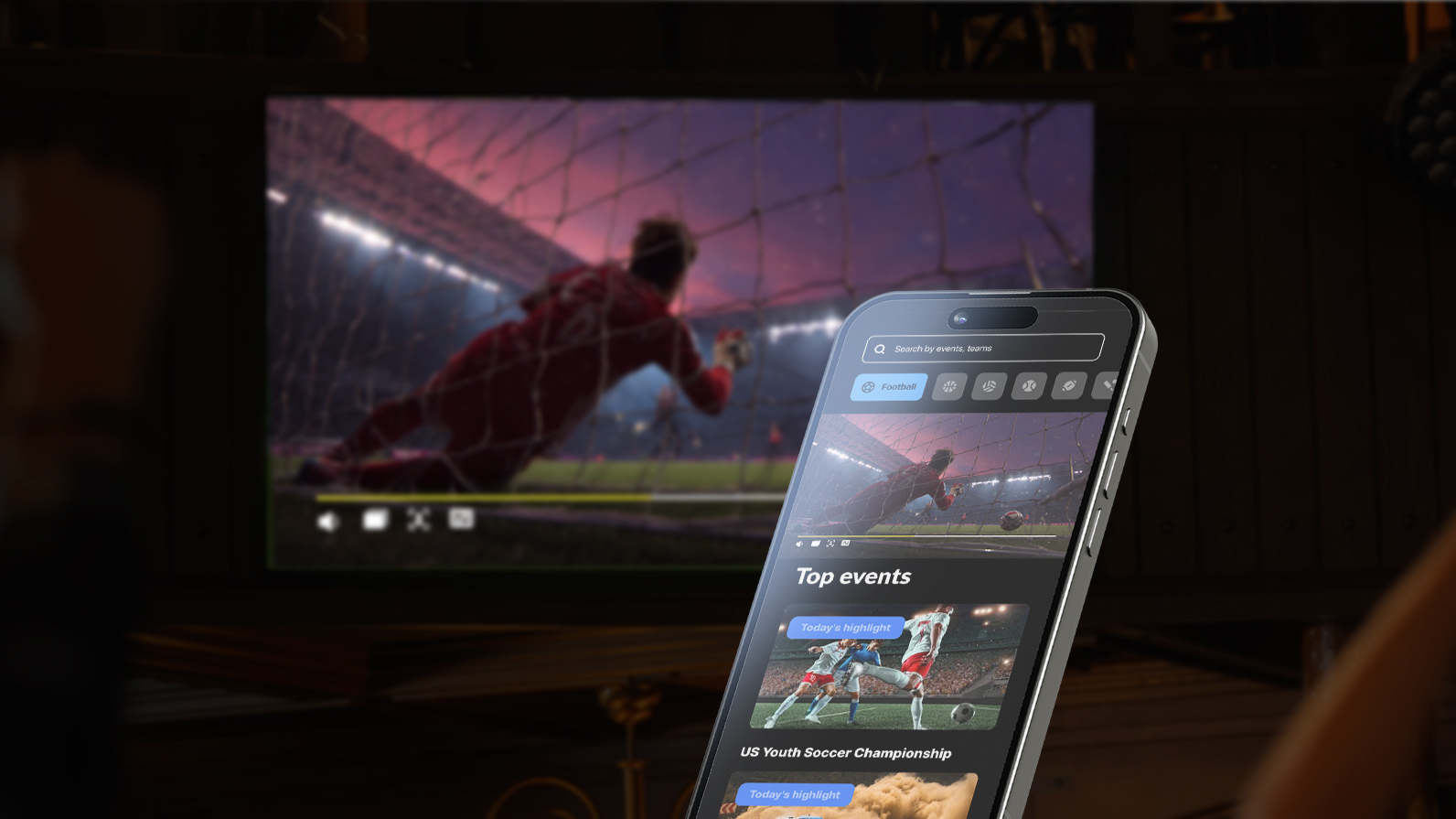
In a large-scale sports project, Oxagile built a highly scalable second-screen platform that handled millions of concurrent viewers. Viewers engaged through live polls, real-time trivia, synchronized replays, and shoppable moments, all designed to tap into the emotional peaks of the game.
The impact: The solution turned passive viewers into active participants, maximizing attention and interaction during live events.
“Our biggest live audiences still deliver scale — but the yield per viewer hasn’t moved in years.”
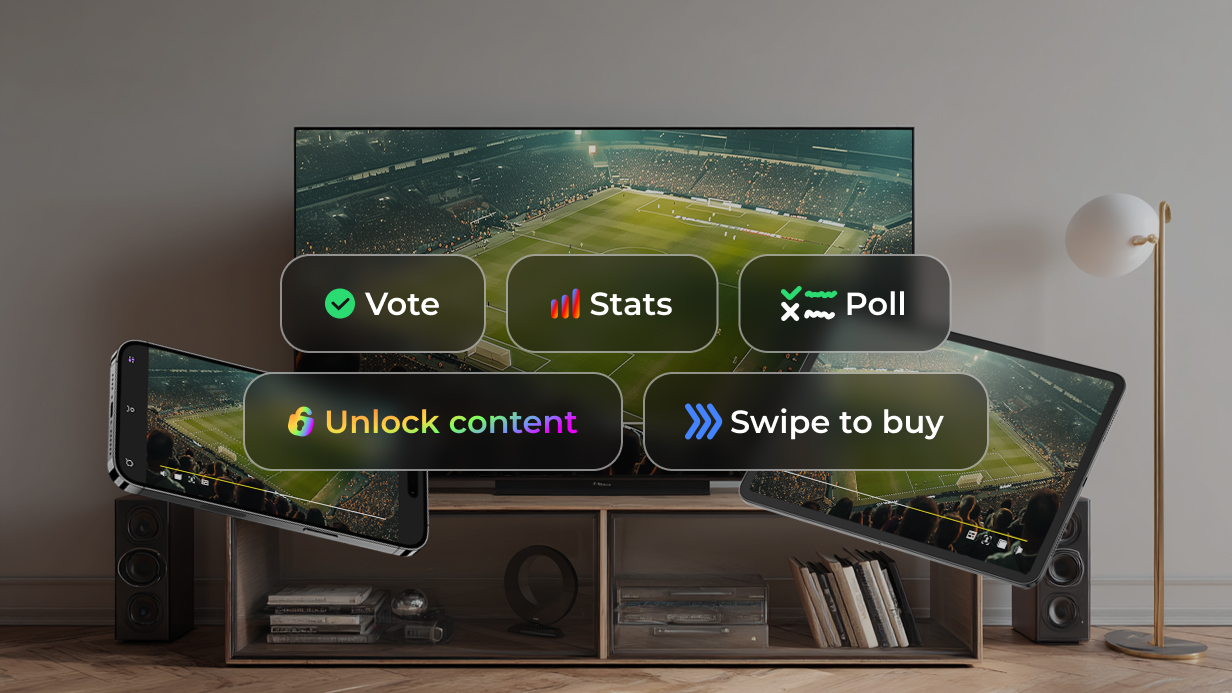
That’s exactly where second screen ads redefine the broadcaster’s business model. Instead of selling exposure once, you’re monetizing the same attention stream multiple times. Each synchronized interaction, be it a poll, coupon claim, content unlock, or product tap, becomes a separate commercial event with its own value.
SSA lets broadcasters move from selling GRPs to selling verified actions. Packages can include CPM for airtime plus cost-per-interaction or cost-per-acquisition pricing, creating incremental, high-margin revenue without adding ad clutter. It’s not “more ads”, it’s higher yield per second of content.
Operationally, this means that a 30-second spot is no longer a terminal event: it’s a launchpad for a measurable chain of engagements that can feed CRM data, commerce events, or brand analytics. It’s a shift from inventory sales to participation economics, where the broadcaster earns from both impressions and outcomes.
“Advertisers keep asking for ROI data we can’t provide. Platforms like YouTube or Meta can show conversions instantly — we can’t.”
SSA levels that playing field by bringing deterministic attribution to broadcast. Using time-coded triggers, ACR, or watermarking, companion devices identify the precise second an ad airs and activate matching mobile or web actions. Each event is then logged with a time stamp, allowing broadcasters to attribute clicks, sign-ups, or purchases directly to the broadcast moment.
That capability transforms traditional broadcast metrics (like reach or share) into digital-grade accountability. Instead of selling “estimated impact”, you’re selling verified engagement that advertisers can reconcile against their own dashboards.
For sales teams, that’s the difference between negotiating on perceived brand value and negotiating on measurable performance.
“We’re being squeezed between CTV platforms and walled gardens that own both data and relationships. We’re losing our leverage in the ad supply chain.”
Second screen ads offer a way to rebuild data independence. When companion devices are triggered by ACR or network-controlled timecodes, the broadcaster collects deterministic first-party interaction data — without surrendering it to third-party platforms.
This creates a proprietary dataset of authenticated attention: who interacted, when, through which show, and in what context. That data can be monetized directly through audience extension, performance guarantees, or cross-platform retargeting partnerships.
“Our ad inventory is fragmented across linear, CTV, and digital. SSA sounds interesting — but how does it fit operationally?”
Fragmentation is the reality, but SSA is designed to operate across all screens — linear, CTV, and digital — and act as the glue connecting them.
For linear TV, second screen campaigns don’t require viewers to change habits; instead, companion-device activations are synchronized to the broadcast timecodes. A 30-second spot can trigger a push notification, mobile banner, or interactive in-app module in near real time, extending the airtime moment into measurable engagement.
Operationally, SSA allows broadcasters to unify inventory across platforms:
That data feeds into CRM, retargeting, or analytics pipelines, giving sales teams deterministic metrics for engagement, conversion, and repeat viewership.
Today, screens compete harder than brands do, and attention is something you earn, multiply, and measure.
For brands, second screen advertising turns visibility into velocity. It connects the emotional spark of the big screen with the instant action of the small one — bridging storytelling and sales in the same heartbeat. It’s not about interrupting; it’s about extending the moment when attention is at its peak.
For agencies, it’s the chance to move beyond clever creatives into a verifiable impact. SSA transforms the ad break into a testable, optimizable touchpoint. One where every swipe, tap, or share becomes a line in a performance report. It’s where creativity meets accountability without losing its soul.
And for broadcasters, it’s the blueprint for reinvention. Second screen ads make audience participation part of the programming fabric, creating new value streams, richer data, and longer viewer lifespans. It shifts the model from selling time to selling outcomes: from broadcasting to behavior-building.
At Oxagile, we keep ourselves accountable to the same rule we’ve been preaching here — attention must translate into action. So make the most of every viewer moment.
If you want to turn second-screen potential into sustained audience value, we help brands, agencies, and broadcasters connect the creative, commercial, and technical dots that make every interaction trackable, actionable, and revenue-driving.
1. Case study: How Quaker connected with TV viewers via second screen — Marketing‑Interactive
2. Synced ads: effects of mobile ad size and timing — Frontiers in Communication
3. A 2024 study on the effect of second screening on repeat viewing — ResearchGate
4. The effect of second screening on repeat viewing: Insights from large‑scale mobile diary data — Journal of the Academy of Marketing Science

Second screen ads appear on companion devices like smartphones or tablets while viewers watch TV or CTV content. They extend the main broadcast experience and turn passive viewing into measurable interaction and data-driven engagement by syncing through timecodes, ACR, or app signals.
Such campaigns keep brands visible when attention splits, turning distraction into participation. They bridge the emotional pull of TV with the immediacy of mobile, letting brands stay present in the exact moments audiences drift. This leads to measurable engagement and intent-driven data.
Broadcasters gain the advantages of second screen advertising by turning fleeting attention into repeat viewership and monetizable interactions. SSA delivers deterministic attribution, new revenue models, and first-party data ownership, which helps networks move from selling airtime to selling verified engagement.
For ad agencies, the real gains lie in accountability and differentiation. SSA links the story seen on TV to the actions taken online, translating creative thinking into data-driven proof of performance and measurable ROI.

