













This website uses cookies to help improve your user experience




OTT advertising continues to grow as brands look for more targeted, measurable ways to reach viewers. For content distributors and aggregators in the ad publishing space, this is a key challenge and an opportunity. Their inventory needs to perform well enough to bring in more brands and keep them coming back.
Unlike traditional TV, OTT gives you the tools to optimize ad delivery, track detailed performance metrics, and offer advertisers precise audience targeting at scale. But simply having access to these tools isn’t enough, because the real value lies in how you use them.
What is OTT in advertising, and why is it attracting so many brands? This article breaks down its key benefits and explains what you can do on the platform side to maximize ad effectiveness and grow your base of advertisers.
Key takeaways:
OTT marketing focuses on how streaming platforms use video distribution, data, and ad delivery to generate revenue and attract advertisers. It combines elements of digital advertising and traditional TV but operates under different constraints and opportunities.
Compared to digital marketing, OTT offers limited user-level tracking but stronger engagement and higher completion rates. Compared to linear TV, it allows more precise targeting, flexible campaign setup, and more detailed performance reporting.
In practice, OTT marketing includes managing ad-supported models such as AVOD and FAST, setting up ad delivery (client-side or server-side), working with programmatic demand, and using first-party data to improve targeting and measurement.
Selling impressions isn’t enough for platform owners. Inventory also needs to be predictable in reach, frequency, and performance so advertisers can plan and scale.
To attract more brands and grow ad revenue, OTT platforms need more than inventory, as performance is defined by fill rate, CPM, and how consistently campaigns deliver results.
AdTech setup defines how inventory is sold, delivered, and measured across devices. In OTT, this includes audience segmentation, frequency control, and campaign tracking across connected TV, mobile, and web, although cross-device consistency remains limited due to fragmented identity.
Advertisers evaluate campaigns using completion rates (VCR), attention metrics, and cross-platform reach. Impressions are just the baseline. What really matters is delivering consistent reach, balanced frequency, and reliable performance.
Most platforms work with multiple demand sources, and the way these connections are structured directly affects performance. Server-side and unified auction setups allow multiple demand partners to compete within a single auction environment, which can improve CPMs and fill rate when demand paths are properly structured.
At the same time, inefficient configurations with duplicated supply paths or too many intermediaries can reduce performance, as additional demand does not always translate into better results. Auction logic and targeting operate as separate layers: auctions define pricing and demand access, while targeting depends on data, first-party signals, and identity frameworks.
In ad-supported models, revenue and user experience depend on how ad load, targeting, and delivery are balanced. Higher ad load increases revenue but can negatively affect retention, while lower ad load improves user experience at the cost of monetization, so platforms continuously test and adjust this balance.
Server-side ad insertion (SSAI) is widely used to reduce buffering and playback issues across devices, particularly on connected TV. Contextual and scene-level targeting help align ads with content, which can support higher completion rates and reduce drop-off.
Brand safety remains a requirement for many advertisers, making content classification, category filtering, and ad quality controls necessary for maintaining demand.
Let’s look at how effective OTT marketing strategies help platforms grow revenue and win more brand partners.

For one of our telecom clients, we developed a solution to insert client-side ads across multiple screens, including web platforms, mobile devices, and Smart TVs. Ads were inserted at the right points in live streams, so the experience stayed smooth for viewers and advertisers kept control over delivery.
This approach increased ad performance and retention, leading to better engagement rates and higher demand for the ad inventory across platforms. It also provided advertisers with detailed performance data, contributing to more targeted and effective ad campaigns.

We designed a comprehensive video ad and monetization platform that keeps inventory management simple and helps advertisers get more out of their campaigns. This platform integrated advanced audience targeting and detailed reporting and analytics, providing a transparent view of campaign success.
For OTT broadcasters, the platform’s ability to fill OTT ad inventory, handle large volumes of ad inventory, and offer VAST and OM SDK / SIMID support made it easier to attract major brands. The payoff was clear: better ROI for both sides and higher ad revenue driven by smarter use of inventory and better visibility into performance.
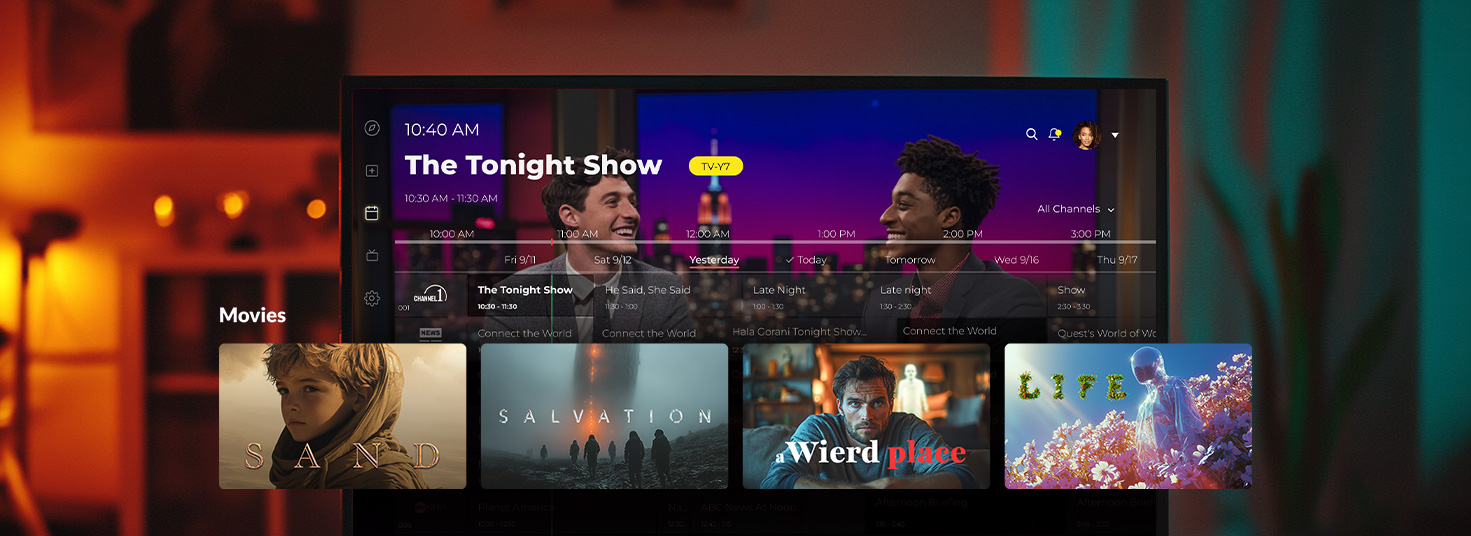
As part of a major VoD upgrade for a telco client, we built a custom advertising module that gave them full control over placements, targeting, and scheduling, along with near real-time analytics.
That shift made a difference. They could fine-tune delivery, improve the viewer experience, and bring in more brands, especially those that care about targeting and transparency.
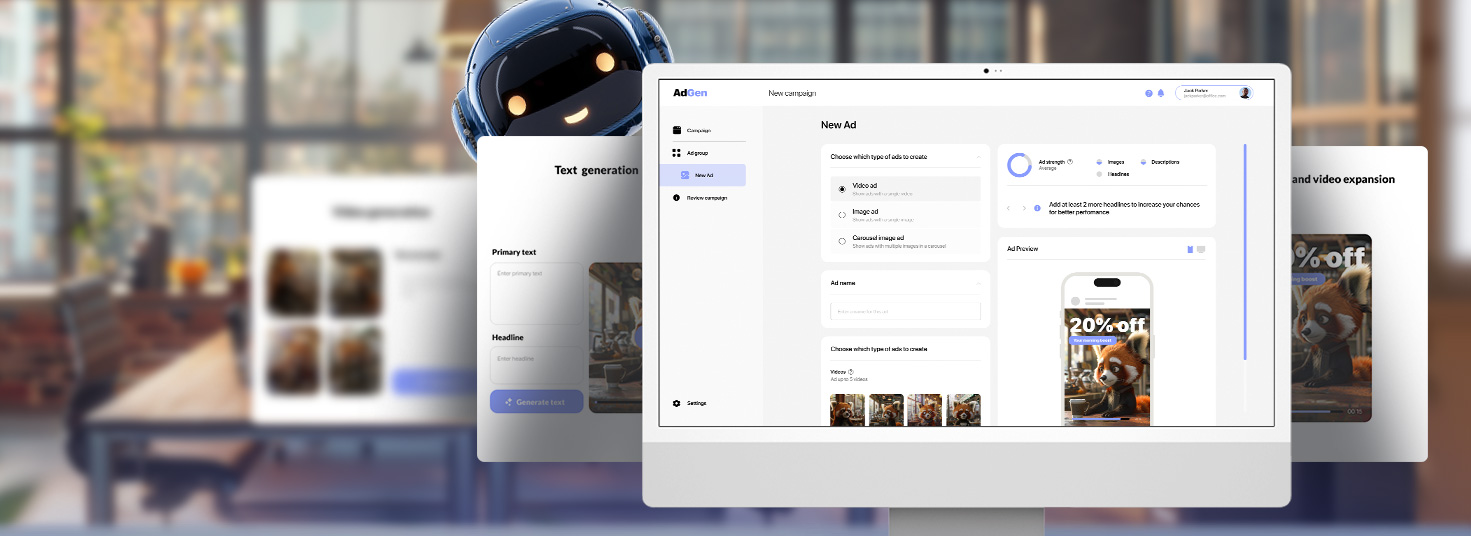
To simplify campaign and creative management, we developed an AI-driven tool that automates the creation of ad campaigns. By analyzing website content, extracting key keywords, and generating creatives on the fly, the tool helped marketers optimize targeting, bids, and creative performance in real time.
AI can take a lot of the grunt work out of ad creation and help OTT platforms scale faster, handling creative and targeting in the background. That usually means better results for advertisers and more budget flowing in.
These OTT advertising examples show what works and the takeaway is simple: better ad strategies lead to higher revenue, stronger engagement, and more brands. The challenge is making them work for your specific audience and content.
Even with a growing interest from advertisers, OTT publishers often face several roadblocks that can hinder performance and slow down the growth of brand partnerships.
Many OTT platforms rely on a mix of third-party ad servers, data management platforms, and analytics tools that don’t always communicate well with each other. This fragmentation can lead to delayed ad delivery, targeting mismatches, and wasted impressions, especially across devices and content types.
Brands want to see how their campaigns perform in real time, including metrics like view-through rates, completion rates, and audience engagement. If your platform doesn’t provide this level of visibility, it’s difficult for advertisers to assess ROI and optimize spend, often leading them to look elsewhere.
When an ad appears next to inappropriate or off-brand content, it reflects poorly on the advertiser and the platform. Without automated ad screening, content matching, and the ability to filter by advertiser category, OTT publishers risk alienating premium ad buyers.
Lack of smart ad frequency control can annoy users with repetitive ads and lower overall engagement. At the same time, underused or poorly segmented ad inventory results in missed revenue opportunities. Finding the balance between maximizing yield and maintaining viewer experience is a constant challenge.

See how the right AdTech decisions can make a difference.
An effective OTT advertising strategy is built around clear goals, a defined audience, and a setup that supports consistent campaign delivery and measurement. Without this foundation, even strong inventory and demand connections will not produce stable results.
Start with clear goals: higher fill rates, better CPMs, premium advertisers, or specific campaign outcomes.
Different goals require different setups. For example, maximizing revenue often leads to higher ad load and broader demand access, whereas attracting premium brands may require stricter brand safety controls and more predictable delivery.
Audience definition in OTT depends heavily on the data available to the platform. In most cases, this includes first-party data such as viewing behavior, device type, location, and subscription status.
Data only matters if it’s usable. Advertisers need clear, consistent audience segments, even across devices.
OTT platforms typically combine different ones depending on content type and audience behavior. AVOD works for broad reach and scale, while hybrid models are combos of subscription revenue with advertising. FAST channels are often used to increase distribution and monetize older or continuous content libraries.
The choice of monetization strategy affects ad load, targeting options, and the type of demand the platform can attract.
Ad formats and delivery methods define how ads are experienced by users and measured by advertisers. This includes pre-roll, mid-roll, and post-roll placements, as well as decisions between client-side and server-side ad insertion.
Server-side ad insertion is often used for more stable playback across devices, while client-side setups may offer more flexibility for certain types of targeting and measurement.
Connecting to demand requires working with multiple partners such as SSPs, ad exchanges, and direct deals. The structure of these connections affects revenue and efficiency.
Unified auction setups can improve competition but require careful configuration to avoid duplicated supply paths and unnecessary intermediaries. At the same time, programmatic direct and private marketplace deals are often used to secure more predictable demand.
Measurement in OTT goes beyond impressions and includes completion rates, attention metrics, and reach across devices. Platforms need to provide reporting that allows advertisers to evaluate campaign performance and adjust spend.
Optimization is an ongoing process. It involves adjusting ad load, refining audience segments, improving demand connections, and testing different configurations to maintain performance over time.
Even with a well-defined business model in place, there’s always room to fine-tune your OTT marketing strategy. Here are several tips to help you to increase yield from your ad inventory.
1. Don’t chase prime time
While it’s tempting to prioritize peak viewing hours (typically 8 PM to 11 PM), a lot of viewing happens outside prime time. Audiences are increasingly watching content on their own terms, and CPMs can vary significantly depending on the time of day. Smart scheduling that considers off-peak hours could deliver better ROI without overpaying for inventory.
2. Ad breaks aren’t a dealbreaker
A common fear is that longer ad pods will scare viewers away, but that’s largely unfounded. Roughly a third of ad pods on streaming platforms can reach 2–3 minutes in some cases, which is comparable to linear TV. Ad relevance and targeting determine how users respond: if the ads match viewer interests, they’ll tolerate and even engage with longer breaks.
3. Match your model to your content value
Avoid forcing a single model across all content types; instead, tailor your approach based on viewer behavior and content strength.
AVOD works well for low-cost or evergreen content where volume can drive ad impressions. Hybrid models, combining subscriptions with ads, help balance revenue predictability and reach. TVOD is ideal for exclusive live events or one-off premium content with high perceived value.
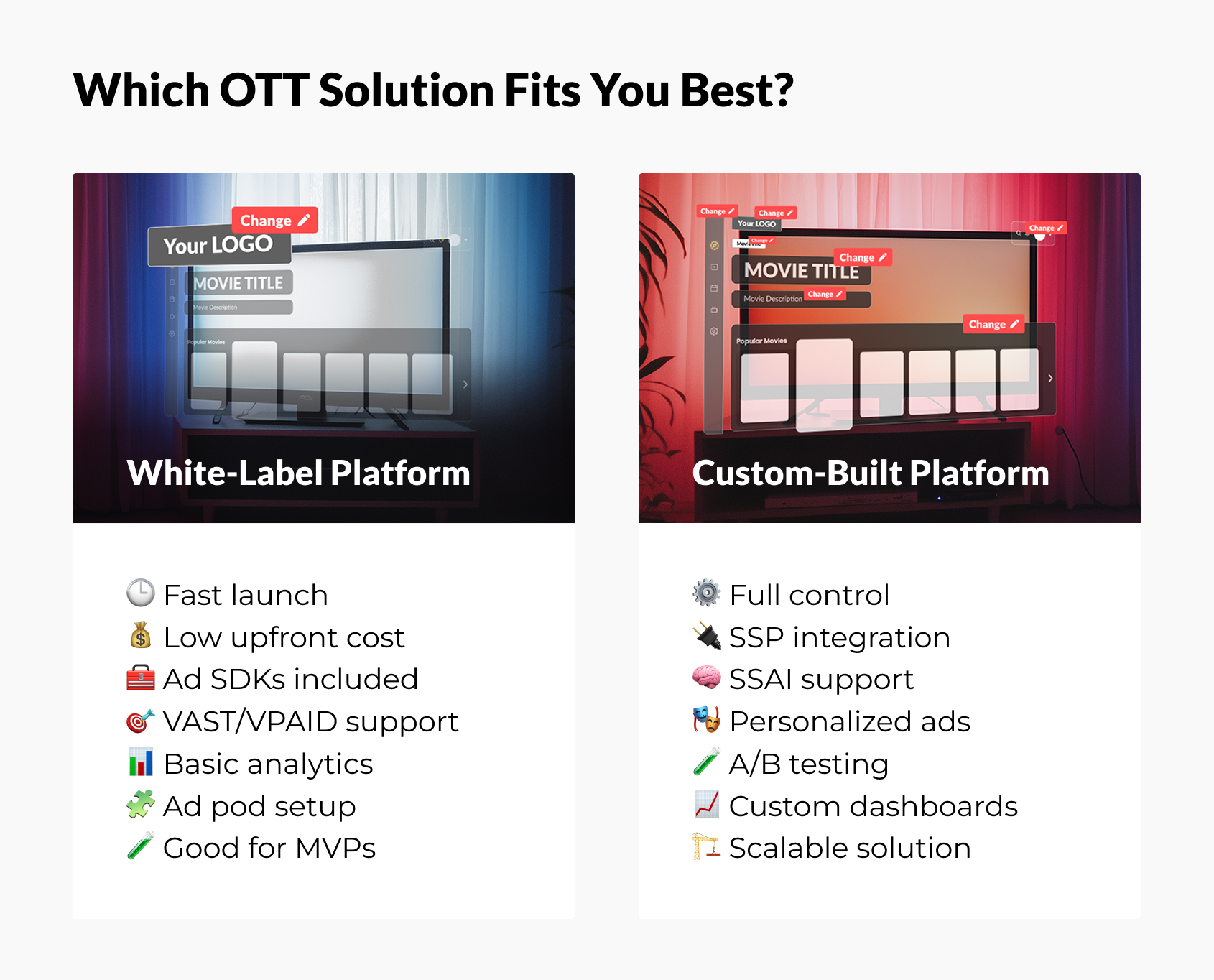
Choosing between a custom-built OTT platform and an off-the-shelf (white-label) solution has a direct impact on how effectively you can monetize your content. Both approaches offer benefits, but in different ways.
White-label platforms let you get to market fast and with minimal upfront investment. Most of them come with built-in advertising tools: ad SDKs, VAST and OM SDK / SIMID support, basic analytics, and ad pod configuration. This makes them a practical option for validating a business model or launching on a tight budget.
Custom-built platforms, on the other hand, give you more control over monetization logic and integrations. With a tailored solution, you can:
If you’re aiming for long-term revenue growth, scalability, and platform differentiation, a custom approach offers the flexibility and robustness to get you there.
Take a look at the top 5 OTT platforms to understand how different monetization strategies and feature sets can impact platform performance.
Strong OTT ad performance doesn’t come from one feature, and there’s no single formula for success. OTT advertising works best when strategy, setup, and execution are aligned. Get that right, and the rest follows.
Trust Oxagile’s team to get it right. With 20+ years in video and AdTech, we know what it takes to build, scale, and monetize OTT platforms that actually deliver.

OTT in advertising is the delivery of targeted, measurable ads through internet-based video platforms instead of traditional TV. It benefits publishers, advertisers, and viewers alike: advertisers gain precise targeting and real-time insights, platforms improve monetization, and audiences receive more relevant ad experiences.
OTT advertising is delivered over the internet through streaming platforms, while linear TV relies on scheduled broadcast or cable distribution.
The main difference lies in targeting and measurement. OTT allows advertisers to target specific audiences, adjust campaigns during delivery, and measure performance using detailed metrics such as completion rates and cross-platform reach. Linear TV offers broader reach but provides limited targeting options and less granular performance data.
A few effective OTT advertising examples include cross-platform ad insertion across devices, custom advertising modules for VoD services, video monetization platforms with advanced targeting, and AI-driven creative ad generation. These strategies improve engagement, raise CPMs, and help platforms attract more brand partnerships.
Key channels include connected TV, mobile devices, smart TVs, and web platforms. With CTV and OTT-enabled AdTech, publishers can apply targeting, frequency control, and near real-time tracking across these channels, ensuring campaigns scale effectively while maintaining strong viewer experiences.
No. OTT advertising is accessible to both large and mid-sized advertisers. While premium inventory and large-scale campaigns can require significant budgets, programmatic buying, private marketplaces, and flexible targeting allow smaller advertisers to run more controlled campaigns. Budget requirements depend on goals, audience size, and the level of reach needed rather than on the platform itself.

