












This website uses cookies to help improve your user experience



A few years ago, picking a monetization model for an OTT platform felt like choosing a lane on a highway: subscription on the left, ads on the right, pay-per-view somewhere in between. Most companies picked a lane and stayed in it. That analogy has expired. The highway is now packed, several lanes are merging, and the platforms pulling ahead are the ones weaving between all of them.
The proof is hard to miss. Netflix closed 2025 with 325 million global subscribers1, but the headline that matters more is this: its ad-supported tier, launched just three years earlier, reached 190 million monthly active viewers2.
Comscore data shows that 45% of all Netflix viewing in the U.S. now runs through the ad tier, up from 34% the year before3. Morgan Stanley estimates that over 100% of Netflix’s net new U.S. subscribers in 2025 came via the ad-supported plan — meaning the ad-free base actually shrank4. Disney+ saw ad-tier viewership jump 16 percentage points year over year. Max followed a similar curve.
When the biggest platforms on earth are diversifying how they earn, treating monetization as a single-model decision is a risk most businesses can’t afford. A modern OTT monetization strategy has to answer a harder question: how do you layer models, match them to different audiences, and build product infrastructure that holds it all together without confusing the people you’re trying to keep?
Finding reliable OTT monetization solutions starts with a practical question — which models actually hold up, where do they crack, and what does a workable combination look like?
Key takeaways:
 Subscriber growth has hit a ceiling in mature marketsContent costs keep climbing faster than revenueViewers have made peace with ads
These three forces explain why OTT monetization has shifted from a category choice to a layered design problem. Thriving platforms treat revenue as a blend of models and not a single bet.
If one trend defines video streaming monetization since 2022, it’s the rise of the hybrid model. Platforms that built their identity on ad-free subscriptions now treat advertising as a core revenue pillar, and the numbers suggest they’re right to.
Netflix spent years publicly rejecting ads before launching its ad tier in November 2022. Three years later, that tier is on track for over $2 billion in 2025 ad revenue, with projections of $9 billion by 2028-20296. The company built its own AdTech platform, integrated programmatic demand from Amazon, Google, and The Trade Desk, and is rolling out interactive video ads globally in 2026. What started as a concession to subscriber fatigue has become the company’s primary growth engine.
Disney+ tells a similar story. Within three months of launching its ad tier, 36% of new sign-ups opted in. By mid-2025, Disney’s combined streaming segment (Disney+, Hulu, ESPN+) hit 164 million monthly active ad-supported users and posted $346 million in operating income for Q3 2025, a swing from a $19 million loss a year prior. Max’s ad-tier viewership rose 10 percentage points year over year5.
The logic is straightforward: price-sensitive viewers get lower-cost access, and premium subscribers keep their ad-free experience. The platform earns from both groups, and the ad tier often generates higher per-user revenue than premium alone — something Hulu proved as early as 2019.
Most platforms adopted a hybrid, expecting to lose something. Instead, they started earning more per viewer than they did with a single model.
Pure ad-supported platforms are having a moment, particularly with catalog content and the lean-back viewing habit that feels a lot like old-school TV, just smarter. AVOD revenue across top streaming platforms grew 39% in 2024 to $14.3 billion, and 2025 projections were at $15 billion7.
Pluto TV is the clearest example — entirely free, monetized through ads, running 200+ live linear channels alongside on-demand content. It hit $1 billion in annual revenue in 2021 and had 78.5 million monthly active users by the end of 2022. After the Paramount-Skydance merger in 2025, the company announced Pluto TV and Paramount+ would share a unified tech stack starting in 2026 — a quiet admission that AVOD and SVOD work better as two halves of the same architecture than as separate businesses.
Tubi, with roughly 100 million monthly active users, and The Roku Channel both surpassed Paramount+, Peacock, Max, and Discovery+ in household market share in August 20258. Free, well-curated content is outperforming some subscription services in raw viewership.
Meanwhile, FAST channels (free ad-supported linear streaming) grew 76% globally between 2023 and 2025, reaching nearly 1,850 active channels. U.S. FAST ad revenue alone was projected at $5.78 billion for 2025.
For OTT app monetization, AVOD and FAST serve as a front door: bring viewers in free, let them build habits around your content, then upsell into paid tiers when the moment is right.
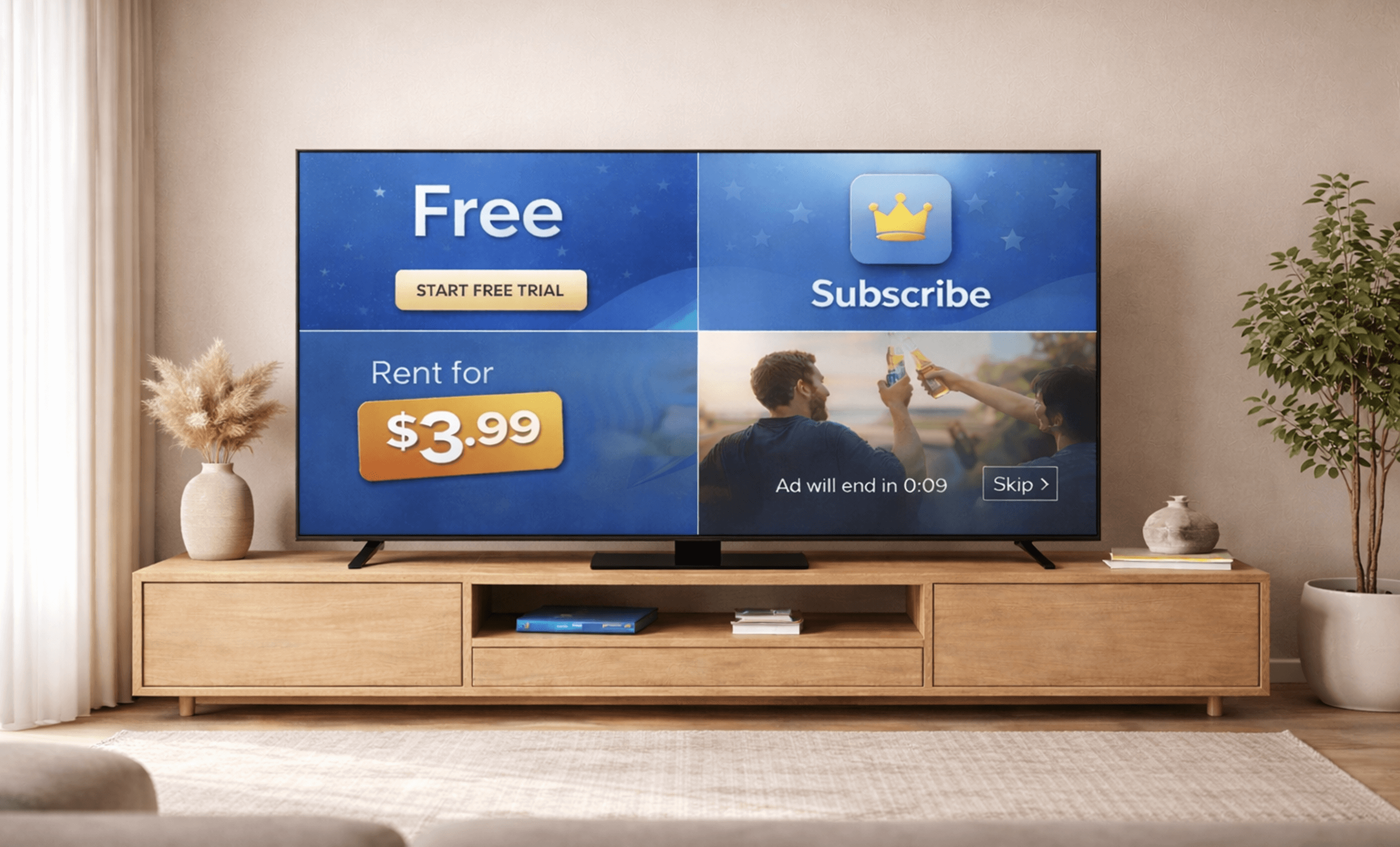
TVOD (pay-per-view) fits content that carries urgency or scarcity — a championship match, a concert stream, an early-access film premiere. Niche sports services use it routinely, and platforms like Google Play and iTunes have long relied on it. It’s rarely someone’s primary model, but as a complement to SVOD or AVOD, it captures revenue from viewers who would never subscribe but will pay once for something they really want.
Bundles matter most to telco-OTT operators, where video lives within a larger package of broadband, mobile, and TV. Verizon’s +Play, for instance, lets customers manage Netflix, Disney+, and others under a single bill. Telcos in LATAM and Europe do the same, treating streaming as a churn-reduction tool inside their core service. The consumer appeal is simple: fewer bills, fewer logins, less friction.

Every combination of SVOD, AVOD, TVOD, and bundling carries its own trade-offs — and the right mix depends on your content, market, and product stage. Oxagile helps OTT businesses map these variables and build the architecture to support them.
Many OTT platforms begin with the assumption that one monetization model will be enough if it is implemented properly. It simplifies pricing and product decisions, but it rarely reflects how audiences actually behave. The same patterns appear again and again when platforms rely on a single approach.
No single model works equally well for every viewer segment. A subscription-only platform excludes the 50%+ of viewers who now prefer ad-supported access, while a pure AVOD service often struggles to support premium productions because advertising revenue per user usually stays below subscription income.
Content type pushes monetization in different directions as well. A large catalog of reality shows or classic series often performs well with ad-supported access, where volume translates into impressions. A flagship original series creates exclusivity that supports subscriptions. A major live sports event or boxing match generates urgency that fits naturally with pay-per-view pricing.
Most platforms end up offering all of these content types, and one monetization model rarely fits them equally well.
Geography changes the equation more than many platforms expect. A $17.99 monthly subscription may feel standard in the United States, but it becomes a barrier in many Southeast Asian or Latin American markets.
This is why global services like Netflix rely on localized pricing and region-specific plans, including lower-cost mobile-only subscriptions in some countries. Applying the same pricing structure everywhere ignores real differences in purchasing power and payment behavior.
Ad markets vary just as much. Some regions support high CPM rates, others depend on scale and lower pricing. Monetization needs localization just as much as content does.
When a single model starts to show limitations, platforms often respond by adding more tiers. The result can easily become confusing instead of flexible.
Five subscription plans with overlapping features rarely improve conversion. If viewers cannot understand within a few seconds what they get and what they pay for, they hesitate. Many simply postpone the decision or leave.
That hesitation matters because viewers are already overloaded with choices. Nielsen reports that about 70% of viewers spend more than 10 minutes deciding what to watch. Adding pricing confusion on top of content selection increases the chance that users abandon the platform entirely.
Even a well-designed monetization structure does not stay optimal for long. Conversion rates shift, churn varies between tiers, ARPU changes by region, and ad fill rates fluctuate over time.
Platforms that do not track these metrics from the beginning usually react too late. Without a feedback loop, pricing and packaging decisions turn into guesswork instead of controlled optimization.
Most of these problems come from treating monetization as a pricing decision rather than a product decision.
Monetization affects entitlement systems, billing logic, ad delivery, analytics pipelines, and user flows. When these elements are designed first and pricing is added later, even small changes become expensive.
Platforms that plan monetization early usually end up with simpler experiences for viewers, even when the underlying system supports multiple models and regional variations.
A modern OTT monetization strategy means blending models at the product and architecture level, calibrated to content, geography, audience behavior, and the stage your business is in.
Picking the right combination of monetization strategies for OTT platforms depends on where several factors intersect. This framework maps them across four dimensions.
| Dimension | SVOD-led | Hybrid (SVOD + AVOD) | AVOD/FAST | TVOD/Bundle |
| Content | Premium originals, exclusive series | Originals + catalog library | Long-tail, catalog, news, reality | Live sports, premieres, niche events |
| Geography | Mature markets (US, UK, Nordics) | Multi-market operations | Emerging markets, lower purchasing power | Market-specific, event-driven |
| Business Goal | Recurring revenue, brand loyalty | Revenue diversification, segment coverage | Audience scale, discovery, funnel entry | Revenue spikes, premium monetization |
| Product Stage | Mature, established brand | Any stage with a multi-tier vision | Launch or growth phase | Complementary to the primary model |
A few real-world patterns show how these dimensions play out:
Telco-OTT operator
Bundle + hybrid. Video is wrapped into a broader service proposition (broadband, mobile, TV). The telco offers a basic AVOD library to all broadband subscribers and upsells premium SVOD content for an added fee, using video as a retention tool rather than a standalone profit center.
Niche sports streamer
SVOD + transactional upsell. A monthly subscription gets fans through the regular season. Championship matches and exclusive behind-the-scenes content carry a one-time fee, which captures revenue from casual viewers who would never commit to a subscription.
Mobile-first platform in an emerging market
AVOD with optional paid tiers. Free ad-supported access builds the base in markets where disposable income limits subscription uptake. Paid tiers exist for users who want ad-free viewing, but the business doesn’t depend on them.
Global entertainment platform
Full hybrid with regional tuning. SVOD in mature markets, AVOD in emerging ones, transactional for live and premium events. Netflix, Disney+, and Max are all moving in this direction.
Alexey Zaberezhny, Video Solutions System Analyst at Oxagile, who has worked on OTT monetization projects for telecom and media clients, puts it bluntly: the most common mistake is applying the same revenue model across all markets and all content types without adjusting for local viewer behavior. His full breakdown of when each business model works best is available in the guide to OTT revenue models — a practical reference if your team is evaluating its model mix right now.
You can pick the right monetization model and still lose money if the product experience drives people away. UX is what turns a revenue strategy into actual revenue, and a few specific patterns matter more than most teams expect.
Context-aware upsell works better than random pop-ups, and the gap is significant. The offer to upgrade lands best after a viewer finishes a free episode and wants the next one, or during a live event where ad-free access would genuinely improve things, or when watch-time data signals deep engagement. Building these triggers into the product requires behavioral analytics and a paywall engine flexible enough to serve different offers to different cohorts at the right moment.
Personalized monetization has become table stakes. Dynamic pricing, localized offers, student discounts, weekend passes, ad-free trials for returning users — these are product features, and platforms that tailor them to behavior consistently report higher ARPU, lower churn, and stronger ad performance.
Tier design is a conversion problem. The best-performing platforms describe tiers in terms of user benefit — fewer ads, higher resolution, more screens — and skip the internal product jargon. Your tier selection screen gets a few seconds of attention at most, so treat it like a landing page, not a feature comparison spreadsheet.
Ad experience is a retention problem. Kantar reported an 8% rise in cancellations due to excessive advertising in Q2 2025. Ad load, frequency capping, relevance — all of these land on the UX side just as hard as the AdTech side. Netflix keeps its ad load intentionally light and commands premium CPMs for it. Platforms that overload viewers with repetitive spots might see a short-term revenue bump, but churn catches up fast.
Running multiple revenue models from a single platform takes more than a spreadsheet. It demands architectural capabilities that many legacy systems were never designed for.
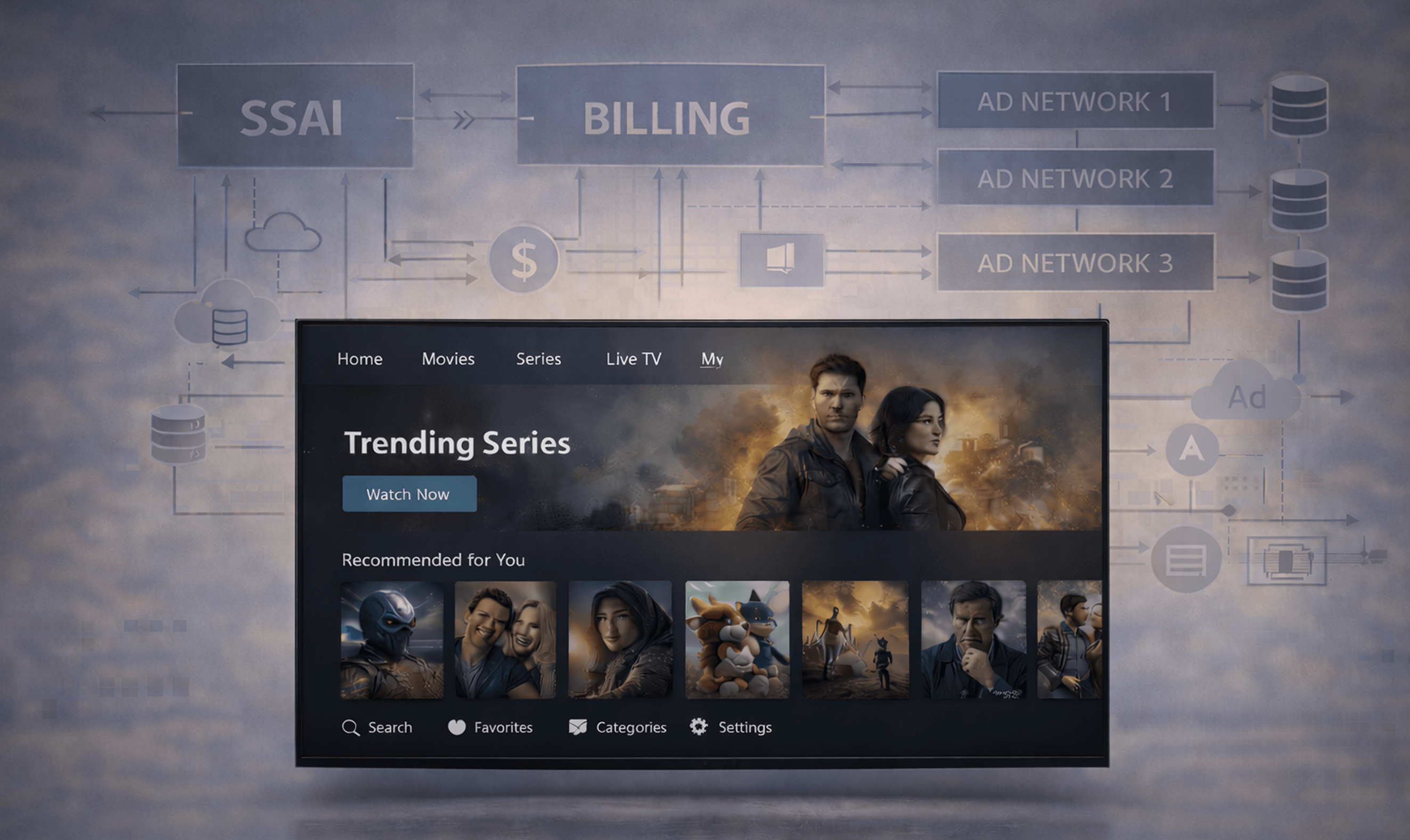
AdTech integration sits at the foundation — server-side ad insertion (SSAI), programmatic demand connections, and real-time bidding. Some companies build in-house, most take a faster route and integrate third-party solutions from Google, Amazon, and The Trade Desk. Either way, the engineering challenge doesn’t change — ad delivery can’t degrade stream quality or introduce latency, because viewers notice both instantly and leave.
Multi-market billing is where things get genuinely complicated. Localized pricing, regional tax rules, currency conversion, and market-specific licensing constraints all have to coexist within a single system. Add concurrent subscription tiers, free ad-supported access, transactional one-time purchases, promotional codes, trial periods, and grace periods for lapsed subscribers, and billing logic quickly becomes the hardest engineering problem in the whole product.
A European telecom operator needed to monetize its VOD service across multiple markets, currencies, and subscription tiers — all on top of existing infrastructure that was never designed for ad-supported streaming.
Oxagile built a custom integration layer covering SSAI, multi-platform ad delivery, and billing that connected the operator’s legacy systems with third-party ad networks and payment providers. The project turned a single-model VOD service into a hybrid monetization platform capable of supporting both subscription and ad-funded revenue streams across regions.
The OTT market has moved past the point where a single revenue model can sustain long-term growth. Hybrid approaches are becoming the operational standard, AVOD and FAST are proving their value as both standalone businesses and acquisition channels, and the platforms gaining ground are the ones that calibrate their model mix by market, content type, and product maturity.
But the model itself is only half the equation. The difference between a monetization strategy that performs and one that stalls usually comes down to what’s underneath — billing architecture that handles real complexity, ad delivery that doesn’t compromise the viewing experience, and UX that makes it easy for viewers to pay instead of pushing them toward the exit. These are engineering decisions as much as business ones, and they need to be made early.
If you’re planning to launch or rework your OTT monetization, start with architecture and business logic, the pricing model follows from there. Oxagile helps OTT businesses design the strategy, adapt it to their markets, and build the product architecture to support it.
1. Netflix’s advertising strategy shift is starting to pay off — CNBC
2. Netflix Ad Tier Hits 190 Million Monthly Active Viewers Globally — The Wrap
3. Nearly half of Netflix viewing is occurring on its ad-supported tier — Marketing Brew / Comscore
4. Netflix and Disney+ probably only added ad-tier subscribers this year — Morgan Stanley via Sherwood News
5. Global content spend of streaming companies 2025 — Statista
6. Netflix Advertising: Formats, Costs & Strategy (2026) — AI Digital
7. AVOD vs SVOD: Which is growing faster? — Adwave / MoffettNathanson
8. Report: Nearly 50% of U.S. Households Watch FAST Channels Weekly — Media Play News
The primary models are SVOD (subscription), AVOD (ad-supported), TVOD (transactional/pay-per-view), FAST (free ad-supported linear channels), and hybrid models combining two or more of these. Most modern platforms lean toward hybrid because no single model effectively serves every audience segment, content type, and geographic market.
Traditional TV earns through linear-schedule advertising, bundled cable subscriptions, and content licensing. OTT platform monetization gives viewers a choice in how they pay – subscription, ads, per-title purchase – and when they watch. It also generates granular viewer data that enables targeted advertising, personalized pricing, and behavioral upsell, none of which traditional broadcast can match.
For most new platforms, AVOD or freemium (limited free content with paid upgrades) is the most practical starting point. It lowers the barrier for viewers, builds an audience, and generates behavioral data before you commit to a subscription price. As the audience grows, introduce SVOD tiers and transactional options based on what the data reveals about willingness to pay.
Live sports tend to work best with a TVOD layer (pay-per-event for premium matches) combined with SVOD (season-long subscriptions for regular coverage). AVOD and FAST channels can distribute replays, highlights, and shoulder content, broadening the audience and creating additional ad revenue. The key is matching the model to each piece of content’s urgency and perceived value.

