












This website uses cookies to help improve your user experience



Monetization is where many VoD platforms lose momentum. The content may be strong, the audience may be growing, yet revenue doesn’t scale. Often the problem isn’t the idea, but the platform itself.
Out-of-the-box VoD solutions offer a quick start, but they rarely leave room for growth. Their billing systems are rigid, ad setups limited, and user experience identical across dozens of services. For a business that wants to experiment, test models, or adapt pricing to new markets, that’s a serious constraint.
A custom VoD platform allows you the flexibility to build the model that fits your business, not the other way around. You can integrate SVOD, AVOD, TVOD, or hybrid approaches, design a clear upgrade path for users, and connect analytics that explain how each segment actually behaves. To explore what goes into creating platforms like this, take a look at our approach to VoD application development.
In the sections ahead, we’ll break down the four main VoD monetization models, highlight where each one performs well, and point out the nuances that are easy to overlook when choosing between them. We’ll also touch on why custom development makes these models easier to implement, test, and refine, especially when your platform needs to grow and adapt without hitting structural limits. After that, we’ll cover on the broader market context, including the shifts in viewer behavior and the rise of mixed monetization formats, and wrap up with clear takeaways to help you shape a sustainable revenue strategy.
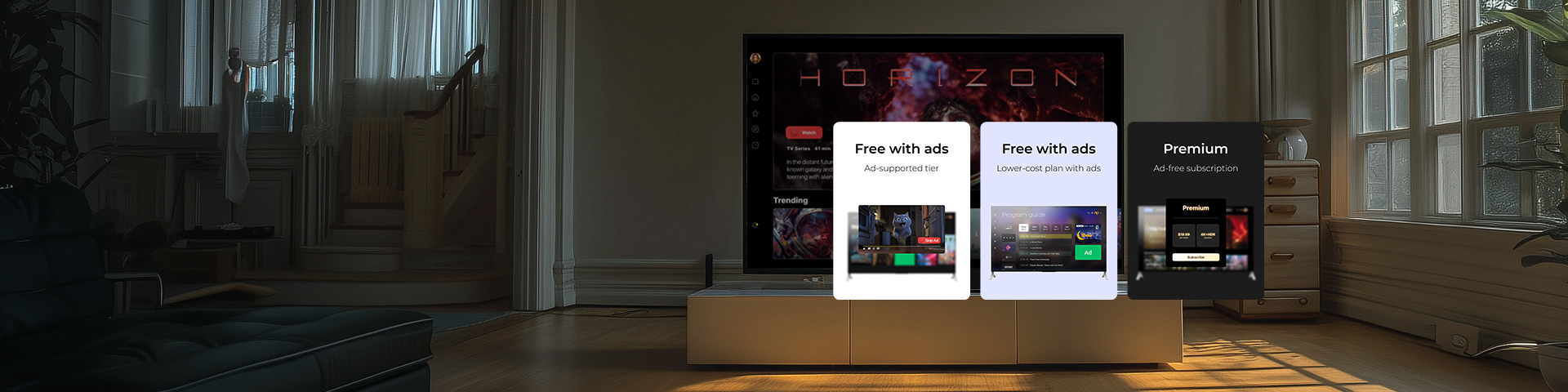
Effective VoD channel monetization always starts with understanding which model your catalog, audience, and release strategy can actually support. Different monetization models attract different types of viewers and require different levels of content investment. There’s no universal best option. What matters is how well the model aligns with your catalog, pricing strategy, and audience behavior. This is where video on demand monetization becomes a strategic exercise rather than a simple feature toggle, because the right structure ensures each content category finds its own revenue path.
AVOD
Broadest reach, lowest direct income
Hybrid
Balanced reach and revenue control
SVOD
Stable recurring income, loyal users
TVOD
Highest price per view, narrowest audience
Subscription-based video-on-demand remains the backbone of most successful streaming platforms. It works best when you have a strong library of high-value or exclusive content that keeps viewers coming back. The advantage is obvious: stable, recurring revenue that allows for clearer financial planning.
Yet, the SVOD model has changed. As users grow more selective about how many subscriptions they maintain, many providers introduce ad-supported subscription tiers or lower-cost bundles to minimize churn. Platforms like Netflix or Disney+ show how mixing traditional subscriptions with sponsored plans can expand reach without devaluing the core offer.
SVOD is worth considering if your content builds long-term engagement: think series, continuous releases, or niche collections with loyal communities. But it also demands constant investment in fresh content and UX improvements to justify recurring payments.
Ad-supported VoD has gained new momentum as audiences tire of subscription overload. Instead of charging for access, you open content for free and monetize attention through ads. The trade-off: you need significant traffic and strong ad operations to make the math work.
AVOD is ideal for platforms targeting mass audiences or working with lower-licensing-cost content. It’s also effective as a discovery stage for new users, letting them explore content before committing to a paid plan. Many hybrid platforms use it exactly this way: as an entry point that feeds conversion into SVOD tiers.
The key to making AVOD sustainable is relevance and frequency control. Poor ad targeting or overloaded breaks push users away faster than they generate revenue. Smart analytics and integrations with modern ad exchanges make the difference between a thriving ad-supported ecosystem and one that simply clutters the screen.
Transactional video-on-demand works when content itself feels like an event. Viewers pay for one-time access, whether to rent or purchase, and expect an ad-free, premium experience. That’s why TVOD thrives around live broadcasts, early film releases, sports, concerts, and exclusive digital premieres.
The upside is immediacy: every transaction brings direct revenue, which can be reinvested into production or marketing. The challenge is scale. Unlike subscriptions or ads, transactions depend on consistent demand — something not every platform can maintain long-term.
For niche content owners or event-focused businesses, though, TVOD offers a flexible and transparent way to monetize. It lets you test pricing strategies, experiment with bundles, or release high-demand content separately from your main catalog. When integrated into a broader ecosystem, it complements both ad- and subscription-based streams, helping diversify income.
Few platforms rely on a single model anymore. The hybrid approach, blending SVOD, AVOD, and TVOD, has become the industry’s middle ground. It gives users choice while protecting your bottom line.
For example, you can keep your base catalog ad-supported, reserve premium releases for subscribers, and charge separately for high-value events. This layered structure allows you to target different audience segments: casual viewers, loyal fans, and premium buyers without forcing everyone into one paywall.
Hybrid monetization also works as a retention strategy. Users who aren’t ready to subscribe can stay engaged through free content, while subscribers enjoy added value. The model mirrors what we now see across market leaders: ad-supported Netflix plans, free FAST channels, and dynamic pricing experiments across platforms.
What’s the catch? Hybrid models only perform when infrastructure supports them. Managing complex pricing logic, multiple revenue streams, and user segmentation requires a flexible backend — something most white-label solutions aren’t built for. That’s where custom development becomes more than a nice-to-have; it’s the foundation for sustainable monetization.
If you’re still shaping the foundations of your VoD product, our comprehensive guide to VoD app development offers a clear overview of the core components behind modern streaming platforms — from content architecture to UX and monetization readiness.

Our team can help you understand which revenue models make the most sense for your catalog and audience dynamics. We’ll outline the technical foundation required to support them and show where flexibility matters most. And we’ll translate this into a scalable platform blueprint that leaves room for experimentation and long-term growth.
Choosing a monetization model is only the starting point. The real work begins when you need to apply it to your platform and keep adapting it as your audience and content evolve.
That’s where many out-of-the-box VoD solutions start to feel restrictive. Introducing a new pricing tier, updating billing flows, testing ad formats, or segmenting users often requires workarounds or long waits for vendor updates. Over time, these limitations slow down experimentation and make it harder to respond to user behavior.
A custom VoD platform removes these bottlenecks. It gives you the flexibility to shape monetization around your business goals rather than around predefined templates. With a custom setup, you can:
Support any revenue mix — SVOD, AVOD, TVOD, or a hybrid — without being constrained by fixed paywall logic.
Adjust billing and payment flows to match local markets, currencies, partners, and promotions.
Use analytics that reflect your actual KPIs, from conversion patterns to ad performance and viewing habits across segments.
Refine user experience to guide viewers naturally from free access to paid options through clear upgrade moments.
Scale and evolve the platform as your catalog expands or new business cases appear.
This flexibility is what allows platforms to grow sustainably and stay responsive to shifting audience expectations.
To see how these principles are implemented in practice, explore our approach to VoD application development.
Even a well-chosen monetization model performs differently depending on what happens across the streaming landscape. Viewer expectations shift, pricing experiments become more common, and new distribution formats gain traction. Keeping track of these changes helps refine your revenue strategy and avoid decisions that age too quickly.
One of the clearest developments is the continued rise of ad-supported formats. FAST channels have expanded rapidly over the past two years, with the global count reaching roughly 1,850 channels in 2025 — a double-digit increase compared to the previous year1. Viewing time is growing as well: FAST consumption in the U.S. rose by more than 40% year-over-year in 20252, showing that audiences remain open to free, ad-supported viewing when the catalog and user experience are well aligned.
Subscription-first platforms are also adjusting. Major players such as Netflix now rely on ad-supported tiers as one of their key growth mechanisms, with tens of millions of users choosing lower-priced plans that blend premium content with advertising3. This shift reinforces the idea that hybrid setups, not pure subscription models, are increasingly defining user expectations.
As Smart TV usage continues to rise, VoD TV monetization becomes heavily influenced by how well a platform adapts to large-screen viewing habits, device-specific UX, and the increasing role of connected TV ad inventory.
Content categories evolve too. Sports, in particular, continue to reshape engagement patterns. Recent moves by Netflix, Disney, Warner Bros. Discovery, and Fox toward more unified sports offerings show how quickly live and on-demand strategies are blending. For teams evaluating both formats, our overview of live streaming vs video on demand offers a concise look at how each model supports different business goals. As these formats converge, many platforms naturally expand their monetization mix, combining subscriptions for core access, ads for reach, and transactions for high-value events.
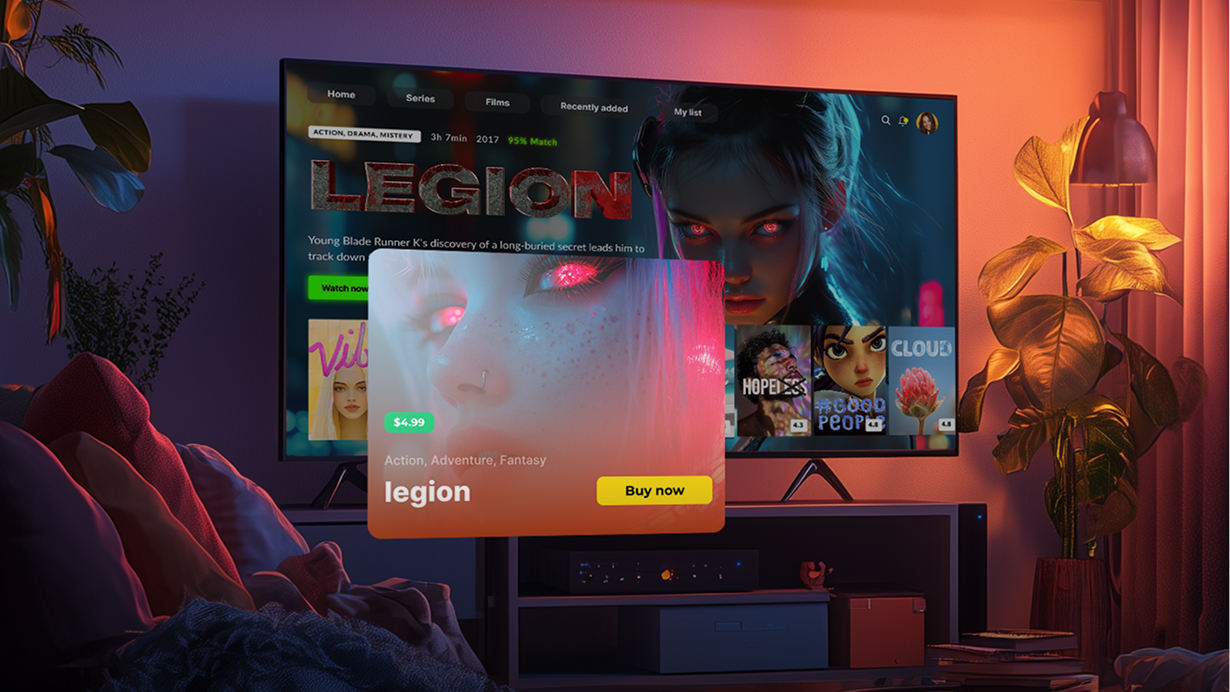
One of our recent Smart TV projects shows how this convergence plays out in practice. A youth-focused broadcaster asked us to build a Samsung Tizen app that could handle both live streaming and VoD with the kind of clarity and speed big-screen users expect. The result became a flexible, multi-platform solution later adapted for LG, Sony, Amazon Fire, Android TV, and Apple TV, proving how much monetization potential opens up when live and on-demand experiences are built into a single, custom Smart TV ecosystem.
After comparing SVOD, AVOD, TVOD, and hybrid setups, one pattern stands out: monetization only works when it reflects how your audience actually behaves, not how the market looks in theory.
The strongest platforms rely on combinations, not single models.
Different segments respond to different value propositions, and most services fine-tune their revenue mix over time. A flexible structure usually performs better than trying to force all users into the same approach.
The ability to shift models matters more than the model itself.
Viewer expectations change quickly. People may binge a series on a subscription plan, but choose ad-supported access for casual viewing and pay-per-view for a high-profile event. A platform benefits when it can support these patterns without friction.
Movement between free, subscribed, and transactional access should feel seamless.
Discovery, conversion, and upsell work best when the platform guides the user naturally between tiers instead of creating unnecessary barriers in billing logic, entitlement rules, or UX.
Technical foundations now define business potential.
Billing flexibility, analytics depth, and cross-device UX directly influence how far a monetization strategy can scale. And if you’re assessing what this looks like in practice, exploring our custom video solutions can help clarify the technical capabilities needed to support multi-model monetization.
In the end, the most resilient streaming businesses are those that shape monetization around their catalog and their audience but not around the limitations of off-the-shelf solutions.
If you’re evaluating the next step in your monetization strategy or planning to redesign your VoD platform, we can help you build a foundation that supports experimentation, growth, and multiple revenue paths. Our team works across the full cycle — from model planning to custom VoD and hybrid platform development that scales as your business does.
Share a few details about your project, and our team will outline practical next steps and the technical approach that fits your goals.
1. FAST channel landscape update: Global channel count and catalog growth — The Measure
2. U.S. streaming consumption report: FAST year-over-year trends — The Current
3. Netflix’s ad-supported tier hits 70 million users — Reuters

VoD monetization relies on understanding how each part of your catalog delivers value and how different audience segments behave. Before choosing a revenue structure, evaluate content demand, viewing patterns, and device usage. This helps determine whether subscription, advertising, transactional access, or a hybrid blend will work best. A flexible platform architecture allows ongoing adjustments as user behavior and market conditions evolve.
VoD channel monetization focuses on maximizing revenue from a continuously refreshed stream of content rather than a static library. This requires balancing reach with retention, optimizing ad load, and ensuring easy transitions between free and premium tiers. Channels also rely heavily on real-time analytics to refine scheduling, pricing, and content priorities. A tailored platform setup helps maintain control over monetization logic and adapt it quickly.
VoD TV monetization involves aligning in-app revenue tools with viewing behavior on Smart TV devices, where engagement patterns differ from mobile or web. Users expect simpler navigation, clear value propositions, and easy access to premium titles. Monetization tools must support seamless payments, ad integrations, and entitlement logic optimized for big-screen UX. Platforms with flexible billing and UI control achieve higher conversion and better retention on TV apps.
Video on demand monetization becomes sustainable when the platform supports several revenue paths that can evolve together. Instead of relying on a single model, combine recurring subscriptions, ad-supported layers, and one-off paid events. This allows different user groups to choose the level of commitment they prefer. Strong analytics, flexible pricing, and the ability to experiment with revenue mixes strengthen long-term outcomes and help maintain stability as the catalog grows.

