














This website uses cookies to help improve your user experience

OTT architecture often gets reduced to a neat diagram of boxes and arrows. It looks orderly, almost harmless. In reality, each box hides a separate class of engineering decisions, and each arrow represents a dependency that can affect latency, resilience, scalability, security, or cost.
In this article, we use a cutaway view of an OTT platform to explain how the main architectural layers work together, from ingestion and encoding to storage, DRM, delivery, playback, analytics, and monetization. For companies investing in OTT platform development, that architectural view matters just as much as the platform’s feature set.

To keep the discussion grounded in real implementation logic, this article includes commentary from Andrey Gordeev, Solution Architect at Oxagile. His insights help connect the visual scheme with the practical decisions teams make when designing OTT systems for stable streaming, audience growth, and long-term flexibility.
Key takeaways:
Some architectural ideas are easier to explain step by step. Others make more sense when you can see the whole mechanism at once. OTT platform architecture belongs to the second category. A visual cutaway helps show not just which components exist, but how content moves through the system and where key design decisions begin to affect scalability, resilience, and streaming quality.
The diagram below offers that end-to-end view. We will use it as a map and move through the platform layer by layer, starting at the point where content first enters the system.
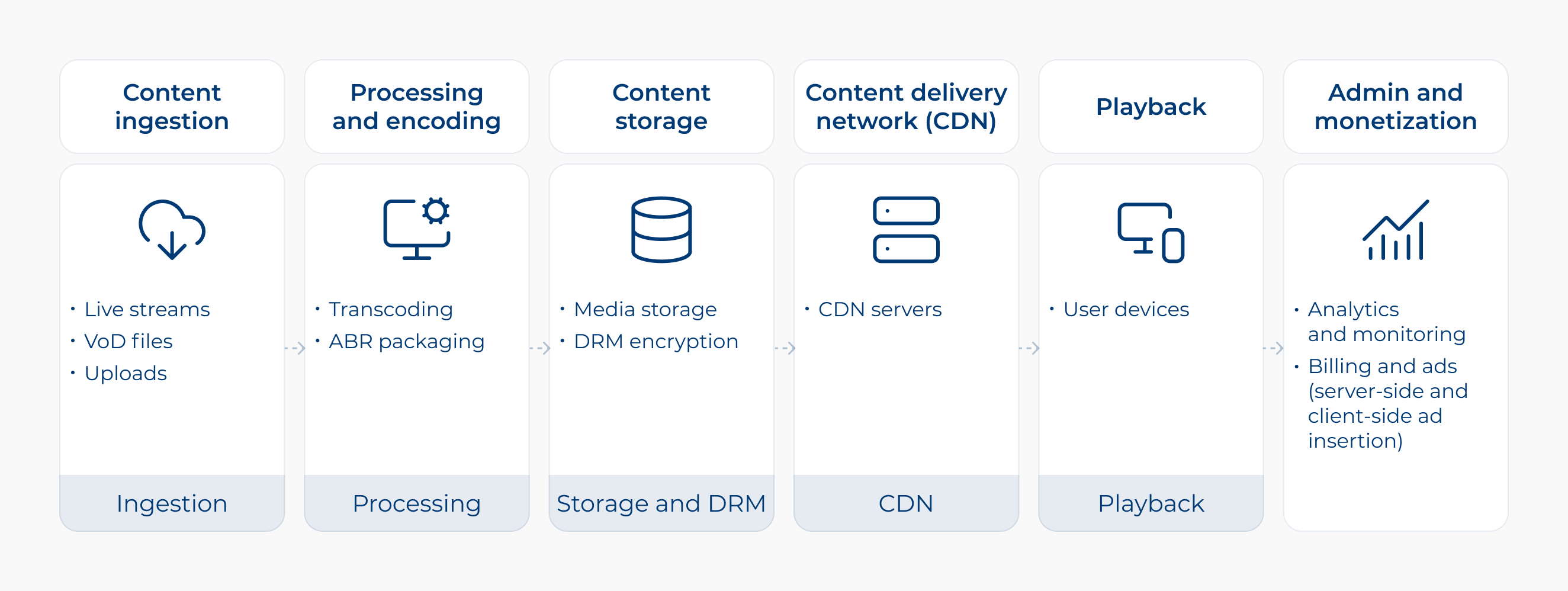
Content ingestion is the front door of an OTT platform. This is where the system accepts incoming video, validates it, and prepares it for the next stage of the workflow.
Depending on the service model, this layer may handle:
Although all three enter the platform through the ingestion layer, they place different operational demands on the system. Live streams require continuous handling, strict availability, and fast recovery from interruptions. VoD assets move through a more controlled flow that allows the platform to validate files, extract metadata, store mezzanine assets, and launch downstream processing once the upload is complete.
Expert comment:
“The real design question at this stage is about operational behavior. Live ingest has to keep moving, recover quickly, and stay aligned to time-based delivery. VoD ingest can afford a more deterministic flow with deeper validation, metadata work, and reprocessing options built in.”
In practice, that usually leads to separate ingest entry points and orchestration logic for live and VoD workflows, even when both eventually connect to shared storage or common downstream services. Live pipelines often rely on protocols such as RTMP or SRT and move directly into near-real-time packaging. VoD workflows are more likely to use uploads, signed URLs, multipart transfer, or accelerated file delivery, followed by validation and processing steps that are less time-sensitive.
The same distinction carries over into the control plane. Live ingest services typically deal with stream lifecycle, reconnect behavior, timing drift, redundancy, and ad marker handling. VoD ingest services focus on asset lifecycle, checksum validation, metadata enrichment, approval states, versioning, and reprocessing.
Andrey explains:
“A shared platform does not require a shared ingest rhythm. You can reuse storage, identity, observability, and media services underneath, but the intake logic should reflect the way each content type behaves in production.”
A well-designed ingestion layer gives each workflow enough room to operate on its own terms while still fitting into a modular OTT system architecture.
Once content enters the platform, it has to be prepared for delivery across different devices, screen sizes, and network conditions. At this stage, a single source video becomes a set of playback-ready versions that the OTT service can distribute more reliably and efficiently.
This layer typically includes:
In practical terms, this layer functions as the platform’s production floor. The system takes one input asset and creates a ladder of quality variants so the player can adjust playback to the viewer’s current connection and device capabilities. That is what allows a stream to remain watchable when bandwidth drops instead of sliding into constant buffering.
As Andrey puts it:
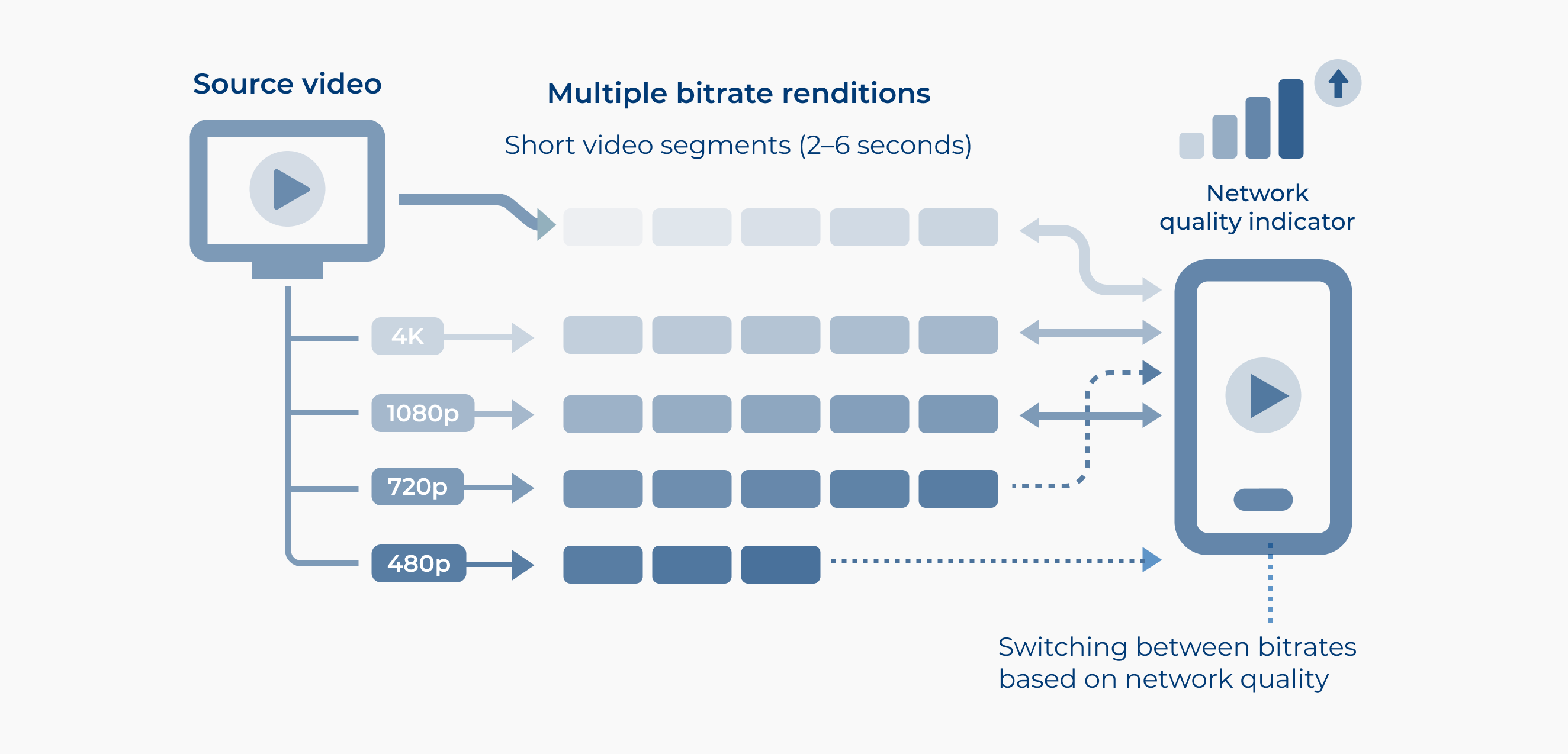
“Adaptive bitrate is one of the core stability mechanisms in OTT. You do not store one perfect version of a video and hope every user can handle it. You store multiple renditions and let the playback logic move between them based on real conditions.”
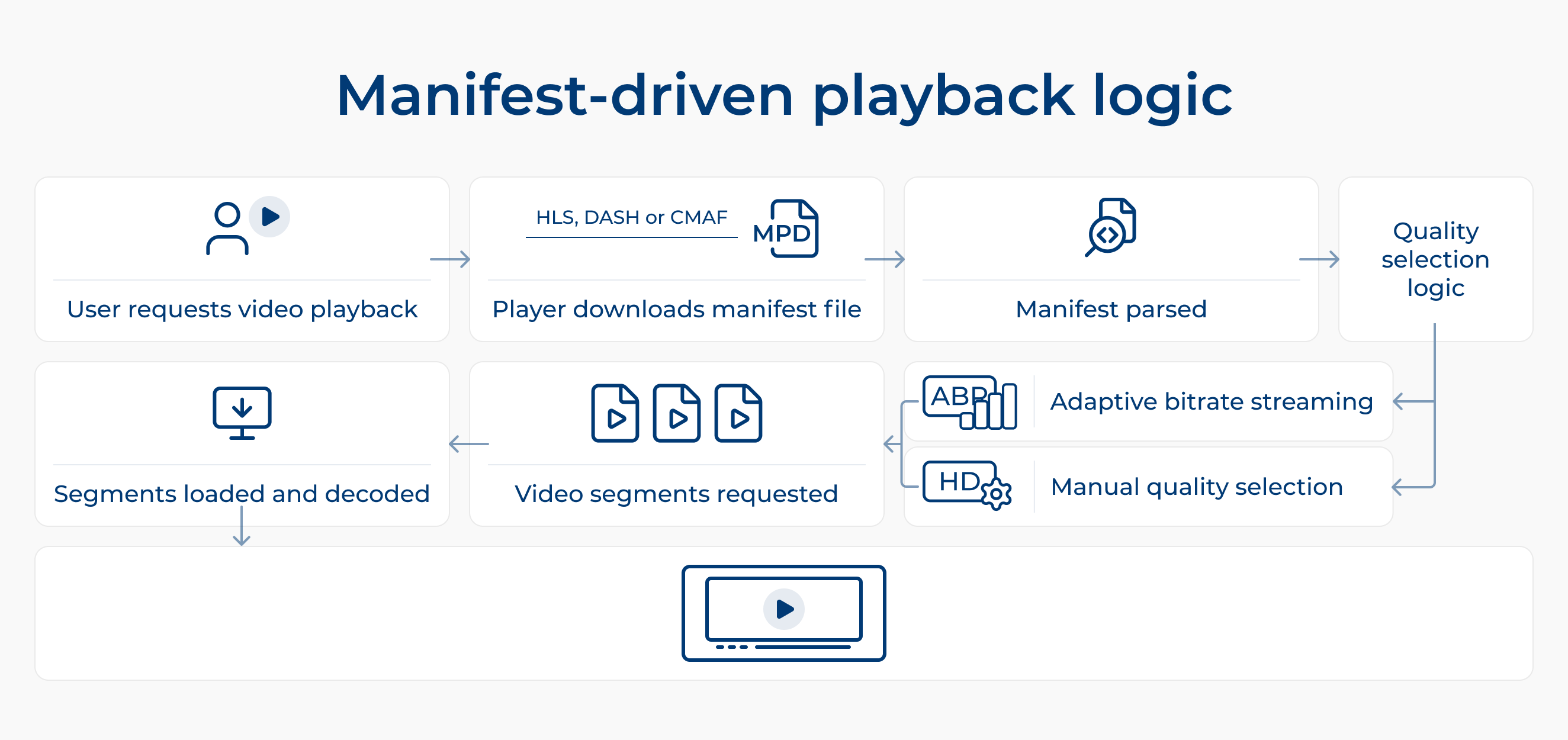
ABR packaging makes that possible. Instead of delivering a full video file in one piece, the platform breaks it into short chunks, usually a few seconds long, and references them through manifests. The player reads the manifest, requests the most appropriate segments, and can switch to a lower or higher bitrate as network conditions change. That switching behavior is one of the quiet workhorses of good streaming Quality of Experience (QoE). When it works well, the viewer barely notices it.
Chunk size matters here as well. Shorter segments can reduce latency and make bitrate switching more responsive, which matters more in live streaming scenarios. At the same time, smaller chunks increase request overhead and make the overall delivery chain more sensitive to tuning. Segment strategy reaches far beyond packaging details. It affects how the service balances latency, playback stability, and infrastructure load.
Andrey notes:
“Chunking is part of the delivery logic, not a technical afterthought. Segment duration influences latency, switching responsiveness, manifest behavior, and overhead across the chain. Small changes there can ripple much further than teams expect.”
Content delivery network (CDN) thinking starts to matter at this point too, even though CDN itself belongs to a separate architectural layer. For on-demand content, a distributed delivery infrastructure helps place assets closer to the user and reduces delay under heavy demand. For both live and VoD, adaptive bitrate packaging helps the platform hold up when viewers connect under very different network conditions.
The two mechanisms solve different parts of the same delivery problem.
Expert comment:
“CDN and ABR work on different parts of the path. CDN reduces the distance and distribution pressure. ABR helps the stream survive real playback conditions on the last mile. You usually need both if you want quality to hold under load.”
A strong processing and encoding layer shapes how stable the stream feels, how gracefully playback adapts, and how well the platform behaves under audience spikes, device diversity, and fluctuating connectivity.
After processing, the platform needs a reliable way to store media assets and protect access to them. Within an OTT system, this part supports two parallel tasks: keeping content available for delivery and enforcing the rules that determine who can watch it, on which device, and under what conditions.
This part typically includes:
In most modern OTT platform backend architecture setups, media storage is built on object storage. That model works well for large-scale video libraries, distributed delivery workflows, and flexible lifecycle management. The storage foundation must support both operational efficiency and content availability, as the platform depends on fast access to manifests and segments throughout the playback chain.
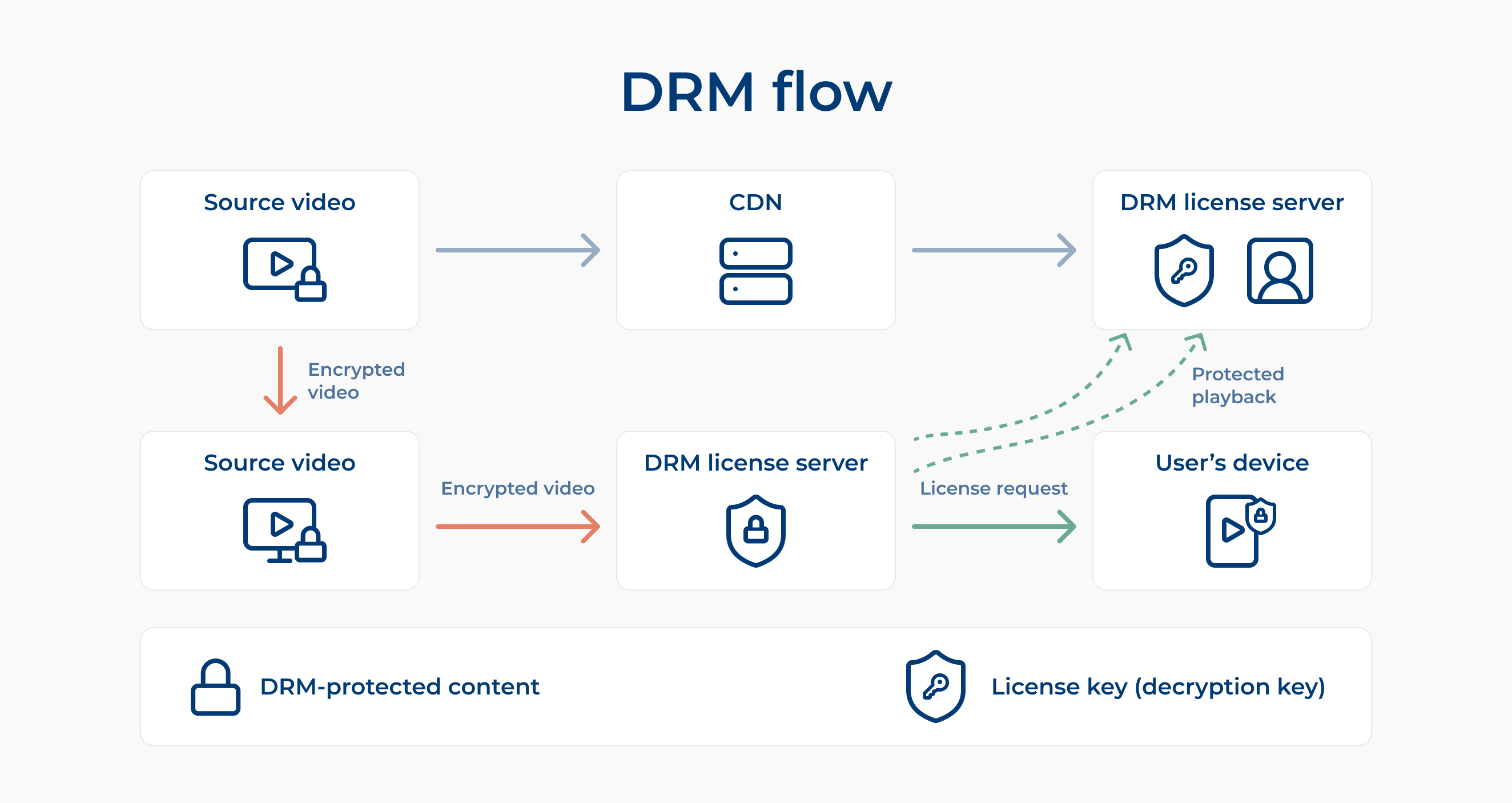
Protection brings additional complexity. Premium video services usually combine several DRM technologies because device support varies across platforms. Apple platforms require FairPlay. Android and many browser-based clients rely on Widevine. Microsoft platforms often involve PlayReady. A scalable OTT platform architecture often brings these technologies together to preserve device reach and maintain the security level expected for commercial streaming.
Andrey explains:
“DRM selection follows device strategy. If the service has to run across Apple, Android, browsers, and connected TV platforms, the protection model has to mirror that footprint. The architecture follows distribution requirements first.”
The underlying encryption model matters as well. Basic segment encryption can be sufficient for lower-tier protection scenarios, but premium OTT services tend to use common encryption approaches that enable a single media asset to work with multiple DRM systems.
That is one reason why combinations such as CENC with CMAF packaging have become common in OTT platform architecture design. They give teams a cleaner path to cross-platform delivery, reducing duplication in the media pipeline.
Security levels also vary at the device level. Some clients primarily use software-based enforcement, while others support hardware-backed decryption through secure execution environments. That difference affects studio compliance, premium playback scenarios, and 4K content distribution. As content rights become stricter, hardware-backed protection often shifts from a preferred option to a hard requirement.
Andrey notes:
“There are three separate questions here: how the media is encrypted, how the license is issued, and where enforcement happens on the device. Teams get into trouble when they collapse those into one generic ‘DRM decision’.”
License behavior deserves attention too. Live streaming often benefits from short-lived licenses and key rotation, which reduce the piracy window during high-value events. VoD services may also need persistent licenses for download-to-go functionality or more granular entitlement rules tied to region, subscription tier, or device class. Those choices belong to early design discussions because they affect packaging, entitlement logic, and playback behavior across the system.
According to Andrey:
“For live premium events, key rotation matters because the value window is short and piracy moves fast. For VoD, the pressure shifts toward entitlement rules, offline access, and how long the client is allowed to keep a license.”
In practical terms, this part of OTT video platform architecture serves two purposes: storing media for delivery and enforcing the access rules tied to content protection, licensing, and playback rights.
Once the content is processed, packaged, and protected, it has to reach viewers quickly and consistently across different geographies. That delivery path depends on CDN infrastructure. Within an OTT service, the CDN handles traffic distribution, reduces the distance between content and the viewer, and helps the platform stay responsive under heavy demand.
This part typically includes:
A CDN changes the economics and performance profile of content delivery. Without it, users in one region may need to pull video from infrastructure located far away, which increases latency and places more strain on central resources. With CDN distribution in place, the service can cache popular assets closer to the end user and serve them with fewer delays.
For VoD, that advantage becomes most visible during mass-viewing spikes, when a high-demand release starts pulling traffic from large audiences at once. CDN placement helps absorb that load and reduces the risk of bottlenecks at the origin. For live delivery, the picture is more nuanced. CDN still matters, but it works alongside other factors such as segment duration, packaging logic, and playback behavior.
Andrey notes:
“CDN solves one class of problems very well: distance and distribution pressure. If millions of users request the same content, you do not want all of them hitting the same origin path. You want that demand absorbed closer to the audience.”
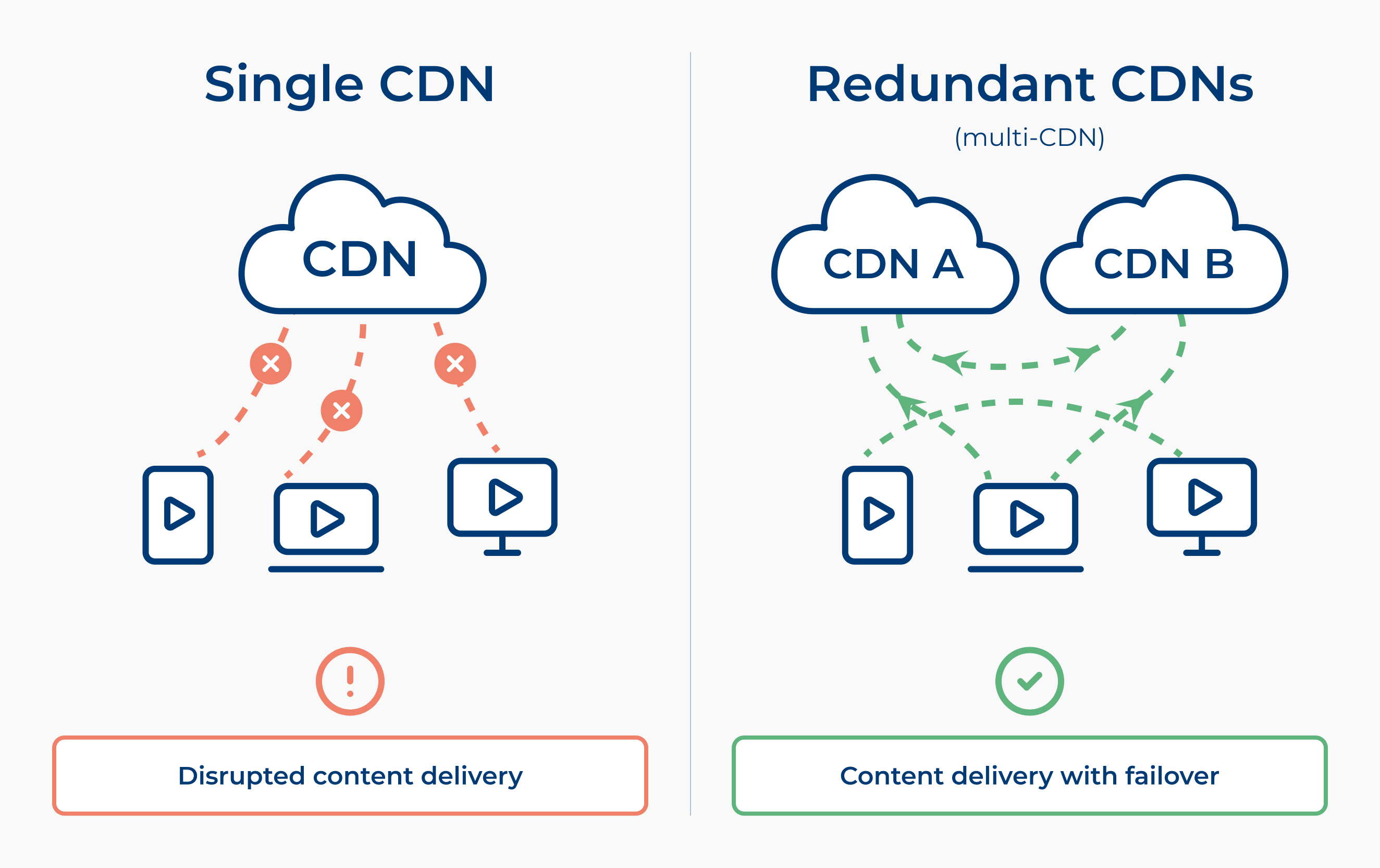
The decision between single-CDN and multi-CDN setups depends on scale, risk tolerance, and operational priorities. A single CDN can serve many OTT platforms perfectly well. For very large services, redundancy becomes a more serious design consideration. In those cases, traffic can be replicated or switched across providers to reduce exposure to outages or regional delivery issues.
That said, multi-CDN adds overhead. It introduces more operational complexity, more routing logic, and more coordination across providers. For smaller or mid-scale services, that overhead may outweigh the benefit.
Expert comment:
“Multi-CDN makes sense when delivery risk becomes expensive enough to justify the extra moving parts. At a smaller scale, a strong single-CDN setup with solid redundancy planning is often the more practical choice.”
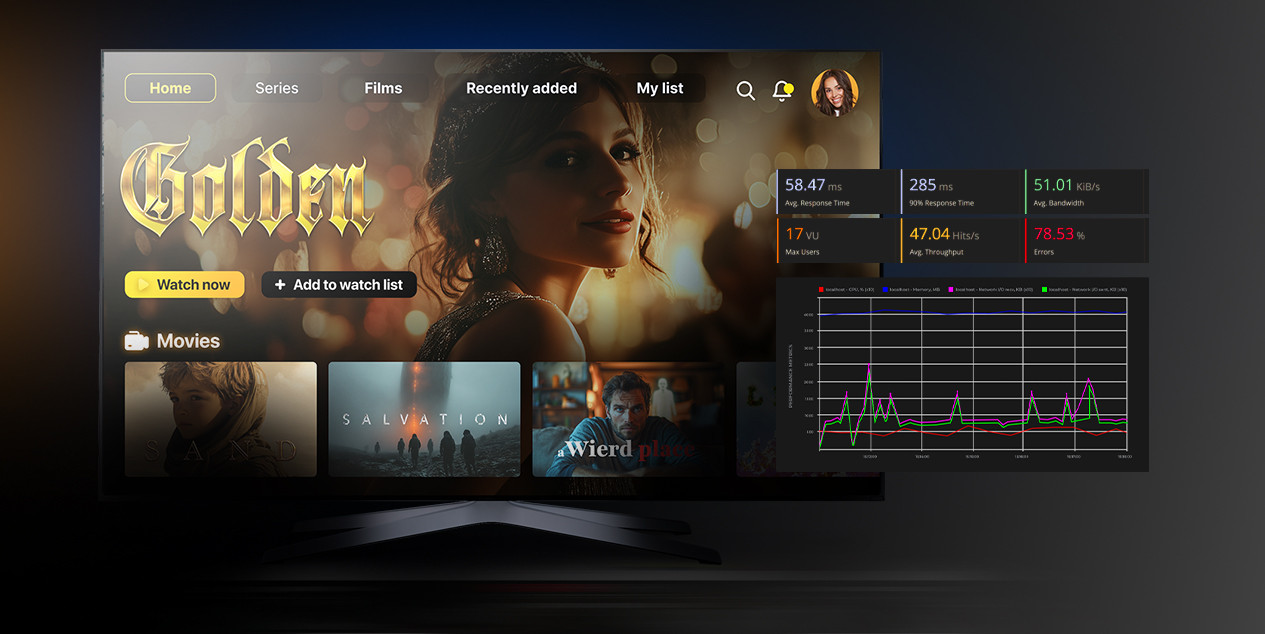
Architecture work does not always begin with a blank page. In one of our OTT consulting engagements, we joined an existing interactive VoD initiative to examine the current solution and define where its technical foundation could be strengthened. The work included:
CDN design has a direct impact on user experience, but it also influences infrastructure cost, resilience, and operational flexibility. In that sense, this part of the platform supports far more than just content delivery. It helps determine how well the service behaves when popularity suddenly arrives like a marching band at 3 a.m.
Playback is the point where all previous decisions become visible to the viewer. By the time the user presses Play, the platform has already ingested, processed, packaged, stored, and distributed the content. What happens next depends on how well the player, the manifest, the delivery path, and the device work together.
This part typically includes:
At this stage, the player reads the manifest and uses it as the basis for playback. The manifest defines which renditions are available, where the segments are located, and how the client can adapt under different conditions. As a result, playback quality depends not only on the player itself, but also on how well the service prepares the stream for different devices, network conditions, and viewing scenarios.
A smart TV, a mobile phone, and a laptop may play the same title, yet they do so under different constraints. Screen resolution, decoder support, network type, and device-specific playback capabilities all affect how the stream is delivered and rendered. Viewer location adds another variable, since regional delivery rules, monetization logic, and content entitlements influence how a particular session is resolved.
As Andrey puts it:
“Playback is largely determined by the manifest and by the client’s capabilities. The player selects from what the platform has already prepared, based on the type of device, the available network conditions, and the rules attached to that session.”
For most OTT services, playback itself is not the main place for architectural invention. Many platforms rely on proven player technologies provided by device vendors or established playback frameworks. The more important decisions sit one step behind the player: how the service structures manifest, organize renditions, and coordinate playback with DRM, ad insertion, and delivery logic across devices and regions.
That is why playback works best when it is treated as the visible outcome of upstream decisions. When the surrounding setup is solid, the experience feels simple. When it is not, the player often gets blamed for issues that started much earlier in the chain.
No OTT platform runs on video delivery alone. Once content reaches the viewer, the service still needs a way to measure what is happening, support business models, and turn audience activity into operational and commercial signals. That is the role of the admin and the monetization part of the system.
This part typically includes:
At this stage, analytics serve a business purpose as much as a technical one. The platform needs visibility into what viewers watch, how sessions behave, where monetization events occur, and how the service performs under real demand. Some of that data supports quality control and troubleshooting. Some of it shapes revenue and product decisions.
Advertising creates one of the most data-intensive paths in the whole system. The service may need to track impression delivery, completion, click-through behavior, downstream actions, campaign pacing, budget consumption, and fulfillment against contractual targets. Those signals feed the broader ad stack and determine how inventory is served, measured, and optimized.
Andrey explains:
“Advertising analytics is one of the places where OTT data becomes operational in real time. The platform is not simply recording that an ad existed. It needs to know whether it was served, watched, clicked, and whether the campaign is consuming the budget in the right way.”
Recommendations come from another major decision loop. The platform uses behavioral signals such as watch history, genre preference, session patterns, and repeat viewing to shape what appears next for the user. That affects discovery, retention, and the perceived relevance of the service.
Some technical metrics also sit in this part of the system, but their role is different. Playback quality, bitrate adaptation, and network-related behavior are important, yet many of those outcomes are already influenced by choices made earlier in the delivery chain. At the admin and monetization stage, the more valuable question often concerns what the platform should learn from user behavior and how that insight should affect revenue and experience.
Expert comment:
“If you look at business impact, recommendations, and advertising usually sit at the center. One drives what the user sees next. The other drives how the platform earns. That is why those analytics loops matter so much.”
This part of the platform gives operators a working view of performance, audience behavior, and monetization outcomes. Without it, even a technically sound service becomes much harder to optimize, scale, and grow with confidence.
An OTT platform does not become scalable just because someone labels it ‘cloud-native’ on a slide. It becomes scalable when the system can absorb more users, more traffic, and more complexity without turning playback into a casualty.
Streaming quality is tested under much less tidy conditions than any architecture scheme suggests — shifting demand, uneven network conditions, regional traffic patterns, live events, and the usual mischief of production systems. The real question is which technical decisions give the platform enough room to grow without making it fragile. The same choices also shape the OTT platform backend architecture, influencing how the service scales, absorbs failures, and supports delivery under changing demand.
Below, we break down the factors that help OTT services withstand pressure and continue delivering a stable viewing experience as they scale.
As the audience grows, an OTT platform must distribute traffic and workloads across multiple services, regions, and instances. In practice, that usually points teams toward stateless services, horizontal scaling, cloud infrastructure, and deployment patterns that do not tie growth to a single machine or location.
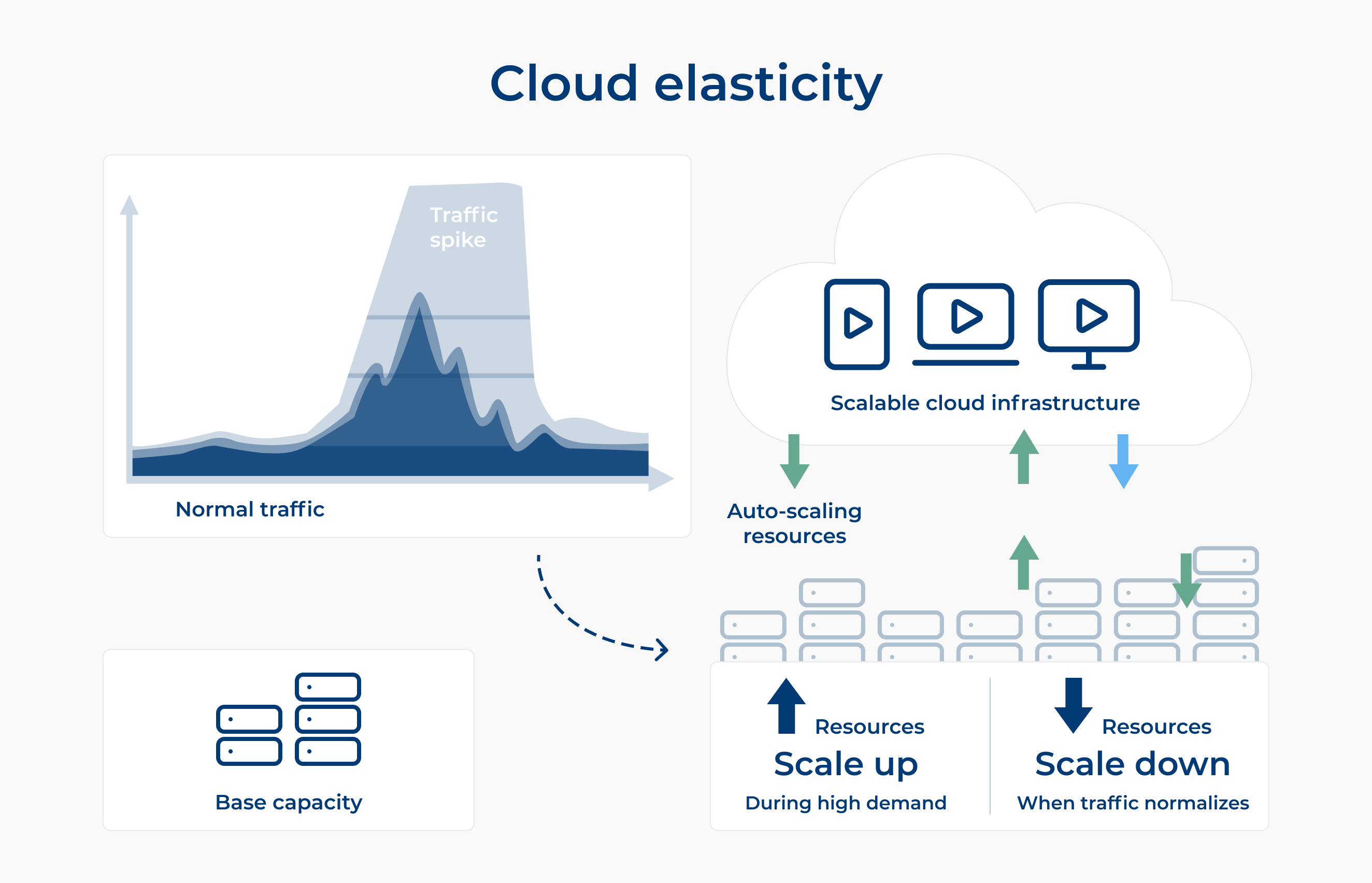
Demand in OTT is inherently uneven. Premieres, live events, seasonal spikes, and regional peaks can reshape load very quickly, so a scalable OTT platform architecture has to expand without excessive delay and contract without leaving too many idle resources behind.
Andrey’s tip:
“If you expect the platform to grow, horizontal scaling is the safer direction. Vertical scaling helps up to a point, but once the audience becomes large enough, one stronger server no longer solves the problem. You need capacity distributed across multiple machines, and cloud infrastructure makes that much easier because you can bring instances up and down around real demand instead of guessing the maximum in advance.”
Our OTT development services cover everything from design and assessment to improving platforms with scalability, delivery efficiency, resilience, and monetization in mind. Whether you are planning a new service or strengthening an existing one, our team can help turn architectural weak points into a more reliable foundation for growth.
For viewers, streaming quality shows up in very concrete ways: how fast playback starts, whether the stream stalls, how smoothly bitrate shifts happen, and whether the session survives service-side issues without visible disruption.
On the platform side, that depends on decisions around buffering, redundancy, failover, and delivery logic. Those settings shape how the service behaves under unstable networks, mixed device conditions, and traffic spikes.
Expert comment:
“Latency is only one part of QoE. Availability matters too. If one storage target fails, another should take over without breaking playback. The same goes for buffering: there is always a trade-off between responsiveness and resilience, and that balance has to be chosen deliberately.”
Protocol choices influence how well the platform serves different devices and playback scenarios. In practice, HLS and DASH remain the main delivery standards, but their suitability depends on client support, format requirements, and the technical profile of the service.
Compatibility is a major part of that decision. Newer devices can support higher resolutions, frame rates, and more advanced delivery features, while older ones often come with tighter limits. A solid OTT system architecture accounts for that variation early, so device diversity does not turn into delivery friction later.
Andrey notes:
“Protocol choice is closely tied to device support. Some clients can work with higher resolutions, frame rates, or newer delivery formats, while older ones cannot. Compatibility limits shape delivery strategy from the beginning.”
Traffic in OTT rarely follows a polite schedule. A quiet weekday, a season premiere, and a major live event can produce completely different load patterns, sometimes within the same week. Infrastructure that expands and contracts with demand gives teams a cleaner way to handle those swings without sizing the whole platform for a permanent peak.
Andrey explains:
“One of the first questions in solution design is where spikes come from — time of day, seasonality, major events, marketing pushes. Cost optimization starts there. The wrong scaling model doesn’t only waste money; it distorts architectural decisions across the platform.”
Viewers do not care which component failed. They care whether playback survived it. That is why resilience in OTT depends on graceful takeover paths across storage, delivery, and service orchestration, with enough redundancy to prevent a local failure from becoming a visible outage.
Expert comment:
“Redundancy is not the same as backup. Backup helps you recover data. Redundancy keeps the service running while something is already broken.”
Taken together, these decisions shape whether a platform stays dependable once audience size, traffic patterns, and product scope begin to shift. The core challenge is not simply to launch a service that works under normal conditions, but to design one that continues to behave predictably when conditions stop being normal.
Expert comment:
“A platform usually looks fine in the happy path. The real test starts when demand spikes, one component degrades, traffic shifts across regions, or a new requirement appears without much warning. That is when design quality becomes visible.”
A mature OTT platform is shaped by the quality of its decisions long before viewers notice the interface or press Play. Long-term stability depends not on how many services exist in the stack, but on how well they work together under pressure, how deliberately trade-offs are handled, and how much room the system leaves for change.
That is one reason OTT design work often starts with questions beyond feature scope. Growth patterns, traffic behavior, resilience, monetization, device diversity, and operational constraints all influence the structure of the platform from the outset. When those questions are addressed early, the service gets a stronger foundation for both day-to-day delivery and future expansion.
At Oxagile, we help companies define and refine OTT platform architecture at different stages of product maturity — from greenfield solution design to architecture assessment and targeted improvements for existing platforms. If you are planning a new service or need to strengthen an existing one, we’re here to help.
OTT platform architecture design defines how the platform’s main components work together across ingestion, processing, storage, delivery, playback, monetization, and analytics. Its job is to shape a system that performs reliably, supports business growth, and stays manageable as product requirements evolve.
An OTT platform backend architecture typically covers server-side services for content ingestion, transcoding workflows, packaging, DRM, storage, CDN coordination, user and subscription logic, analytics pipelines, and monetization. It is the operational backbone that moves content from source to screen.
A scalable OTT platform architecture gives the service room to grow across users, regions, traffic peaks, and new functionality without forcing major redesign every time demand changes. Common enablers include stateless services, horizontal scaling, cloud elasticity, multi-region deployment, and delivery redundancy, where scale justifies it.
OTT system architecture affects streaming quality by how it handles buffering, failover, content delivery, storage availability, and playback adaptation under live traffic conditions. When those elements are well-tuned, the platform is better positioned to maintain startup time, playback continuity, and bitrate stability.

