











This website uses cookies to help improve your user experience

It’s 8:57 PM in London. Kickoff is in three minutes.
Somewhere in a control room, a team of engineers is staring at dashboards, not at the pitch. Forty-seven camera feeds are locked on Wembley Stadium. Encoders are warmed up. Edge nodes across four continents are primed. Three hundred million viewers are about to press play, and any one of them could hear their neighbor scream “GOAL!” a full thirty seconds before the ball crosses the line on their screen.
This is the scenario that defines ultra-low latency video streaming, not as a technical curiosity, but as an engineering requirement with real commercial consequences. A sports broadcaster who delivers the decisive penalty kick ten seconds late loses viewers to Twitter, to the pub down the street, to any source of truth that moves faster than their pipeline. The latency gap becomes a credibility gap, and the credibility gap becomes a revenue gap.

This guide breaks down how sub-second video delivery actually works, what it demands from your architecture, and where it creates measurable business value. In the techniques section, we also share practical insights from Oxagile’s Solution Architect, Andrey Gordeev, whose experience with high-pressure, large-scale broadcasts informs the engineering recommendations.
Key takeaways:
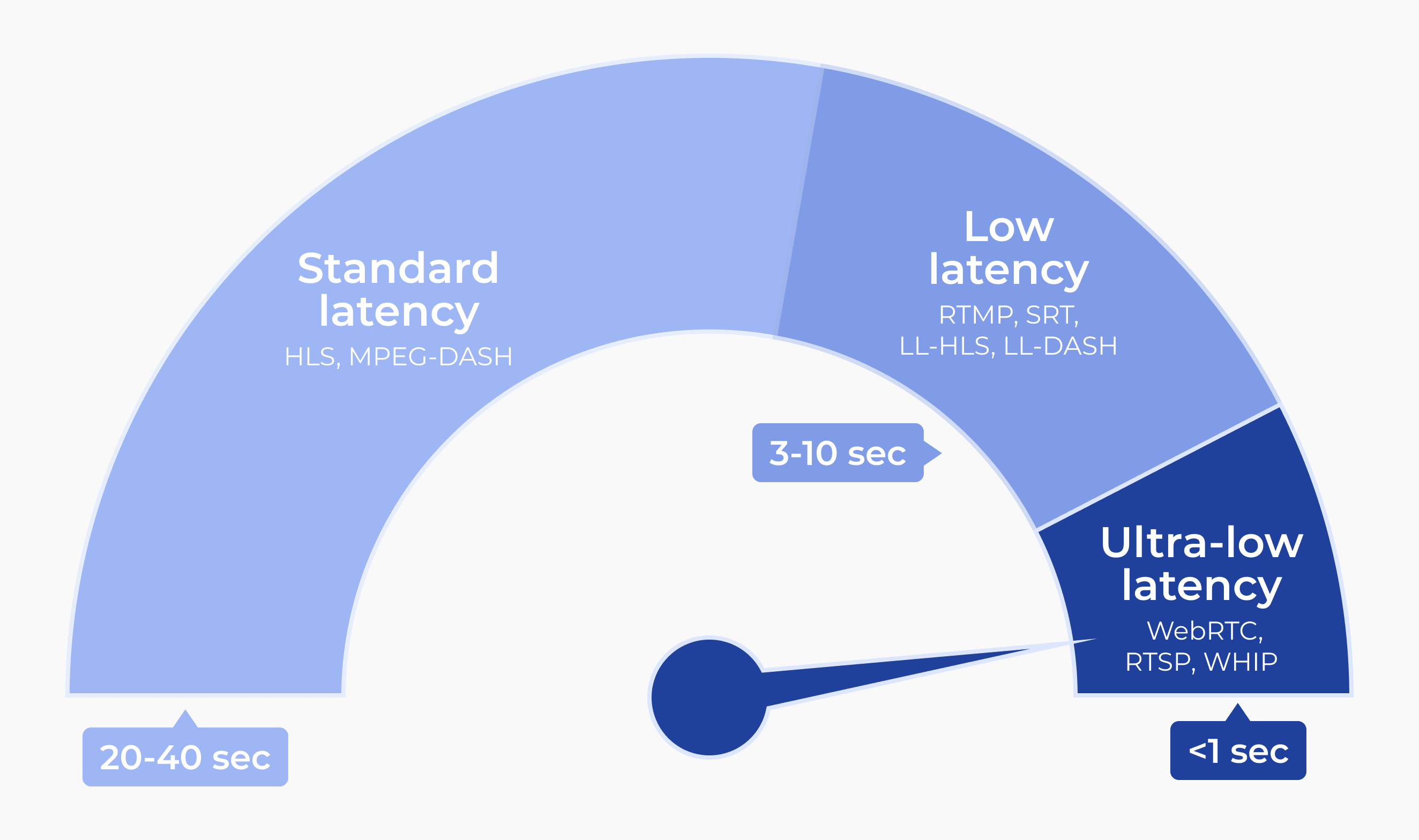
Ultra-low latency video streaming is the delivery of live video with less than one second of delay between the moment a scene is captured and the moment it appears on the viewer’s screen. It sits at the faster end of a latency spectrum that ranges from traditional OTT broadcasting (20-40 seconds of delay) down to real-time communication (100-500 milliseconds), and it requires a fundamentally different streaming architecture to achieve.
Back in the control room, the engineers have a more specific target than ‘fast’. They’re operating within a defined latency tier, and moving from one tier to the next means rethinking the architecture from the ground up.
| Streaming type | Typical latency | Architecture |
| Traditional OTT | 20-40 seconds | Long segments (6-10s), deep player buffers, standard CDN |
| Low latency | 3-10 seconds | Shorter segments (2-4s), optimized CDN routing, reduced buffer |
| Ultra-low latency | Under 1 second | Chunked CMAF (Common Media Application Format) or WebRTC, sub-second buffers, edge processing |
| Real-time | ~100-500 ms | Direct peer connections, no buffering, limited scale |
The distinction between low latency and ultra-low latency is worth spending a moment on, because it’s commonly misunderstood.
Low latency streaming takes the traditional OTT pipeline and optimizes it: shorter segments, smarter CDN configuration, a trimmed-down player buffer. The fundamental delivery model stays the same. You’re still encoding video into discrete chunks, distributing those chunks through a content delivery network, and reassembling them in the player.
Ultra-low latency changes the model. Chunked delivery starts transmitting partial segments before the encoder has finished processing them, so the player no longer waits for a complete 6-10 second chunk to arrive. Buffers shrink from tens of seconds to fractions of a second, edge processing pushes computation closer to the viewer, and the entire pipeline, from capture to display, has to be built around speed as a first-order constraint rather than an afterthought.
For the Champions League broadcast, this difference is the difference between viewers seeing the goal at roughly the same time as the stadium crowd, and viewers seeing it after their social media feeds have already erupted with spoilers.
Streaming low latency isn’t a single problem. It manifests differently depending on the use case, and the business consequences vary accordingly.
Live sports broadcasting is the proving ground for ultra-low latency, and the Champions League scenario shows exactly what’s at stake.
A sport streaming platform competing with terrestrial broadcast has to match or beat the latency of over-the-air television, which typically runs 3-5 seconds behind real-time (just like in one of our recent projects). If your OTT stream adds another 20-30 seconds on top of that, your viewers are experiencing the match in a different temporal reality than anyone watching on cable or sitting in the stadium.
The commercial impact is direct. Betting platforms integrated with live sports feeds require sub-second accuracy, and even a three-second delay on a penalty kick makes in-play wagering unreliable. Second-screen experiences, where viewers interact with polls, stats overlays, and social feeds synchronized to the broadcast, fall apart when the stream is out of sync. And subscriber retention suffers: research consistently shows that viewers abandon streams with noticeable latency during live events, especially when they discover the delay through external spoilers.
Gaming streams with real-time audience participation, live shopping events where hosts respond to viewer comments, and virtual concerts with crowd interaction all depend on a feedback loop between broadcaster and viewer. That loop tolerates about one second of delay before interaction starts to feel broken, like a bad video call where people talk over each other because the audio hasn’t caught up.
The economics of live commerce, in particular, hinge on impulse. A host holding up a product and saying “grab it now” loses its urgency if “now” arrives on the viewer’s screen two seconds later. Flash sales, limited drops, and auction-style formats all degrade when latency introduces ambiguity about what’s still available.
Auctions are the sharpest case for ultra-low latency because they involve binding financial decisions made in real time. If bidder A sees the current price update 800 milliseconds after bidder B, the auction is structurally unfair.
A high-value art auction where one bidder sees the current price 800 milliseconds after another is structurally unfair — and the legal and reputational consequences of that kind of asymmetry are serious, whether you’re trading livestock, commodities, or a Basquiat.
Let’s return to the control room — the broadcast is live, and what the engineering team has built, stage by stage, tells us why each component matters for sub-second delivery.
A traditional OTT pipeline moves through five stages: capture, encoding, packaging, CDN distribution, and player rendering. An ultra-low latency pipeline has the same stages, but every one of them has been re-engineered for speed, and several of them overlap in ways that would be impossible in a conventional setup. This is what makes live streaming software development for sub-second delivery a fundamentally different engineering challenge.
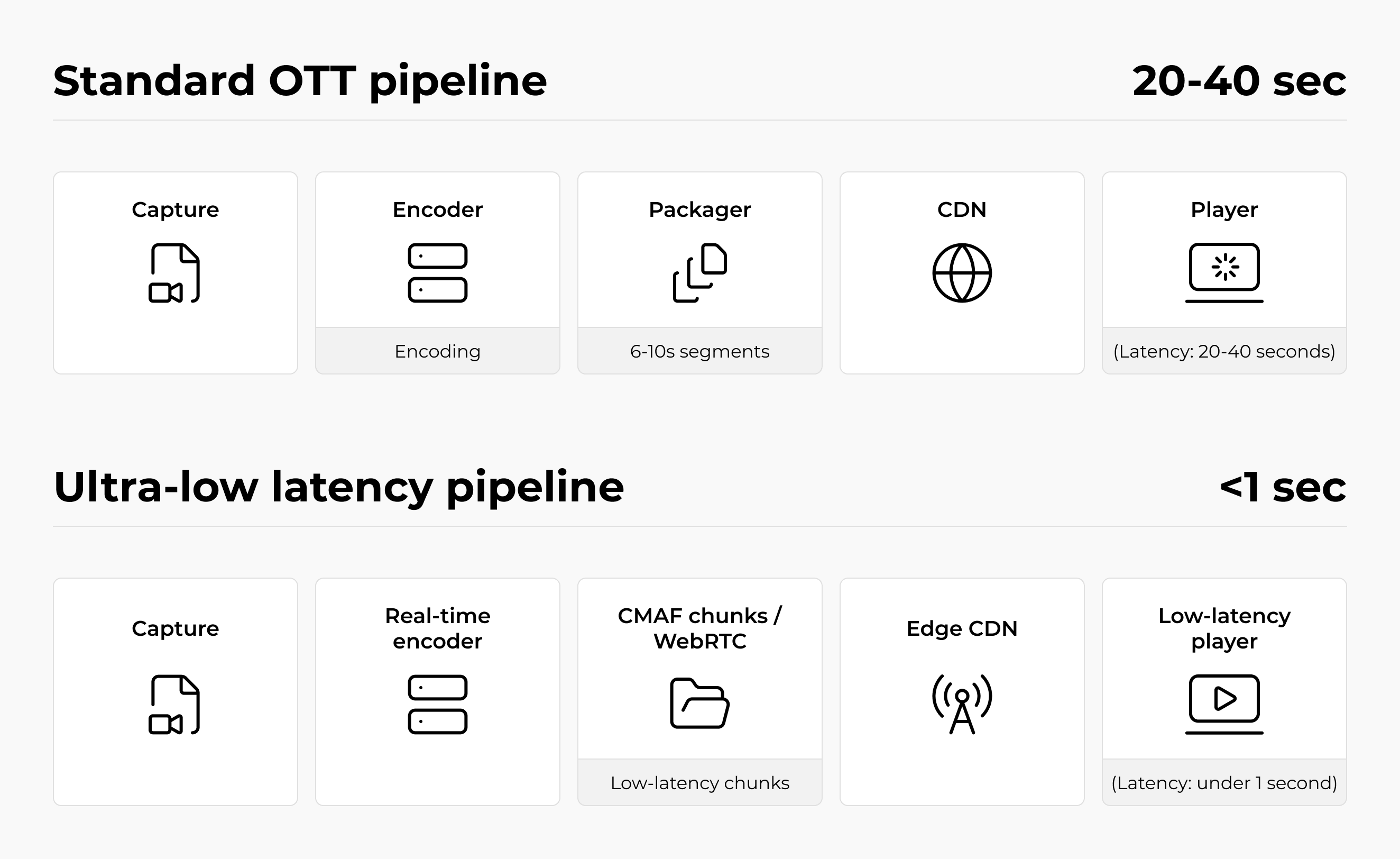
Each stage is faster, yes, but the real shift is that they overlap. They’re no longer fully sequential.
Chunked delivery means the packager starts transmitting data before the encoder has finished processing the full segment. The CDN’s edge nodes begin caching and distributing partial content almost as soon as it’s available. And the player starts rendering with a buffer so small that it’s measured in fractions of a second rather than in whole segments.
Andrey Gordeev, Oxagile’s Solution Architect, frames the infrastructure challenge in terms of elasticity:
“Cloud infrastructure is highly relevant here because it allows you to scale instances up and down. If you only have a few physical machines, you are limited when demand grows or drops.
A good example is retail during Black Friday. With fixed infrastructure, you hit capacity limits, and later resources remain unused. Cloud allows you to run three instances under normal conditions, reduce to one at night, and scale up to ten during peak demand.”
The Champions League final draws an audience curve that no fixed infrastructure can handle: a steady baseline that explodes to hundreds of millions in the fifteen minutes before kickoff, holds there for ninety minutes — plus stoppage time, plus penalties if the universe decides to test your infrastructure — and then falls off a cliff. Pay for capacity you don’t use nine months of the year, or watch your streams buffer during the one night that matters.

The techniques below look straightforward on paper. In production, they interact in ways that are hard to predict without experience. If you’d rather skip the trial-and-error phase, Oxagile’s streaming team can get you there faster.
The architecture describes the structure. These five techniques describe the engineering decisions that determine whether sub-second delivery actually works in practice.
Traditional streaming encodes video into segments, typically 6-10 seconds long, and the player can’t begin rendering until it receives a complete segment. Chunked delivery breaks this constraint by transmitting segments in smaller pieces as they’re encoded.
The two primary implementations are CMAF chunked transfer and partial segments in LL-HLS (Low-Latency HTTP Live Streaming). Both allow the player to start playback before the full segment is available, which eliminates the segment-duration delay that accounts for a large portion of traditional OTT latency.
As Andrey puts it:
“There are mechanisms related to chunking and segment sizes, along with manifest configurations. Video is delivered piece by piece.”
The practical impact is that the player no longer waits 6-10 seconds for the first renderable frame. With chunk sizes measured in hundreds of milliseconds, the initial delay drops to a fraction of what it would be with conventional segmented delivery.
The player buffer exists for a good reason: it absorbs network jitter and bandwidth fluctuations so the viewer sees smooth, uninterrupted playback. But buffer size is directly proportional to latency. A 20-second buffer means the viewer is always watching content that’s at least 20 seconds old.
| Configuration | Buffer size | Trade-off |
| Traditional OTT | 20-30 seconds | Very stable, very delayed |
| Low latency | 3-5 seconds | Moderate stability, moderate delay |
| Ultra-low latency | 0.5-2 seconds | Minimal delay, higher rebuffering risk |
Reducing the buffer to sub-second levels is one of the most impactful latency optimizations, but it’s also one of the riskiest. With less buffer to absorb network instability, the stream is more vulnerable to rebuffering events, those moments where playback freezes and the viewer sees a loading spinner. The engineering challenge is finding the point where the buffer is small enough to deliver acceptable latency but large enough to maintain watchable quality.
Andrey’s perspective on this trade-off:
“Full tolerance is largely about buffer size. It is about finding the balance between stability and system load.”
Players in ultra-low latency pipelines need ABR (adaptive bitrate) algorithms that are specifically tuned for small-buffer conditions, a topic we cover in technique five below.
Not all streaming protocols are created equal when it comes to latency. The choice of protocol shapes the entire delivery architecture and determines the ceiling for how low your latency can go.
| Protocol | Typical latency | Best suited for |
| WebRTC | Under 1 second | Interactive streaming, video conferencing, small-to-medium audiences |
| LL-HLS | ~2-5 seconds | Scalable live streaming, Apple ecosystem, large audiences |
| LL-DASH | ~2-5 seconds | OTT platforms, broad device compatibility |
WebRTC was originally designed for peer-to-peer communication (think video calls), and its architecture reflects that origin: minimal buffering, direct connections, and sub-second latency by default. Adapting it for one-to-many broadcast scenarios introduces scaling challenges, but solutions like SFU (Selective Forwarding Unit) architectures and WebRTC-to-CMAF bridges have made it viable for audiences in the tens of thousands.
LL-HLS and LL-DASH take a different approach, optimizing the HTTP-based delivery model that already powers most OTT infrastructure. They don’t reach sub-second latency as easily as WebRTC, but they scale more naturally through existing CDN infrastructure and support much larger simultaneous audiences.
For the Champions League broadcast, the likely architecture combines both: WebRTC for interactive features (real-time polls, co-watching, low latency video conferencing for remote commentary teams) and LL-HLS or LL-DASH for the primary video feed to hundreds of millions of viewers.
A CDN (content delivery network) reduces latency by caching content on edge nodes geographically close to viewers. For ultra-low latency video streaming, the standard CDN playbook needs three specific enhancements.
First, edge node placement matters more than it does for VoD. When a viewer in São Paulo requests a live stream, the content needs to be available on a nearby edge node almost instantly after it’s produced. This requires push-based distribution rather than the pull-based caching model that works for on-demand content.
Second, routing optimization ensures that viewer requests reach the nearest edge node through the fastest available path, which isn’t always the geographically closest one. Network conditions vary in real time, and an optimized CDN takes congestion, peering arrangements, and last-mile connectivity into account.
Third, multi-CDN strategies provide redundancy and load distribution. No single CDN provider offers optimal coverage everywhere. For a global event like the Champions League final, a live streaming platform typically routes traffic across multiple CDN providers based on real-time performance metrics, shifting viewers from one provider to another if edge nodes become saturated or experience degraded connectivity.
As Andrey explains:
“CDNs replicate content closer to the user, reducing latency. This principle is commonly used in VoD but applies to live streaming as well.”
ABR is the mechanism that lets a stream adjust video quality based on the viewer’s available bandwidth and device capability. Under normal conditions, ABR switches between pre-encoded quality levels, say 1080p, 720p, and 480p, to maintain smooth playback even when network conditions fluctuate.
In ultra-low latency scenarios, standard ABR algorithms struggle. They were designed for environments with large buffers, where the player has seconds of content stored and can afford to take time evaluating whether to switch quality levels. With a sub-second buffer, the ABR algorithm has almost no runway for decision-making. If it switches to a higher bitrate and the network can’t sustain it, rebuffering happens almost immediately.
Solutions include buffer-aware ABR algorithms that weight buffer occupancy more heavily in their switching logic, more conservative bitrate selection that prioritizes stability over maximum quality, and faster adaptation cycles that respond to bandwidth changes in hundreds of milliseconds rather than seconds.
Andrey describes the underlying logic:
“Multiple quality versions are stored, and the system selects the appropriate one based on connection quality to prevent freezes.”
The result is a system that may not always deliver the highest possible resolution, but consistently delivers watchable, uninterrupted playback at sub-second latency, which is the combination that actually retains viewers.
This section might seem counterintuitive in a guide about ultra-low latency streaming, but it’s arguably the most important piece of architectural advice we can offer: don’t optimize for latency you don’t need.
Achieving ultra-low latency incurs real costs: the infrastructure is more complex and more expensive to operate, the reduced buffer makes the stream more fragile, and the engineering team needs specialized expertise in protocols, CDN configuration, and player tuning that goes well beyond standard OTT development. The cloud scaling required for peak events, as Andrey Gordeev described, carries its own operational burden on top of all that.
For many streaming use cases, these costs aren’t justified:
The architectural guidance here is straightforward: match your latency target to your use case, and resist the temptation to treat sub-second delivery as a universal requirement.
Every engineering team going through live streaming app development needs to understand what they’re trading away when they commit to sub-second delivery. The short version: lower latency means smaller buffers, and smaller buffers mean less room to absorb network hiccups.
A viewer on a 50 Mbps connection that drops to 10 Mbps for two seconds during a congestion spike illustrates the problem clearly. A player with a 20-second buffer swallows that disruption without the viewer ever noticing. A player with a 0.5-second buffer has nowhere to hide: the stream either freezes or drops to a visibly lower resolution.
The tools for managing this tension are:
And here’s the competitive reality of events like the Champions League final: if traditional broadcasters deliver 1080p with consistent quality and 3-5 seconds of latency, an OTT platform delivering 720p with occasional rebuffering and 0.8 seconds of latency is technically impressive, but the experience is worse. No one cares if you’ve reduced the delay by 4 seconds if the picture quality suffers when it matters.
Oxagile’s streaming solutions practice approaches latency as an architectural decision that shapes the entire pipeline, from the first design conversations through production monitoring. The team works across every stage:

The Champions League scenario we’ve used throughout this guide isn’t hypothetical. Oxagile’s team has built and operated streaming infrastructure for high-concurrency live events where latency, scale, and quality all have to work simultaneously, and where the margin for error is measured in milliseconds.
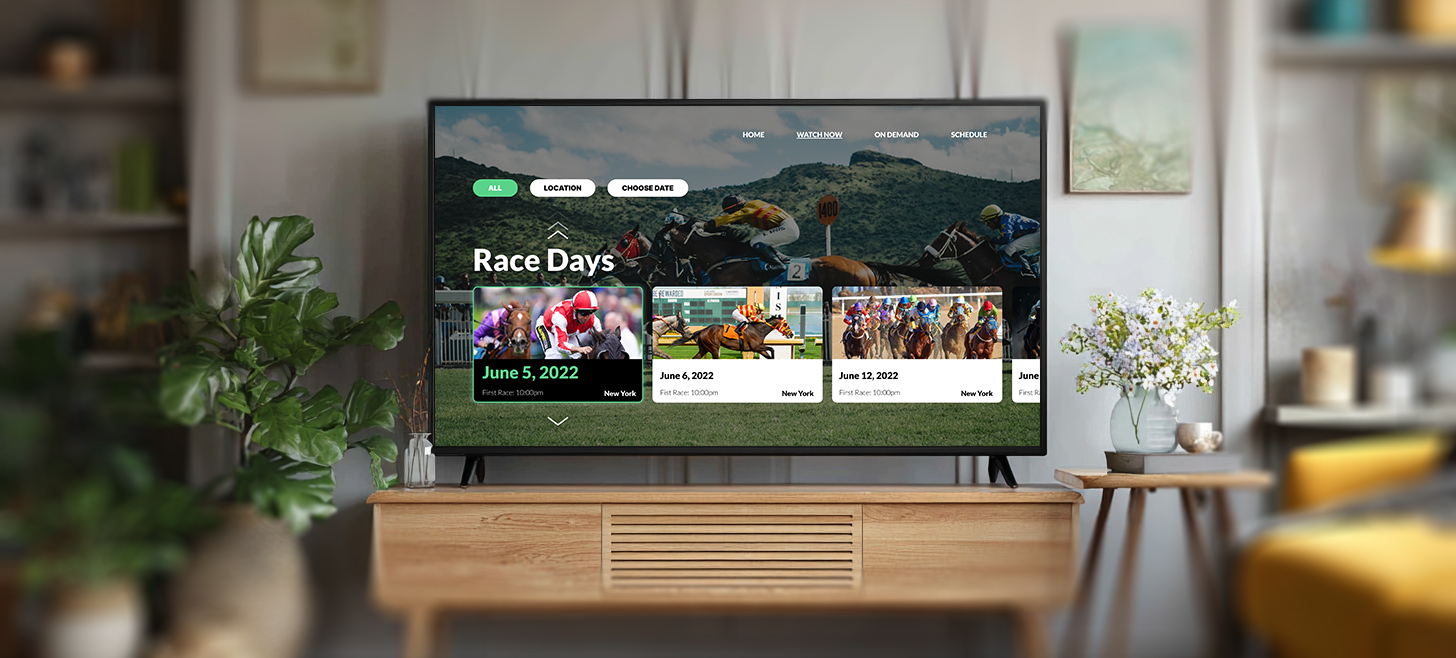
The Champions League is one scenario. Here’s another: a client came to Oxagile with a live horse racing event on the calendar, less than 2.5 months until launch, and nothing built yet. The deadline was the race itself, and races don’t reschedule for your engineering backlog.
The platform had to deliver simultaneous live broadcasts and on-demand replays across Roku, Apple TV, and Amazon Fire TV, with Akamai CDN, AWS Elemental Live, and Streamroot working together under the hood to keep streams stable at peak concurrency. The engineering team ran Scrum with a dedicated Scrum Master, shipping potentially deployable increments from the earliest sprints so the client could see progress in real time and course-correct before the deadline closed in.
Every architectural decision we’ve described in this guide — CDN configuration, encoding pipeline, multi-platform player tuning — had to be made and executed in weeks, not quarters. The platform launched on schedule, and race day ran clean.
It’s 9:48 PM now. Stoppage time. The score is level, and somewhere in São Paulo a viewer’s stream freezes for 400 milliseconds — long enough for the ABR algorithm to drop from 1080p to 720p, short enough that he doesn’t notice. In the control room, an engineer watches the buffer occupancy graph dip and recover. The CDN failover didn’t trigger, and the pipeline held.
That’s what ultra-low latency looks like when it works: invisible. Nobody in the stadium crowd, nobody on the couch, nobody in the control room remembers the infrastructure when everything goes right. They remember the goal.
But building a system that disappears into the background during the most-watched 90 minutes of the year takes months of architectural decisions, each one a trade-off between speed, stability, and cost. Those trade-offs only make sense when the use case demands them — a Champions League final, a live auction with seven-figure bids, a flash sale that sells out in 12 seconds. For a VoD library or a recorded lecture, the same engineering is an expensive solution to a problem that doesn’t exist.
The real skill is knowing the difference.
Your next big broadcast is coming. Maybe it’s not the Champions League final, but for your viewers, it might as well be. The architecture decisions you make now determine whether they see the goal live or read about it on Twitter first. Oxagile’s team has spent over 20 years building streaming infrastructure for exactly these moments, let’s make sure yours holds up.

Ultra-low latency streaming delivers live video with less than one second of delay between capture and playback — that’s the ultra low latency meaning in practical terms. It uses specialized techniques like chunked CMAF delivery, sub-second player buffers, and edge-optimized CDN infrastructure to achieve speeds that traditional OTT pipelines, which typically run 20-40 seconds behind real-time, cannot match.
Low latency streaming (3-10 seconds of delay) optimizes the traditional OTT delivery model with shorter segments, smarter CDN routing, and reduced buffers.
Ultra-low latency (under 1 second) requires a fundamentally different architecture: chunked delivery that transmits partial segments during encoding, sub-second buffers, and protocols like WebRTC or CMAF chunked transfer that are designed for near-real-time operation.
WebRTC delivers sub-second latency and is best suited for interactive streaming and smaller audiences. LL-HLS and LL-DASH achieve 2-5 seconds of latency and scale more effectively through existing CDN infrastructure. Many production systems combine these protocols, using WebRTC for interactive features and LL-HLS or LL-DASH for primary video distribution.
Yes. Lower latency means smaller player buffers, which reduces the stream’s ability to absorb network fluctuations. This can lead to more frequent rebuffering or quality switches. Engineering teams manage this trade-off through tuned ABR algorithms, multiple encoding renditions, and real-time QoE monitoring.
Video on demand, news broadcasting, educational streaming, and other use cases where real-time synchronization isn’t critical work well at 10-20 seconds of delay. Over-engineering latency for these scenarios adds infrastructure cost and operational complexity without proportional business benefit.
Live sports broadcasting, interactive streaming and gaming, live commerce and shopping events, online auctions, financial trading platforms, and any scenario where viewer decisions or engagement depend on temporal accuracy.

