














This website uses cookies to help improve your user experience


For many businesses, the connected TV (CTV) ad ecosystem feels like a kaleidoscope: multiple platforms, different roles, and overlapping functions. Out-of-the-box solutions promise speed and simplicity, but they rarely deliver optimal targeting, analytics, or revenue control.
A ready-made DSP is like renting a generic billboard on a busy street. It works, but you can’t control who sees it or when. This article helps map that kaleidoscope. We break down the CTV ad stack, highlight the best CTV advertising platforms per role, and show how custom integrations can unlock better results.
A CTV advertising stack covers the full path from the brand or agency to the viewer’s screen, moving through demand-side platforms (DSPs), supply-side platforms (SSPs), ad servers, and finally into the CTV app. Each layer plays a defined role in ensuring campaigns run efficiently, data flows correctly, and inventory is sold at premium rates.
Once you see how these connected TV campaigns are built, measured, and optimized in real time, it becomes clearer where the real value comes from. Issues tend to surface at specific points, and that’s when investing in deeper integrations or custom-built solutions makes sense.
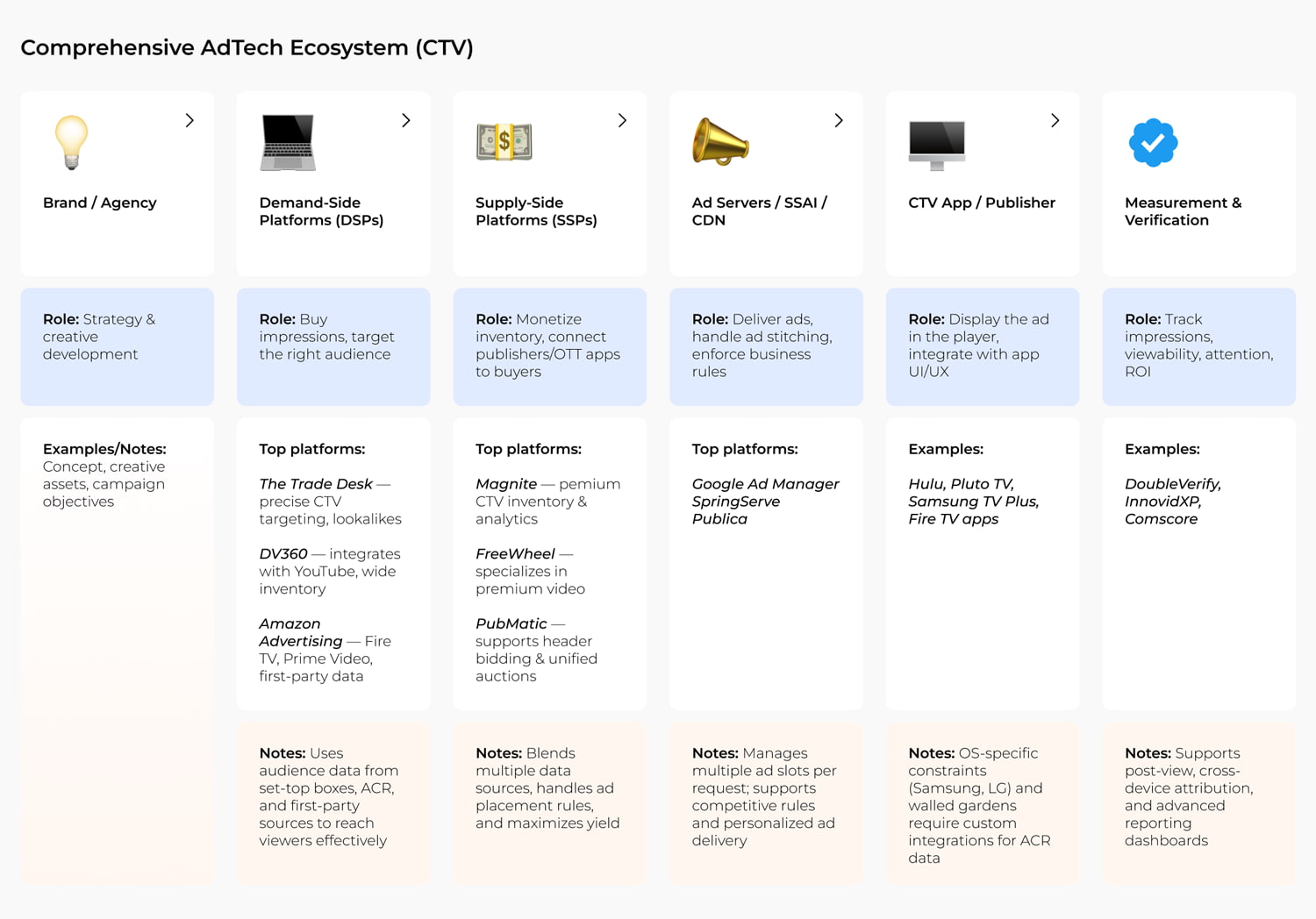
Advertisers define goals, create campaigns, and develop creatives. For example, a travel brand may create multiple ad variants tied to location signals from CTV devices.
DSPs help advertisers purchase CTV ad space programmatically and optimize audience targeting, frequency control, bidding, and spend efficiency. When a viewer reacts to a second-screen activation, such as a shoppable prompt, the DSP can trigger sequential messaging, showing tailored follow-up ads fueled by that immediate engagement.
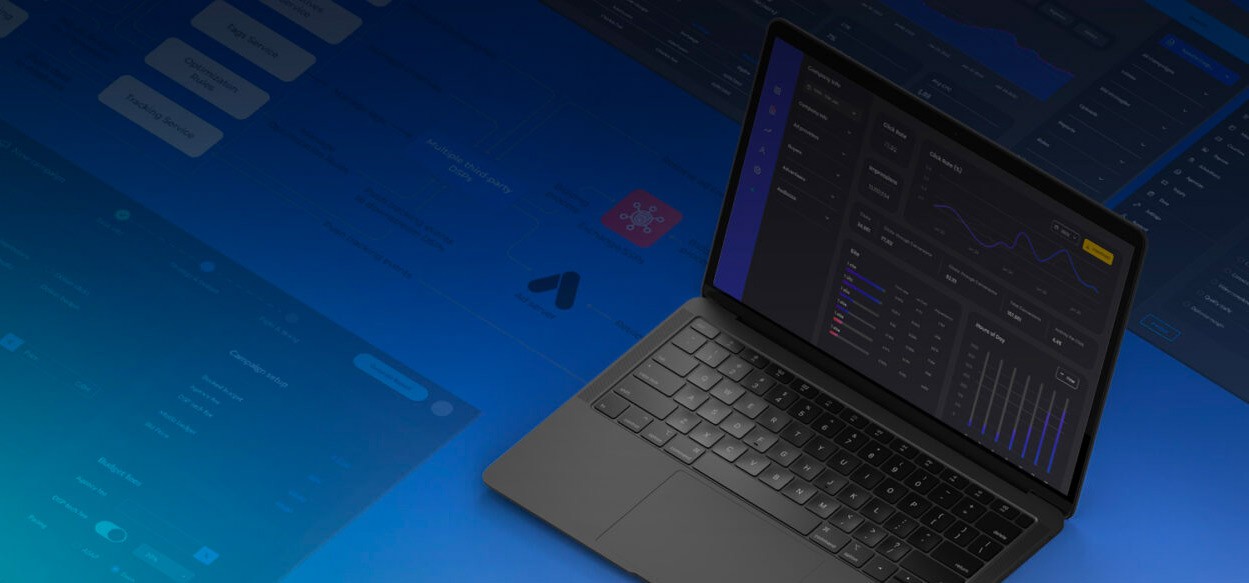
To target diverse audience segments, especially coveted CTV viewers, a client wanted to unify several DSPs under one roof. The DSP aggregator enabled quick campaign launches, real-time performance tracking, and seamless cross-DSP targeting.
SSPs help publishers and OTT apps manage and monetize their inventory, apply yield strategies, and connect with multiple demand sources. A free ad-supported streaming television (FAST) channel may route its inventory through multiple SSPs to compete for the highest CPM.
Ad servers and server-side ad insertion (SSAI) systems handle dynamic ad stitching and deliver stable playback across devices. During live sports, SSAI keeps transitions fluid even when ad breaks fire at unpredictable moments.

Let’s talk about building an SSAI setup tailored to your streaming workflow.
Ads are seen on FAST channels, AVOD services, broadcasters’ own apps, and OEM channels. Cross-device identity resolution is becoming essential as households switch between CTV, mobile, and web.
These tools track impressions, validate delivery, verify brand safety, and detect fraud. A big trend now is measuring attention and engagement — tracking not just that an ad played, but whether viewers watched it all the way through.
CTV HomeScreen ads are leading this shift1, delivering a 48% attention rate — 16% higher than YouTube skippable pre-roll. This shows how quickly viewers notice and engage with these placements.
Oxagile’s tip:
Each layer matters. DSPs optimize spend, SSPs maximize publisher revenue, and measurement platforms protect against fraud. To get the full benefit, make these layers work together through clean integrations and shared data.
Breaking platforms into subgroups helps businesses evaluate options based on function rather than hype.
Platform category | Purpose | Top CTV ad platforms | Key features |
DSP | Purchase inventory programmatically | The Trade Desk, DV360, Amazon Advertising | Key for audience targeting, lookalike modeling, campaign optimization |
SSP | Monetize publisher inventory | Magnite, FreeWheel, PubMatic | Focus on premium inventory, header bidding, analytics |
Ad Server / SSAI | Ad insertion and delivery | Google Ad Manager, SpringServe, Publica | Ensures smooth ad playback and dynamic ad insertion |
Measurement | Tracking and verification | DoubleVerify, Comscore, InnovidXP | Measures impressions, ensures brand safety, prevents fraud |
Picking the best CTV & OTT advertising platforms isn’t just about choosing the most popular names on the market. Broadcasters and advertisers need to carefully assess how each solution fits their inventory, audience targeting, integration needs, analytics capabilities, and overall ROI. A cautious, structured approach makes sure that every dollar spent on CTV ads drives value, reduces wasted impressions, and helps maximize revenue from each ad pod.
Let’s outline the key criteria for evaluating CTV platforms from a few angles.
Criteria | What to look for | Example in CTV context |
Inventory and reach | Access to premium publishers and device coverage | Roku, Samsung, LG, Fire TV; broad device coverage increases campaign scale |
Audience targeting | Behavioral, demographic, contextual, geo-based, first-party data integration | Automatic Content Recognition (ACR) data from Smart TVs, set-top box logs, first-party CDP audiences, cross-device panels |
Integrations | CRM, DMP, CDP, analytics, APIs/SDKs for custom solutions, cross-channel support | Pulling CRM segments into DSP, blending DMP datasets with SSPs, pushing audience data to measurement dashboards |
Analytics and attribution | Post-view and cross-device tracking, BI export, ROI measurement | Viewability, attention-based metrics, completion, cross-device attribution, custom reporting via DSP/SSP |
Interactive features and UX | QR codes, CTA buttons, AI-based recommendations, personalization | Shoppable QR codes, dynamic CTAs in ad breaks, interactive product overlays, AI-based content suggestions, choose-your-path ad formats |
Pricing and transparency | CPA/CPM models, bidding transparency, private vs open auctions | Unified auctions / header bidding for fair competition, private marketplace deals for premium inventory |
Oxagile’s tip:
Focus on the criteria that align with business goals. Coverage, targeting, and analytics usually top the list.
There’s no one-size-fits-all approach in CTV. When a business needs full control, on-demand features, or deeper customization than off-the-shelf tools can offer, bespoke integrations start to shine. Here are the scenarios where that difference really matters.
Many broadcasters come to Oxagile not for a turnkey ad platform, but to extend or optimize the custom streaming solutions they already operate.
Off-the-shelf CTV ad platforms rarely support the level of integration broadcasters need, especially when they manage proprietary video players, custom SSAI workflows, or region-specific distribution models. In contrast, custom solutions offer the following benefits:
For instance, a mid-size broadcaster with its own CTV service struggled to sell premium inventory. A custom solution integrated ad stitching, user behavior data, and personalization. This tailored approach resulted in higher CPMs and more precise audience targeting.
Here are a few typical indicators that custom development is a better option:
Personalize every viewing experience with our CTV and addressable TV expertise — because relevance drives results.
What if you just need to test a new audience or run a short campaign? While custom solutions offer maximum control, sometimes a simpler platform is enough.
1. Quick hypothesis testing
Sometimes you just need to see if an idea works — fast. For example, a media buyer might want to test a new audience targeting strategy for a short campaign. Instead of waiting weeks to build a full CTV stack, they can spin up a campaign on a ready-made platform like The Trade Desk and start collecting performance data within hours. It’s all about validating the approach quickly without heavy development.
2. Limited technical resources
Not every publisher has a full AdTech team in-house. Imagine a small streaming service that wants to serve personalized ads but doesn’t have engineers to handle ad servers, SSP integrations, and analytics pipelines.
A ready-made CTV platform covers all the under-the-hood work — ad delivery, reporting, and optimization — so the team can focus on content and strategy rather than technical setup.
3. Short-term campaigns or standard use cases
Sometimes campaigns don’t need bells and whistles. A marketing agency running seasonal promotion across multiple clients might just need standard CTV reach with reliable reporting.
Pre-built platforms give them templated campaign setups, instant inventory access, and built-in measurement — everything they need to launch fast, track results, and move on, without reinventing the wheel.
Oxagile’s tip:
Don’t rank custom vs ready-made as better or worse. Each has scenarios where it excels. Custom solutions shine when you need full control, while ready-made platforms speed up launch and simplify operations. Build a stack that meets your business objectives while giving room to experiment and optimize — with expert technical support, so decisions are based on data rather than guesswork.
CTV advertising is a complex ecosystem where publishers and advertisers should constantly balance speed, flexibility, and ROI. Ready-made platforms can accelerate time to market, while custom integrations offer deeper targeting, stronger analytics, and more control over workflows.
Building a high-performing ad stack is easier when you break the process into clear, manageable steps:
When you pick the right mix and have expert guidance, the jumble of CTV choices can become a clear, manageable setup.
Align, activate, and amplify your ad performance.
1. CTV HomeScreen ads hit 48% attention rate, 16% above YouTube skippable pre-roll — Teads

A CTV advertising platform is a tool that helps advertisers deliver video ads to connected TV devices. It works by connecting advertisers with publishers through demand-side platforms (DSPs) and supply-side platforms (SSPs). The platform manages targeting, delivery, and reporting, often using first-party and device-level data to improve accuracy. Best CTV advertising platforms streamline ad placement, optimize budgets, and provide insights on audience engagement.
CTV platforms focus on TV-connected devices, while traditional digital platforms serve desktops or mobile devices. Unlike display or OLV ads, CTV ads often run full-screen, with interactive features and attention-focused metrics. Modern platforms offer server-side ad insertion, cross-device tracking, and advanced targeting options that standard digital platforms may lack. This makes campaigns more precise and engaging for viewers.
The best CTV & OTT advertising platforms help publishers maximize inventory yield and connect with multiple DSPs. Examples include FreeWheel, Magnite, and PubMatic. They support dynamic ad insertion, header bidding, and audience analytics. These platforms also provide real-time insights, allowing publishers to optimize ad revenue while maintaining a seamless viewing experience.
A platform is considered the best when it combines reach, targeting, and analytics into one solution. Key features include first-party data integration, cross-device measurement, and support for interactive ad formats. Best-performing platforms also offer robust reporting, transparent bidding, and easy integration with existing workflows. The main advantage is improved campaign efficiency and actionable insights.
Top CTV advertising platforms include The Trade Desk, DV360, Amazon Advertising, FreeWheel, and Google Ad Manager. They lead in reach, targeting capabilities, and analytics. These platforms help brands and agencies deliver personalized campaigns across devices, measure attention, and optimize for performance-driven outcomes. Using the highest-rated platforms can simplify complex ad operations while improving campaign effectiveness.
CTV advertising platforms improve ROI by enabling precise audience targeting, dynamic ad insertion, and multi-device tracking. They reduce wasted impressions and provide data-driven insights for optimization. Platforms that integrate analytics, first-party data, and SSP connections help advertisers refine campaigns continuously. As a result, brands can increase engagement, reach premium inventory, and measure attention effectively across OTT and CTV channels.

