










This website uses cookies to help improve your user experience


Comparisons like Titan OS vs Google TV have moved from niche debate to boardroom decision. Titan isn’t thought of as an emerging alternative now, it is considered alongside established Smart TV platforms. Built with a strong focus on monetization control, content discovery, and OEM flexibility, it challenges the assumptions that have long shaped dominant ecosystems.
This article shifts the perspective. We compare this OS directly with other major Smart TV operating systems: Google TV, webOS, and Tizen, drawing on our hands-on experience with Titan OS app development and multi-platform delivery. Our goal is not to rank platforms, but to clarify where their strengths, constraints, and trade-offs become visible in real products.
You will find a focused comparison across key dimensions: UX flexibility, performance, app ecosystems, advertising integration, customization for OEMs, development effort, update cycles, data control, and implementation cost. We also cover the main strengths and limitations of Titan and provide an OS-agnostic view shaped by our experience delivering Smart TV and OTT solutions across Android TV, Google TV, LG webOS, Samsung Tizen, and Titan OS.
Key takeaways:
The Smart TV operating system layer has transitioned from a device-centric feature into a core strategic battleground for content, data, and advertising monetization.
These patterns reflect a market where the Smart TV interface has become the primary gateway to video consumption and connected experiences. It’s not a niche segment.
Globally, more than half of all households worldwide are projected to own a Smart TV in 2026 (~1.1 billion homes), a figure that contextualizes long-term adoption and installed base growth3.
Forecasts estimate that the global Smart TV market value will grow to around 825 billion USD by 2036 at a double-digit CAGR, pointing to sustained expansion of both devices and platform revenue opportunities4.
Multiple reputable sources indicate:
Several forces crystallized:
As a result, the role of the Smart TV OS in controlling discovery, data, and monetization became a decisive factor in platform strategy. This is the environment Titan OS is in, a market where control over the OS layer is increasingly aligned with control over business outcomes.

Fall back on Oxagile’s ample expertise developing applications for Titan OS and other Smart TV platforms.
Operating systems for Smart TVs are no longer compared primarily through feature checklists. The discussion shifted toward structural differences: how platforms distribute control, how flexible they are by design, and how much strategic autonomy they leave to OEMs and partners.
This is exactly the logic behind the Smart TV OS positioning diagram below. By looking at operating systems through the lenses of control and flexibility, it becomes clear why comparisons such as Titan OS vs Google TV, webOS vs Titan OS, and Titan OS vs Tizen are not interchangeable technical debates, but reflections of fundamentally different platform models.

At a high level, today’s Smart TV OS can be understood through three dominant approaches.
Google TV is a representative example of such platforms, which are built to maximize scale and standardization. They tightly integrate content discovery, data flows, and monetization into a broader ecosystem logic.
This model often accelerates time-to-market and simplifies distribution, but it also fixes many strategic parameters outside the OEM’s control. Oxagile has previously explored these trade-offs in practice, including platform-specific constraints and opportunities, in the context of Titan OS vs Android TV within its broader work on Smart TV app development.
In systems like webOS and Tizen control moves closer to the hardware layer. Over time, both have become media platforms with their own advertising and content strategies.
This approach enables strong vertical integration, but it remains structurally closed and difficult to adapt beyond the owning brand. Design consistency, navigation patterns, and UX behavior also vary significantly across these platforms, an aspect Oxagile analyzes in more detail in its article on Smart TV design across platforms.
Titan OS sits outside both of these dominant models. As reflected in the upper-right quadrant of the positioning diagram, Titan OS combines OEM-led control with a higher degree of flexibility. Rather than inheriting a predefined ecosystem logic or a single-manufacturer roadmap, it is designed as an adaptable OS layer that can support different regional requirements, monetization setups, and UX strategies.
This distinction became especially relevant as several market realities converged recently:
The choice of operating system has a direct influence on more than just deployment speed. It affects how content is surfaced, data is governed, and revenue models change over time. From this perspective, Titan OS is not positioned as a universal replacement for ecosystem-led or manufacturer-owned platforms. It addresses a growing segment of the market that treats the Smart TV OS as strategic infrastructure, not as an interchangeable software component.
This view aligns with Oxagile’s broader experience across Smart TV and OTT ecosystems, including work with multiple operating systems and platform models outlined in OTT app development practice.
Seen through this lens, comparing Titan OS with Google TV, webOS, and Tizen becomes a way to compare different answers to the same core question: who controls the Smart TV experience, and on what terms. That comparison is where we turn next.
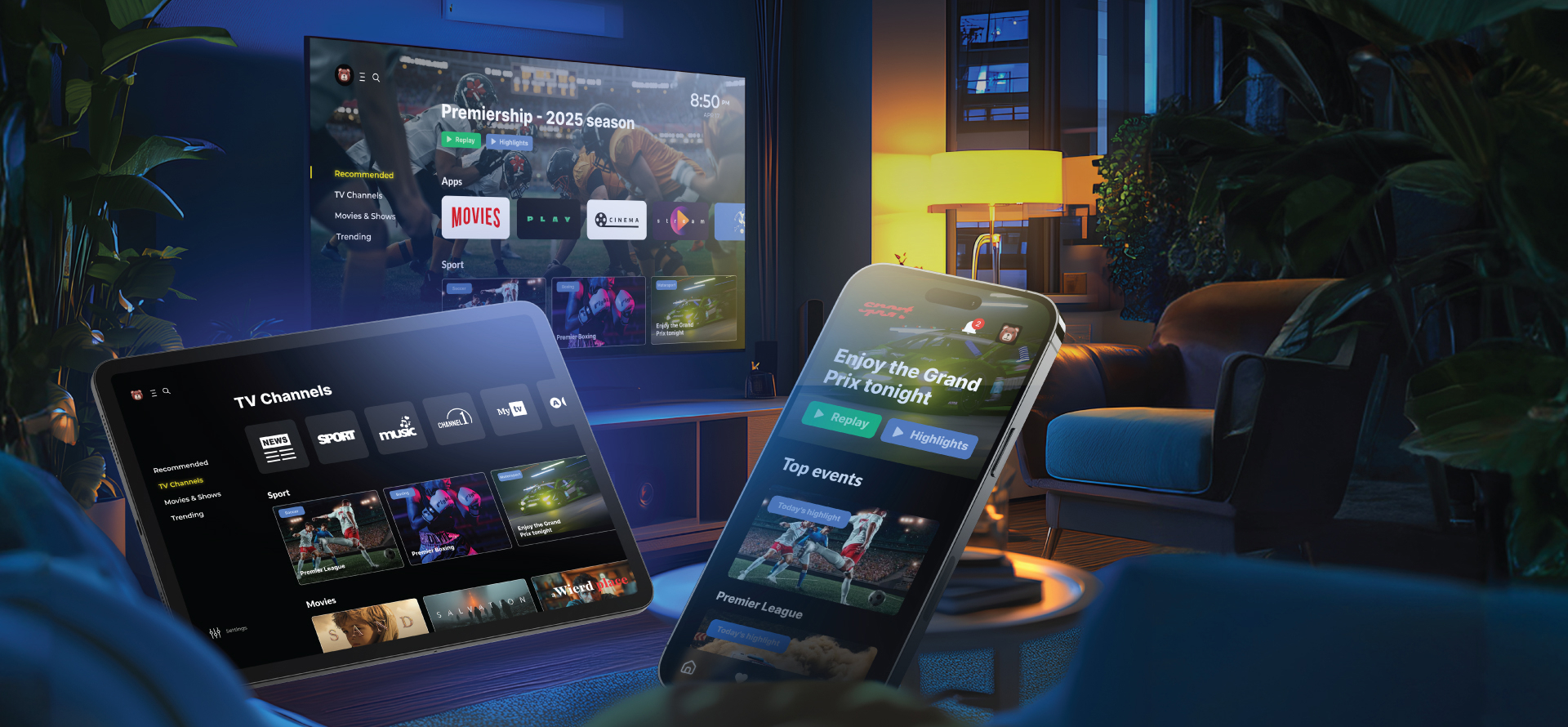
In a recent project for a video platform provider working with telecom operators, Oxagile delivered a white-label OTT solution designed for fast rollout across markets and devices. The platform supported 13 operating systems and 25 device types, while remaining configurable for different telco partners through a shared architectural core.
Key outcomes:
As Smart TVs became the primary interface for video consumption, operating systems started to differ less in what they support and more in how they shape the business behind the screen. Looking at Titan OS next to other platforms is therefore about understanding how different OS models influence control, flexibility, and long-term ownership.
When teams compare Titan OS vs Google TV, the discussion usually gravitates toward user experience, monetization, and data. Both platforms are technically capable, but they are built around very different assumptions about who should define the rules of the platform.
| Titan OS | Google TV | |
| UX / design flexibility | OEM-controlled UX and content discovery logic | Standardized UX defined by the ecosystem |
| Advertising integration | Flexible, supports custom ad stacks and monetization models | Deeply integrated into Google’s ad ecosystem |
| Data control | First-party data controlled by OEM / partners | Data governance driven by the platform owner |
| OEM customization | High level of customization across UX and business logic | Limited customization options |
| App ecosystem | Selective, growing ecosystem | Large, mature global ecosystem |
| Cost of adoption | Project-based, transparent | Low entry cost, higher long-term dependency |
The contrast here is straightforward: Google TV optimizes for scale and standardization, while Titan OS is designed for teams that want to retain control over how experience, data, and monetization evolve over time.
The conversation around webOS vs Titan OS tends to surface later in the product lifecycle, when development workflows, update cadence, and platform constraints become more visible. Both platforms support polished Smart TV experiences, but they differ significantly in how much flexibility they allow beyond the default model.
| Titan OS | webOS | |
| Development model | Flexible, OEM-driven | Strict platform guidelines |
| App requirements | Adaptable to project needs | Defined and enforced by LG |
| Update cadence | Determined by the OEM roadmap | Tied to the manufacturer roadmap |
| UX and design | Customizable per product or market | Consistent but constrained |
| Regional adaptability | High | Limited |
| Ecosystem openness | Independent | Closed, brand-owned |
The key difference here lies in platform governance: webOS follows a manufacturer-controlled model, while Titan OS leaves room for OEMs to adapt the platform as their product and market strategy get modified.

For Samsung (Tizen) and LG (webOS) Smart TVs, Oxagile built applications that turned live event viewing into an interactive experience. Viewers could switch camera scenes from their phone and instantly project them onto the TV, making the second screen an active part of the broadcast rather than a companion.
What made it work:
Titan OS vs Tizen is most often discussed in the context of ownership and long-term dependency. While both platforms operate close to the device layer, their strategic implications for OEMs are fundamentally different.
| Titan OS | Tizen | |
| OEM customization | High | Limited to Samsung’s ecosystem |
| Control over UX and roadmap | Controlled by the OEM | Controlled by the manufacturer |
| Advertising strategy | Flexible, configurable | Proprietary and platform-driven |
| Data ownership | OEM-led | Platform-led |
| Cost structure | Transparent, project-based | Implicit cost through ecosystem lock-in |
| Suitability for third-party OEMs | Yes | No |
Here, alignment forms the distinction. Tizen is optimized for a single manufacturer ecosystem, whereas Titan OS is built to support independent OEM strategies across markets and use cases.
Looking into the comparisons with Google TV, webOS, and Tizen, Titan OS emerges as a platform with a clearly defined set of strengths and limitations. It is not a universal choice for every Smart TV project, but Titan OS is an operating system optimized for specific priorities: primarily control, flexibility, and ownership.
One of the most distinctive advantages of Titan OS is the level of control it offers over monetization. Unlike ecosystem-led platforms, Titan OS allows OEMs and partners to define their own advertising strategy, integrate custom ad stacks, and experiment with monetization models without being locked into a predefined platform logic.
The platform also makes integration of FAST channels and content-driven experiences possible relatively fast. For products where time-to-market and rapid iteration matter, this flexibility can be a tangible advantage, especially compared to more rigid or approval-heavy ecosystems.
From a cost perspective, Titan OS typically offers a more transparent and competitive adoption model. Instead of hidden long-term dependencies or indirect ecosystem costs, implementation tends to follow a project-based structure that is easier to align with business planning.
Another important strength lies in interface flexibility. Titan OS gives device manufacturers room to adapt UX and content discovery to their brand, market, or regional requirements, so they don’t have to conform to a single standardized interface. This makes the platform particularly appealing for OEMs seeking differentiation beyond hardware specifications.

At the same time, Titan OS comes with trade-offs. As such, its application ecosystem is less mature than that of large, established platforms like Google TV. While this is not always a blocking factor, it can influence content availability expectations in certain markets.
Documentation and developer resources are another area where Titan OS may feel lighter, especially when compared to ecosystems with years of accumulated tooling, samples, and community support. For teams accustomed to highly structured platform documentation, this can increase the learning curve during early development stages.
Finally, Titan OS currently has fewer large-scale enterprise deployments that are publicly documented. For organizations that rely heavily on proven enterprise references, this relative lack of visibility may require a higher level of internal validation and piloting before full rollout.
There is no single Smart TV operating system that works equally well for every product, market, or business model. As the comparisons in this article show, Google TV, webOS, Tizen, and Titan OS are built around different trade-offs between scale and control, standardization and flexibility, speed and long-term ownership.
Oxagile’s work spans Android TV and Google TV, LG webOS, Samsung Tizen, and Titan OS, across custom video streaming products for different regions, devices, and audience sizes. This hands-on exposure makes the differences between platforms tangible in real development cycles, UX decisions, monetization setups, and operational constraints.
Working with multiple Smart TV operating systems highlights two important realities. First, every platform has limitations that only surface once a product moves beyond initial launch. Second, those limitations are rarely universal: what becomes a blocker on one OS may be irrelevant on another.
That is why choosing a Smart TV OS is means matching capabilities to intent and priorities. Understanding how each stack behaves in production helps, which is why our multi-platform perspective allows us to approach OS selection pragmatically, helping OEMs and streaming services choose a platform that supports their specific business objectives, as it’s easier than forcing the product to adapt to the constraints of a default ecosystem.
Choosing a Smart TV OS is only half the equation. What matters just as much is how the app is designed, built, and scaled across platforms: Google TV, webOS, Tizen, and emerging operating systems like Titan OS.
1. Smart TV Penetration Yet to Plateau — Marketing Charts
2. 61% of U.S. internet households use smart TV as primary streaming device — PR Newswire
3. Global Smart TV ownership projection by 2026 — Market.us Scoop
4. Smart TV Market, Global Market Analysis Report — Future Market Insights
5. Smart TV market share by OS — Coherent Market Insights
6. Connected TV 2025 statistics — MarketingLTB

When evaluating Titan OS vs Google TV, the key long-term trade-off lies in platform ownership versus ecosystem leverage. Google TV offers immediate access to a mature ecosystem and proven scale, but it also anchors product evolution to Google’s roadmap, monetization logic, and data governance model. Titan OS, by contrast, shifts more responsibility to the OEM or platform owner, but in return provides greater control over UX, monetization strategy, and data usage. Over time, this difference becomes especially relevant for products that aim to differentiate their business model rather than compete purely on distribution reach.
The impact of webOS vs Titan OS often becomes visible after the initial launch phase. While webOS provides a stable and well-defined development environment, updates, platform changes, and feature rollouts are closely tied to the manufacturer’s release cycle. Titan OS offers more flexibility in how and when updates are introduced, which can accelerate iteration for teams that need to adapt quickly to market or product changes. However, this flexibility also requires stronger internal ownership of the development process and platform decisions.
The question of Titan OS vs Tizen is most critical when platform independence is a strategic requirement. Tizen is tightly integrated into Samsung’s hardware and ecosystem, making it a natural choice within that environment but limiting its applicability for third-party OEMs. Titan OS, on the other hand, is designed to support independent OEM strategies across devices and markets. This distinction matters most for companies that want to avoid long-term dependency on a single manufacturer-controlled platform and retain control over UX, data, and monetization.
Google TV has the widest adoption among TVs from brands like Sony, TCL, and Hisense. This makes it the platform for global reach and scale. Tizen is used by Samsung and offers a large but more closed ecosystem tied to a single dominant manufacturer. Meanwhile, Titan OS is still developing. It appears on Philips TVs and highlights regional growth and platform independence.

