













This website uses cookies to help improve your user experience




Entering new markets is rarely just a question of promotion, partnerships, and content libraries. For OTT products on Smart TV platforms, expansion is often accompanied by ambitious launch campaigns, high expectations, and significant marketing investments. Yet quite often, the technical readiness of the application itself is still treated as a secondary concern or something to improve after release.
The OTT market today leaves little room for that assumption. Competition is intense, user acquisition costs are high, and viewers have near-zero tolerance for friction. When a Smart TV application is introduced to a new audience, including launches in emerging markets such as Africa or Latin America, success depends not only on what the app offers, but also on whether it can withstand real-world conditions.
In many cases, the first large-scale rollout exposes issues that were not apparent during development or limited pre-release testing. First impressions are not shaped by content alone. They are shaped by whether the app starts quickly, plays video without interruptions, and remains stable when network quality fluctuates, devices are constrained, or backend systems experience peak load. Freezes, long loading times, and crashes are not perceived as temporary technical issues. From a user’s perspective, they signal an unreliable service, and in an overcrowded OTT landscape, switching to a competing app that simply works takes seconds.
In Smart TV applications, resilience and stability effectively describe the same thing: consistent performance under real-world operating conditions.
From a business standpoint, launching without a resilience-first approach is a high-risk move. Marketing campaigns amplify visibility, but also technical weaknesses. If performance, stability, and fault tolerance are not prepared for scale, even the strongest go-to-market strategy can backfire, leading to wasted acquisition budgets, poor retention, and reputational risks for partners and operators. For this reason, app resilience has become a strategic concern for companies delivering Smart TV app development services.
In this article, we examine app resilience as a foundational element of an OTT expansion strategy. We explain why heterogeneous device environments and unstable operating conditions demand a different technical mindset, how insufficient Smart TV application reliability and stability directly affect first impressions and business outcomes, and which mistakes companies make most often when scaling Smart TV applications.
Finally, we introduce a practical resilience checklist based on real production experience. It outlines the key areas to address before a large-scale launch. These include network adaptation, backend offloading, memory management, and player tuning, all of which contribute to resilient Smart TV apps that can withstand real-world usage.
When OTT products expand into emerging markets such as Africa or LATAM, they enter a space where many assumptions common in EU or US launches no longer hold. The key challenge lies in the technical conditions under which Smart TV applications are expected to operate.
One of the defining characteristics of these markets is the high share of low-end and mid-end Smart TV devices. Televisions have a much longer replacement cycle than smartphones, meaning older models with limited CPU, memory, and graphics capabilities remain in use for years. From an application perspective, this creates a highly heterogeneous device landscape where resource constraints are not an edge case but a baseline condition.
Network conditions add another layer of complexity. Internet connectivity in emerging markets can be unstable, bandwidth inconsistent, and sensitive to peak-time congestion. For Smart TV applications, this affects everything from app startup and navigation to video playback and backend communication. Designs that implicitly rely on stable, high-throughput connections tend to break down when those conditions are not guaranteed.
Peak load behavior further amplifies these challenges. Popular content releases, live events, or major promotions often trigger sudden spikes in concurrent users. When network quality and device performance are already constrained, such spikes can quickly expose weaknesses in application resilience, backend capacity, and client-side error handling.
These factors explain why approaches that work well in more homogeneous, high-end environments cannot be transferred as-is. In emerging markets, technical resilience focuses on building Smart TV applications that can adapt to constrained devices, fluctuating networks, and uneven load patterns during normal operation. Without this adaptation, even well-designed products risk underperforming at scale.
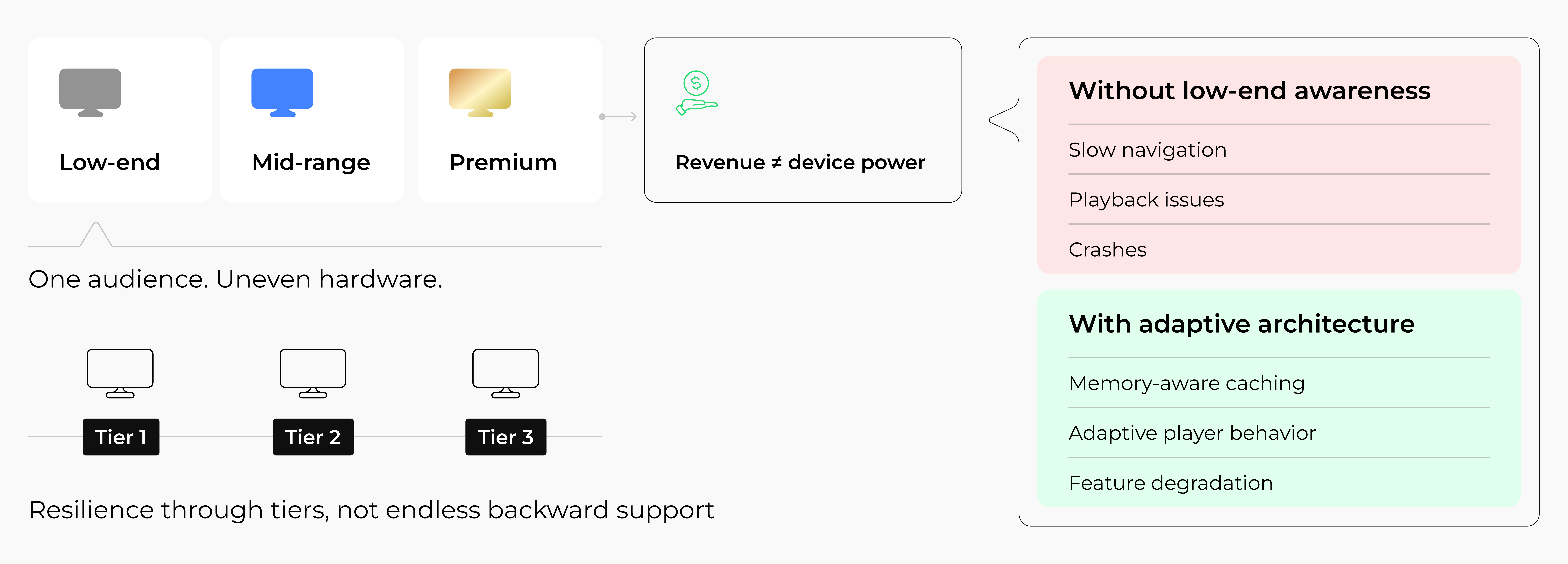
As already mentioned, in many emerging markets, Smart TV adoption is shaped by long device lifecycles and gradual hardware turnover. A wide range of device capabilities therefore coexist within the same audience, creating an uneven technical baseline for OTT applications. Such diversity directly influences how Smart TV apps are perceived and adopted after launch.
From a commercial standpoint, device capability does not correlate with revenue potential. Subscription-based OTT models generate the same income per user regardless of whether content is consumed on a premium Smart TV or on a more constrained model. Excluding part of the device spectrum reduces the reachable audience without delivering any financial benefit.
From an operational perspective, constrained devices amplify the impact of architectural and implementation choices. In practice, this translates into a higher sensitivity to common design decisions, including:
When these factors are not explicitly addressed, Smart TV applications are more likely to exhibit unstable behavior, including slow navigation, degraded playback, and higher crash rates.
Addressing these risks does not require lowering overall product quality. Well-designed Smart TV app architectures allow functionality and resource usage to adapt to device capabilities. Memory-aware caching, configurable player behavior, and controlled feature degradation enable a single product strategy to support heterogeneous devices and, at the same time, preserve stability and performance.
At the same time, resilience does not imply unlimited backward compatibility. Practical approaches focus on clearly defined device tiers and realistic usage patterns.
For Smart TV applications, the first interaction often determines the entire lifecycle of the user relationship. Unlike web or mobile products, OTT apps don’t benefit from repeated trial attempts. Viewers expect the application to work immediately and reliably, especially when it is launched as part of a large-scale market entry.
And in emerging markets, tolerance for technical issues is particularly low. Network instability, constrained devices, and peak-time congestion are perceived by users as part of everyday usage. As a result, any visible instability during the first sessions shapes the overall perception of the service.
From the user’s perspective, common issues are interpreted as product flaws, which include:
Such behavior quickly erodes trust. Viewers rarely wait for updates or fixes, and they do not distinguish between performance issues, backend incidents, or network failures. In an OTT market, switching to a competing Smart TV app that delivers a smoother experience requires minimal effort.
The business impact of a weak first impression extends far beyond user frustration. Launching to a large audience without sufficient attention to Smart TV app stability can lead to several cascading effects, like:
Several recurring mistakes tend to amplify these risks. Teams often prioritize feature completeness and visual polish, postponing resilience validation. Common patterns include releasing with a strong focus on flagship devices, skipping large-scale performance and resilience testing, and relying on optimistic assumptions about network quality. Without fallback scenarios and degraded modes, Smart TV applications remain fragile at the exact moment when they are most exposed.
In this context, resilience becomes a prerequisite for protecting both marketing investment and long-term growth. A stable first impression builds user confidence, reinforces brand credibility, and creates the conditions for sustainable audience growth.

How does a Smart TV app behave when it is released across multiple platforms and device tiers at once, under real user load, and non-ideal operating conditions?
A large-scale Smart TV app rollout demonstrated how strongly first impressions depend on both resilience and performance decisions made before launch. Device heterogeneity, memory-related performance constraints, and uneven network behavior quickly surfaced issues that would have directly impacted retention if left unaddressed.
Key challenges addressed during the rollout included:
At scale, resilience cannot be treated as an isolated technical concern. In Smart TV applications, stability, performance, and fault tolerance are intertwined, with weaknesses in one area inevitably surfacing in another. Playback issues may originate from network behavior, memory pressure, backend overload, or player configuration, yet the user experience suffers regardless of the root cause.
Production experience consistently shows that separating performance optimization from resilience work leads to blind spots.
In real-world conditions, these boundaries blur, and Smart TV applications are evaluated by users not as standalone subsystems, but as a whole.
For this reason, resilience needs to be addressed as part of the go-to-market strategy instead of something that can be postponed until after launch. Especially during market expansion and high-visibility releases, applications face sudden increases in traffic, heterogeneous device usage, and unpredictable network conditions. Without explicit preparation for such scenarios, growth efforts tend to expose structural weaknesses.

If you are preparing a Smart TV launch or planning to scale an existing OTT product, resilience work often requires external validation and hands-on expertise from a Smart TV app development company. Architecture review, resilience testing, and tuning for real operating conditions help reduce technical and commercial risks before market entry.
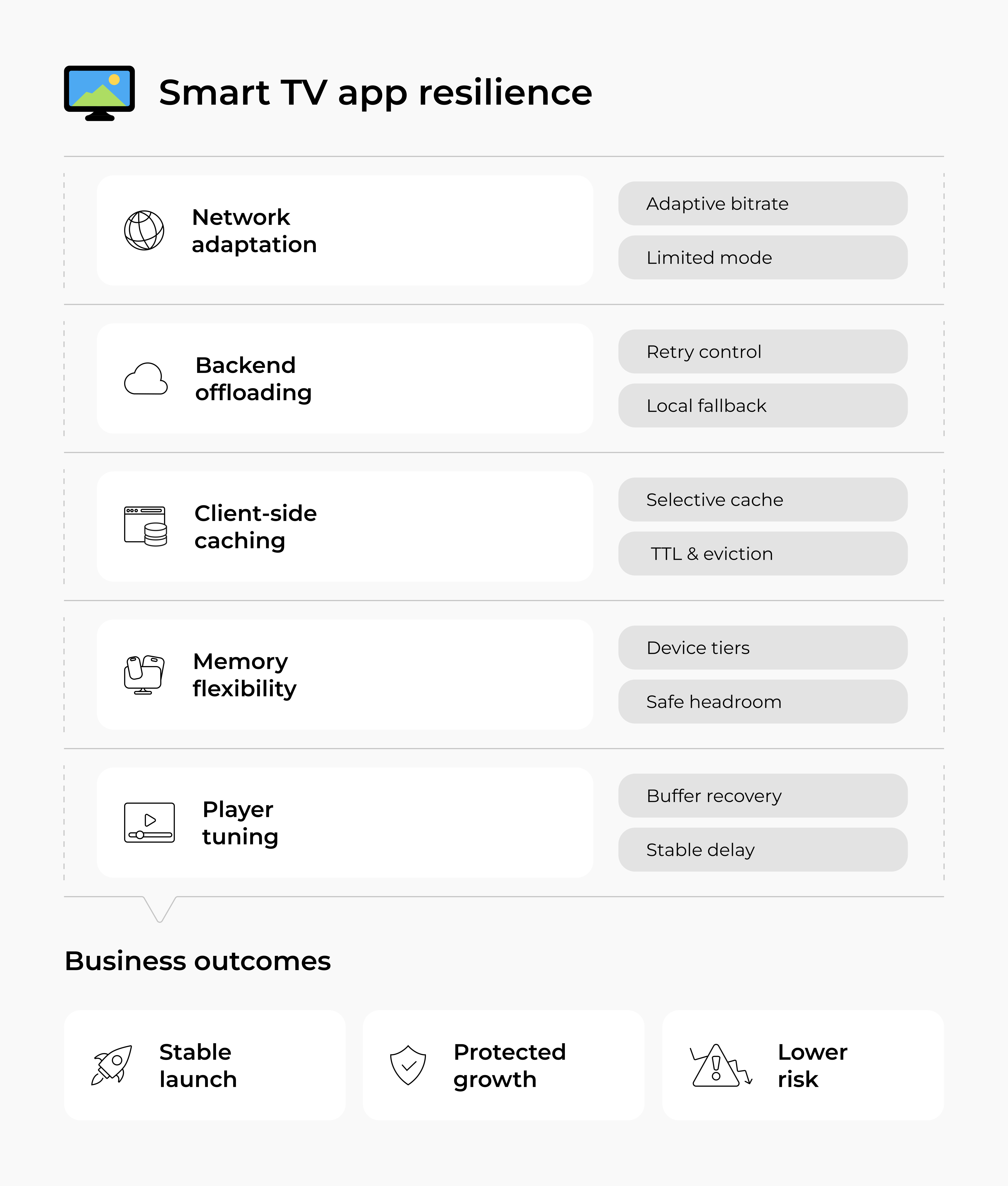
Below, we present a resilience checklist based on hands-on production work performed during large-scale Smart TV rollouts. It reflects recurring problem patterns observed in real applications and focuses on practical measures that improve reliability and stability under load.
The checklist was originally developed for a client planning to expand its market presence into emerging regions, including LATAM and Africa, where device heterogeneity, network instability, and peak-load sensitivity play a particularly significant role. Rather than listing abstract best practices, it highlights areas where architectural and configuration decisions have a direct impact on first impression, user retention, and operational risk.
Unstable network conditions remain one of the most underestimated risks for Smart TV applications at scale. Assumptions about consistent bandwidth and predictable latency rarely hold once an app reaches a broad audience. Resilient applications treat network degradation as a normal operating state, adjusting asset delivery, caching behavior, and playback logic accordingly.
In practice, playback stability often depends on how quickly the player reacts to bandwidth drops. Production experience shows that slower quality downgrade increases the likelihood of freezes, while conservative upgrade paths reduce visual quality fluctuations. In several rollouts, starting playback at a lower acceptable quality and enabling adaptive bitrate logic only after playback stabilization resulted in fewer interruptions and a more predictable viewing experience under poor network conditions.
Real-world client story:
In one project, playback issues surfaced immediately under unstable network conditions. Adaptive bitrate logic caused slow quality upgrades at startup, leading to a noticeable delay before acceptable playback quality was reached. To mitigate this, playback was started at the lowest acceptable quality, with adaptive bitrate enabled only after the player entered the playing state. This slightly increased startup time, but internal benchmarking showed the trade-off to be acceptable.
Additional tuning revealed that buffer exhaustion during bandwidth drops caused short freezes, which were resolved by allowing the player to fetch more segments in parallel, improving recovery speed after quality downgrades.
Backend systems tend to experience the highest stress precisely during moments of peak user interest. Authentication flows, session renewals, and metadata requests can surge within minutes, turning minor slowdowns into user-facing failures. Resilient Smart TV applications are designed to reduce backend dependency when instability occurs, instead of amplifying it through aggressive retries.
Production incidents repeatedly demonstrate how short timeouts combined with immediate retries can escalate backend degradation. Adjusting retry strategies, introducing randomized intervals, and using last-known-good client-side data allow applications to preserve navigation and playback while backend services recover, significantly reducing visible disruption during high-traffic periods.
Real-world client story:
A production incident occurred during a live release of a high-demand series scheduled at peak hours. A surge of API calls within a short time window overloaded authentication and metadata services, while short client timeouts combined with immediate retries amplified the failure. Users were unable to retrieve session tokens and access the live stream.
Client-side changes focused on revising retry behavior, introducing randomized retry intervals, optimizing token refresh logic, and serving personal content from last-known-good local data while backend load was high.
Client-side caching improves responsiveness and reduces backend load, but only when applied selectively. Smart TV devices operate under tight memory constraints, making indiscriminate caching a frequent source of instability. Effective caching strategies balance asset lifetime, invalidation rules, and memory availability across device tiers.
In production environments, memory leaks caused by improperly managed cache references often surface gradually, first as sluggish navigation and later as out-of-memory crashes. Adaptive cache sizing and disciplined eviction policies consistently prove more effective than static configurations, especially when applications need to remain usable during temporary backend degradation.
Real-world client story:
In several deployments, aggressive local caching improved responsiveness but gradually led to stability issues on memory-constrained devices. Investigation showed that excessive asset retention and improper cache reference handling caused memory growth over time, first manifesting as sluggish navigation and later as crashes.
Refining cache scope, adjusting cache lifetimes, and aligning cache size with device memory capacity reduced memory pressure, preserving the benefits of local data reuse during backend degradation.
Memory pressure remains one of the most common causes of Smart TV app crashes. Beyond caching, aggressive preloading, oversized player buffers, and large in-memory asset collections frequently exhaust available resources on constrained devices. These issues usually do not appear in isolation; instead accumulate over time until stability degrades.
Resilient applications adapt memory usage to device capabilities. Production tuning shows that avoiding unnecessary preloading and allocating memory headroom for core functionality significantly reduces crash rates, even when supporting heterogeneous device landscapes.
Real-world client story:
Stability analysis across heterogeneous Smart TV devices showed that crashes clustered on lower-memory platforms. The main contributors were oversized in-memory collections, aggressive preloading, and player buffer configurations that left insufficient headroom for the rest of the application.
By introducing memory-aware caching, reducing unnecessary preloading on constrained devices, and tuning player memory usage, crash frequency decreased without affecting functionality on more capable hardware.
Playback behavior dominates user perception of Smart TV applications. Live streaming scenarios introduce additional sensitivity, as content delivery depends on tightly coordinated pipelines. Player configuration plays a decisive role in determining whether temporary disruptions lead to visible failures or recover gracefully.
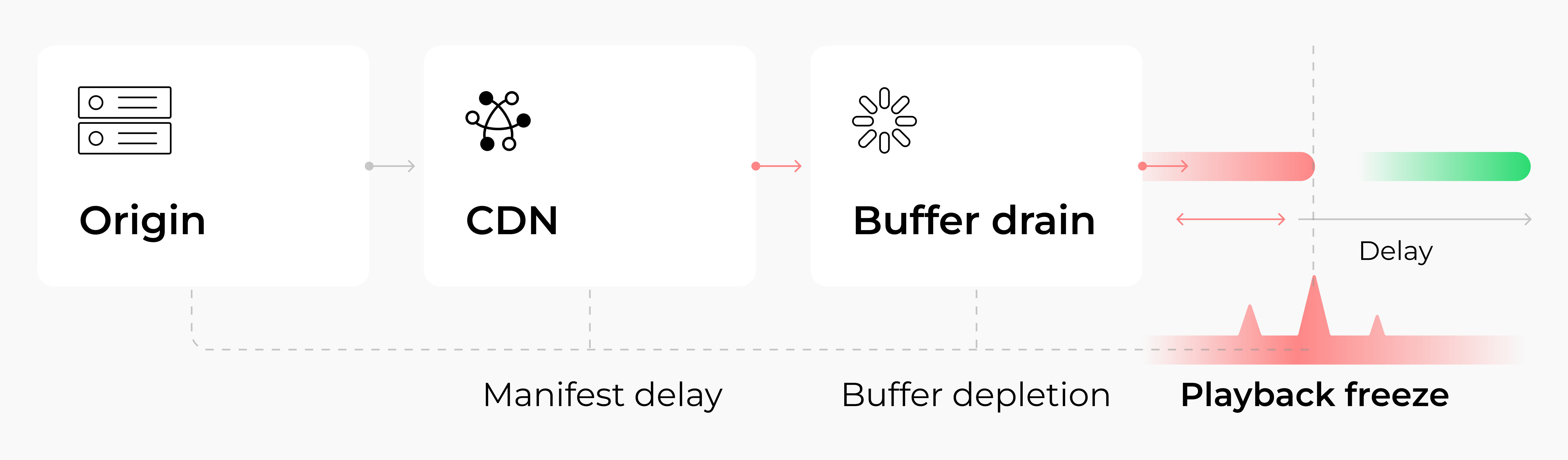
In live environments, insufficiently adaptive manifest fetching and buffering logic often cause growing playback delays and eventual freezes. Real-world tuning experience shows that faster recovery after missed manifest updates and flexible buffer refill strategies stabilize live playback and prevent delay accumulation, even when upstream components momentarily fall behind.
Real-world client story:
In a live streaming project with strict latency requirements, testing revealed a steadily growing gap between playback and real time. The issue originated from delayed chunk availability on the server side combined with rigid manifest polling on the client.
When manifest updates were missed, the player continued polling at a fixed interval, allowing buffer reserves to drain. After adjusting the manifest fetching logic to react faster to missed updates, playback stabilized and recovered without accumulating additional delay.
Smart TV app resilience directly influences how OTT products scale, retain users, and protect their market position. As competition intensifies and acquisition costs rise, technical stability becomes inseparable from commercial outcomes. Applications that fail under real-world conditions undermine marketing efforts, erode user trust, and limit growth potential at the very moment when expansion is most critical.
In emerging markets, these risks surface faster and more visibly. Device diversity, long hardware lifecycles, unstable networks, and sharp traffic spikes expose weaknesses that may remain hidden in more homogeneous environments. Addressing resilience early reduces uncertainty and allows teams to approach market entry with realistic expectations rather than optimistic assumptions.
Resilience should therefore be viewed as an investment in sustainable growth. Stable startup behavior, predictable playback, and graceful degradation protect first impressions and support retention, while adaptive client-side logic reduces dependency on backend availability during peak load. Together, these factors lower the cost of scaling and increase the likelihood that new users remain engaged beyond the initial launch window.
Strong first impressions are difficult to recover once lost. Preparing Smart TV applications to operate reliably across constrained devices and unstable conditions proves more efficient than attempting to win back users after early failures. In this context, resilience becomes a foundational capability that turns market entry into long-term presence instead of just a short-lived spike in attention.
Organizations planning Smart TV launches or preparing to scale existing OTT products often face these resilience challenges under tight timelines and high visibility. At Oxagile, we address them through a structured approach that combines performance work with stability engineering and production-driven validation.
The checklist in this article, supported by concrete customer stories where these issues were identified, addressed, and resolved in production, reflects the patterns our specialists repeatedly encounter in real deployments: unstable networks, peak-load backend pressure, memory constraints across device tiers, and player behavior that requires deliberate tuning.
When market entry involves significant acquisition spend and partner exposure, resilience planning becomes part of risk management.
Start a focused, technical conversation around your specific constraints and goals.

Smart TV app resilience describes the ability of an application to maintain predictable behavior under stress conditions that typically accompany market entry and scale. From a business perspective, it protects acquisition investments, reduces early churn, and stabilizes growth metrics by reducing the risk that technical issues undermine first impressions during high-visibility launches.
Smart TV application reliability focuses on consistent, fault-tolerant behavior across real operating conditions, including unstable networks, backend degradation, and device constraints. Performance optimization improves speed and responsiveness under expected conditions. At scale, both aspects intersect, but reliability determines whether an application remains usable when assumptions about infrastructure no longer hold.
Market expansion typically amplifies usage patterns rather than revealing new ones. Increased traffic, broader device diversity, and higher concurrency expose weaknesses that may remain hidden in limited deployments. Smart TV app stability supports growth initiatives by preventing visibility from turning into negative user experiences, protecting retention and partner relationships during critical launch phases.
Resilient Smart TV apps limit the impact of technical failures on business outcomes. Graceful degradation, adaptive client behavior, and controlled backend dependency prevent outages from escalating into user-facing disruptions. As a result, marketing campaigns deliver sustained value, support costs decrease, and reputation risks associated with failed launches are minimized.
A practical Smart TV app resilience checklist focuses on readiness. It should cover adaptation to unstable networks, backend offloading strategies, client-side caching discipline, memory flexibility across device tiers, and player tuning for live and on-demand content. Addressing these areas before launch significantly reduces the likelihood of early user churn and operational incidents.

