












This website uses cookies to help improve your user experience


When streaming businesses talk about growth, the conversation usually revolves around content, new markets, and user acquisition. Hardware is often treated as a secondary concern, or in other words, something technical teams will “optimize later”. Yet when it comes to mass-market smart TVs, this assumption can quietly erode revenue, slow down scaling, and increase user churn.
Baseline devices continue to play a significant role in the smart TV ecosystem. For many OTT platforms, broadcasters, and telecom-backed streaming services, they account for a substantial share of active users. These devices are actively used, generate subscription revenue, and shape real usage patterns across different regions and demographics.

This article is based on an in-depth interview with Alexander Skamarokha, Performance Engineer at Oxagile, whose project experience spans multiple smart TV and OTT platforms. In his work, low-end device support frequently emerges as a practical requirement driven by market realities rather than technical preferences.
Expert comment:
“One of our clients was preparing to expand into the African market. A large share of users there relies on the baseline device segment: people don’t upgrade TVs frequently, expensive subscriptions are uncommon, and internet quality is often unstable. At the same time, these users actively consume content and pay for subscriptions. From a business perspective, revenue does not depend on whether the payment comes from a high-end or a low-end device.”
Similar patterns appear well beyond emerging markets. In many regions, mass-market smart TVs are widely used by:
These user groups often demonstrate stable viewing habits and predictable subscription behavior, provided the application remains usable and reliable on their devices.
Based on practical experience gained through smart TV app development services, this article examines how low-end smart TV devices influence key business metrics across streaming platforms. We discuss how low-end devices are commonly misdefined, why release year alone does not reflect real device capabilities, and how decisions around smart TV app performance, compatibility, and optimization affect ROI, time-to-market, and churn. We also explore why device strategy should be shaped early, during requirements gathering and device matrix definition.
In business conversations, low-end smart TVs are still frequently associated with the release year. Devices from 2015 — 2017 are often grouped into this category by default, while newer models are treated as inherently “safe” from a performance standpoint. Project experience shows that this approach rarely reflects how smart TV platforms actually behave in production.
As Alexander Skamarokha explains:
“What is commonly referred to as low-end in current projects is defined not by age, but by a set of technical constraints typical for mass-market smart TVs: limited memory available to applications (often measured in hundreds of megabytes rather than gigabytes), less powerful system-on-a-chip configurations, and older embedded Chromium versions that affect web-based application behavior.
Devices from very early model years are often no longer part of the active ecosystem. They are rather deprecated than low-end, unavailable in app stores, or excluded from platform support altogether. In most modern OTT projects, the practical lower boundary typically starts much later (closer to 2020) simply because anything older tends to fall outside real-world usage and support scenarios.”
The larger issue, however, lies elsewhere. Release year does not describe device capability. Within the same model year, manufacturers release multiple product tiers, ranging from flagship TVs to mass-market models. These devices can differ significantly in memory size, processing power, and graphics capabilities, despite sharing the same release window.
Platform behavior adds another layer of complexity. When developing apps for operating systems such as Tizen and webOS, it is important to account for the fact that both hardware and software evolve on a yearly basis. Each new TV lineup typically comes with an updated version of the operating system (major or minor), as well as changes in the embedded Chromium engine and other system components.
These software updates occur alongside annual hardware changes, which further increases diversity in real-world performance characteristics. As a result, even TVs released in the same year can demonstrate noticeably different performance behavior, depending on the combination of hardware configuration, OS version, and browser engine they run on.
For web-based smart TV applications, browser support becomes equally important. Smart TV app development is usually based on JavaScript frameworks, which makes performance and compatibility closely tied to the embedded browser engine. In practice, Chrome version often becomes part of the device matrix alongside OS requirements, influencing both development constraints and long-term maintainability.
Alexander summarizes this reality succinctly:
“Low-end is a relative concept. It keeps shifting over time as applications become heavier and platforms evolve.”
As smart TV applications grow more complex, adding richer interfaces, animations, autoplay elements, and personalized recommendations, the performance threshold moves forward. Devices that once handled applications comfortably may begin to struggle, regardless of their release year.
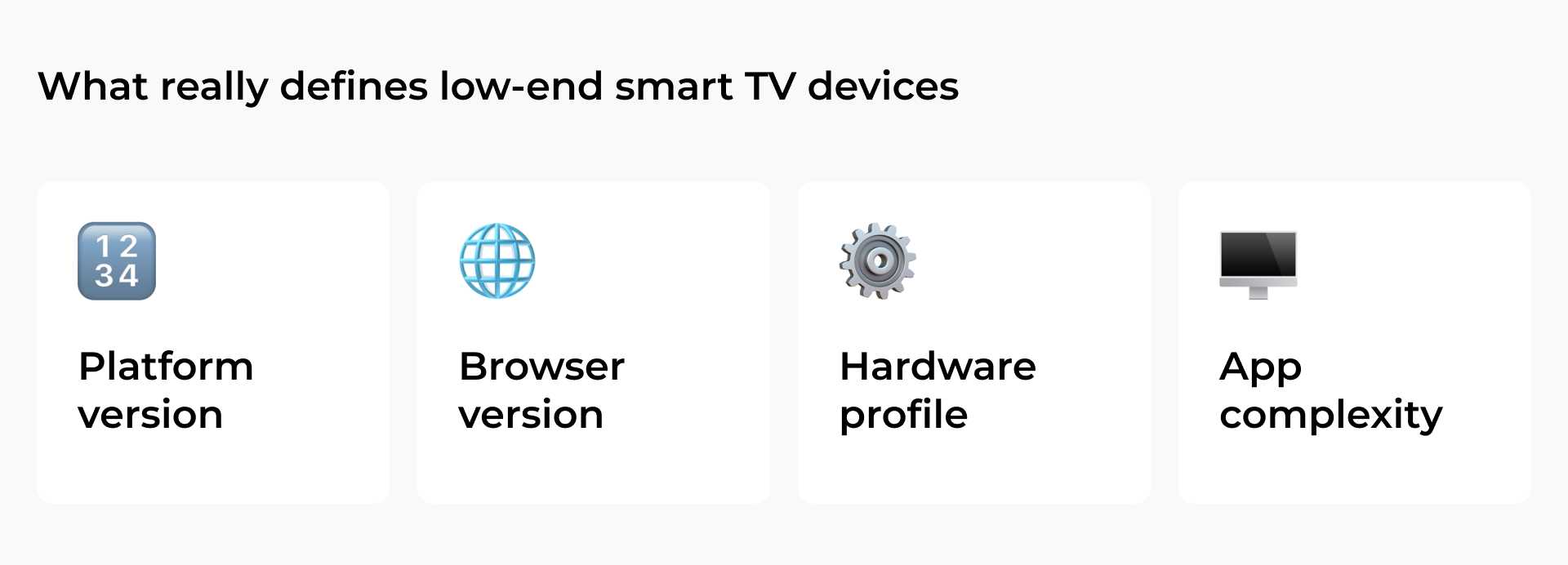
For streaming businesses, this explains why defining mass-market smart TVs by age alone leads to oversimplified decisions. Platform version, browser compatibility, and hardware configuration together determine whether a device can support acceptable smart TV app performance and user experience, and whether including it in the support strategy contributes to sustainable growth.
In real-world smart TV projects, mass-market devices rarely represent a narrow or marginal segment. More often, they form the baseline audience that defines how applications are designed, tested, and optimized. This is especially true for OTT platforms and streaming services that aim to reach scale rather than niche premium users.
In practice, low-end smart TV devices typically correspond to mass-market UHD / 4K televisions that are widely available, reasonably priced, and actively used. These devices dominate sales volumes and household penetration across regions, making them the most representative segment from a business perspective.
Alexander emphasizes that performance work is usually centered around this mass-market layer.
Expert comment:
“We optimize applications for the most common 4K TVs. This segment represents the largest part of the market. If an app performs well there, it will behave even better on more powerful devices.
At the same time, we do not ignore higher-end platforms as a market segment. Instead, we leverage their capabilities more actively. For example, by enabling additional features or visual effects that can be selectively disabled on low-end devices. This feature-driven approach allows the product to scale across hardware tiers without compromising stability on mass-market TVs.”
This approach directly influences smart TV app compatibility and long-term maintainability. Instead of targeting the weakest possible hardware or, conversely, optimizing exclusively for flagship models, teams define a realistic baseline that reflects how the majority of users actually consume content.
From a development standpoint, this baseline becomes the reference point for smart TV app performance optimization. Applications are built and tested to ensure smooth navigation, predictable playback behavior, and acceptable load times on mass-market devices. More powerful TVs benefit naturally from stronger hardware, while extremely old or highly constrained models fall outside the supported scope.
This strategy also supports predictable scaling. By aligning development efforts with the largest device segment, streaming platforms reduce fragmentation, limit technical debt, and maintain faster iteration cycles. Performance improvements applied at the baseline level tend to propagate upward, improving the experience across the entire supported device range.
For businesses, treating low-end devices as a mass-market foundation allows forming clearer expectations around coverage, cost, and performance. It also helps teams to balance reach and sustainability, preserving a consistent user experience across the most commercially relevant part of the smart TV ecosystem.
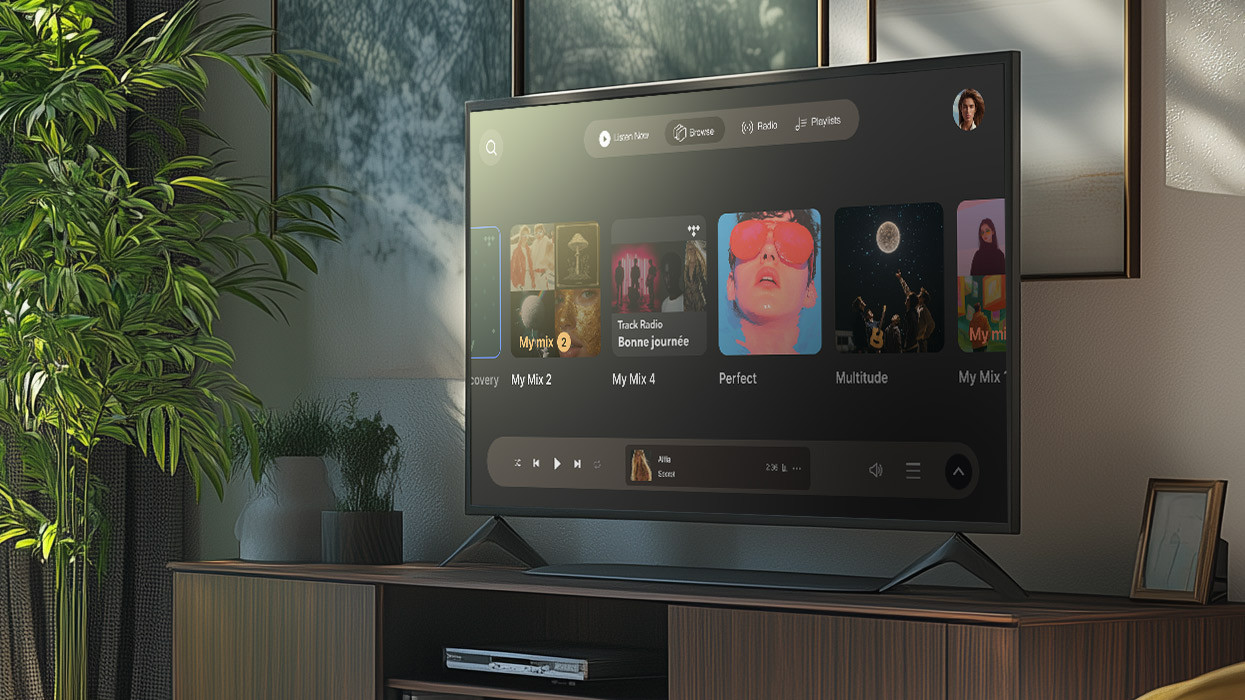
In one of Oxagile’s smart TV projects for a music streaming service, a large share of active users relied on mass-market smart TVs with limited hardware resources. Application performance on these devices directly affected engagement and session duration.
The team focused on defining a realistic low-end baseline and optimizing the app around it:
This approach allowed the client to improve performance across the most commercially relevant device segment, meanwhile avoiding the cost and complexity of supporting severely constrained or deprecated hardware.
Supporting mass-market smart TVs is a practical necessity for many streaming platforms. For a large share of users, these devices remain the primary way to access content. At the same time, an effective support strategy requires clear boundaries, especially when performance expectations, budgets, and long-term maintenance are taken into account.
Project experience shows that challenges often begin when the support of hardware-constrained devices is interpreted too broadly. Treating all older or weaker devices as part of the same category can lead to performance issues on low-end smart TVs that are difficult to resolve without compromising product quality. In such cases, teams invest significant effort into stabilizing platforms that were never designed to handle modern application complexity.
Alexander Skamarokha notes:
“The goal is not to exclude mass-market devices as a segment. The real task is to determine which low-end devices can realistically deliver acceptable app performance and which ones introduce disproportionate technical and financial risk. Very old or severely constrained platforms often require extensive effort while offering little room for meaningful optimization.”
From a development standpoint, this directly affects smart TV app compatibility. Supporting a carefully selected baseline allows teams to maintain consistent behavior across platforms and versions and avoid fragmentation that slows down iteration and increases maintenance overhead.
Then, optimizing smart TV app performance becomes critical. Optimization efforts are most effective when they target the mass-market low-end segment rather than extreme edge cases. This balance enables streaming businesses to reach a wide audience, preserve user experience, and avoid support commitments that undermine scalability and ROI.

Defining the right level of low-end support requires a balance between audience reach, performance expectations, and long-term maintainability. Being a smart TV app development company, Oxagile helps streaming businesses shape device strategies that align technical feasibility with real business goals — from early planning to production-ready solutions.
In real projects, low-end smart TV devices rarely enter the conversation as a strategic concept from the start. According to Alexander Skamarokha, they become visible at moments when a product begins to scale — geographically, commercially, or both.
Based on his experience, expansion into new markets often reshapes the device landscape more radically than expected. Regions with strong growth potential tend to rely on mass-market smart TVs with limited hardware resources and inconsistent connectivity. Products designed around high-end assumptions may struggle to deliver stable behavior under these conditions, affecting both first impressions and long-term retention.
Alexander points out that devices with limited hardware capabilities quickly expose how well product decisions align with real usage patterns.
Expert comment:
“Low-end devices surface all trade-offs much faster. As soon as the application becomes heavier — more UI logic, more memory pressure, more recommendations — constrained hardware shows whether those decisions are sustainable.”
From a business perspective, this visibility matters. Performance behavior on mass-market devices directly influences churn among users who rely on smart TVs as their primary viewing environment. Device strategy also affects time-to-market: the broader and less defined the support matrix, the more complex testing and certification cycles become. Over time, these factors accumulate and shape ROI.
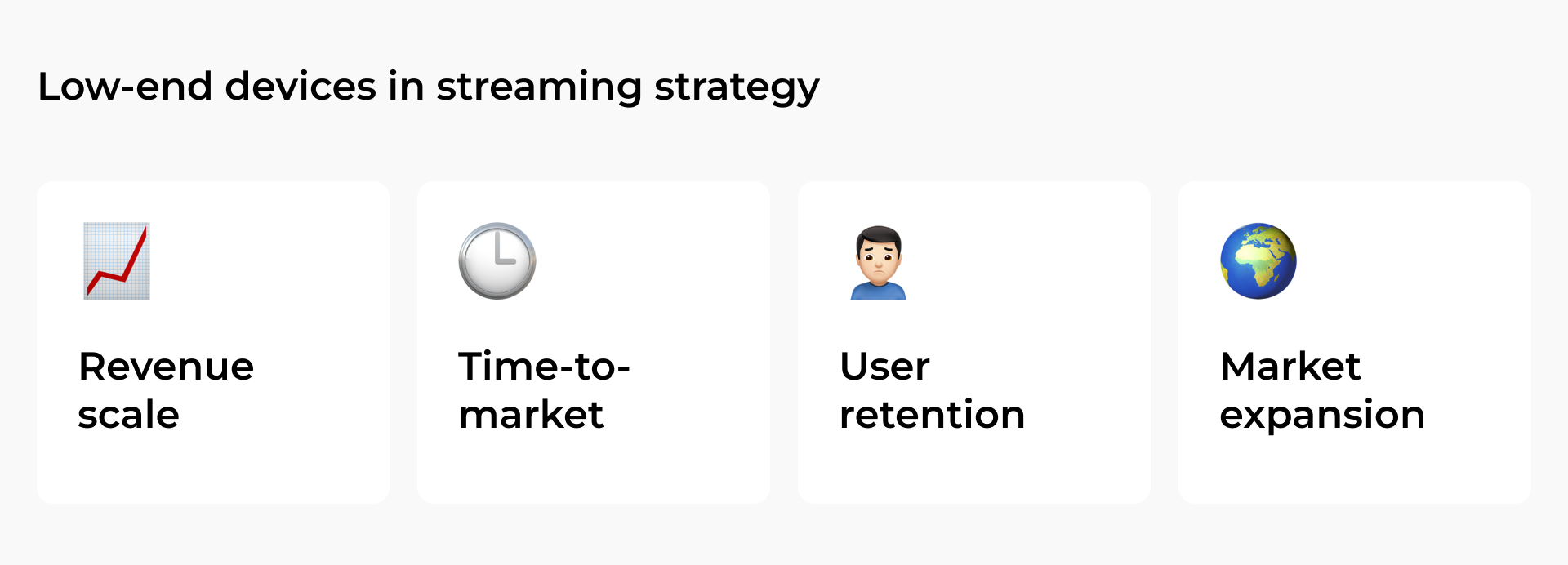
Treating low-end smart TV devices as part of a growth strategy allows streaming businesses to align ambition with execution. It creates space to scale without locking the product into assumptions that only hold true for a narrow, high-end audience.
Once mass-market devices are recognized as strategically important, the next challenge lies in defining how far support should extend. Alexander Skamarokha emphasizes that this question arises in nearly every smart TV project, often during requirement discussions or later, when commitments become difficult to honor.
In practice, support boundaries become problematic when low-end is interpreted too broadly. Very old or severely constrained platforms demand increasing engineering effort while offering limited room for optimization. Alexander describes these situations as high-risk commitments.
Expert comment:
“You can agree to support very weak devices, but later discover that delivering a fast, stable, and usable application on them requires a lot of work without a guaranteed result.”
Instead of relying on device age, Alexander advocates evaluating support through capability. Platform versions, browser behavior, hardware profiles, and projected application complexity provide a more reliable foundation for decision-making. This approach helps teams understand which devices can realistically deliver acceptable smart TV app performance at scale, even on entry-level devices.
Defining a reasonable boundary of support allows teams to focus smart TV app performance optimization efforts on devices that represent the largest share of active users. As Alexander notes, this balance helps streaming platforms serve low-end audiences effectively without overextending product commitments or slowing down long-term development.
Low-end smart TVs remain a persistent reality of the streaming market. They shape how platforms scale, how reliably they perform in new regions, and how consistently users engage with content over time. Treating low-end support as an afterthought or a purely technical challenge often leads to decisions that limit growth.
Projects discussed in this article show a different pattern. When mass-market devices are approached as part of a broader business strategy, they clarify priorities. They expose the real cost of product decisions, highlight performance limits early, and provide a practical lens for balancing audience reach with sustainability. In this context, low-end becomes a reference point for disciplined growth rather than a constraint.
The key question for streaming businesses is no longer whether mass-market devices matter. It is which devices meaningfully contribute to revenue, retention, and long-term scalability, and where support begins to generate diminishing returns. Answering this question requires both market awareness and performance expertise grounded in real project experience.
Oxagile’s team is ready to help you define a support model that aligns technical feasibility with business goals.

Smart TV app performance low-end devices have often becomes a constraint that subtly reshapes the product roadmap. Features that appear viable during planning may require simplification, a staged rollout, or an alternative implementation once performance behavior on constrained hardware is observed. Teams that account for this early tend to prioritize features with the highest user impact rather than those that disproportionately increase application weight.
Performance issues on low-end smart TVs typically occur in real use rather than during basic testing. These include memory pressure during long viewing sessions, delayed UI response as screens become more dynamic, and unstable playback when multiple background processes compete for limited resources. Such issues often intensify as applications evolve and accumulate new features.
To optimize apps for low-end devices, teams focus less on removing features and more on reshaping how those features behave. Common approaches include simplifying UI state management, reducing unnecessary background logic, controlling animation density, and designing progressive loading strategies. This allows applications to preserve core functionality while staying within realistic performance limits.
Assessing smart TV performance on low-end devices requires more than synthetic benchmarks. Reliable evaluation combines testing on representative mass-market hardware, monitoring memory and CPU behavior under prolonged use, and validating performance during peak interaction scenarios. This approach helps teams identify risk areas before they affect production users.
Low-end smart TV user experience plays a critical role in retention, especially for audiences that rely on smart TVs as their primary viewing device. Delays, freezes, or inconsistent navigation often lead users to disengage quietly rather than complain. Stable behavior, predictable interactions, and smooth playback tend to have a stronger impact on long-term engagement than visual sophistication alone.

