
End-to-end eLearning Portal Development
Custom-built solutions with role-based access, real-time progress tracking, and native integrations
SCOPE YOUR PORTALFull-cycle eLearning portal development services
End-to-end development
eLearning consulting, product scoping, iterative development, and post-launch improvement are all part of the scope. Domain knowledge at each stage keeps architecture and feature decisions sound over time.
Third-party integrations
APIs, custom connectors, and integration testing connect your portal with ERP, CRM, payment systems, and other third-party tools. Enterprise deployments add SSO configuration, HRIS sync, and SCORM/xAPI/LTI compliance.
Solution enhancement
Your portal gets audited and improved across usability, performance, reliability, and security. Our engineers also handle database migration with minimal disruption to running operations.
Innovation enablement
Advanced capabilities, like AI-driven course recommendations, conversational tutoring assistants, and computer vision-based proctoring are available as configurable additions to your portal. Each is scoped within your institution’s compliance and policy framework.

Seen enough to know what your portal needs?
Share your requirements with the experts in our eLearning portal development company and get the architecture outline, integrations, and delivery timeline.
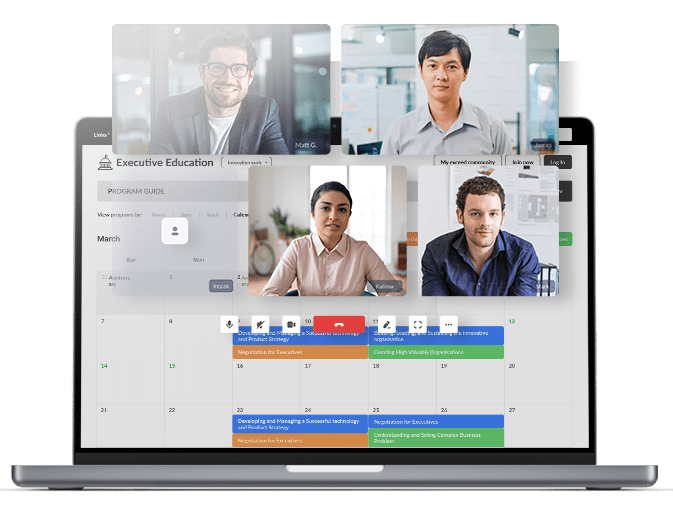
eLearning portals shaped by cross-sector engineering






Powerful online video capabilities
Build full-spectrum video infrastructure: live streaming, on-demand content libraries, and multi-CDN delivery scaled for thousands of simultaneous learners.
- Monetization models: subscriptions, pay-per-course, and in-video ads
- Live-to-VoD conversion
- RTC-enabled video-conferencing and messaging
- Desktop sharing and co-browsing
- Second-screen functionality
- VR and 360-degree video content

Our eLearning portal development methodology
Learner disengagement often starts with friction. Clear UI, smooth onboarding, personalized learning paths, and capable search address the core experience.
Mobile optimization covers every learner and device: phone, tablet, and smartwatch, alongside WCAG compliance.
Infrastructure that can’t handle concurrent load during live sessions or enrollment peaks puts continuity at risk.
Fault-tolerant, scalable architecture and load and stress testing keep thousands of simultaneous learners running, even at peak.
Licensed content is a target: unauthorized access, redistribution, and data handling gaps.
DRM, encryption, access control, and watermarking protect content at the platform level. GDPR, PCI DSS compliance, and disaster recovery planning cover the rest.
Why choose Oxagile for eLearning portal development
 EdTech
 expertise
Work across learning content aggregators, providers, and certification companies informs how we scope every eLearning portal project.
 Video
Video engineering
20+ years of online video engineering inform live streaming, VoD libraries, and live session infrastructure built directly into portal architecture.
 Analytics
Learning analytics
Purpose-built analytics layers surface engagement, learner behavior, and program performance data for L&D teams and administrators.
 AI
AI in eLearning
Conversational tutoring assistants, automated grading, and AI-driven content recommendations are capabilities built and deployed across eLearning projects.
 mLearning
Mobile delivery
mLearning expertise covers native and cross-platform builds alongside the web portal, for any mobile delivery model.
 LMS & CMS
LMS and CMS
Wide LMS and CMS platform coverage keeps integrations and content migrations on track without tooling learning curves.
Learning portal development tech stack
React • Angular • Vue.js • Next.js • React Native • Flutter
Node.js • Python • Java • Django • FastAPI • Spring Boot
WebRTC • FFmpeg • HLS • AWS MediaLive • Cloudflare Stream • Mux
SCORM • xAPI • LTI • AICC • cmi5 • H5P
TensorFlow • PyTorch • OpenAI API • LangChain • Hugging Face • OpenCV
PostgreSQL • MongoDB • Redis • Elasticsearch • Apache Kafka • Power BI
AWS • Google Cloud • Azure • Docker • Kubernetes • Terraform
OAuth 2.0 • SAML • Keycloak • Widevine • FairPlay • Auth0
eLearning projects portfolio

FAQ
The timeline depends on the scope. A portal covering core functionality, like user management, course delivery, and progress tracking, typically takes 3 to 6 months. Full-featured builds with video streaming, proctoring, gamification, and AI capabilities run 9 to 18 months. A discovery and scoping phase of 4 to 8 weeks usually precedes development to lock in architecture and feature priorities.
The cost is driven by feature depth, integration complexity, compliance requirements, and team composition. A core portal runs roughly from $50,000 to $150,000. Mid-range builds with video, analytics, and third-party integrations typically fall between $150,000 and $500,000. Full-featured platforms with AI, proctoring, and custom infrastructure can exceed that. A scoping engagement produces a more precise estimate based on specific requirements.
Yes. LMS integration is a standard part of learning portal development. It relies on LTI standards, REST APIs, and custom connectors where native options are limited. We’ve worked with Moodle, Canvas, Blackboard, and a range of other platforms. The specific approach depends on platform version, hosting environment, and data exchange requirements on both sides.