













This website uses cookies to help improve your user experience




People are already buying from ads without leaving the screen, without opening a browser, and without being pushed into a separate shopping journey that competes for their attention. A product appears inside a video, the interaction happens in the same interface, the purchase is confirmed, and the moment passes, with no extra steps or follow-up required.
When this works, the impact is immediate. Brands lose fewer customers between interest and checkout, media platforms convert attention into measurable revenue rather than abstract reach, and the path to purchase becomes shorter and far more efficient than the classic “click and hope” model.
This new ad format actually signals a deeper shift. Once ads can complete transactions independently, the role of media shifts from persuasion to transaction processing. This quietly changes how brands think about margins and how broadcasters and streaming platforms think about monetization.
Shoppable ads combine content, advertising, and the checkout process into a single experience. This concept is becoming increasingly popular across social platforms, websites, and connected TV environments.
Shoppable ads are advertising formats that allow users to purchase a product directly within the ad experience itself, without being redirected to a separate website as the primary step. The ad becomes a transactional interface, not just a message that points somewhere else.
All this means that the moment of exposure, the moment of intent, and the moment of purchase can all happen in the same environment. The user does not need to remember the brand, search for the product later, or navigate through multiple pages to complete the transaction. The ad closes the loop.
This is the key difference between shoppable ads and traditional digital advertising. Classic ads are built around persuasion followed by delayed action. Shoppable ads are built around immediacy. They assume that if intent exists, the system should remove friction rather than introduce additional steps.
From a business perspective, shoppable ads are not defined by a specific platform or device, but by a shared principle: zero-friction purchase inside the advertising interface. Whether the interaction happens through a tap, a remote control, a QR code, or a voice command is secondary. What matters is that the ad itself is capable of moving the user from interest to transaction in one continuous flow.
As this logic expands into connected TV environments, the quality of interaction on the TV screen becomes critical. For example, Roku app development increasingly plays a role in making shoppable experiences usable and scalable beyond mobile and web.
Shoppable ads appear across very different environments:
Across all of these contexts, the role of the ad changes in the same way. It no longer exists only to influence behavior later. It becomes part of the commerce infrastructure itself.
Shoppable ads appear across different platforms, but they follow the same principle: the buying action has to fit naturally into how people already behave in that environment. When the interaction feels forced or unfamiliar, the advantage of shoppability disappears.
The mechanics matter because they determine whether a user acts or hesitates. A purchase flow that works well on a phone may feel clumsy on a TV screen, and an interaction designed for passive viewing may be ineffective in a fast-scrolling feed. Effective shoppable campaigns are built around these constraints, not layered on top of them.
Social platforms were the first place where shoppable ads scaled, mainly because user behavior already revolves around constant interaction. Taps, swipes, and quick decisions are expected, so adding product tags or in-feed checkout rarely feels disruptive.
In these formats, commerce is usually embedded directly into the content through dynamic product catalogs, short purchase overlays, or tagged items inside videos. The goal is to keep the buying step close to the moment of discovery and avoid anything that slows the flow.
From a business perspective, social shoppable ads work best for impulse-driven categories and campaigns where speed matters more than extended consideration, provided that creative assets and product data stay perfectly aligned.
On websites and in display placements, shoppable ads operate in a more deliberate context. Users are often already comparing options or moving toward a decision, which makes interactive banners and shoppable units a way to remove the final points of friction instead of creating demand from scratch.
These formats typically let users explore products, select variations, and enter a checkout flow without navigating away from the page. The benefit is that you can keep the most engaged users on your site and reduce the chance that they will click on competitor pages or marketplace results.
For publishers, shoppable display formats provide an additional performance-based dimension to standard inventory, equipping brands to establish a clearer link between exposure and outcome.
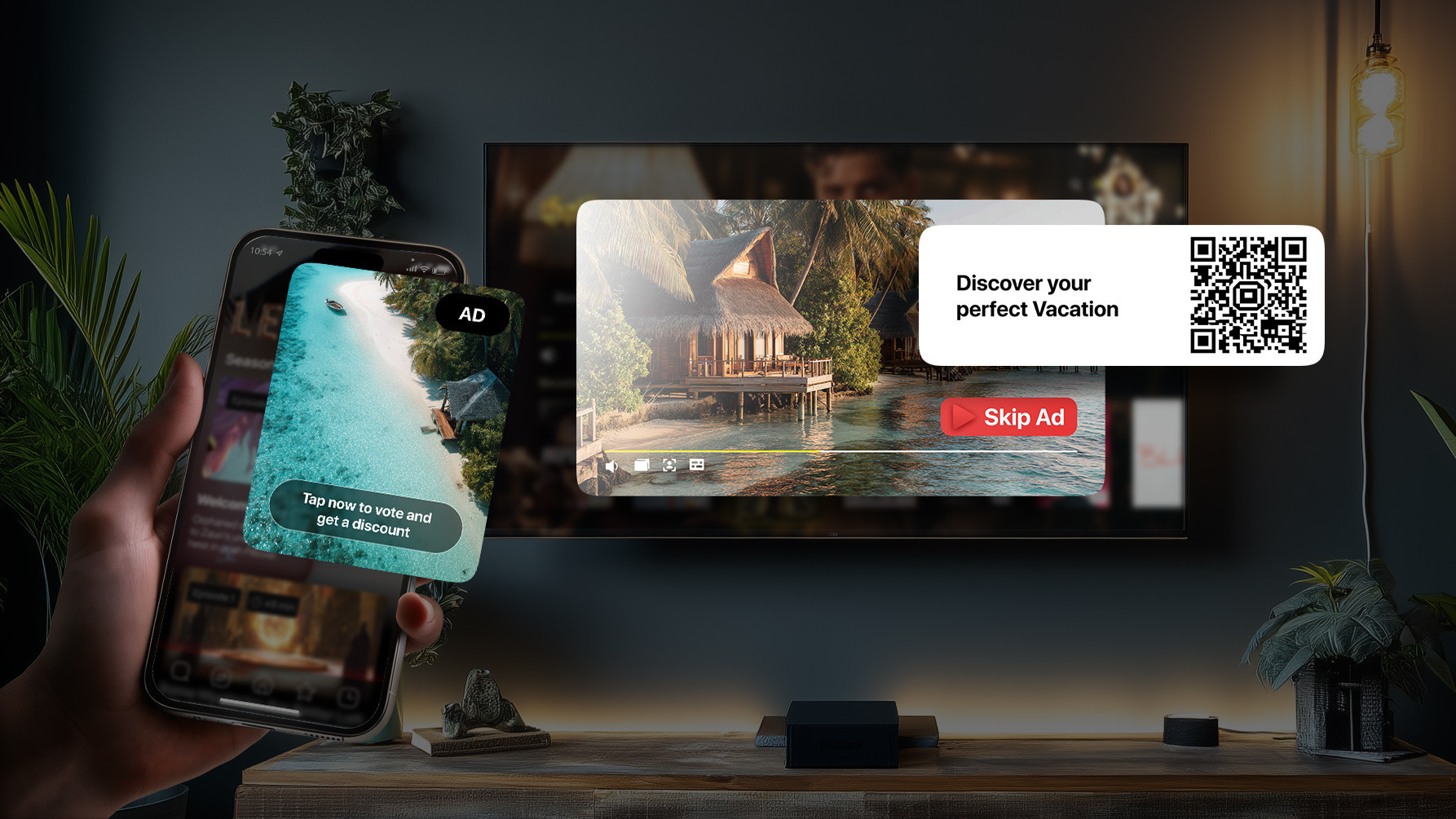
Connected TV and streaming platforms introduce a different set of constraints. Viewers are attentive and relaxed, but interaction is limited to a remote control and a few deliberate actions.
Shoppable ads on CTV are designed around this reality, relying on simplified confirmation flows, remote-based input, and stored payment details. The objective is to make the purchase possible without breaking the viewing session or forcing the user into a second device unless necessary.
In this context, Roku shoppable ads have become a practical reference for how commerce can function on the TV screen, using remote-driven interactions rather than mobile-style interfaces. For streaming platforms and broadcasters, these formats create inventory that can be measured not only by reach but by completed transactions.
Some shoppable experiences lean on indirect interaction, not on native checkout. QR codes, second-screen handoffs, and voice-based actions make it possible for brands to attach commerce to video content even when full on-screen purchasing is not feasible.
These interactive shoppable ads work by keeping the call to action visible throughout playback without interrupting it, thereby shifting the transaction to a device that is better suited to input. When implemented carefully, this approach preserves the viewing experience yet still captures purchase intent.
The meaning of “shoppable ads” varies from one player to another. For brands, they are primarily about control and efficiency. For broadcasters and streaming platforms, they are about expanding what advertising can be worth. Looking at both sides separately makes the logic clearer.
Brands do not come to shoppable ads looking for novelty. They come because too much value is lost between interest and purchase, and because too many buying decisions wind up happening in places they do not fully control.
Every additional step between exposure and checkout increases the chance that the user drops out, gets distracted, or ends up buying something else. Ads help reduce that distance by allowing the purchase to happen whilst the customer is still thinking about it, right there and then, in the same place where they first saw the product.
For brands, this is not about pushing harder. It’s about removing unnecessary transitions. When the ad itself supports the buying action, conversion isn’t a separate task, it becomes a natural continuation of interest.
Marketplaces remain an important sales channel, but they come with trade-offs. Competition is immediate, differentiation is limited, and margins are under constant pressure. Brands are able to bring transactions closer to their own media activity with shoppable ads, meaning that they no longer have to count on marketplace listings after the ad has done its job.
This does not replace marketplaces, but it changes the balance. Brands can decide when it makes sense to keep the purchase within their own ecosystem and when to be reliant on third-party platforms, so they don’t have to be locked into one path.
When the transaction happens closer to the ad exposure, brands gain clearer visibility into what actually drives sales. Instead of depending on inferred attribution or platform-level summaries, they can connect creative, placement, and audience signals directly to purchase outcomes.
This data becomes increasingly valuable as privacy restrictions grow and third-party signals fade. Unlike traditional advertising, shoppable ads support a model where performance is measured not by engagement proxies but through real transactions.
Shoppable ads also bridge the long-standing divide between departments. Brand campaigns are typically evaluated based on reach and perception, whereas performance campaigns are evaluated based on conversions. However, shoppability enables both of these goals to coexist within the same placement.
A high-quality video can build brand value and still offer a clear path to purchase, without turning the creative into a hard sell. For brands, this means fewer trade-offs between storytelling and efficiency.
From the perspective of media platforms, shoppable ads are less about selling products and more about increasing the value of attention.
Traditional video advertising monetizes impressions. However, shoppable ads introduce outcomes into the equation. When ads can be linked to completed purchases, inventory can be priced based not only on exposure but also on performance.
This opens the door to higher eCPMs (effective cost per mille), especially for premium placements where attention is strong and context matters.
Broadcasters and streaming platforms can operate at the intersection of content and commerce with shoppable ads, without becoming retailers themselves. The platform makes interaction easier, letting brands handle inventory, pricing, and fulfillment.
This creates a new category of advertising product that goes beyond standard spot placements, offering advertisers a way to connect viewing directly to action.
Marketplaces dominate the final step of many purchase journeys, but they are not the only place where transactions happen. When commerce is embedded into the viewing experience, media platforms can offer brands an alternative path to purchase that keeps users within the content environment.
This shifts part of the commercial value back toward media owners, instead of sending it downstream to external platforms.
The most important shift for broadcasters and streaming platforms is conceptual. Advertising stops being evaluated solely on how many people saw it, and starts being valued based on what viewers did next.
When “view” and “purchase” are connected within the same ecosystem, advertising becomes easier to justify, simpler to optimize, and more defensible in competitive media budgets.

Shoppable scenarios on TV have to work with a remote, not a mouse, and remain usable for viewers who depend on assistive technologies. Custom Roku development is the way to build purchase flows with clear focus order, predictable navigation, audio guidance, voice search, and readable on-screen text, so it meets CVAA requirements.
Oxagile has practical experience developing Roku applications with built-in accessibility support and successfully passing platform certification, helping brands and media platforms expand reach and avoid conversion loss caused by unusable TV interactions.
Every shoppable format is built around the same question: how much action can you reasonably expect from a user in a given context? The mechanics define not just how the purchase happens, but what kind of products, audiences, and commercial models the ad can support.

This mechanic places the product and the buying action directly inside the ad unit. Users can explore basic product details, select variants, and add items to a cart without being redirected to a separate page.
Where it works: Mobile-first platforms and social environments where users are accustomed to fast, continuous interaction. These formats perform best in feeds where content and advertising are visually similar and where buying actions feel like a natural extension of scrolling behavior.
Business value: By eliminating redirects and page loads, tap-to-buy formats reduce abandonment at the most fragile point of the funnel. They are particularly effective for impulse-driven purchases and repeat-buy categories, and they help brands scale conversion-oriented campaigns without sacrificing reach or creative flexibility.
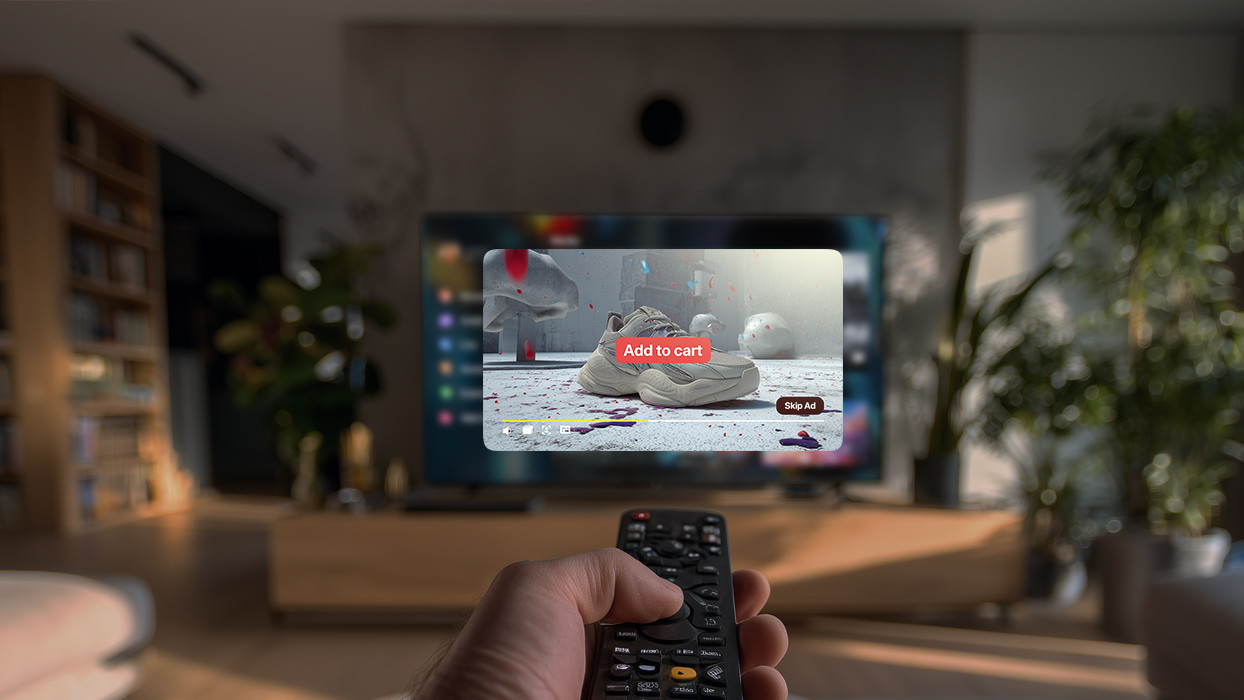
Remote-based shoppability sets viewers up to interact with an ad using the TV remote, typically through a short on-screen prompt that opens a purchase overlay and allows confirmation with minimal input.
Where it works: Connected TV and streaming platforms designed for lean-back viewing, where attention is close but interaction needs to remain simple. Roku environments are a typical example, as they support remote navigation and stored payment details.
Business value: This mechanic keeps the entire transaction within the viewing experience, which reduces friction and preserves context. It encourages more considered purchasing decisions, often resulting in higher average order values, and provides platforms with an alternative way to monetize premium attention beyond impression-based models. This is the foundation of Roku shoppable ads that aim to combine brand impact with direct outcomes.
QR-based shoppability shifts the transaction from the primary screen to a mobile device where users can scan a code displayed within the ad.
Where it works: Linear TV, streaming platforms without native checkout, and campaigns where the purchase flow requires more detailed interaction than a remote can provide.
Business value: QR-driven formats offer a practical entry point into shoppable advertising without deep platform-level integration. They empower brands to link high-attention video content with mobile checkout processes, maintaining a clear link between exposure and action.
Live shoppable formats combine video, real-time interaction, and commerce. Viewers may ask questions, explore products, and complete purchases during the broadcast.
Where it works: Live streaming platforms, social video environments, and campaign formats centered around launches, demonstrations, or influencer-led content.
Business value: Live commerce creates a strong connection between engagement and sales, especially for products that benefit from explanation or social proof. For brands, it provides immediate feedback on content effectiveness, and for platforms, it turns scheduled programming from passive media to a measurable sales channel.
Some interactive shoppable ads focus on capturing purchase intent, not forcing immediate checkout. These formats give users the freedom to save a product, request a reminder, or send details to another device.
Where it works: Lean-back viewing environments and premium content contexts where users may be interested but not ready to transact immediately.
Business value: Intent-first mechanics prevent demand from being lost due to timing or context. This equips brands to reconnect with interested users later on, taking care to maintain a respectful and lightweight interaction that doesn’t disrupt the viewing experience.
The strongest signal that shoppable ads are more than an experiment is that large brands are already using them to solve very specific business problems. In each case, the mechanic is chosen not because it looks innovative, but because it fits the context in which the audience is consuming content.
Walmart’s collaboration with Roku is one of the clearest examples of commerce moving onto the primary viewing screen. Instead of asking viewers to scan a QR code or search for a product later, the ad lets them initiate and confirm a purchase using the TV remote.
The interaction is deliberately minimal. A viewer presses a button on the remote, sees a purchase confirmation screen, and completes the transaction using stored payment details. The entire flow is designed around lean-back behavior, with no expectation of browsing or comparison.
Why it works: This approach reduces the path to purchase to a small number of intentional actions. It also keeps the viewer inside the streaming experience. For Walmart, it turns TV advertising into a direct sales channel. For Roku, it creates premium inventory that can be measured by completed transactions, not just reach. This model has become a reference point for Roku shoppable ads and for TV commerce more broadly.
Amazon’s advantage in shoppable advertising comes from its ability to integrate commerce directly into its streaming ecosystem. In ad-supported environments and related video placements, product discovery and purchasing are closely connected to the content experience.
When ads aren’t treated as isolated interruptions, commerce becomes an extension of viewing. Products featured in or around content can be surfaced contextually, and the transition from interest to checkout remains within Amazon’s platform.
Why it works: Every step happens inside an ecosystem that already has identity, payment, and fulfillment in place. From a business perspective, this turns streaming inventory into a transactional surface, where content consumption and shopping reinforce each other, not compete for attention.
On social media platforms, shoppable ads have become an integral part of everyday browsing. Brands such as Sephora, Nike, and IKEA use dynamic product catalogs that automatically sync pricing, availability, and visuals with ad creatives.
A user sees a product in a video, taps it, selects a variant, and completes the purchase without leaving the app or breaking the browsing flow. The experience feels closer to discovery than checkout, which is exactly why it performs well.
Why it works: Social shoppable formats thrive on impulse and familiarity. Brands can scale performance-driven campaigns and preserve the look and feel of native content by aligning creative content with real-time product data. In many categories, this approach has resulted in significant conversion increases compared to traditional click-out ads.
YouTube’s integration with Shopify connects long-form and short-form video content directly to product catalogs. Creators and brands can surface shoppable overlays during videos, so viewers explore and buy products without leaving the platform.
Instead of considering video as top-of-funnel exposure, the model treats it as a functional part of the sales process. Product discovery, explanation, and transaction can all happen in one session.
Why it works: YouTube already plays a major role in product research. Shoppable overlays remove the need for viewers to pause, search, and compare elsewhere, which helps brands convert attention that would otherwise dissipate after the video ends.
Live shoppable streams, popularized in Asian markets and increasingly adopted elsewhere, combine demonstration, interaction, and purchasing in a single format. Viewers can ask questions, see products in use, and buy without leaving the stream.
Platforms like Amazon Live show how this model scales when paired with analytics and inventory integration.
Why it works: Live commerce performs best when trust and explanation matter. The immediacy of the format minimizes hesitation, and real-time feedback puts brands in the position to adjust their messaging quickly. For platforms, it turns scheduled video into a measurable sales channel, not passive content.
Across very different platforms and mechanics, the underlying principle stays the same. Shoppable ads work when they remove unnecessary transitions and let users act without delay.
The brands that succeed with shoppable advertising are not chasing novelty. They are choosing interaction models that match how their audiences already consume content, and they are treating media placements as potential transaction points rather than just exposure.
Shoppable ads are not a trendy format added on top of existing media, but a new operating model for how commerce and content intersect. Today, they already compete with marketplaces by allowing purchases to happen closer to the moment of discovery, and over time, they are likely to become the standard wherever video holds attention.
For media companies, this creates a more direct way to monetize attention. For brands, it offers a path to sell without relying entirely on intermediaries. The outcome, however, depends on how well the system is designed. Such ads only work at scale when architecture, data, and analytics support real transactions, not just impressions.
Shoppable advertising requires more than creative formats. It requires solid adtech foundations, reliable data flows, and interaction design that fits the platform and the audience. Oxagile works with brands and media platforms to design and build commerce-enabled video and advertising solutions that scale across CTV, streaming, and digital environments.

Interactive shoppable ads are formats that let users interact with products directly inside the ad and move toward a purchase without leaving the platform. Depending on the environment, interaction can happen through taps, remote controls, QR codes, or voice actions, with the goal of turning interest into action inside the same experience.
Roku shoppable ads are shoppable formats built for connected TV, where viewers interact using a remote rather than touch or typing. They allow users to start and confirm purchases on the TV screen, often with stored payment details, while staying inside the streaming experience.
Shoppable ads examples include tap-to-buy video ads on social platforms, remote-based purchase flows on connected TV, and shoppable overlays in streaming and video content. In all cases, the idea is to reduce the steps between discovering a product and completing a purchase.

