













This website uses cookies to help improve your user experience



Nobody launches a streaming platform expecting to launch it twice. Yet that is exactly what happens to companies that race to market with a polished interface and a stacked content library, only to find, weeks or months later, that the infrastructure underneath cannot hold.
A CDN configuration nobody questioned during development throttles playback at peak hours. An encoding pipeline built for cost savings quietly degrades the viewing experience across half the device ecosystem. An architectural decision made eighteen months ago by someone who has since left the company now blocks every scaling effort. The fix takes eight weeks and six figures. The damage to subscriber trust is already done.
This keeps happening because of a basic asymmetry most companies underestimate. Every OTT platform has two layers: the visible one — the interface, the play button, the row of recommended titles — accounts for roughly ten percent of the system. The other 90% hides beneath: encoding pipelines, CDN logic, DRM handshakes, analytics engines, monetization layers, device-specific rendering quirks.
Attention and budget flow naturally toward what audiences can see, and the invisible part only shows itself when something expensive breaks. OTT consulting reverses that sequence, it makes the hidden layer visible before it becomes a crisis, not after.
And that hidden layer keeps growing more complex. Competition in streaming has compressed the margin for error to almost nothing: audiences now expect instant playback, intelligent recommendations, and a flawless experience on every screen they own.
Behind each of those expectations sits a chain of technical and product decisions like CDN selection, adaptive bitrate strategy, codec configuration, subscription logic, content rights management, where a single miscalculation compounds quietly until retention numbers start sliding and nobody can pinpoint why. OTT consulting services bring the specialized experience needed to get those decisions right before code is written and budgets are locked in.
This article draws on Oxagile’s 20+ years of work in OTT and video technologies to explore when consulting becomes essential, how it works in practice, and what it delivers across different stages of a streaming project.
Key takeaways:
Knowing when to hire OTT consultants often comes down to recognizing patterns that internal teams are too close to see. The symptoms show up in dashboards, support tickets, and sprint reviews, but the root causes tend to sit one or two layers deeper. Here are the most telling clusters.
The architecture of an OTT platform is its skeleton — everything else hangs on it. When companies build that skeleton without deep streaming-specific expertise, the problems tend not to announce themselves right away. They accumulate: an unclear platform architecture that turns every new feature into a negotiation with technical debt, scaling solutions bolted onto aging technology stacks that resist horizontal growth, AWS configurations that were good enough at launch but bleed cost as traffic climbs.
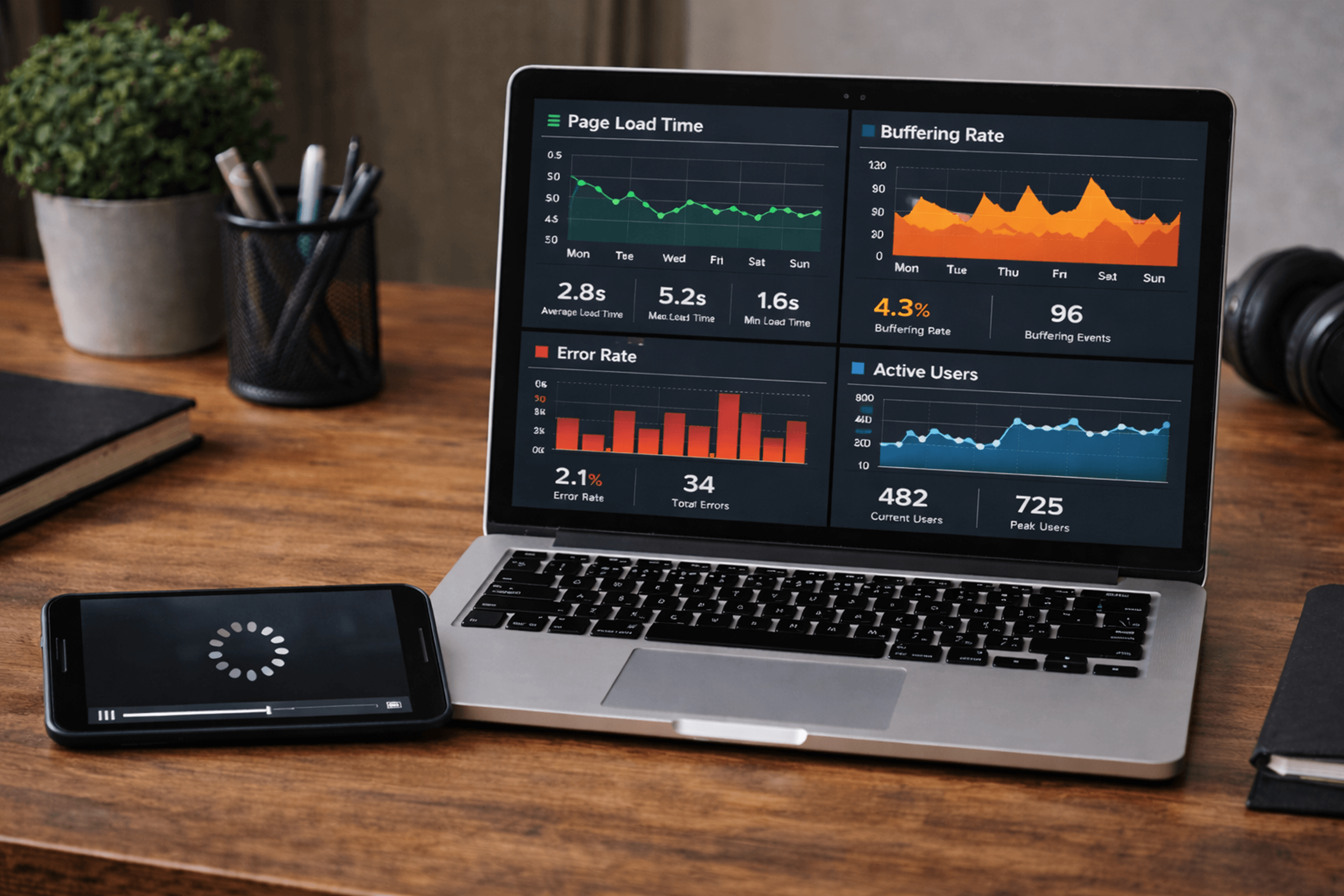
Performance problems follow. Buffering complaints rise. CDN, DRM, CMS, and MAM integrations interact in ways nobody planned for. Total cost of ownership goes up without any proportional increase in capability. These are not individual bugs, they are architectural signals, and fixing them one at a time is like treating symptoms without diagnosing the disease.
We conducted an architectural audit, code review, and AWS configuration analysis for a VoD platform struggling with performance under growing load. The engagement revealed bottlenecks invisible to daily operations and produced a clear map of what needed to change.
The result: reliable performance at significantly higher traffic volumes and a measurable reduction in operational costs.
Sometimes the platform holds up technically, yet the numbers tell a different story. Low engagement, declining retention, poor conversion rates — these often trace back to UX friction that server monitoring will never catch. Cluttered layouts overwhelm viewers instead of guiding them. Navigation logic that made sense during design confuses actual users. Onboarding flows ask for too much too soon, and recommendation carousels surface content that feels random instead of personal.
OTT platform consulting brings a structured lens to these problems. A UX audit across Smart TV, mobile, and web catches friction points that internal teams, too familiar with their own product, tend to miss. The gap between how designers imagine a user journey and how audiences actually move through it is one of the costliest blind spots in streaming.
A pattern we often encounter: the platform performs beautifully in pilot mode, with a controlled user base and a limited content library. Then audience growth picks up, and the seams start showing. Load testing was insufficient or skipped entirely. Infrastructure provisioning assumed linear growth when the actual pattern is spiky and unpredictable. Features that worked for five thousand concurrent users collapse at fifty thousand.
What makes these failures frustrating is that they are almost always preventable with the right assessment beforehand. OTT technology consulting at the pre-scale stage costs a fraction of what emergency remediation costs after a public failure.
Consulting is sometimes misunderstood as a company handing over a document of recommendations and walking away. How Oxagile practices it looks very different — a layered process where each phase builds on the findings of the one before.
Every engagement starts with collecting business and technical requirements in a structured discovery phase. The point is to understand what the business actually needs, which is sometimes a very different conversation from what the client initially asks for.
A strategic roadmap takes shape during this stage, anchored to real business metrics: ARPU, churn rate, engagement depth, and content consumption patterns. Oxagile always begins here, with deep discovery and business analysis, because focusing on actual client problems from day one cuts the risk of building solutions to the wrong questions.
With discovery findings in hand, the next layer is a thorough architecture analysis. Bottleneck detection, solution flexibility testing, scalability assessment — the system gets examined as it operates today and as it will need to operate at two, five, or ten times the current load.
The interactive VoD platform audit mentioned earlier is a good example: a comprehensive review of architecture, code, database design, and system load behavior that opened up optimization paths for quality of experience and operational cost reduction.
The product layer gets the same depth of scrutiny. UX testing across devices (each with its own interaction model, screen real estate, and user expectations) uncovers issues that A/B testing alone cannot explain.
The evaluation ties into the broader product strategy, connecting interface decisions to the conversion and retention metrics that actually move revenue. Finding interface bottlenecks that silently drag down conversion is one of the highest-value activities in OTT platform consulting, because the fixes tend to be straightforward once the problems are out in the open.
Analysis without a plan is expensive information that goes nowhere. The findings from architecture review, UX evaluation, and performance testing converge into a prioritized roadmap: architectural improvements, UX enhancements, load testing protocols, and performance targets, all sequenced by impact and dependency.
Once the assessment wraps, what you’re left with isn’t a slide deck, it’s a development plan that makes launch more predictable and far less risky.
Oxagile’s OTT consulting company model does not stop at recommendations. Consultants work alongside technical and product teams during implementation, providing quality control, analytics integration guidance, and load testing support.
The move from strategy to execution is where many consulting engagements fall apart, as recommendations sit in a slide deck and never reach production. Embedded support keeps that from happening.
A streaming platform is never truly finished: content libraries expand, audiences shift, devices evolve, and competitors ship new features. Ongoing evaluation and optimization after launch keep the platform stable, competitive, and tuned to how audiences actually behave. The cycle of measuring, evaluating, and improving is what keeps platforms growing steadily instead of peaking and flattening out.
Launch is where most vendors disappear, and most problems start. Oxagile sticks around — tuning ad delivery, optimizing billing logic, adapting monetization to new markets, and making sure the architecture scales with the audience, not against it.
A common misconception about OTT consulting is that it belongs at the start of a project and ends when development kicks off. Our experience tells a different story: consulting delivers the most when it runs through the entire project lifecycle, shifting its focus as the platform moves from concept to live service.
Strategic recommendations are only as good as their execution. Oxagile embeds deeply into implementation phases, not as a sideline advisor but as part of the working team.
In multi-tenant video streaming platform projects, for instance, the engagement starts with consulting on architecture decisions, technology selection, scalability planning, and continues as Oxagile takes full ownership of frontend development. The consulting layer carries forward into the coding phase, evolving from assessment into active technical leadership.
Quality assurance in OTT does not wait until the product is feature-complete. Oxagile’s QA specialists introduce automation frameworks and load testing protocols during the consulting and architecture stages, well before the first release.
Testing the system’s behavior under projected audience loads, geographic distribution patterns, and peak traffic scenarios catches the kind of failures that would otherwise show up in production in front of real users, at the worst possible moment.
Data is the nervous system of a strong OTT platform, but many companies treat analytics as an afterthought, adding them once the product is live. At Oxagile, our specialists help implement comprehensive OTT analytics from the beginning, including viewing data, engagement metrics, churn indicators, and measuring the effectiveness of personalization.
With the right instrumentation in place, every product decision, from content acquisition to UI redesign, is based on actual audience behavior instead of gut feeling.
The return on OTT consulting shows up across four dimensions that reinforce each other:
| Benefit | How it works |
| Reduced technology risk | Catching architectural, performance, and integration problems early eliminates the compound cost of fixing them after launch. |
| Cost optimization | Proper architecture choices and infrastructure configurations prevent overspending on cloud resources, CDN costs, and redundant tooling. |
| Faster time to market | A structured roadmap and UX audit compress the path from concept to launch by cutting rework cycles and realigning priorities. |
| Increased ARPU and retention | Better UX, data-driven personalization, refined monetization models, and actionable analytics feed directly into revenue growth and lower churn. |
The iceberg metaphor carries all the way through, and it holds for every OTT platform: what audiences interact with is a small fraction of the system that makes the experience possible.
Professional consulting makes the rest visible: the architecture behind scale, the UX that drives conversion, the analytics that shape decisions, the monetization logic that keeps the business alive. Getting those hidden layers right is what separates platforms that grow from platforms that pour their resources into constant, reactive fixes with no clear end in sight.
Oxagile has run enough OTT projects to prove that consulting pays for itself when it’s tied to real engineering decisions. Deep technical expertise paired with product-level thinking means every recommendation translates directly into a platform built to grow.
Whether your platform is still on the whiteboard or already live and hitting its limits, the signals we’ve mentioned probably sound familiar. OTT consulting turns those risks into a clear path forward before they become expensive problems.

The most common triggers include persistent performance issues, rising infrastructure costs without clear justification, declining user engagement or retention metrics, difficulty scaling beyond a pilot audience, and uncertainty about platform architecture for a new streaming product. In general, the earlier consulting begins, the greater its impact on cost and quality.
Deliverables vary by engagement scope but commonly include architectural audits, performance assessments, UX evaluations across devices, strategic roadmaps with prioritized improvements, load testing protocols, analytics implementation plans, and ongoing optimization support. Leading OTT consulting companies also embed with development teams during implementation so that recommendations reach production.
OTT technology consulting focuses specifically on the technical decisions that underpin a streaming platform: CDN selection and configuration, encoding and transcoding pipelines, DRM implementation, adaptive bitrate strategy, cloud infrastructure optimization, and system architecture design. It makes sure the technology stack supports current needs and can scale with audience growth.
OTT platform consulting requires deep domain expertise in video delivery, content management, streaming protocols, multi-device UX, and media-specific monetization models. General IT consultants may understand cloud infrastructure or software architecture broadly, but streaming platforms introduce unique challenges around real-time content delivery, rights management, and viewer experience optimization that demand specialized knowledge.

