













This website uses cookies to help improve your user experience




Since you are reading this article, chances are that you are a fintech or e-commerce industry professional with a solid understanding of online payments. However, it’s also possible that you may be missing out on some important and hard-to-detect nuances of payment system design that may be creating multiple kinks on your revenue hose, slowing down your ability to scale, and potentially leading to unfortunate cashflow leaks.
These defects rarely appear on the surface. Tucked deep within your payment architecture, they often sit there for years, silently eating away at your MRR, leaving customers disgruntled with consistent payment issues and high processing fees, and spawning seemingly random and inexplicable end-of-month reconciliation problems.
From an outside perspective, the revenue bucket is constantly getting filled with incoming payments. What many companies often fail to see is that its bottom is leaking. Leaking their money, day after day.
This guide approaches payment orchestration from an engineering and operational perspective. We will look at the architecture behind the payment orchestration layer, where the ROI actually comes from, common implementation challenges, and what teams should consider before introducing another software layer into their payment stack.

We asked Kyrylo Petrov, our Director of Fintech Technology Consulting at Oxagile, to comment on the most common real-world implications of hitting the limitations of an existing payment infrastructure, dispel some myths surrounding payment orchestration, and share his thoughts on the best practices of building flexible, self-regulating payment pipelines.
Key takeaways:
What issues can a system that looks generally healthy and performant have? The reasons are quite diverse, spanning purely technical and wider operational aspects:

Most companies do not (and cannot) address all of these issues at once. In practice, they tend to pile up gradually as businesses expand into new markets, add more providers, introduce recurring billing and subscriptions, or optimize for resilience and conversion.
At some point, this stack of problems outgrows payment processing itself. The focus of attention and the bulk of maintenance efforts shift to constant, resource-consuming manual coordination across a complicated payment ecosystem.
Kyrylo comments:
“This is usually the moment when companies realize they can no longer treat payments as a ‘dumb pipe’ where money simply flows from point A to point B. At scale, payments become a dynamic operational system that requires centralized coordination, routing logic, observability, failover mechanisms, and continuous optimization.”
This is exactly where payment orchestration enters the story, but there is a caveat. While lots of engineering teams identify it as an efficient remedy for their amassing payment concerns and start looking for recommendations, they quickly run into platform-heavy messaging and SaaS sales pitches instead of practical implementation guidance.
Most payment setups work well in the early stages of growth. Typically, it’s a single PSP, a straightforward checkout flow, and a small set of payment methods. Just what a business needs to start accepting payments.
Based on our experience, problems start emerging when the business expands faster than the original payment design was meant to handle.
For example, a company could enter new markets and discover that approval rates would differ significantly from the norm when payments were processed through local acquirers. As subscription numbers and revenue go up, recurring payment failures and churn become more visible and painful.
At this point, product teams realize that they need alternative payment methods that existing local providers do not support well. At the same time, finance teams come requesting unified reporting across multiple PSPs, while legal and compliance teams flag a growing list of regional requirements that the original architecture never accounted for. Finally, engineering teams are asked to add redundancy, anti-fraud tools, and even routing logic into basic infrastructure that wasn’t designed for this level of complexity.
This is typically how what starts as a simple connector turns into a knot of hastily implemented payment integrations and workarounds bordering on kludges. In practice, we often see companies reach this point after adding their second or, more commonly, third PSP.
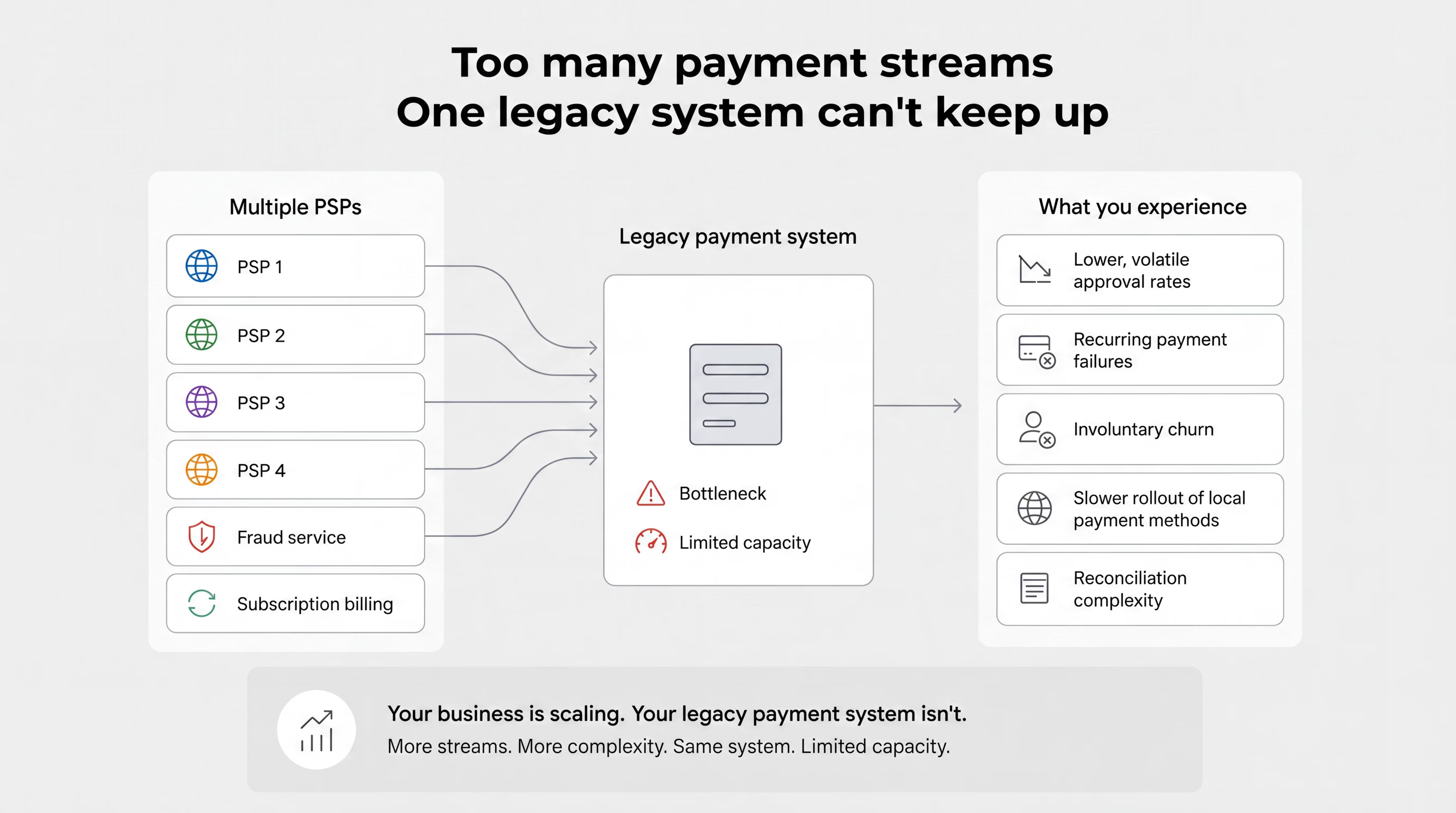
The original architecture expects a single processing flow, but when extra ones are introduced along with routing rules, fallback and retry logic, subscription edge case processing, and reconciliation algorithms, things tend to get complicated. Common symptoms may include:
Payment orchestration helps address them and introduce an element of stability into infrastructures on the cusp of chaos. In fact, orchestration becomes vital for struggling organizations because the cost of maintaining fragmented payment operations starts limiting growth potential, conversion rates, and engineering velocity all at the same time.
Kyrylo explains:
“What’s interesting is that some of our prospects are really cautious about implementing payment orchestration, assuming it would involve tearing down whatever they’ve built so far.
The reality is different, and this choice is not about going all-in on chance. It’s a massive upgrade of the existing system that unlocks new dimensions in terms of control, flexibility, security, and observability.
Think of an advanced “intelligent home” system added to your house. The house is still there, but you get high-definition cameras, climate control, water leakage detection, and more for your peace of mind. This makes a world of difference.”
From a process perspective, payment orchestration is the coordination and routing of transactions across multiple providers, methods, and channels. It dynamically selects the optimal path for each transaction based on factors like transaction amount, processing fee, success rate, geography, or predefined fallback logic, among others.
From a software perspective, a payment orchestration platform is a type of middleware layer that sits between a business and its PSPs, offering a single integration point that abstracts away the complexity of managing multiple payment service providers. It takes care of routing rules, retry logic, fraud detection, reconciliation, logging, and reporting, letting businesses add or switch providers without re-engineering their checkout flows and infrastructure.
Its primary role is not to process payments but to centralize and manage the logic surrounding how payments move through the system.
Expert’s comment:
“Companies panic because they think orchestration means rebuilding payments from scratch. But it is important to understand that payment orchestration platforms are not payment gateways and do not replace payment gateways in any way.
Your existing gateways, acquirers, processors, and fraud systems remain in place. The orchestration layer coordinates them and saves you the trouble of implementing separate sets of processing logic for each payment provider.”
As we mentioned above, you will see countless advertisements of payment orchestration providers promising fast, smooth, hassle-free integration and all sorts of amazing outcomes for your business. Your search results page will be full of silver bullets, and all you need to do is purchase their product subscription.
In practice, however, platforms never improve payment performance instantly and automatically.
As Kyrylo puts it:
“No matter how advanced Primer, Yuno, or Payoneer are and how many features they come with, out-of-the-box, they are just infrastructure frameworks that require weeks or even months of configuration, experimentation, testing, and fine-tuning to your business model and processes.”
For example, your routing logic must always be manually aligned with:
Commercial orchestration platforms reveal their full potential only when they are supported by engineering teams who constantly gauge their performance, optimize routing logic and error handling, and make multiple other adjustments across the board.
Expert’s opinion:
“Going with a commercial payment orchestration provider is like building a music studio from the ground up. It’s not enough to buy a complete set of professional sound equipment and plug it into power.
Each device has to be properly wired and configured for optimal output, the speakers must be spatially aligned, and the entire setup needs to be tested from A to Z multiple times before the first customers walk through the front door. And this improvement process never ends.
Payment orchestration is much like that. Without continuous adjustment and optimization, your ‘music’ will never hit the charts.”
Not every business needs payments orchestration. Based on our experience, for companies doing business in a single region with a single connected PSP and relatively stable payment flows, spending money on an orchestration layer can be overkill. In many cases, a well-designed and executed direct integration will be the simplest and most maintainable solution.
Orchestration starts making sense when payment operations become strategically important to business growth, user retention, and regional expansion.
Kyrylo notes:
“Here’s an easy formula for determining if you should consider the idea of adding payment orchestration to your stack: when the combined cost of running fragmented payment ops exceeds that of adding an orchestration layer, go for it!”
The most common signals include:
In practice, we often see orchestration getting a much higher priority at the point where the payment infrastructure stops being just a part of the back office and starts turning into an operational bottleneck.

We are always open to having meaningful and insightful conversations. Reach out to our fintech team for a complete analysis of your business case and actionable recommendations on moving forward. Our payment integration experts have been involved in multiple high-complexity projects with millions of users, sophisticated routing logic, and seamless, multi-phase service rollouts.
In the most general terms, payment orchestration acts as a centralized command and control layer between your application and the external payment ecosystem.
In this model, instead of posting every transaction through a single hardcoded payment flow, the orchestration layer autonomously evaluates rules, conditions, and provider status in real time and then decides on how the transaction should be processed.
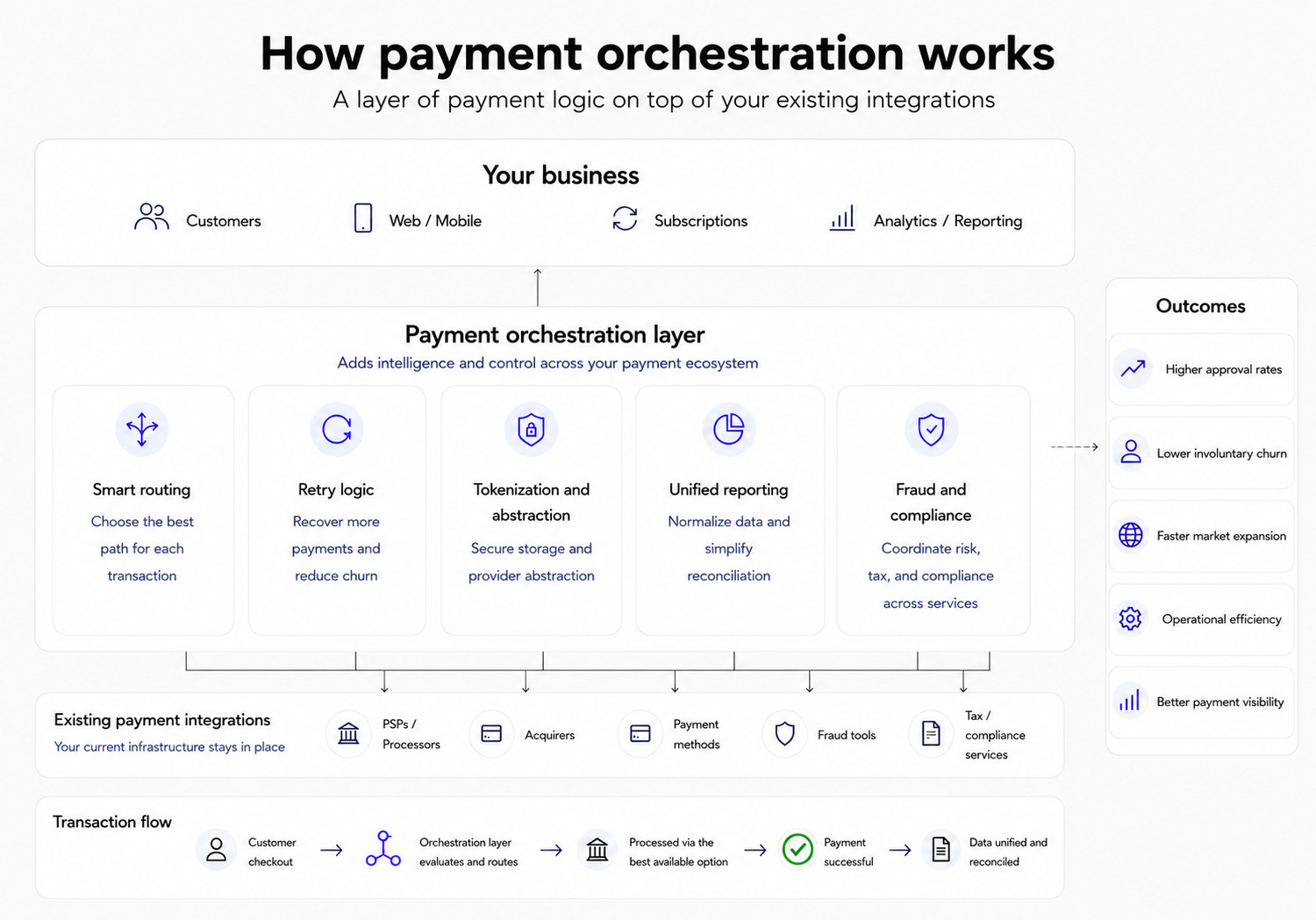
The decision-making logic can be quite complex and may involve routing and retry paths, token handling methods, fraud checks, compliance rules, reconciliation workflows, and communication with multiple PSPs or payment services simultaneously.
The ultimate goal here goes far beyond connecting more providers. The goal is to create a flexible payment infrastructure that can dynamically respond to changes in business, regional, and operational requirements. Let’s break it down by functions.
One of the main purposes of orchestration is smart transaction routing across multiple integrated PSPs and acquirers.
Transactions can be routed automatically based on location, issuer behavior, average approval speed, processing fees, or provider availability. This allows engineering teams to aim for higher authorization rates, introduce failover logic, and reduce or eliminate single-processor lock-in without embedding complex routing rules right into the application layer.
If you are a subscription business, you’ll be happy to find out that orchestration often plays a major role in reducing churn.
Kyrylo’s point of view:
“One of the greatest misconceptions that we deal with regularly is that payment retries are just repeated payment attempts on a timer. The truth is that issuer behavior differs in a big way across regions, card types, and even time of day. A retry strategy that works in Western Europe may be a terrible choice for LATAM or MENA.
In our projects, we often end up fine-tuning retry timing, PSP switching, and fallback sequencing over weeks based on statistical data and live authorization patterns we capture. It’s super important, since small improvements in recurring recovery rates can translate into major revenue gains at scale.”
Working with multiple PSPs often translates into incomplete reporting, inconsistent transaction data, and end-of-month reconciliation challenges.
What teams underestimate is that these aren’t just operational headaches. Persistent mismatches between PSPs, internal ledgers, and bank settlements quickly stop looking like a data problem and start looking like a fraud problem, even outside regulated fintech. The default assumption from finance and audit is simple: if money can’t be cleanly accounted for, someone is taking it. At scale, even a fraction of a percent becomes a real issue.
Orchestration platforms normalize payment and settlement data into a unified view, giving finance and ops better visibility and a clean audit trail.
Modern payment flows involve much more than pushing transaction data to the processing party.
Fraud prevention isn’t just stolen card detection, it spans real-time transaction monitoring, velocity rules, behavioral analytics, and sanctions screening. Compliance is even broader: KYC/KYB, tax, data residency, and licensing thresholds that shift with transaction volumes. Layer on the data you’re required to store, audit, and surface on demand across jurisdictions with conflicting rules, and you’re dealing with infrastructure-grade obligations, not extra services.
A well-designed orchestration layer coordinates all of this within a single flow, instead of forcing each provider integration to carry its own fraud and compliance logic.
Now that we’ve had enough theory, let’s jump to some practical cases of taking online businesses to a whole new level with payment orchestration.
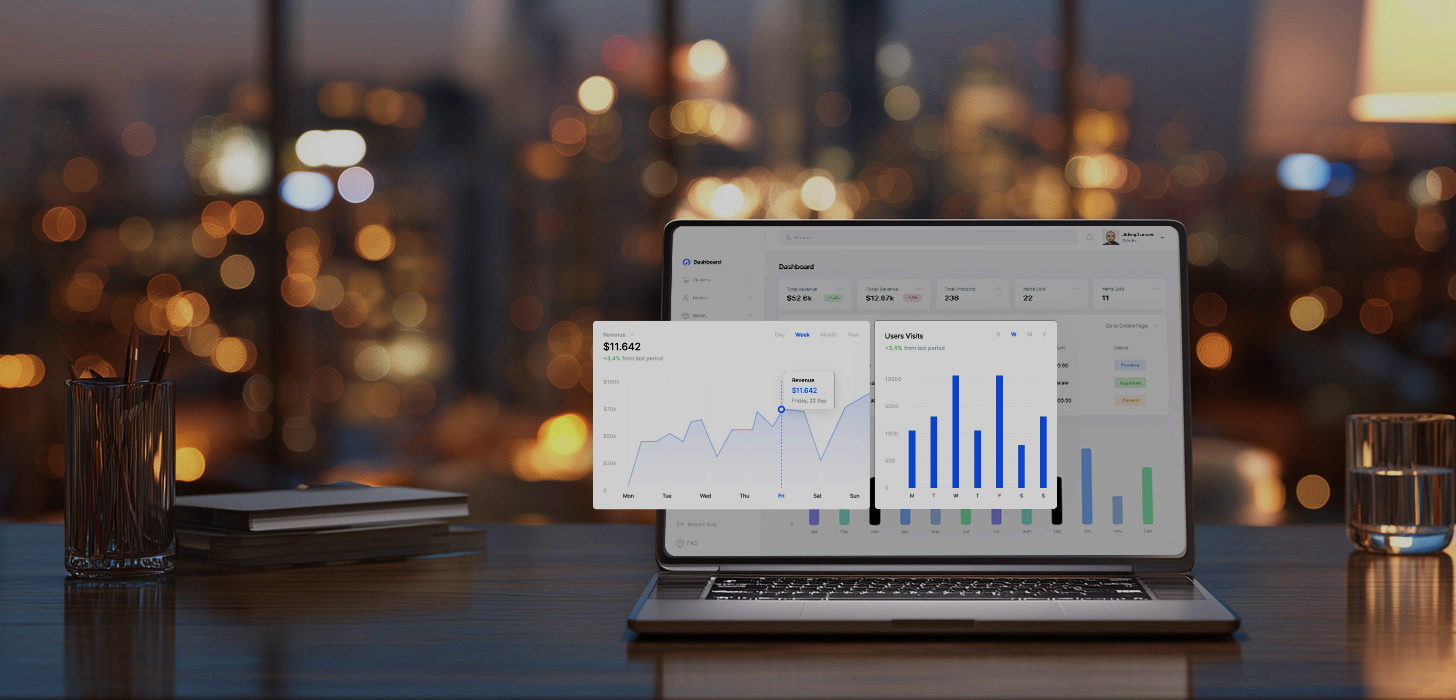
Our client operates as a Merchant of Record for major global D2C streaming platforms, including the NFL, NHL, Tennis Channel, Optus Sport, NHK, and Volleyball World. At that scale of operation, payment infrastructure becomes inseparable from subscriber retention and operational stability.
The challenge was not in multiple payment gateway integration, something that we do on a regular basis. The platform was already operating across a number of global regions, currencies, issuers, and subscription flows. The task was focused on reliably coordinating all of these moving parts at scale.
We selected Primer, a popular payments orchestration platform, to serve as the foundation for routing, provider coordination, and payment method management. From there, the engineering work was about turning a generic orchestration toolkit into a subscription-specific payment system: extended and adapted to the client’s billing model, regional realities, and operational workflows.
Most of the work went into the layers Primer doesn’t provide out of the box:
The result was a subscription billing infrastructure built with orchestration capabilities and the custom logic needed to support millions of D2C renewals globally. It reduced payment friction, improved renewal rates, and accelerated the rollout of regional payment methods, including emerging local providers like Pix Automático in Brazil.
Yet another project where we dealt with an orchestration challenge was focused on fixing payment drop-offs, a fairly typical issue that many international companies often face.
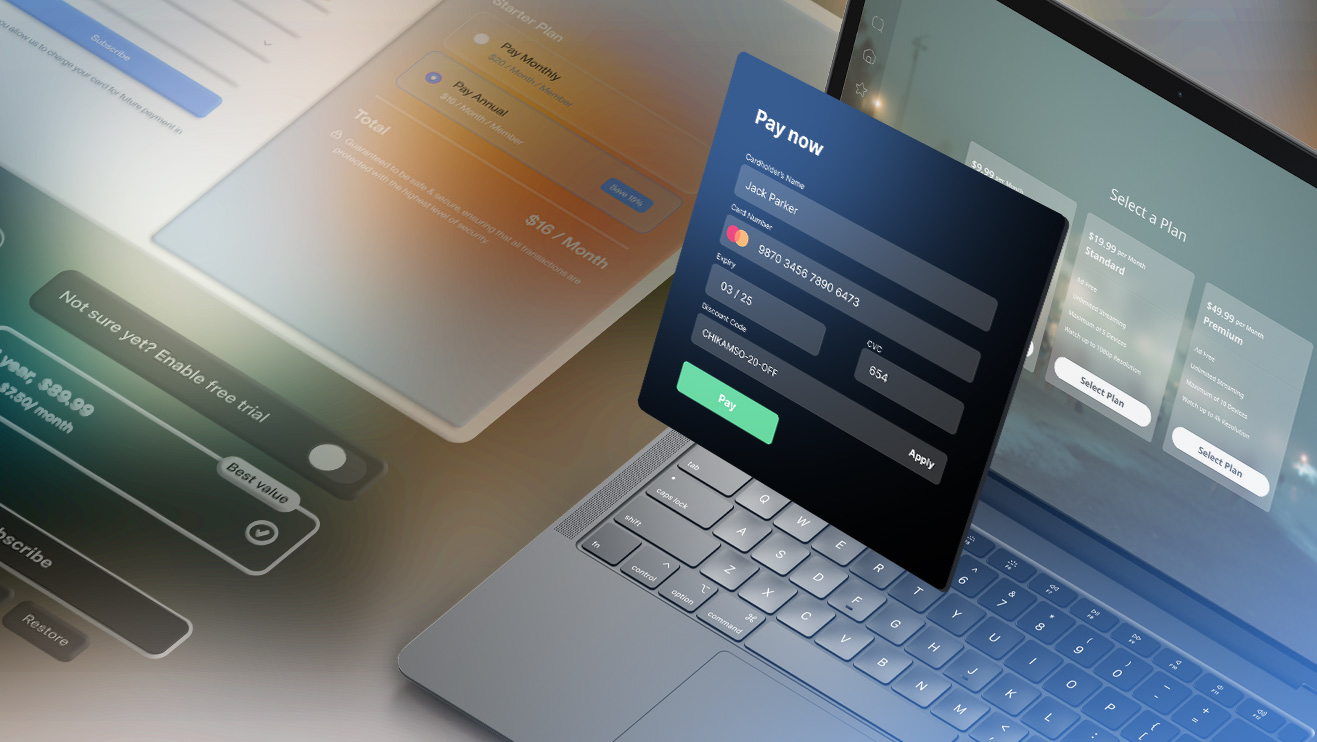
The main problem Oxagile was asked to solve was inconsistent payment performance between regions. Different PSPs, issuers, and local payment conditions resulted in fluctuating success rates and frustrating checkout friction for international users.
From the payment orchestration perspective, the solution was predominantly about improving coordination between existing payment providers through:
By implementing a more flexible orchestration layer on top of payment routing and transaction management, the client gained a higher degree of control over payment performance without rebuilding the existing payment infrastructure.
Both projects essentially illustrate the same thing: payment orchestration is almost never just a fancy routing tool. In the enterprise world, it has become an efficient method of centralizing payment decision-making, reducing payment stack fragmentation, and creating enough architectural flexibility to support long-term growth initiatives.
The simple answer to this question is “it depends on how much control you actually need.”
Pros:
Cons:
With that in mind, if you want to choose the platform path, make sure to evaluate more than the number of supported PSP connectors. In practice, factors like routing configurability, retry flow customization, recurring billing support, token lifecycle management, reporting visibility, and API quality will matter far more during real implementation projects.
Pros:
Cons:
Kyrylo’s summary:
“Based on our experience, companies rarely decide to build their own orchestration layer because, all of a sudden, they want more flexibility.
Much more often, the decision is triggered by running into situations that they could not fully control, like a PSP outage that hurt revenue, routing bottlenecks in new markets, or vendor limitations that slowed down ongoing transformation.
Over time, many teams realize that payment orchestration is not only about streamlining transactions. It’s about doing away with PSP lock-ins and the ability to react faster when something goes wrong.”
There is also a third scenario. Some enterprises weigh the advantages and disadvantages of standard options and choose to adopt a hybrid approach where orchestration providers are used only as the foundation. All the custom payment logic and operational layers are wrapped around them to address business-specific requirements.
The most important thing to remember is that orchestration is not just another payment product. When implemented correctly and at scale, it becomes a crucial element of the operational infrastructure that determines how resilient, flexible, and scalable your payment ecosystem can be.
While the platform itself is important, most of the value comes from how orchestration is engineered around your business logic, billing behavior, routing strategy, and production.
This is exactly why successful payment orchestration projects are far from being plug-and-play. They require experienced fintech teams that understand payment systems across multiple layers of the payment stack: general architecture, data security, and day-to-day operation in an actual business environment, including edge cases, data reconciliation, and compliance in various regions.
Our team of experienced integration engineers and fintech architects are ready to discuss your payment infrastructure challenges and advise on the optimal remediation scenario that will meet your budget and timeline preferences.

Payment orchestration is a control layer placed above PSPs, gateways, and payment security tools that helps businesses manage routing, retries, reporting, and payment optimization centrally. In simple terms, the payment orchestration meaning is centralized coordination of the entire payment ecosystem.
A gateway or payment service provider processes payments. Payment orchestration coordinates multiple providers and adds centralized logic for routing, failover, retries, and operational management across the entire payment stack.
Not by itself. Some platforms help reduce the PCI scope through data tokenization or hosted flows, but the compliance scope ultimately depends on the overall payment architecture and data handling practices employed by the company.
Basic implementations may take a few months from start to finish. Enterprise environments with multiple PSPs, subscription systems, and custom payment logic typically require phased rollouts over longer periods of time.

