













This website uses cookies to help improve your user experience



Mobile is now the main commerce surface, not a smaller version of the web. Recent findings suggest that mobile’s share of global e-commerce is projected to reach 64% by 20301. Yet mobile payment gateway integration is not a shrunk-down web integration. It is a distinct problem.
Sure, mobile payments look easy, largely thanks to the existence of Apple Pay, Google Pay, Stripe SDK, or Adyen SDK. Those look like full-blown solutions, but are they?
Mobile payment integration has unique architecture and operational challenges that aren’t visible on the surface. Most rollout delays occur outside the SDK: in token management, payment state handling, subscriptions, reconciliation, and platform-specific user journeys. Plus, there are unique constraints, compliance issues, and scalability concerns.
Fortunately, there are real solutions that deliver on all fronts. This guide is designed for CTOs, product owners, payment leaders, and fintech operators looking for technologies that support their global payment and subscription ecosystems.
Key takeaways:
Payment gateway integration in mobile application development extends far beyond connecting an SDK and accepting card details. A modern mobile payment stack typically combines the payment gateway, processor, acquiring bank relationships, and wallet rails such as Apple Pay and Google Pay, while the application team remains responsible for the entire payment experience. That includes:
Mobile introduces implementation considerations that differ significantly from web checkout. Teams must account for variable network conditions, native user experience expectations, biometric authentication, deep-linking and app-switching behaviors, as well as compliance with iOS App Store and Google Play payment policies. These constraints influence architectural decisions from the beginning.
The quality of the payment experience has a direct impact on conversion. Reducing input fields, supporting digital wallets, surfacing real-time payment states, and minimizing authentication friction move completion rates.
At the same time, mobile-specific security controls, including device biometrics, tokenized credentials, and adaptive authentication patterns, have become standard considerations for modern payment integrations.
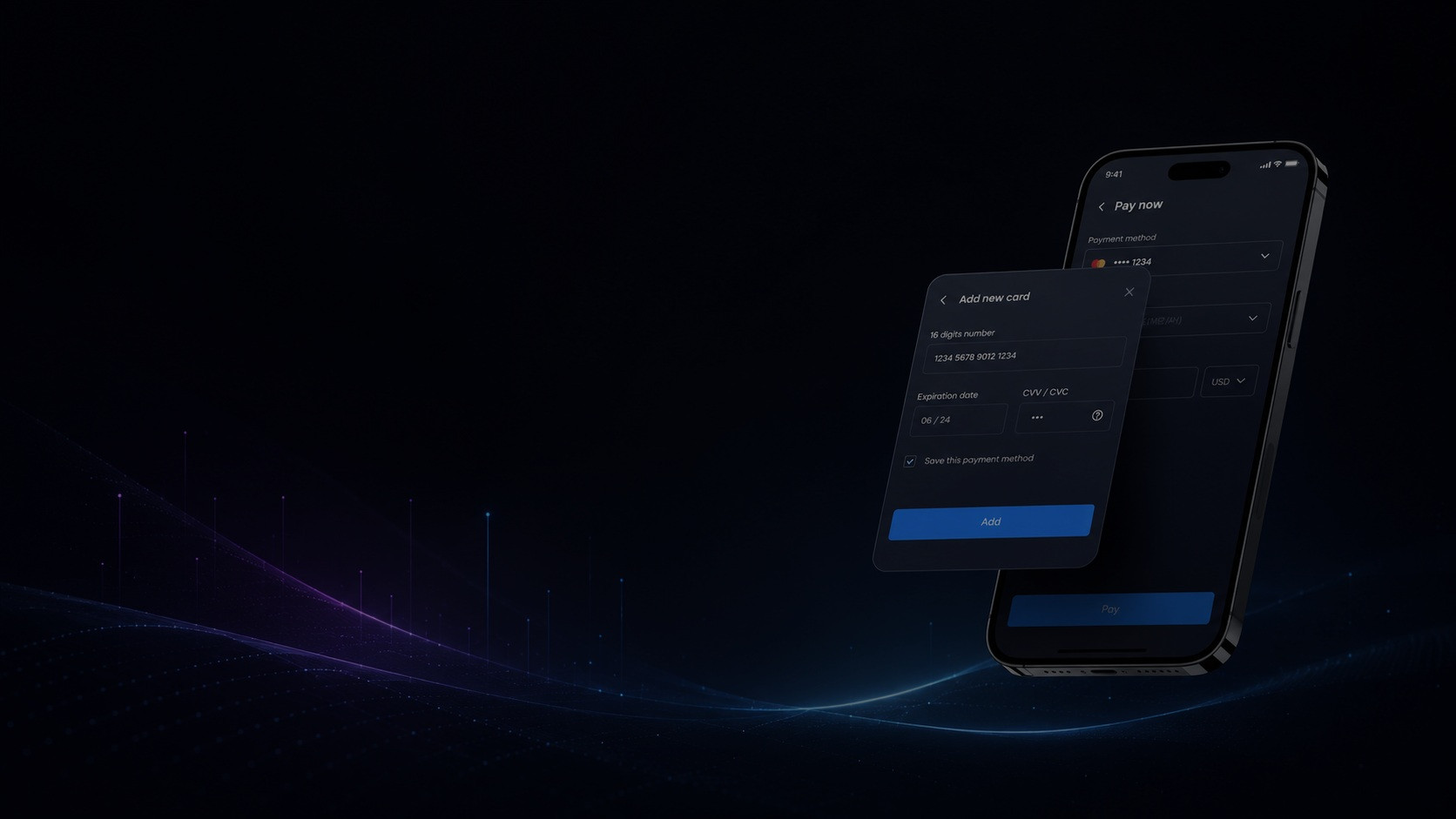
In mobile environments, the native user experience effectively becomes part of the payment infrastructure. On the web, a hosted checkout can strip away much of the complexity.
In an app, payment performance influences far more than transaction success. It affects conversion rates, app ratings, retention, subscription uptake, and renewal outcomes. Essentially, the payment flow is undeniably a core part of the product experience, so it’s not just a transaction mechanism.
Mobile applications also operate in inherently unstable environments. Users switch between Wi-Fi and cellular networks, place apps in the background, lose connectivity, or return to expired sessions midway through a purchase. Payment architectures need to anticipate interruptions, preserve state, and recover gracefully without forcing users to start again.
Another common misconception is that the SDK embedded in the application is the most difficult aspect of implementation. In practice, it’s usually the simplest. The more demanding work sits behind the app layer:
These operational capabilities ultimately determine the reliability and scalability of mobile payment software solutions.
In practice, one of the most common implementation challenges isn’t payment authorization itself but keeping payment status synchronized across the mobile client, backend services, and PSP events. We’ve seen cases where a payment is successfully authorized, but the user closes the app before the final confirmation screen appears. Without proper webhook handling and payment state reconciliation, this can create support issues, duplicate purchase attempts, and inconsistent customer experiences.
Finally, mobile introduces platform-specific requirements that shape payment decisions from the outset. Teams must navigate Apple App Store and Google Play policies, support native authentication mechanisms, satisfy application store requirements, and design secure deep-linking and app-switching experiences that maintain continuity throughout the payment journey.
Treating SDK installation as the payment project itself is among the most frequent mistakes teams make. In reality, integrating a payment solution is usually just the starting point.
One more possible issue is leaning on WebViews to replicate a web checkout. It speeds up early development, but it tends to produce a rougher, more disjointed experience, weaker support for native authentication, and added friction at payment completion.
Testing practices can also create blind spots. A recurring mistake is treating payment testing as a transaction validation exercise instead of a customer journey one. Successful payments are usually easy to validate. Edge cases such as interrupted 3DS authentication, delayed webhook delivery, duplicate callbacks, or users switching devices mid-session are often where production incidents originate.
Many teams validate only successful transactions and overlook failed authorizations, interrupted sessions, expired tokens, chargebacks, and connectivity problems. Yet, thorough testing of edge cases is essential for spotting payment issues before they affect customers in production.
Designing payment flows around a single market and one preferred payment method limits future growth. Mobile payment experiences should be built with localization, regional preferences, and the flexibility to support additional payment methods as expansion plans evolve.
A mobile payment integration often starts as a straightforward implementation, but as the business scales, the project becomes increasingly complex.
A good indicator that outside expertise may be valuable is when payment decisions begin affecting expansion plans, customer retention, or engineering velocity rather than just transaction acceptance. Another warning sign appears when payment-related work begins consuming disproportionate engineering effort. Teams that initially expected a simple gateway integration often find themselves spending increasing time investigating failed payments, reconciling transaction discrepancies, onboarding new payment methods, or adapting to provider-specific requirements.
A few signs that scaling is becoming challenging include:
At this stage, payments are no longer simply an integration task. They become an ongoing operational capability that requires careful architecture, monitoring, optimization, and a strategy that adapts as the business expands.

Accelerate your development and business expansion with Oxagile’s expert team.
One of the first questions teams ask is whether they can simply reuse their existing web checkout experience inside a mobile app. In some cases, they can, but the decision comes with trade-offs.
A native SDK-based integration typically delivers the smoothest experience, better support for biometrics and wallets, and greater control over optimization. Hosted payment pages can reduce implementation effort and compliance scope, while embedded web checkouts often accelerate delivery but may introduce friction, inconsistent UX, and limitations around native capabilities. Wallet-first experiences may significantly improve conversion for eligible users, but they require platform-specific implementation and ongoing maintenance.
The choice of a mobile payment gateway should also account for long-term architectural needs. Decisions around tokenization strategy, ownership boundaries between the app and backend services, payment state management, subscription support, and webhook handling will influence how easily the platform evolves. Teams should also consider how difficult it will be to add new payment methods, introduce wallets, or switch providers in the future.
Ultimately, successful mobile app payment gateway integration is less about connecting a payment provider and more about making architectural decisions that support growth, maximize conversion, and maintain operational resilience over time. Selecting the right payment gateway for mobile app experiences means balancing implementation speed with the flexibility needed to scale, making sure the chosen payment solution adapts as business requirements change.
There isn’t a single implementation model that works for every mobile product. The right approach depends on how much control you need over the customer experience, how much engineering effort you can invest, and how important flexibility will be as payment requirements change.
| Approach | Advantages | Trade-offs |
| Native SDK integration | Delivers the most native-feeling experience, supports biometrics and wallets natively, and provides greater control over checkout optimization and payment states. | Requires more development effort, backend coordination, and ongoing maintenance as SDKs and platforms evolve. |
| Hosted checkout pages | Faster to implement, reduces PCI compliance scope, and shifts much of the payment UI maintenance to the provider. | Offers less control over branding and user experience, and may introduce friction through redirects or app switching. |
| Custom payment flows | Best suited for businesses with unique purchase journeys, marketplace models, complex subscriptions, or strict branding requirements. Provides maximum flexibility for future payment capabilities. | Demands significant investment in architecture, security, compliance, testing, and long-term support. |
Rather than approaching the decision as a simple “build-versus-buy”, teams should evaluate each option through the lens of user experience, platform constraints, compliance responsibilities, maintainability, and scalability.
A payment implementation that accelerates an initial launch may become restrictive when adding subscriptions, supporting additional payment methods, expanding internationally, or optimizing checkout performance. The most effective choice is usually the one that aligns with both current product goals and anticipated growth.
When a company began expanding further into a global market, Oxagile stepped in to help it overcome PSP challenges, resolve payment drop-offs, and recapture lost revenue.
Many teams assume that once they’ve selected a payment provider, implementation becomes a straightforward development project. In reality, the period between choosing a solution and going live is where the most important decisions are made. The question isn’t simply how to add payment gateway in app environments, but how to design a payment experience that remains reliable, scalable, and user-friendly as the product grows.
Unlike web implementations, mobile payment gateway integration must account for native user expectations, device-level authentication, app lifecycle interruptions, platform policies, and unstable network conditions. Teams often focus heavily on SDK installation, only to discover later that payment architecture, state management, subscriptions, observability, and operational workflows have a much greater impact on long-term success.
Instead of thinking about implementation as a sequence of development phases, it’s more useful to view it as a series of checkpoints. The decisions made around payment experience design, backend ownership, platform capabilities, testing strategy, and post-launch monitoring will determine whether the rollout improves conversion and retention or creates new operational challenges.

The first question should never be, “Which SDK do we install?” It should be, “How should users pay inside the app when using their mobile devices?”
Payment experience decisions shape nearly everything that follows. Teams need to determine whether users will make one-time purchases, manage subscriptions, adopt a wallet-first experience, save cards for future purchases, or use regional payment methods. These choices influence tokenization approaches, authentication requirements, backend services, and even provider selection.
One architectural decision that frequently becomes expensive to revisit is token ownership. Teams often optimize for launch speed and tightly couple payment logic to a specific PSP. Later, when business requirements call for provider migration, regional expansion, or additional payment methods, those early design decisions can significantly increase implementation effort.
Defining the desired customer journey early helps prevent architectural compromises later in the project.
One of the biggest lessons in mobile payments is that the app itself represents only a small part of the payment ecosystem.
The mobile client handles customer interactions, but the majority of payment responsibilities typically sit behind the scenes. Backend services manage tokens, orchestrate payment requests, process webhooks, track transaction states, reconcile settlements, handle refunds, and maintain subscription lifecycles.
Designing clear ownership boundaries between the mobile application and backend systems is essential. Without them, teams often struggle with duplicate payment events, inconsistent statuses, and limited visibility into failed transactions.
In many implementations, uncertainty around payment state causes difficult production issues. For instance, a PSP may authorize a transaction while the mobile app loses connectivity before receiving confirmation. Designing for these scenarios requires clear ownership of payment state and reliable event synchronization between the gateway, backend services, and mobile client.
Native mobile implementation introduces platform-specific requirements that web teams may not anticipate. Beyond integrating a payment SDK, developers need to consider device capabilities, authentication patterns, app policies, and release management processes.
| Platform | Key considerations |
| iOS | Apple Pay integration, App Store payment rules, biometric authentication through Face ID or Touch ID, deep-link handling, and app-switching experiences during authentication. |
| Android | Google Pay support, broader device diversity, OS fragmentation, varying hardware capabilities, and additional testing across devices. This is particularly important when selecting a payment gateway for Android app deployments. |
| Cross-platform | SDK compatibility with frameworks such as Flutter or React Native, synchronized release management, dependency updates, and increased testing complexity across multiple environments. |
Although iOS and Android share many payment concepts, implementation details often differ enough to require platform-specific planning from the outset.
Mobile payments tend to fail in ways that desktop checkouts rarely do. Users may place the app in the background during authentication, move between Wi-Fi and cellular networks, encounter interrupted 3D Secure challenges, return to expired sessions, or experience wallet authentication timeouts. Connectivity can degrade unexpectedly, causing payment states to become inconsistent if recovery mechanisms aren’t designed properly.
Successful testing goes beyond validating approved transactions. Teams should simulate real-world interruptions and edge cases to make sure users can resume payments without confusion or duplicate charges.
Oxagile’s team has found that some of the most valuable payment tests involve scenarios that product teams rarely simulate during early development. These include delayed PSP responses, repeated webhook events, wallet authentication timeouts, network transitions during checkout, and users returning to the app hours after an interrupted payment attempt.
Going live is only the beginning of the optimization process. A successful mobile payment rollout is not measured solely by whether transactions are processed. More meaningful indicators include:
Monitoring user behavior alongside payment events allows teams to identify friction points, refine authentication flows, and continuously improve the experience. Over time, this operational visibility often becomes just as valuable as the initial integration itself.
Mature payment teams typically track metrics across the entire payment journey. Indicators like checkout abandonment, authentication success rates, wallet adoption, payment-method-specific conversion, and recovery rates for failed transactions may reveal optimization opportunities long before revenue impact becomes visible.
A mobile payment project can look like a mobile development initiative. In practice, the checkout screen is only one layer of a much larger payment ecosystem. The long-term success of a mobile payment gateway integration depends on what happens behind it: backend payment services, tokenization, webhook processing, subscription management, reconciliation, observability, and ongoing optimization.
This is often where the difference between smooth launches and problematic rollouts becomes apparent. A pattern we’ve observed across mobile payment modernization projects is that implementation complexity rarely comes from connecting the gateway itself. The harder work typically emerges later, when teams need to support new payment methods, migrate providers, improve authorization performance, expand into new regions, or troubleshoot production payment issues at scale. Planning for these scenarios early helps keep payment gateway costs on track.
The team at Oxagile can help assess your requirements, identify potential challenges, and design an implementation approach that aligns with your product goals.
Reach out to discuss your payment strategy and explore the most effective path to launch and scale.
1. Worldpay Digital Payments Overtake Cash and Cards Globally — FinTech Magazine

You can, but it often creates a subpar user experience. WebViews may limit access to native capabilities such as biometric authentication, Apple Pay, and Google Pay, introduce friction during redirects or 3DS challenges, and make payment failures harder to recover from. They can work for simple use cases, but they rarely deliver the same conversion and usability benefits as a well-designed native flow.
No. A payment SDK can significantly reduce your PCI scope by handling sensitive card data and tokenization, but compliance also depends on how your backend systems process, store, and transmit payment information. Payment-related workflows outside the SDK still need to be assessed as part of your overall compliance strategy.
It depends on your priorities. Native SDKs typically offer the best user experience and the greatest control. Hosted checkouts are faster to implement and reduce compliance responsibilities. Server-to-server or highly customized flows are often preferred when businesses need unique payment journeys, advanced subscriptions, marketplace capabilities, or extensive branding customization.
If your requirements are relatively simple and your team has payment expertise, an in-house implementation may work. However, if you’re launching internationally, adding subscriptions, migrating providers, supporting multiple payment methods, or facing growing operational complexity, working with a specialized partner can reduce implementation risks and accelerate time to market.
Timelines vary widely. A straightforward wallet or card acceptance implementation may take a few weeks, while projects involving subscriptions, multiple payment methods, backend orchestration, platform-specific requirements, and provider migrations can take several months. The biggest variables are usually backend work, testing, and operational readiness rather than SDK installation itself.
No. Apple Pay and Google Pay are payment methods and authentication mechanisms, not payment gateways. They securely provide payment credentials to an underlying payment processor or gateway, which is still responsible for authorizing, capturing, settling, and reconciling transactions.
The right implementation often depends less on the gateway itself and more on the business model.
E-commerce apps typically prioritize fast checkout experiences. Common features include one-tap purchases, card-on-file tokenization for returning customers, and wallet support through Apple Pay and Google Pay to reduce checkout friction and improve conversion.
Marketplace platforms usually require more sophisticated payment capabilities. In addition to accepting payments, they often need merchant onboarding workflows with KYC verification, escrow or delayed fund release mechanisms, split payments, and payout APIs to transfer funds to sellers, service providers, or creators.
SaaS and subscription-based apps focus heavily on recurring billing. These implementations need subscription lifecycle management, automated renewals, retry logic for failed payments, invoicing, proration, and tools to minimize involuntary churn caused by expired cards or failed authorizations.
In practice, the most effective mobile payment setup is the one that aligns with the operational requirements of your business model, and one that remains flexible enough to support new payment methods, additional markets, and evolving customer expectations over time.

