













This website uses cookies to help improve your user experience




Something interesting is happening in fintech right now.
There can be moments when you catch yourself thinking that the current fintech trends season is like a menu where every dish uses the same ingredient, just plated differently. The ingredient being AI, of course. And if you’re juggling equal parts AI fatigue and low-key worry about missing or misinterpreting genuine, market-shifting developments, you’re in good (and big) company.
We are going to sift through the loudest AI announcements, the “exciting news” LinkedIn takes, and the avalanche of predictions to highlight a few unmistakable currents that you can capitalize on or at least avoid getting blindsided by when they grow massive.
The fintech industry trends below stem from a dual vantage point. First, they mirror our hands-on fintech development work with clients of different sizes arriving with very specific requests, headaches, and roadmap ambitions.
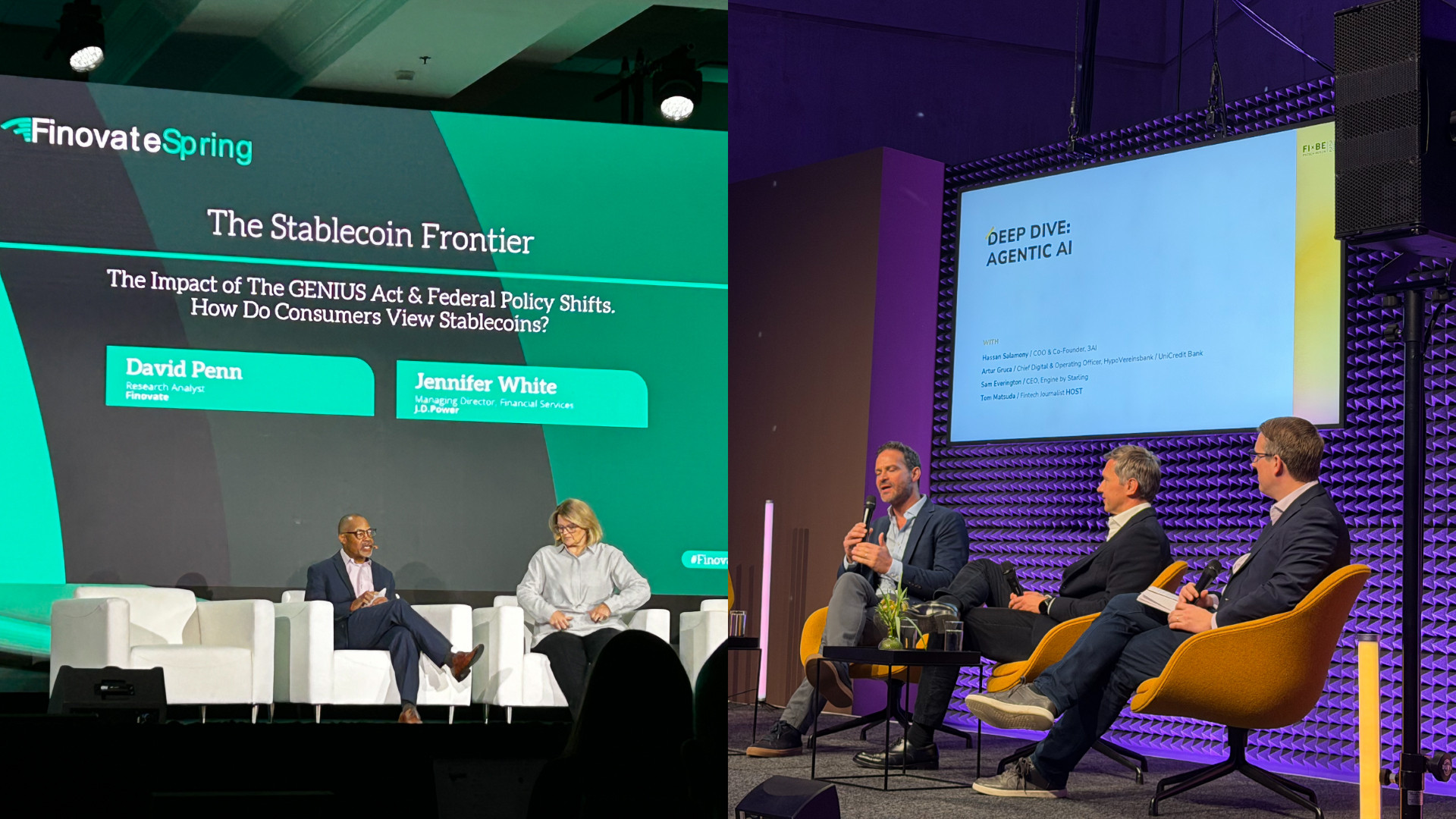
Second, our firsthand observations from the major fintech conferences across the continents that we attended and participated in this season:
The point that remains consistent across most clients, conversations, and events is that the industry has outgrown the old logic where fintech itself was the main attraction. It is shifting now from “building new products” to “rethinking the foundation”. The demand for smarter payments, sharper fraud control, seamless onboarding, instant lending decisions, embedded finance, real-time treasury visibility, and hyper-personalized financial experiences is very real.
And though the industry is innovating aggressively (and we’ll go deeper on this as well), the top fintech trends now keep circling back to the same core themes: orchestration, compliance, embedded infrastructure, identity, scalability, and resilience.
Key takeaways:
So here are the general and B2B fintech trends that our partner conversations, conference-floor insights, and market data consistently point to.

Identity checks used to live in the compliance department and screened customers at onboarding. But one of the strongest and most important emerging fintech trends discussed during Stockholm Fintech Week was that identity verification is taking its place at the center of fintech economics. In 2026, trust has its own tech stack, its own metrics, and its own seat at the product table.
But financial platforms are caught between two irreconcilable pressures. Regulators demand deeper visibility into customer actions, ownership structures, transaction patterns, and shifting risk exposure. Meanwhile, users expect frictionless onboarding and seamless transactions.
A good identity system must thread this needle perfectly.
This is why KYC (Know Your Customer) and KYB (Know Your Business) have moved beyond procedural compliance. What we’re seeing more of today is that they now form unit economics, platform resilience, and institutional credibility. A weak verification engine still creates regulatory exposure, but now it also distorts risk models, contaminates transaction ecosystems, and slowly inflates business costs.
The discussion in Stockholm also reflected that identity has become a live intelligence layer embedded into financial system itself. Risk profiles mutate in real time and fraud patterns fragment across devices, jurisdictions, and synthetic entities engineered to mimic legitimate activities with precision.
This forces fintech firms that turn to us to rethink the architecture behind trust. Static KYC checks are giving way to uninterrupted verification models that securely monitor behavioral anomalies, beneficial ownership changes, sanctions exposure, and transactional inconsistencies long after onboarding concludes.
KYB, in particular, has grown into a forensic exercise as embedded finance, crypto infrastructure, and cross-border payouts took off. Verifying a company today means tracing ownership structures, screening founders, checking sanctions exposure, and spotting ghost businesses built for fraud loops.
We held out for just a few paragraphs and AI climbed straight to second on the fintech technology trends list.
The appetite for deploying AI everywhere, from underwriting and fraud detection to merchant risk scoring and transaction anomaly detection, has created another challenge: the need for infrastructure to keep the AI from blowing up the business.
AI systems that work beautifully in labs can torpedo a business through a single regulatory violation or a cascade of hidden failures. Model hallucinations, opaque decision pathways, or performance drift don’t just create operational friction. We’ve seen them expose companies to fines, reputational damage, and compliance investigations that dwarf the cost of implementation itself.
This pressure has spawned an entirely new category around AI governance, treating it as core infrastructure and including:
What separates this from consumer-facing AI is the cost of failure. A streaming service’s algorithm recommending the wrong movie costs nothing. A navigation app miscalculating a route wastes twenty minutes. A financial system failing occasionally destroys trust forever and, sometimes, even crosses into criminal liability.
Open banking entered the market under the banner of regulation. PSD2 pushed European banks to expose customer data through APIs, and the industry initially framed the opportunity around consumer products: account aggregation, personal finance dashboards, cleaner digital banking experiences. That narrative turned out to be the visible surface of a much larger structural shift.
The real transformation unfolded inside operational finance. Open banking gradually became embedded into the machinery of enterprise workflows, where payments, treasury operations, accounting systems, and procurement processes started interacting with each other directly rather than through manual intervention and delayed reconciliation cycles. A procurement approval could initiate a payment automatically. Ledger updates began reflecting transactional changes in near real time instead of surfacing weeks later during month-end close, when finance teams discovered surprises.
What emerged alongside this automation was a new form of complexity. Financial workflows rarely exist inside a single environment anymore. ERP platforms, banks, fintech providers, payroll systems, and treasury infrastructure all operate according to different settlement schedules, reporting standards, and processing logic. One system registers a payment as completed while another still treats it as pending. Reconciliation gaps surface hours later, sometimes after liquidity positions or reporting assumptions have already shifted downstream.
In all such cases simple data-access APIs stop solving the problem. Financial infrastructure now requires orchestration layers capable of coordinating state changes across fragmented systems moving at different speeds. The challenge is already far from being access to financial data. It is maintaining transactional coherence in an ecosystem where every participant processes financial events according to its own internal clock.

There are more and more conversations we are having with clients at Oxagile around designing compliance infrastructure that can support continuous monitoring, entity-centric risk models, and multi-jurisdiction auditability. How is that related to this trend?
The upcoming European Anti-Money Laundering Regulation fundamentally changes how financial institutions need to approach compliance, monitoring, and business verification.
What many compliance teams already recognize, but have not fully operationalized, is that the fragmented vendor ecosystems built over the last decade were never designed for what AMLR requires.
Sanctions screening, identity verification, transaction monitoring, and manual review workflows have often existed across disconnected systems stitched together through manual processes and spreadsheets. That architecture was built for a world where compliance happened primarily at onboarding and was revisited periodically.
That world is closing. And the things start compounding quickly.
Customer structures evolve. Beneficial ownership changes in various jurisdictions. Transaction patterns shift underneath existing risk assumptions. A trust model that is accurate today can silently drift out of date tomorrow, especially for cross-border businesses operating in multiple regulatory environments.
AMLR expects institutions to detect that drift in near real time, not during the next scheduled review cycle.
In practical terms, AMLR requires fintech companies to stop treating compliance as a checkpoint and start building it as an operational layer. Core AML functions need to function as a unified architecture maintaining live trust models as customer structures, beneficial ownership data, and transaction cadence evolve over time.
And the audit standard itself is changing too.
Most compliance teams are still documenting processes for single-jurisdiction reviews and periodic oversight. AMLR moves the requirement toward sustained traceability at a level of granularity many organizations are simply not built for yet.
The most consequential fintech shifts usually look operational before they look revolutionary. And that’s probably the case we’re seeing with virtual cards becoming one of the most important infrastructure layers in fintech.
A few years ago, they were mostly treated as useful but limited digital versions of corporate cards. Today, it’s safe to consider them a programmable payment infrastructure embedded directly into procurement workflows, travel platforms, vendor management systems, and B2B ecosystems.
And the real shift is control. Finance teams get payments that carry rules inside them from the start:
Fintech platforms are using these cards to simplify payouts, procurement teams to reduce supplier friction, and enterprises to tighten governance without slowing teams down.
And underneath all of this sits something even more valuable: structured transaction data.
Every virtual card generates granular context around spend behavior, approval logic, vendors, limits, and workflows. That data is increasingly useful for automation and future anomaly detection.
On the technical side, virtual cards need to be deeply embedded into core finance systems like ERP and accounting platforms, so every transaction flows automatically into reconciliation, reporting, and audit layers. Just as importantly, they depend on identity-aware access controls that define not only who can spend, but under what context, project, or approval chain.

Payment infrastructure isn’t a quiet backend utility as it used to be. It is turning into a live coordination problem shaped by fragmented rails, regional schemes, wallets, and processors that behave differently depending on geography, load, and timing.
This is why payment orchestration platforms are moving to the heart of fintech operations. Their job is no longer just routing transactions to the “best” provider. That idea is too simple for today’s environment.
Instead, orchestration now looks like real-time system management: balancing processor failover, retry logic, token behavior of different providers, cost-aware routing, response normalization, and settlement aggregation in inconsistent reporting streams. On top of that sits settlement aggregation, where reporting and reconciliation often arrive in mismatched formats among multiple partners.
The complexity is not in any single component, but in how they interact under stress. Peak traffic exposes hidden constraints. Fraud checks introduce latency that changes authorization outcomes. Tokenized credentials may behave differently depending on which path they travel through.
Because of this, payment performance is shifting from static configuration to continuous adaptation. Systems constantly redistribute traffic, reconcile data, and keep the checkout experience unchanged for the user.
Even processor choice is evolving. It is less about coverage and pricing alone, and more about managing exposure. Relying on a single provider now means inheriting its uptime risks, roadmap decisions, and pricing shifts. Seen through this lens, orchestration absorbs that complexity and shapes it into something that still behaves like a single, coherent flow, even when underneath it is anything but.
One more pattern keeps surfacing with consistency during our fintech projects: fraud prevention is moving closer to the transaction itself, slipping into the live flow of data instead of sitting behind it as a separate control layer. What started as a technical upgrade now feels more like a structural industry shift, easily landing among the latest fintech trends.
So what changes when fraud detection starts operating at the same speed as the transaction itself?
The answer lies in context. Modern systems combine activity traces, device fingerprints, transaction lineage, and session anomalies into dynamic risk profiles that keep adjusting as new signals appear. A customer may look legitimate in one interaction and slightly off-pattern moments later, forcing detection models to rethink risk on the fly instead of relying on rigid thresholds or delayed recalibration.
The foundation behind this approach runs through event-driven pipelines where ingestion, enrichment, and scoring exist inside the same uninterrupted flow. Data doesn’t wait for overnight analysis or manual review anymore. Decisions surface directly from the stream, shrinking the gap between detection and response to milliseconds.
At the same time, fraud itself didn’t sit still while defences got smarter. AI-generated phishing, synthetic identities assembled from fragments of real data, account takeover schemes…
The uncomfortable truth for fraud teams is that static rule sets age badly. Attack logic mutates faster than quarterly model updates can track, which means detection systems that can’t absorb unfamiliar activities on the go are essentially running on borrowed time between the last attack pattern and the next one nobody’s seen yet.
AI keeps surfacing in almost every conversation, yet a few recent fintech trends still stand out more sharply than the rest. Fintech stats keep highlighting the same point: users have very little tolerance for anything that slows them down, and expectations regarding payment speed have risen.
Long payment forms, repeated card entry, and multi-screen confirmation flows already feel strangely outdated in mobile-first environments where purchases happen mid-scroll, mid-commute, sometimes almost impulsively. That’s why, in our payment app development services, demand keeps shifting toward one-click payments, biometric authentication, and securely stored credentials.
But the interesting part sits underneath the interface.
Customer-facing payment experiences may look deceptively simple, though maintaining that level of smoothness now depends on deeply sophisticated backend orchestration. Authorization rates, routing latency, retry logic, token management, processor failover, settlement timing, and regional acquiring paths all feed directly into conversion performance. At scale, even small interruptions inside transaction flows start acting like revenue leaks.
The result is a broader rethink of fintech UX trends themselves. Invisible payments, frictionless onboarding, and real-time transaction transparency are becoming infrastructure-level expectations woven directly into how modern payment systems are built.

Is your solution ready for smooth real-time operations, ongoing compliance, processor independence, and operational resilience? If not, that’s perfectly fixable.

AI that runs business processes now supports:
These systems operate inside highly regulated environments where reliability, traceability, and consistency matter significantly more than conversational fluency.
This creates major engineering challenges because financial AI systems require extensive governance infrastructure around them. Monitoring model behavior, detecting drift, validating outputs, and maintaining auditability become essential parts of production deployment.
Agentic commerce is pushing digital payments into a space where purchasing is no longer a hands-on action, but something handled by AI agents operating within user-defined rules. These systems are beginning to move beyond recommendations, taking on routine decisions like reordering supplies, renewing subscriptions, or timing purchases based on price or usage patterns.
A simple example is a household agent tracking grocery consumption and automatically reordering essentials before they run out, or a travel assistant executing a booking the moment a target fare appears, according to preferences set long before the transaction happens.
The key shift is separation between intent and execution. Users define constraints once, while agents manage ongoing decisions in the background, turning payments into a continuous process, not just isolated events.
This introduces a sharper focus on trust and authorization. If an agent initiates a payment, the system needs clear proof of legitimacy, transparent decision trails, and the ability to audit or reverse actions when needed. As a result, payment infrastructure is starting to treat agent-driven activity as a distinct class of interaction, where consent is structured, persistent, and machine-executed.
Fintech is drifting away from scattered point solutions toward horizontal orchestration layers that weave financial operations into a single continuous flow, where payments, lending, treasury, compliance, and accounting stop being separate worlds with their own gravity. The emphasis moves toward modular, composable architecture that slots into existing ERP systems, accounting tools, banking rails, and niche SaaS setups without forcing businesses into reconstruction mode.
What matters here is how naturally these layers sit between systems, taking on the role of connective fabric spanning stacks that were never designed to speak the same language. The most resilient setups tend to blend into the background of existing architecture, syncing workflows that would otherwise rely on manual stitching and periodic reconciliation, leaving fewer gaps for drift to hide in.
As fintech platforms multiply and regulatory frameworks layer on top of each other, the infrastructure for running compliance across dozens of business customers at once has outgrown its status as a feature and claimed territory as a product category in its own right.
The operational ask is substantial. Platforms have to:
That’s a specific set of concerns, which is why a dedicated market is forming around them.
The result is a pull toward compliance-as-a-service foundation, where fintech companies hand off regulatory complexity to specialists who’ve already built the plumbing, and get back to focusing on whatever differentiates their product. The underlying engineering puzzle that you need systems that keep each tenant’s compliance posture cleanly isolated from the next, without burning through the efficiency that shared infrastructure is supposed to deliver in the first place.
B2B fintech companies view APIs not just as integration mechanisms but as revenue streams and competitive moats. Rather than selling monolithic products, winning platforms expose granular financial capabilities, like fraud detection, lending decisions, payment processing, settlement coordination, as independently consumable services that others can stack on top of.
This ecosystem approach requires investment in API stability, developer experience, pricing models that accommodate variable usage patterns, and network effects that reward platforms attracting quality partners.
This evolution also reflects one of the broader fintech marketing trends, where platform ecosystems and developer-first positioning shape brand differentiation.
The fintech companies pulling ahead in 2026 aren’t the ones announcing the boldest AI integrations or shipping the most Instagram-friendly features. They’re the ones doing the unglamorous work underneath:
Most fintech trends, whether AI adoption, embedded finance, adaptive fraud prevention, open banking expansion, or new AML and regulatory requirements, only become valuable when companies have architecture mature enough to absorb them without creating instability.
When analysts write “fintech trends include real-time payments adoption” and “AI governance emerges as critical”, they’re documenting the outcomes of infrastructure-first companies that made those bets earlier. When companies report “we reduced fraud by 40%” or “we cut onboarding time by 75%”, they’re publishing the results of decisions made months or years prior.
Trends are seductive shortcuts. They offer narrative clarity: adopt this pattern, follow this roadmap, and join this wave. But fintech’s maturation demands the opposite discipline.
That’s why the companies moving fastest in 2026 aren’t the ones chasing trends. They’re the ones that invested in foundations first, designed for resilience instead of growth velocity, and prepared identity, compliance, and payment systems for new constraints.
Look at what’s too fragile, overloaded, or breaking at scale and observe the bottlenecks that consume engineering resources when adoption compounds. That’s what separates those scaling well from the ones who will spend 2027 fixing what should have been built right the first time.
You’ve read the fintech trends. You understand what’s coming. The gap between knowing and building is where most companies lose. That gap is where we work.

Adopting modern fintech trends this way is possible, though most banks achieve this gradually and not through full core replacement. Many institutions now introduce orchestration layers, APIs, event-driven middleware, and embedded infrastructure around existing core systems without rebuilding everything from scratch.
This approach lets banks to support real-time payments, AI-driven fraud monitoring, embedded finance, and modern compliance workflows and at the same time reduce operational risk during migration.
Modern financial systems need significantly more flexibility, scalability, and resilience than monolithic platforms can realistically support. Real-time payments, AI operations, adaptive fraud systems, embedded finance, and multi-region compliance all change and advance at different speeds.
Microservices let fintech companies update individual components independently, scale infrastructure dynamically, reduce deployment risk, and integrate external providers more efficiently.
The biggest fintech industry trends include operational AI adoption, real-time payments, embedded finance, programmable treasury infrastructure, identity-centric compliance systems, payment orchestration, and API-driven financial ecosystems.
The common denominator through all of them is infrastructure modernization, not purely customer-facing innovation.
The most transformative fintech technology trends include AI governance systems, graph-based fraud detection, event-stream processing, real-time payment infrastructure, programmable APIs, and identity intelligence platforms.
These technologies require fintech architecture to become far more modular, observable, and resilient than traditional financial systems.

