














This website uses cookies to help improve your user experience


Integrating with a payment gateway API is rarely hard because of the API itself. The API documentation from payment service providers (PSPs) like Stripe, Adyen, Checkout.com, or Worldpay will get you to your first successful test transaction in days, sometimes hours. The challenge is everything else.
Payment gateway API integration gets complicated because payments are distributed, asynchronous, regulated, and business-critical. A single transaction touches card networks, acquiring banks, fraud detection services, and reconciliation systems before the money settles. Each of these systems can fail independently, respond at different speeds, and behave differently depending on the region, currency, or payment method.
Calling the API is the quick part. Building an integration that survives production traffic, handles failures gracefully, supports regional expansion, maintains compliance, and accommodates multiple providers is months of work. So the question often changes from “Can we connect this gateway?” to “Can our payment layer support what the business needs next?”
This article covers what that engineering work actually looks like and what you should know before starting.
Key takeaways:
A payment gateway API is one interface into a much larger payment processing chain. The API lets your application send payment requests and receive responses, but behind that interface sits an acquiring bank, card networks (Visa, Mastercard, etc.), fraud screening tools, 3-D Secure authentication services, and reconciliation systems.
When you integrate a payment gateway, you’re connecting to all of these, not just the gateway’s REST endpoint. The gateway translates your API calls into the protocols these systems understand, routes transactions, handles authentication challenges, and returns results. Your integration must account for the behavior of the entire chain, not just the gateway itself.
Your application is not simply talking to an API endpoint. The request enters an ecosystem that may include a, processor or acquirer, card network, issuing bank, fraud services, 3-D Secure infrastructure, token vaults, merchant systems, and settlement and reconciliation processes.
The online payment gateway API is the interface your application can see. Behind it, several systems have to agree on what happened to the transaction. This distinction matters because the API response is only one piece of payment truth.
A useful way to think about API integration payment gateway projects is that you are connecting your business logic to a financial lifecycle, not attaching a payment button to a website.
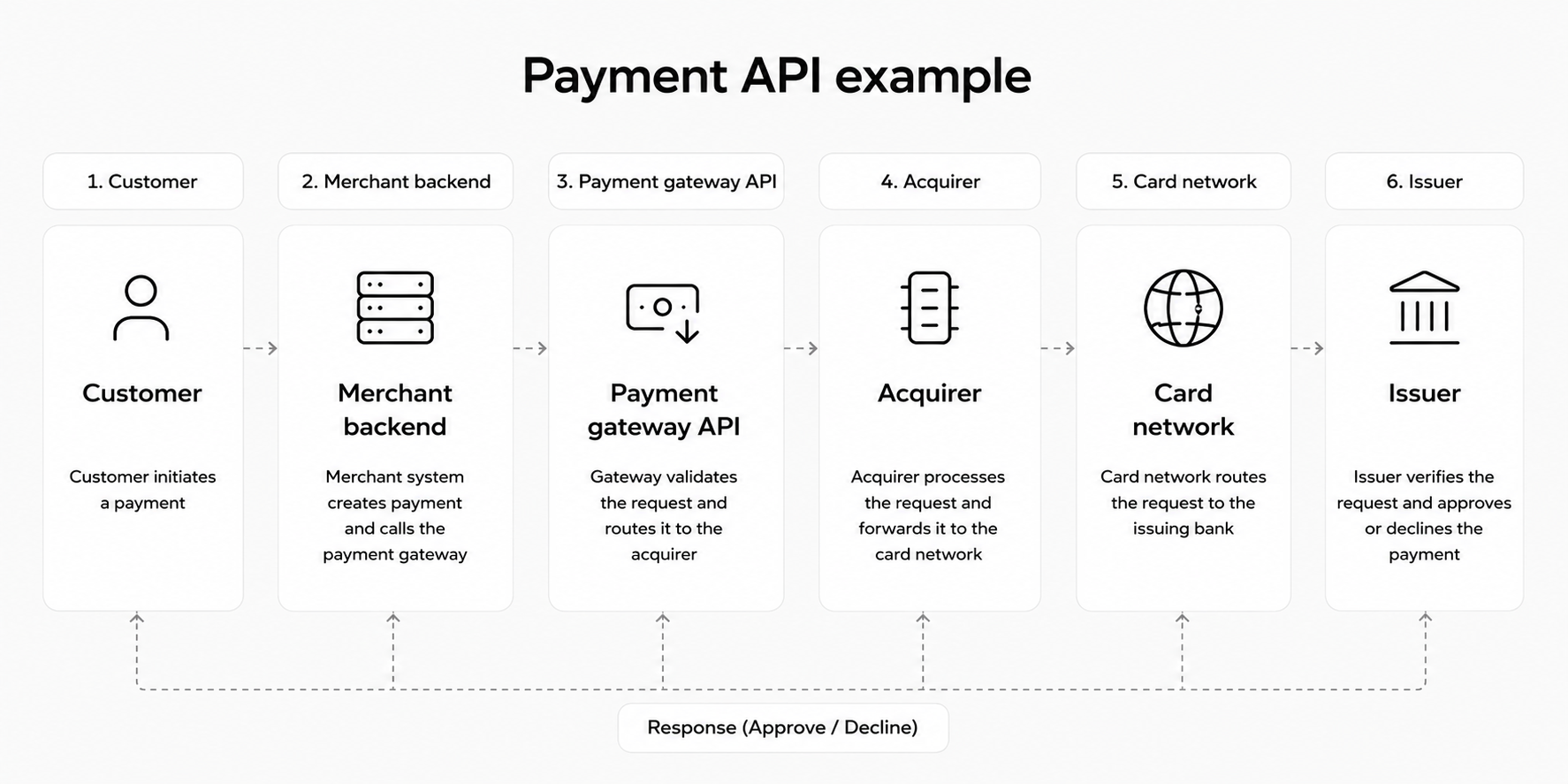
A typical card payment moves through several stages. The following sequence unveils the underlying payment gateway architecture and explains why integrations can get complicated:

All of those steps can happen within several seconds.
There are multiple systems involved, and the stages have an asynchronous nature. Each stage can fail or behave unexpectedly. Authorizations expire. Captures can be partial. Settlements happen on banking schedules, not yours. Chargebacks arrive weeks later. Your integration needs to track the payment state across all of these events.
That gap between “the API returned success” and “the money is accounted for correctly” explains much of the complexity that follows.
Before writing any code, you need to decide where sensitive card data will live and how much of the checkout experience the business needs to control. This decision determines your PCI DSS compliance scope and shapes your entire integration architecture.
Also referred to as the redirect model, when the customer leaves the merchant-controlled payment interface (either partially or entirely) to complete a payment on the gateway’s hosted page. After the payment, they return to the site with a transaction result.
In this case, you never touch sensitive cardholder data, which keeps your PCI scope minimal. The trade-off is reduced control over the checkout experience and potential friction from the redirect. This is a common path for businesses aiming for a quick launch and that have relatively standard payment requirements.
The gateway provides JavaScript components (iframes or secure fields) that render directly on your checkout page but are supplied and controlled on the payment provider’s side.
In this online payment gateway API scenario, card data goes straight to the gateway without passing through your servers. You get a branded, in-page experience and keep PCI scope low. Most modern integrations use this approach.
This approach implies that your servers collect card data and send it directly to the gateway API. This gives you complete control but puts card data on your systems, expanding the PCI scope significantly. Direct API integrations require PCI DSS SAQ D compliance or full certification, which involves substantial security controls and annual audits.
Apart from that, additional effort needs to be made to achieve proper tokenization, authentication flows, webhook processing, observability, error handling, and provider-specific behavior. Most businesses don’t need this level of control and can avoid the compliance overhead.
Your business model adds another layer.
If you facilitate transactions between buyers and sellers (like a platform or marketplace), you need to split payments between parties, handle payouts to sellers, and manage compliance for money transmission because one customer payment may need to be divided.
Gateways like Stripe Connect or Adyen for Platforms provide these capabilities, but integrating them is more complex than standard payment acceptance.
Apple Pay, Google Pay, and other digital wallets require separate integration paths, device-specific handling, and additional certification. They’re worth adding for conversion benefits, but they expand scope.
For the merchant, a wallet is one more payment method. But for the payment platform, it means adding another flow, which must fit cleanly into the same transaction model.

Oxagile’s experts are here to advise on architecture, compliance scope, or multi-provider strategies.
Explore our payment integration services.
The API documentation created by vendors tells you how to call the payment endpoint, outlining the request format. It doesn’t tell you how to build a production system that handles the edge cases. These are the areas where most teams underrate the payment engineering work.
Payment requests fail for many reasons: network timeouts, gateway outages, rate limits, malformed requests, insufficient funds, fraud blocks, and authentication failures. Each failure type requires different handling.
Uncertainty is the hardest case. A timeout doesn’t mean the payment failed. It might have succeeded, and you need to check before retrying. An insufficient funds decline shouldn’t be retried immediately, but a temporary gateway error may be worth retrying after a delay.
Your integration needs to distinguish between these cases and respond appropriately, as generic error handling leads to duplicate charges, lost transactions, or poor customer experiences.
Retries can originate almost anywhere. If a customer refreshes the page, resends a request on mobile after losing connectivity, clicks “Pay” twice, or your retry logic fires during a timeout, you could charge them multiple times. The system has to be tweaked to recognize that these attempts represent the same business operation.
Idempotency keys prevent this. You generate a unique key for each payment intent and send it with the request. The gateway uses it to deduplicate requests: if it receives the same key twice, it returns the original result instead of processing a new transaction.
Implementing idempotency correctly means generating keys at the right point in your flow, storing them reliably, and handling edge cases like key collisions or expired keys. Skip this, and you’ll deal with angry customers and manual refunds.
The checkout screen creates the impression that payments happen in one request, but not all of them do. Payments are event-driven, and a single transaction can generate events over weeks. You authorize now, capture later, receive a webhook tomorrow, process a refund next week, and handle a chargeback next month.
This means that mature payment integration should be event-driven too. Your system must track payment state across time, handle out-of-order event delivery, and reconcile state when events arrive late or are missed. If you design for synchronous request-response patterns, you’ll struggle when reality doesn’t match.
Not every failed payment should be retried.
A naive retry strategy that hammers the gateway after every failure will get you rate-limited, flagged for suspicious activity, or blocked. Worse, you might retry a payment that partially succeeded, leading to duplicate charges.
Every day, your payment processor sends settlement files listing what actually settled, fees deducted, chargebacks received, and currency conversions applied. Matching these files (reports, settlement files, payouts, fees, refunds, disputes, and eventually the money received) against your internal transaction records is called reconciliation. It’s essential for accurate accounting and is an ongoing operational cost, not a one-time integration task.
This sounds simple when you read each payment API example case like that, until you have thousands of transactions per day, fees calculated differently than expected, timing differences between capture and settlement, and chargebacks appearing weeks after the original transaction.
PCI DSS compliance addresses cardholder data protection, yet payment security is broader. API keys and secrets need rotation policies and secure storage. Webhook endpoints must verify signatures to prevent spoofed events. Tokenized card data still needs protection, and tokens can be misused if leaked.
It is advisable for systems to follow least-privilege principles:
These aren’t PCI requirements specifically, but they’re necessary for operating payment systems responsibly.
How is all of this handled in real payment projects? An integration like the one in the following example shows why it often takes longer than expected. The API calls were straightforward. The complexity came from business requirements, data migration, and operational continuity.

A high-volume subscription commerce platform processing approximately $100 million per year across more than 50,000 recurring transactions daily engaged Oxagile to integrate a new card gateway alongside their existing provider.
The challenges went beyond a standard API integration:
The team went live in approximately three months with no service interruption. After launch, Oxagile took over 24/7 payment support, including incident playbooks, real-time observability, and automated incident response.
We can’t give a universal answer to how long such a project can take, but they typically move through five phases.
| Phase | What is handled |
| Discovery and design |
|
| Integration development |
|
| Testing and certification |
|
| Compliance and security review |
|
| Hardening and go-live |
|
Overall, the timeline can fall in the 3 to 6 months range, if we’re talking about a straightforward single-gateway integration with standard requirements. Many things can expand the scope and affect the cost of development, including but not limited to these points that each can add on weeks or even months of work:
What can go wrong during such projects? Here are some of the issues we see repeatedly in payment integrations, often discovered only after go-live, that can serve as a quick diagnostic:
One client came to Oxagile with a common growth problem: their business had expanded internationally, but payment performance hadn’t kept up.
Different PSPs performed inconsistently across regions. Approval rates varied. Payment drop-offs increased. There was no way to optimize routing or fail over quickly when a provider underperformed.
The API integration on its own wasn’t the challenge. The client had working integrations with multiple gateways. The problem was orchestration: no unified layer to route intelligently, retry strategically, or add new providers without significant rework.
Results: 80% faster PSP integrations (new providers added in days instead of weeks), 30% higher payment approval rates from optimized routing, and a single operational view across all payment providers.
Before starting a payment gateway integration, work through these questions with your team to shape scope, timeline, and architecture decisions:
A payment gateway API is an interface, and the API call is the simplest part. The real work is everything around it: modeling payment states, handling failures, tracking transactions across asynchronous events, reconciling against settlement data, and building systems that scale globally while staying compliant and maintainable.
Designing an integration that survives production traffic, adapts to business growth, and remains operational for years is the harder problem. Plan for that scope from the start.
If you’re building from scratch, adding providers, or migrating to a new gateway, Oxagile’s fintech engineers can help scope the work and identify the architectural approach that fits your business.
A straightforward single-gateway integration typically takes three to six months from discovery through production hardening. This includes integration development, testing, compliance work, and go-live. Scope expands significantly if you’re adding subscriptions, marketplace payments, multiple regions, or migrating from an existing provider. Each additional requirement can add weeks or months to the timeline.
Hosted checkout redirects customers to the gateway’s payment page. You never handle card data, minimizing PCI compliance scope. Direct API integration sends card data from your servers to the gateway, giving you full control over the payment experience but requiring PCI DSS SAQ D compliance or full certification. Embedded fields (iframes) offer a middle ground: in-page experience with minimal PCI scope.
A payment gateway is the service that routes payment transactions between your application and the financial network (acquirers, card networks, issuing banks). The payment gateway API is the programmatic interface you integrate against. Your code calls the API; the gateway handles the routing. You might interact with multiple gateways through a single orchestration API, or integrate directly with one provider’s API.
Yes, but scope varies. If you use hosted checkout or embedded fields, you complete a simpler self-assessment questionnaire (SAQ A or SAQ A-EP). If your servers handle card data directly, you need SAQ D or full PCI certification, involving extensive security controls and annual audits. Most businesses choose hosted or embedded options specifically to minimize compliance requirements.
Yes. Payment gateway APIs require engineering work: building the integration, handling authentication, processing webhooks, and managing errors. Low-code checkout tools can handle simple scenarios, but production-grade integrations that handle edge cases, timeouts, retries, and failover need experienced developers. The complexity scales with your checkout requirements, transaction volume, and number of payment methods you support.
Consider multiple gateways when expanding to regions where your primary provider has weak coverage, when authorization rates could improve by routing to better-performing providers, when you need redundancy against provider outages, or when you want negotiating power on fees. The trade-off is additional integration complexity and the need for an orchestration layer to manage routing and failover.
Yes, but it requires careful planning. The main challenges are token portability (migrating stored card tokens to the new provider), handling in-flight transactions during cutover, and testing the new integration thoroughly before switching traffic. Live migrations are possible with parallel-run strategies, but they’re operationally complex. Plan for migration from day one, even if you don’t expect to switch soon.

