













This website uses cookies to help improve your user experience
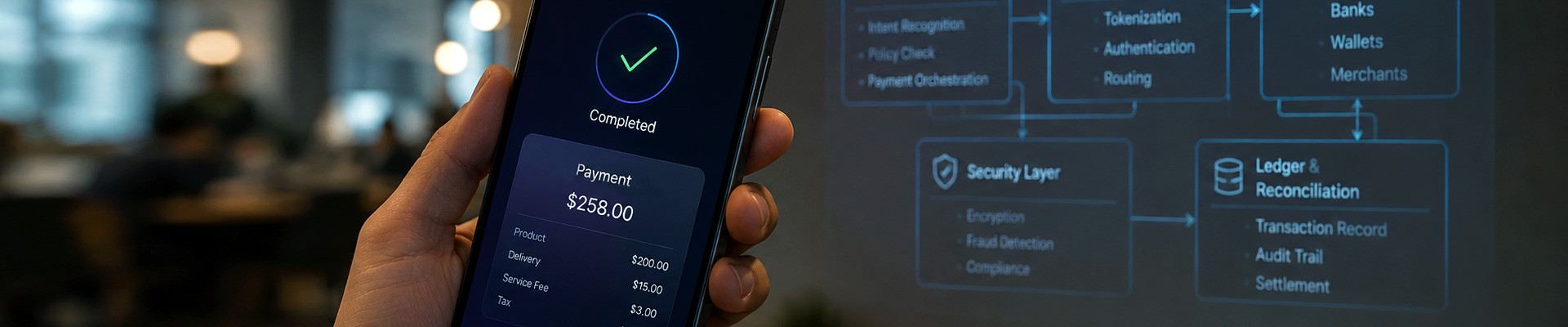



Agentic payments move AI agents beyond recommendations and automated checkout. An agent gets authority to initiate a financial transaction on someone else’s behalf, potentially without a human approving that specific purchase. And commerce is only one use case. The same model applies when agents pay for API access, compute, data, or services consumed by other machines.
In payments, that changes the problem considerably. A conventional payment flow starts with a user action, but an agentic one may start with an inferred intent, run through several autonomous decisions, and reach the payment rail seconds later. The architecture has to establish what the user actually authorized, what the agent is allowed to spend, which merchants or services are in scope, how long that authority lasts, and what happens when the agent retries, changes a payment method, or gets something wrong.
In this article, we’ll pin down the agentic payments definition, draw the line between them and all other types of automated payments, and explain the inner workings of such systems at the technical level.

We asked Alexander Gimranov, Oxagile’s Fintech Software Architect, to share his thoughts on agentic AI payments and the fundamentals of creating a reliable agentic payments infrastructure. He has years of experience building enterprise-level, AI-powered fintech solutions and has contributed to the success of multiple projects delivered by our company.
Key takeaways:
Agentic payments are transactions that an AI agent initiates and executes on behalf of a human, without requiring manual approval for each and every payment. It is the agent that uses its preconfigured logic to determine whether a payment is needed, when to make it, how much to pay, which counterparty to use, and even, in certain cases, which payment rail to select.
There is one caveat to keep in mind: the agent itself is not the source of authority, as it’s merely an execution mechanism. The authority lies within the mandate.
A mandate acts as a set of guardrails and defines the boundaries within which the agent can operate: spending limits, permitted transaction types, allowed counterparties, transaction velocity, supported currencies, and specific conditions that require human intervention. At any given moment, these parameters can be changed or even revoked by a person or company that issued the original mandate.
| Criteria | Recurring subscriptions / autopay | Rules-based payments | Agentic payments |
| Payment triggered by | Schedule or recurring billing event | Predefined event or condition | Agent decides that payment is needed |
| Decision made by | Merchant / billing system | Application logic | AI agent acting within a mandate |
| Payment amount | Predetermined or contractually defined | Defined by rules | Determined by agent within allowed limits |
| Counterparty | Typically predetermined | Defined by rules | Selected by agent within permitted scope |
| Payment rail | Typically preselected | Defined by implementation | May be selected based on policy and context |
| Approval by human | Given when recurring payment is authorized | Usually not required | Not required for each transaction |
| Primary control | Recurring authorization | Application rules | Mandate enforced by a policy engine |
| Adaptability | Low | Very limited | High, within given authority |
Alexander describes it this way:
“In agentic payments, the model can analyze the situation in detail and propose an action, but it is not responsible for deciding whether that action is actually permitted. That decision is delegated to a specialized control layer that reads the mandate and provides an independent source of truth for the policy decision and its audit trail.”
The agentic commerce implications for payments become clearer when we look at what happens behind the curtain. From the outside, an agentic payment flow looks almost like a regular one: an agent, instead of a person, decides to make a payment, then the payment is processed and logged.

A typical agentic payments infrastructure
Before anything happens, the agent must determine that a financial action is actually necessary. The decision can be based on a user’s request, a trigger in a business workflow, a message from an external system, or even another agent’s action.
At this stage, the agent can compare available options, select a merchant, calculate the amount due, and determine whether a payment should happen immediately or later.
Alexander comments:
“What’s important to understand is that this is still a preliminary manifestation of intent. The fact that an AI model analyzed the context and decided that something should be purchased does not give it permission to spend the user’s money.”
This is a watershed moment that separates agentic commerce payments from simply giving an LLM access to a payment method.
A description of the proposed action is handed over to a deterministic policy engine, which evaluates it against the mandate issued by the user or organization. It may check:
For example, an agent may be instructed to purchase concert tickets in specific sectors under $300. Even if the model suggests seats in other sectors with a better view (based on reviews) for $330 each, the policy engine will follow the mandate and reject the purchase.
Alexander explains:
“This separation of roles is fundamental for understanding consent-driven commerce in agentic payments. The model only proposes. It’s the policy engine that decides on the payment. Remember: if your spending limit lives in a prompt, it’s not a limit.”
The policy engine therefore exists outside the AI model and represents the mandate and its stipulations. Spending limits, whitelisted vendors, and other guardrails should not be embedded in a prompt, pulled from conversation history, or left to the discretion of the LLM.
This separation also creates an independent audit trail: the system can log the mandate that was applied, the rules evaluated, the resulting decision, and the logic for approval or rejection. This becomes vital if a payment is disputed later.
One distinction to keep precise:
The policy engine grants an internal permission, the action is within the mandate. Payment authorization is a separate decision made downstream by the issuer, after the PSP or acquirer submits through the network, and followed by capture, clearing, and settlement. A policy-approved transaction can still be declined, and the two should never share a log status.
Once the policy engine approves the action, the payment system needs a way to process the transaction without exposing full payment credentials to the agent. This is the job of ephemeral credentials.
Depending on the architecture and payment rail, this could be:
Alexander gives an example:
“Ideally, the credential has to have just enough authority to perform that specific action. If an agent is approved to spend $150 with a particular merchant, there is little reason to give it a broader credential.”
A payment moves through fixed states: intent, policy approved, credential issued, submitted, authorized or declined, captured, settled, then refunded, disputed, or closed. And each transition records what caused it.
A retry is a new submission under the same intent. The intent itself stays unchanged.
The mandate has its own states (active, paused, exhausted, revoked, expired) and is checked at policy time and again at submission. Most of the cost sits after authorization: refunds, chargebacks, and representments arrive months after the credential expired and have to resolve back to the mandate ID and the original intent.
This draws a clear line between authority and payment credentials. The mandate defines what the agent is allowed to do, and the ephemeral credential acts as a temporary mechanism for exercising that authority.
Alexander notes:
“Unlike financial records, credentials have a short lifetime. A virtual card may expire immediately after authorization, while a refund may be requested within 30 days or a chargeback initiated months later. The original order, mandate, and transaction therefore need persistent identifiers that survive the credential’s expiry.”
From an architectural perspective, a well-designed system should be able to maintain a clear chain of relationships:

The credential can expire and disappear. The transaction context will stay intact.
Once the payment is approved, it is submitted through the most appropriate payment rail.
For a typical B2C purchase, that might mean a card transaction made through a PSP, acquirer, and card network. Other implementations may use account-to-account payments or purpose-built machine payment mechanisms.
The payment rail is completely separate from the agent and policy engine, and doesn’t have to understand the agent’s chain of reasoning. Its sole job is to process the transaction according to its own authentication, authorization, fraud detection, and settlement rules.
Alexander adds:
“The agentic control layer sits on top of this infrastructure, connecting business intent and the mandate to the actual payment event. This means agentic payment systems can work with existing payment infrastructure and not require an entirely new payment stack.”
This is an extremely important final stage that takes much more than just marking the payment as “successful” in a database.
The system needs to associate the payment result with the original intent and mandate, preserve relevant transaction evidence, and make the chain of actions available for reconciliation and audit.
To meet these objectives, transaction records often contain a such details as:
If a particular business case requires strong attestation, transaction receipts are cryptographically hashed or protected otherwise while the credential is destroyed.
The key principle is that the audit trail follows the financial obligation, not the temporary payment credential. This allows support and finance teams to see which mandate allowed the transaction, which agent initiated it, what policy decision was made, and what happened afterward (instead of simply seeing that “some AI agent spent $129 on March 5th”).
Alexander’s insight:
“The most important architectural principle is to keep the agent and the authority separate. The AI model can propose an action, but spending limits and authorization rules should live outside the model, where they can be enforced deterministically and audited independently.”
Agentic payments apply wherever an AI agent can act autonomously, with use cases falling into three broad categories.
Commerce checkout
This is the number one scenario that most people associate with agentic payments. An agent acts on behalf of a human shopper to find a product or service, make a purchase decision according to a predefined mandate, and complete the payment.
Payment management
In this case, the agent works as part of the payment infrastructure instead of just shopping on behalf of a customer.
For example, an agent can monitor payment activity, find failed transactions, reconcile records, select an appropriate payment rail, or initiate authorized refunds. This category is especially important to scalable agentic payments-as-a-service platforms, because agents operate within existing workflows, where traceability, permissions, and deterministic execution mechanisms are critical.
Machine-to-machine (M2M) payments
Here, one AI agent or autonomous system pays another system for a service. An agent might, for example, purchase API access, compute resources, data, or other digital services or resources as part of an automated workflow. Such ad hoc transactions are often frequent and small, so authorization needs to be instant, mandates machine-readable, and settlement economical even at low transaction values.

Oxagile engineers custom payment systems, payment integrations, and agentic workflows. We can review the existing architecture, identify where AI fits, and work through the controls and infrastructure required for production.
Agents and merchants need a common way to exchange information, establish authority, unequivocally identify the parties involved, and execute and settle transactions without a human overseeing and confirming every step.
The current agentic payments and commerce stack spans several layers, with different protocols and technologies addressing different parts of the transaction flow:
| Layer | Purpose | Examples |
| Checkout | Product selection, cart, checkout, order fulfillment flows | Universal Commerce Protocol (UCP), Agent Communication Protocol (ACP) |
| Delegated authority | Representation and verification of what an agent is allowed to buy or pay for | Agent Payments Protocol (AP2) |
| Agent identity | Determine which user, agent, or service is making a request | Cryptographic keys, OAuth, signed requests |
| Settlement | Executing and settling the actual payment | Card and account-to-account (A2A) rails, x402 |

All of these integration layers address different parts of the flow and are more complementary than competing, though the checkout protocols overlap and the market has not settled on one. The control layer connects the pieces together. It evaluates the proposed transaction against the mandate and business policies, determines whether it can proceed, and keeps the resulting agent, authorization, payment, and settlement records interlinked for audit and reconciliation.
Alexander’s take:
“Protocols solve the interoperability problem, but you still need a control layer to define what an agent is authorized to do.”
Putting agentic payments into production creates risks beyond fraud and stolen credentials. An agent can misinterpret intent, act outside its mandate, fail authentication, trigger transactions at unexpected volume, or behave in ways that are difficult to stop once a workflow is running.
Autonomous agents are exposed to risks that conventional payment software does not have to deal with. One of the most important is prompt injection, where malicious instructions embedded in a webpage, document, or API response can influence the agent’s behavior.
If an agent has access to payment tools, an attacker may try to manipulate it into making an unauthorized purchase or revealing sensitive information.
Alexander points out:
“You can’t let whatever enters the agent’s context dictate a payment. External content is untrusted by default, payment permissions stay narrow, and every transaction still has to clear deterministic policy checks.”
Strong Customer Authentication (SCA) and 3D Secure were originally designed for humans completing an authentication step during a payment flow. A typical AI agent does not have a human available to enter an OTP code, approve a push notification, or solve a captcha puzzle.
This circumstance raises an important question: how can an agent complete a payment when the authentication flow requires human interaction?
Two things make this workable, and neither is the agent solving a challenge at runtime.
Alexander mentions:
“Network rules for agent-initiated transactions are still forming, so the mandate reference therefore has to travel with the authorization request and the flow has to handle a challenge coming back.”
Even the best providers for agentic payments need to build in authentication requirements from the very beginning without assuming that an intelligent agent can figure out SCA on its own at runtime.
An AI agent can follow its mandate to a tee and still get the purchase decision wrong. It might misunderstand a user’s request, misinterpret information returned by a service or tool, or select an inappropriate product or amount. As amazing as LLMs are today, they are still prone to hallucinations.
But what if a transaction was technically within the mandate but did not match the user’s actual intent? Who would be responsible for such a mistake?
Alexander observes:
“You need to know three things after every transaction: what the user asked for, how the agent interpreted it, and what the mandate actually authorized. If you can’t reconstruct that chain later, troubleshooting and disputes get messy very quickly.”
Who carries the loss, in outline? In broad terms, there are three scenarios.
None of this is settled yet, so the logs have to be able to place a transaction in one of those rows.
Anti-fraud systems and velocity controls were designed with respect to human payment behavior. However, AI agents introduce different patterns, including immediate retries, credential or payment-method switching, and several purchases within seconds.
Most human-focused payment systems would treat that kind of behavior as suspicious and start declining payments right away. At companies that have just implemented agentic payments, this issue can impact sales revenue for months or even years before getting noticed and addressed.
Alexander has seen this firsthand:
“This issue makes idempotency more than a nice-to-have. If an agent retries automatically, the system must be able to distinguish a genuinely failed transaction (no result) from one that succeeded but whose response was lost (partial result). Poorly controlled autonomous retries create a direct path from temporary technical failures to duplicate charges.”
Autonomous payment systems require substantially stronger operational controls than conventional workflows. Technical teams need visibility into which agents are currently active, what mandates they are operating under, how much they are spending, what transactions are getting rejected, and whether any anomalies have been detected.
A production system also requires strong observability, fast ways to suspend an agent, revoke a mandate, shut down a payment tool, or stop a specific transaction. These controls need to operate independently of the AI model itself.
From Alexander’s perspective:
“Observability here means one question answered fast: which mandate, which agent, how much so far, and can I stop it in the next ten seconds. If the answer to the last part is ‘we would need to redeploy’, the system is not ready for real money.”
Agentic payments are far more complex than teaching an LLM to click the “Pay now” button. They typically require a custom control layer over the payment architecture, one that can translate delegated authority into controlled, observable financial actions. Alongside that, it has to cover a variety of other critical aspects of the system: authentication, identity management, retries, security, and liability.
Those decisions belong in the architecture before autonomous transactions reach production. Protocol selection is only one piece of it. Identity, authentication, mandates, policy enforcement, retries, observability, and payment infrastructure all have to work together. Here, deep payments engineering experience can make a difference, particularly when moving from an agentic payment prototype to a system trusted with real money.
Oxagile brings payments engineering and applied AI expertise to the same table. Bring us the use case, and we’ll help work through the payment architecture, controls, protocols, and infrastructure needed to put autonomous transactions into production.
Autopay and other automated payments execute according to a predefined schedule, event, or rule. Agentic payments introduce a decision-making layer: an AI agent determines that a payment is needed and may select the amount, counterparty, timing, or payment method within authority delegated by a user or organization. The mandate defines those boundaries, and a separate policy layer enforces them.
Agentic commerce covers the broader purchasing process, such as finding products, comparing options, selecting a merchant, and placing an order.
Agentic payments cover the financial part of that process: delegated authority, authentication, credentials, authorization, payment execution, settlement, and reconciliation. Such payments also exist outside commerce, including machine-to-machine purchases and payment operations.
There is no single SCA flow for agentic payments. The implementation depends on the payment method, issuer, jurisdiction, transaction risk, and the form of delegated authority.
The working pattern: SCA once, when the human sets up or changes the mandate; agent-initiated payments then run as merchant-initiated or mandate-based transactions referencing that authentication. Exemptions are the issuer’s call, so a challenge can still come back. SCA requirements therefore need to be part of the payment architecture, not something left for the agent to resolve during checkout.
Agentic AI payments do not prevent fraud by themselves. They change what needs protection.
An attacker may target the agent’s delegated authority or manipulate its inputs instead of stealing a card number. Controls such as scoped credentials, mandate verification, deterministic policy checks, transaction limits, and immediate revocation restrict what a compromised or manipulated agent is able to do. Payment-provider, issuer, and network fraud controls still apply when the transaction reaches the payment rail.

