














This website uses cookies to help improve your user experience


For the average user, a neobank is just an app. For the team building it, this app is merely the tip of the iceberg. Underneath the sleek UI, you will find a ledger, a licensed partner’s infrastructure, statement intake and reconciliation mechanisms, round-the-clock compliance checks, and a multi-functional operator console with task queues someone has to work on every day.
It’s not uncommon for teams to budget lavishly for the app and then get badly surprised by the cost and complexity of everything else.
Neobanks are cloud-native, fully digital, modular fintech products that often cater to specific customer cohorts: frequent travelers and digital nomads, residents of underbanked regions, gig workers, immigrants and expats, freelancers, students, solo entrepreneurs, and small businesses. Traditional banks tend to be slow to address these customers’ pains, and that’s the opportunity that neobanks build their business around.
There is no single answer to how to build a neobank the right way, as the approach depends on the license, target customers, jurisdiction, revenue model, and how much of the underlying infrastructure you want to own.

We asked Kyrylo Petrov, Director of Fintech Technology Consulting at Oxagile, to share practical insights into neobank architecture and implementation. Kyrylo brings years of hands-on experience building custom fintech solutions, orchestrating complex integration and migration projects, and working with leading platforms in the financial space.
“The banking logic – transaction posting, onboarding, cards, disputes, reconciliation – is the same everywhere and already written. What’s really unique is which providers you pick for your neobank and which modules you need now and later down the road. In our framework, that’s configuration, not code.”
Key takeaways:
Before development starts, several fundamental questions need to be answered.
Some neobanks are based on existing banking platforms using a banking-as-a-service (BaaS) model. They connect to financial services through secure APIs, which can shorten time to market and make experimentation relatively cheap. Others choose to build or buy more of the underlying infrastructure themselves, giving them greater control, flexibility, and ownership of their technology.
What’s particularly interesting is that neobanks can have no banking license of their own, which is often a process that takes years from start to finish. They sit on top of licensed sponsor banks that provide access to operations and the core banking system as part of the BaaS contract (like Dave, Chime, and Current). At the same time, many leading neobanks go to great lengths to obtain one and even become BaaS operators as their technology matures (Monzo and Starling Bank would be good examples).
Kyrylo points out:
“You can’t build a neobank just by picking a handful of great-sounding features that you think your customers will love. Your licensing model, target customer, jurisdiction, and revenue model should all point in the same direction. Otherwise, you may end up with a product that’s technically superb but commercially or legally impossible to scale.”
This is the decision that defines the rest of your journey. A fully licensed neobank entails a multi-year approval timeline, capital requirements, and a banking core you either pay top dollar for or build yourself. What you get in return is full ownership of the platform and undivided control over every product decision.
The easier, much faster path is a sponsor bank relationship. In this scenario, AML/KYC flows, reporting, compliance, and reserve requirements are usually on the partner’s side, which saves you a tremendous amount of time and lets you launch in months, not years.
The trade-off is dependency. Your product may be subject to the partner’s feature approval process, compliance requirements, supported geographies and verticals, and other constraints lying outside of your direct control. You will also share revenue with your partner.
Kyrylo suggests:
“What you can do as a healthy compromise is launch with a partner bank/BaaS, experiment, and, if the product demonstrates product-market fit, start building your own core infrastructure and apply for a license.”
As a bare minimum, a neobank needs onboarding, accounts/statements, and payments. Other capabilities like cards, lending, trading/investments, cryptocurrency support, QR payments, and deposits don’t have to be in the starter pack.
It’s important not to confuse a lean MVP with a half-baked product. Keep the initial scope narrow and focused but make the essentials fully functional. This reduces both the initial regulatory and engineering footprint and gives you something tangible to test with customers.
Know who you are building for. A bank for immigrants and expats needs flexible cross-border transfers and onboarding flows that work with non-standard documents. Small businesses would appreciate fast settlement and card acquiring on top of that. And frequent travelers would look for multi-currency accounts and optimal exchange rates.
These differences are not just a matter of UX. They affect what needs to be built first, which providers you need, and ultimately how customers will use the product.
The right jurisdiction is central to the types of regulatory compliance you’ll have to deal with, as it has a direct impact on your bank’s operations and implementation challenges. They vary broadly between the U.S., UK, EU, LATAM, and Asia, and come with different capital requirements, operational limits, and timelines for obtaining permits and licenses.
When deciding how to start a neobank, stick to this simple rule: build around the revenue model, not isolated features. If you want to focus on interchange fees, a card program is a must-have from day one. If you are after FX spreads, you absolutely need multi-currency accounts right out of the gate. If lending is the goal, make sure you have credit risk assessment tools and a balance sheet.
Every fintech product is built differently and there’s no boilerplate neobank tech stack or system architecture. However, most neobanks are similar in how their essential components are distributed between several distinct buckets.

These are the human-facing parts of the system: web and mobile banking apps for customers, as well as dashboards and consoles that your employees work with. A common pitfall is to channel most of the effort into the customer app while treating internal tools as something less significant.
Teams that fall into this trap find out very soon that every business module generates a steady stream of tasks that someone has to handle: onboarding edge cases, lending decisions that need a human, support tickets, card disputes, fraud alerts, reconciliation breaks, and more. This bulk of work requires queues and a functional back office right from the start.
Kyrylo shares:
“A neobank’s back office deserves just as much attention as its customer app. Every new feature creates operational work: exceptions, approvals, disputes, and cases that automated flows can’t resolve. If you don’t account for that workload from day one, your team will end up managing a growing financial product with spreadsheets and manual workarounds.”
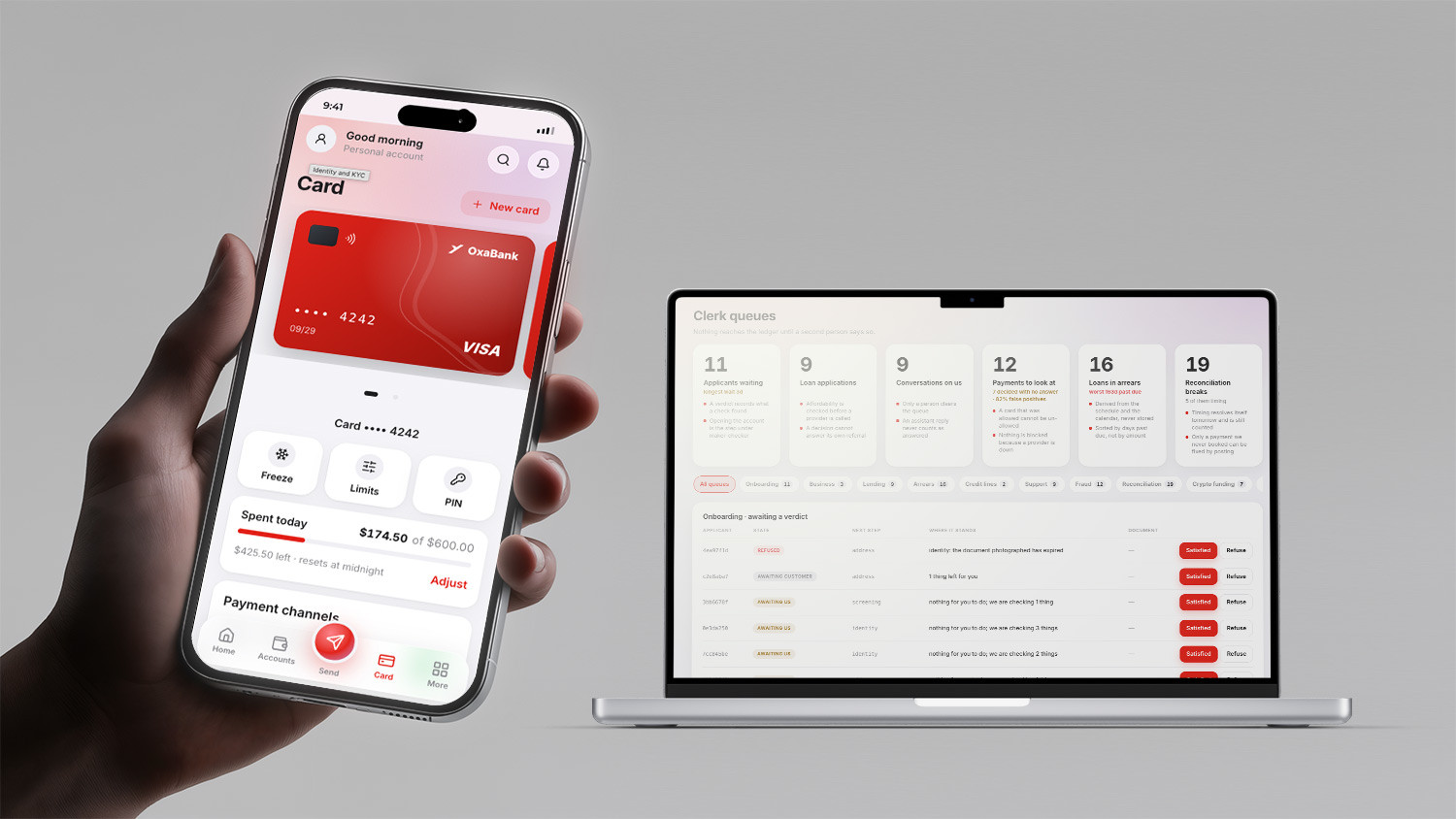
OxaBank
These modules directly correspond to actual features that you will be selling. That includes account creation and management, user onboarding, initial screening, card issuance, fraud detectors, money transfers, reconciliation, support, lending, crypto transactions, investments, and so on.
This layer underlies business modules and is responsible for direct interactions with essential on-platform and third-party services. Fraud detection and sanctions list checks, decisioning flows, credit bureau lookups, notifications, document generation, e-signatures, various registry checks, open banking connectivity, and live FX pricing.
These interactions use service APIs that are billed per call, which means this is where your unit economics gets affected. Moreover, a business module’s margin must be carefully assessed against the cost of the set of service layer calls it depends on.
This layer hosts the components without which no bank can operate:
Since these components are crucial for the operation of the entire platform, there’s little room for creative experimentation at this level. Security, reliability, and observability are the top priorities, regardless of how the core is organized: built in-house, provided by the sponsor bank, or bought from a vendor.
Similarly to payment gateways with multiple integrations and a unified orchestration layer, every capability in a well-built neobank talks to its external provider through a contract, be it the KYC vendor, the card issuer, or the sponsor bank. An adapter implements that contract for a specific provider, and the module only ever knows the contract.
Kyrylo explains:
“Virtually every bank module communicates with external providers through a contract, and it’s the adapter’s job to implement it. Replacing a provider then only requires a new adapter plus credentials, as opposed to an expensive rebuild. A bad vendor choice stops being a five-year commitment you can’t break out of.”

Oxagile’s fintech team will audit your payments and integration setup and map out a step-by-step plan for your current and future integration needs, built for security and scale.
A common misconception is that KYC/AML is a one-time filter applied when a customer first signs up. In real banks and neobanks, these checks are embedded into the product and rerun periodically or when specific triggers are activated.
The KYC/AML workflow typically starts with identity verification, followed by sanctions/PEP checks, and, potentially, other screening methods, depending on the security model and bank’s jurisdiction. The results are used for initial risk assessment and determine whether onboarding can continue, needs manual review, or requires deeper due diligence.

But even when the account is active, the checks should carry on continuously. The system looks for unusual payment activities on a regular basis, and occasional screening can identify changes in a customer’s sanctions or PEP status.
Such findings should be aggregated in a separate back-office space where the bank’s authorized personnel reviews them along with the customer’s ID, transaction history, results of previous checks, and supporting documents. They can then close the alert, request additional information, or escalate it for further action.
Every check and subsequent action should be logged in detail: who was checked, what was investigated, when it happened, what the resulting decision was, and who signed off on the task.
Kyrylo adds:
“Most of these activities may be automated, but manual exception handling is equally important, so that a failed automated check does not just revoke the customer’s access to the system but pushes the case to manual review.”
In the KYC/AML context, process ownership depends on the licensing model you chose. If you went with a sponsor bank or BaaS provider, it will likely be their responsibility, and you will only have to provide details that the partner’s compliance team needs to do their job. If you own the license, your neobank assumes full responsibility for these checks.
Just like any complex software development project, building a neobank requires an iterative, phased approach based on feature priorities.
Define the TA, scope, jurisdiction, revenue, and licensing models (covered earlier). The result is a prioritized product brief: which modules launch initially, which wait for later, which jurisdiction’s regulatory requirements affect the build, and which third parties are in scope for the MVP. If this PRD is not finalized, everything else remains completely tentative.
That’s where you do your research and negotiations with potential sponsor banks and BaaS platforms, card processors, KYC services, and other parties. To save time, do it in parallel, since each partner has a unique contract, an integration timeline, and a set of constraints, like supported geos, product types, and customer segments.
Build in the order of importance:
The system won’t work at all until the ledger is running and reconciling. The result is a core layer that posts, accepts, and settles payments, produces detailed statements, and passes the reconciliation check time after time.
Start by building out only the features the MVP requires: accounts, onboarding, payments, then cards and transfers. Once done, tie each one to its service-layer dependencies (KYC vendor, fraud engine, sanctions screening, notifications). This way, each module will get its own integration tests in partner sandboxes before it’s considered production-ready. The result you want is all MVP modules fully functional in a staging environment, with every adapter tested against the real provider’s sandbox.
Consider penetration testing against the entire staging environment, not individual components. This includes the customer app, the operator console, as well as all API endpoints and adapters to each service. To be on the safe side, include a walkthrough of the entire KYC/AML flow with your own compliance team if you own a license, or the sponsor bank’s compliance team under BaaS.
Launch for a restricted user group, for example, your employees, early adopters on the waitlist, or a beta group agreed upon with your sponsor bank. Test with full production infrastructure up and running, not in staging. The goal is to try to generate reconciliation gaps, reveal integration edge cases, and gauge the amount of support activities that only appear in real-life environments.
The cost estimate depends more on your starting position than the magnitude of your future plans. Developing each and every component from the ground up may lead to a seven-figure budget and year-plus implementation timelines.
Starting with a pre-made platform where the banking logic is already implemented and tested can be a game changer, as you’d only have to pay for configuration, integrations, and your own custom parts.
The ranges below are based on that latter scenario, where our OxaBank platform would be the foundation of your neobank:

Kyrylo reminds:
“Remember, partner fees and compliance operations are the two recurring costs that never show up in these numbers, no matter which implementation path you follow. And in my own experience, the launch date is not defined solely by how fast your team can build, integrate, and ship. It depends heavily on partner onboarding and certification. Start working on this during week one.”
The initial release closes one chapter in your neobank’s history and opens a new one at the same time. From the point onward, the product will tell you what it costs to run and what it makes. Your roadmap should be shaped around this data and not the feature list you had in mind. Keep a close eye on these important signals:
Your future buildout should take all of the above into consideration. Each new feature is expected to add a revenue stream, yet each will come with its own set of obligations and dependencies:
Your ability to innovate and scale will depend on architecture decisions made at an early development stage. In systems where every capability sits behind its own contract with a corresponding provider, adding a new one (like lending) means activating a module and configuring it. If the contract layer is missing, each new product of feature will cause a rebuild of the parts you already have.
Oxagile’s BaaS-based OxaBank solution is designed to compress both the cost and the timeline.

A neobank is a digital-first financial service provider that operates without traditional branches, often targeting specific customer segments. Unlike a traditional bank offering digital services, a neobank may operate without its own banking license, relying on a licensed partner to provide regulated banking services. A digital bank is a broader term that can also describe a fully licensed bank operating primarily online.
A neobank can launch without its own banking license by partnering with a licensed sponsor bank or banking-as-a-service (BaaS) provider. The partner provides regulated banking infrastructure, and the neobank develops its customer experience and product features. However, the neobank may still need separate registrations or authorizations depending on its jurisdiction, activities, and partnership structure.
Neobank development costs depend on the licensing model, architecture, integrations, and product scope. For example, using Oxagile’s OxaBank platform as a foundation, a single-module pilot may start at around $50K, a neobank MVP at $150K, and a broader product offering at $300K. Building the entire infrastructure from scratch can require a seven-figure budget. These estimates exclude partner fees, licensing expenses, and ongoing compliance operations.
Banking as a service (BaaS) provides companies access to regulated banking capabilities through APIs provided by licensed banks or their technology partners. It is a practical option for neobanks looking to launch without building their own banking core or obtaining a full banking license. However, BaaS introduces dependencies on partner pricing, compliance requirements, supported features, and approval timelines.
A neobank MVP built on an existing banking platform can launch within several months, depending on its scope and partner readiness. A limited pilot using a prebuilt module may be ready in weeks. Developing proprietary banking infrastructure or obtaining a banking license can extend the timeline to years. Sponsor bank onboarding, compliance approval, and integration certification often determine the actual launch date.

