
Propelling diverse businesses with emotion recognition

With hundreds of successful product launches behind us, our custom emotion recognition software development company converts emotional input into actionable system responses across virtually any domain.

HealthTech

  • Neurological and developmental screening: Facial micro-expressions, gaze, and action units are analyzed to identify atypical affective patterns.
  • Mental health monitoring: Facial emotion signals are combined with other data to model depression, anxiety, or PTSD, with emphasis on changes over time.
  • Pain detection in non-verbal patients: Facial landmarks and action unit intensity are used to estimate pain in patients unable to self-report.
  • Remote therapy monitoring: Webcam-based affect analysis tracks emotional shifts during digital therapy, relating engagement or withdrawal patterns to treatment progress.
  • Clinical decision support: Metrics like valence or arousal are used to support assessment of stress, discomfort, or clinical decline.

Safety

  • Driver monitoring systems: In-cabin cameras analyze facial expressions, gaze, and eye closure to detect fatigue, distraction, or stress, triggering alerts.
  • Workplace safety monitoring: Emotion recognition identifies stress, fatigue, or cognitive overload in high-risk environments, supporting early intervention and accident prevention.
  • Public safety and surveillance: CV systems analyze crowd emotions to detect panic, aggression, or abnormal behavior patterns, assisting in real-time risk assessment.
  • Human-machine interaction safety: Emotion-aware systems in machinery or robotics detect user frustration or confusion and adjust system responses to reduce operational errors.

Marketing

  • Ad effectiveness analysis: Tracking real-time emotional responses to ads, generating time-aligned engagement profiles.
  • UX and journey optimization: Emotion detection combined with eye tracking and behavioral data highlights confusion or frustration points in interfaces.
  • Retail sentiment analysis: In-store vision systems analyze shopper facial expressions and link them with behavior like dwell time and product interaction.
  • Neuromarketing research: Facial analysis is used to capture implicit emotional responses, complementing or replacing self-reported data.
  • Adaptive content delivery: Real-time emotion classification adjusts content, ads, or recommendations dynamically based on the user’s inferred affective state.

FinTech

  • Emotion-aware customer service: Video and voice analysis detect stress or confusion during interactions, informing routing decisions.
  • Financial UX support: Facial and vocal signals reveal cognitive overload or hesitation, prompting simplified interfaces or contextual guidance.
  • Behavioral fraud detection: Emotional and stress signals are combined with transaction data to strengthen anomaly detection and behavioral authentication.
  • Robo-advisory personalization: Emotional reactions to financial scenarios refine inferred risk tolerance, shaping automated investment recommendations.
  • Risk modeling augmentation: Affective responses during financial disclosures are used as additional behavioral inputs in credit and risk assessment models.

Media and streaming

  • Content performance analysis: Tracking viewer reactions frame by frame highlights moments of boredom, confusion, or peak interest for optimization.
  • Personalized recommendations: Emotional response data is combined with viewing history to refine recommendation systems.
  • Adaptive viewing experiences: Real-time emotion detection identifies disengagement or fatigue and adjusts playback, suggests alternatives, or supports interactive storytelling flows.
  • Trailer and promo testing: Pre-release testing uses facial analysis to measure second-by-second reactions, helping optimize pacing, scene selection, and emotional impact.
  • Ad effectiveness in streaming: Viewer emotional responses to ads are analyzed to evaluate impact and improve targeting, placement, and creative alignment.

Our suite of emotion analysis software development services

Strategic pipeline design and real-world calibration allow emotion recognition to embed across the stack with minimal friction and total architectural stability.

Setting up and connecting data sources such as cameras, microphones, wearables, and text inputs. Building real-time pipelines for synchronizing multimodal data into the system.

Cleaning and standardizing incoming signals for model readiness. Performing face detection, audio denoising, signal filtering, and multimodal alignment.

Transforming raw inputs into structured emotional features. Extracting facial action units, speech characteristics, and physiological patterns from sensor data.

Running ML models that convert extracted features into emotion classes or continuous affect scores. Optimizing inference for real-time performance and stable outputs.

Combining facial, vocal, textual, and physiological signals into a unified emotional state. Applying fusion strategies that balance and align different modalities.

Aligning emotional responses with stimuli such as video scenes or interactions to connect detected affect with the user’s real-time experience.

Tracking emotional states over time instead of isolated moments. Using sliding windows and sequence modeling to capture emotional dynamics and trends.

Exposing emotion results through APIs, dashboards, and event triggers. Integrating outputs directly into applications, analytics systems, and real-time workflows.

Optimizing performance, latency, and scalability across cloud and edge environments. Implementing privacy handling, bias mitigation, and model validation.

Tap into bonus-level value with Oxagile

Beyond custom emotion detection software development services, there’s room to push product value further with smarter video-AI pipelines and tighter integration of emotion intelligence into broader digital ecosystems.

Cross-domain depth

Oxagile can bring together deep expertise in computer vision, ML, and video streaming in one delivery flow, which matters when emotion recognition has to work inside real video products, not just in a lab prototype.

High-load engineering

2+ decades in video platforms and 400+ shipped projects mean hands-on experience with real-time pipelines, heavy traffic, and latency-sensitive streaming systems that don’t forgive weak architecture.

Compliance-ready systems

We always build with GDPR, EU AI Act, CCPA/CPRA, BIPA, and HIPAA constraints in mind, using privacy-by-design practices like consent handling, data minimization, on-device options, and audit-ready logging.

Choose where AI goes next

Build systems that interpret behavior in real time, understand multimodal video context, and adapt to humans, not just inputs.

See dozens of production-grade AI solutions for any complex business realities.

What’s more in our CV expertise for you?


Everything you need to reach your goals. Emotion detection software development can be the entry point, with computer vision extended across video intelligence, user behavior, and real-time decision systems.

Video analysis

Real-time video analysis

Processing live streams and linking visual reactions to exact moments in content or interaction.
Face AI

Face-based intelligence

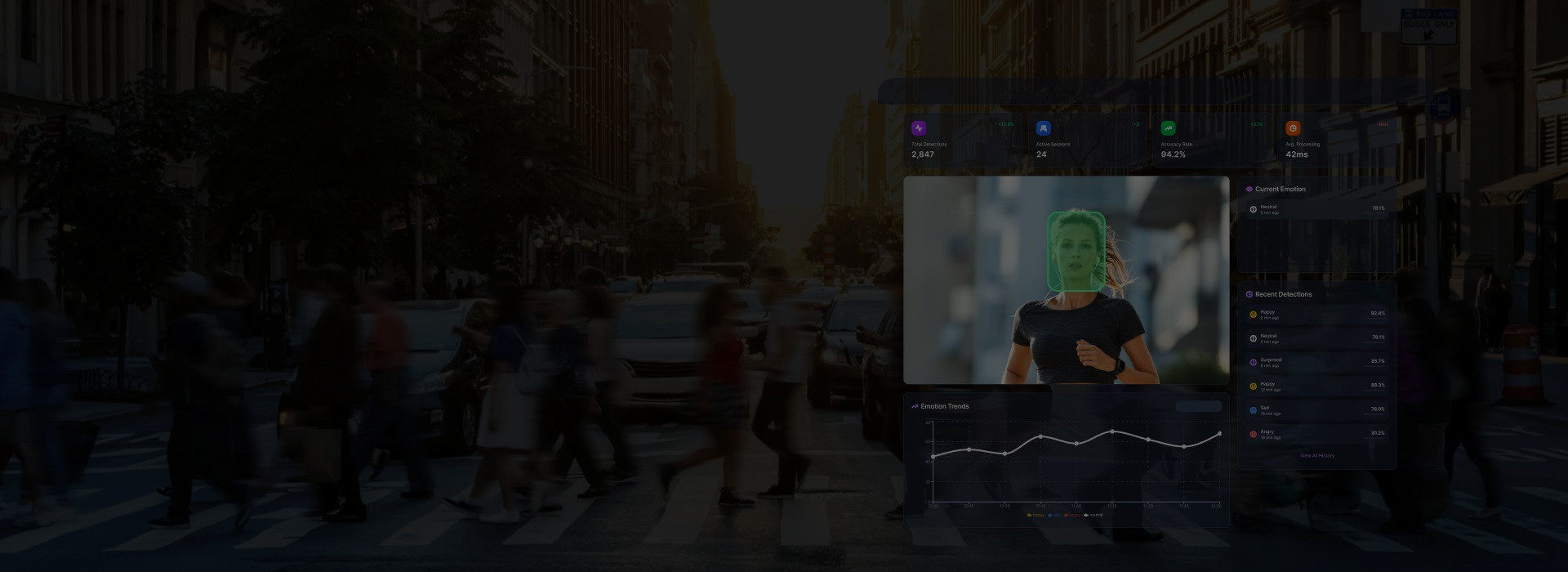
Running detection, recognition, and expression-related analysis on facial signals in real time.

Scene CV

Scene-aware CV pipelines

Combining object tracking, scene detection, and OCR so signals are interpreted in full visual context.

Bio-fusion

Biometric fusion

Blending facial data with voice and other biometric inputs for a unified user state view. 

Text signals

Text signal extraction

Converting speech, transcripts, and OCR into sentiment and intent signals alongside visual data.

Integration

System-level integration

Embedding CV models directly into existing platforms, video stacks, and analytics systems.

The stack powering our development

We turn multimodal signals into interpretable affect data, shaping systems that read and respond to human states in real time with a stack of emotion recognition development tools proven in practice.

DL frameworks

TensorFlow • PyTorch • Keras • MXNet • ONNX • OpenVINO • Hugging Face Transformers

Modules / Toolkits

OpenCV • MediaPipe • Dlib • OpenFace • DeepFace • NVIDIA DeepStream • TensorRT

Emotion & CV APIs

Affectiva • Microsoft Azure Face API • Google Vision AI • Amazon Rekognition

Speech & NLP

Whisper • Google Speech-to-Text • Azure Speech • spaCy • NLTK

Services

AWS AI Services • Google Cloud AI • Azure AI

Hardware

GPU servers • Edge devices • Mobile • Cloud environments

FAQ

What is the difference between facial recognition and emotion recognition?

Facial recognition identifies or verifies a person based on unique facial features, focusing on identity matching. Emotion recognition, or emotion detection software development, analyzes facial expressions, voice, or physiological signals to infer affective states such as happiness, stress, or frustration rather than who the person is.

What are the top business use cases for emotion recognition?

Emotion recognition is commonly used in media and streaming to measure viewer engagement, in marketing to test ad effectiveness, in customer service to detect frustration or satisfaction in real time, and in automotive systems to monitor driver attention and fatigue. It is also applied in healthcare and digital UX optimization.

How accurate is the emotion recognition model across different cultures and demographics?

Accuracy varies depending on dataset diversity, model design, and cultural context. Facial expressions and emotional display rules differ across cultures, so models trained on limited or non-diverse data may show bias. Modern systems improve performance by using multimodal inputs and training on more balanced, representative datasets.

Thinking about emotion recognition you can trust?

We’ll shape a custom solution around your use case, your data, and your environment to deliver outcomes you can rely on and get excited about.

Chat with the team