













This website uses cookies to help improve your user experience




Programmatic advertising is now the standard way publishers sell digital inventory. It goes far beyond filling impressions. Publishers need to drive revenue, connect with multiple demand sources, handle privacy requirements, and make auction decisions in milliseconds. A supply-side platform, or SSP, sits at the center of all of this.
An SSP is designed to allow publishers to sell their ad space in real time, either through ad exchanges or, what’s even better, by connecting directly with demand-side platforms (DSPs). If you’re building a DSP from scratch, having your own SSP is a must. But if you’ve already got an SSP up and running, creating your own DSP isn’t really needed.
This guide breaks down how SSPs work, what components they include, and when building your own platform makes sense. It also covers what modern SSPs look like and what publishers expect from them today.
Key takeaways:
The simplest supply side platform definition refers to the technological platform that publishers use to sell digital advertising inventory through automated auctions. It connects websites, mobile apps, connected TV platforms, and other digital properties with multiple demand sources, allowing advertisers to compete for every available impression.
Every time a user opens a webpage or launches an app, an SSP processes an ad request. Within milliseconds, the platform evaluates available inventory, collects bids, applies publisher rules, selects a winning ad, and records the results for reporting and optimization.
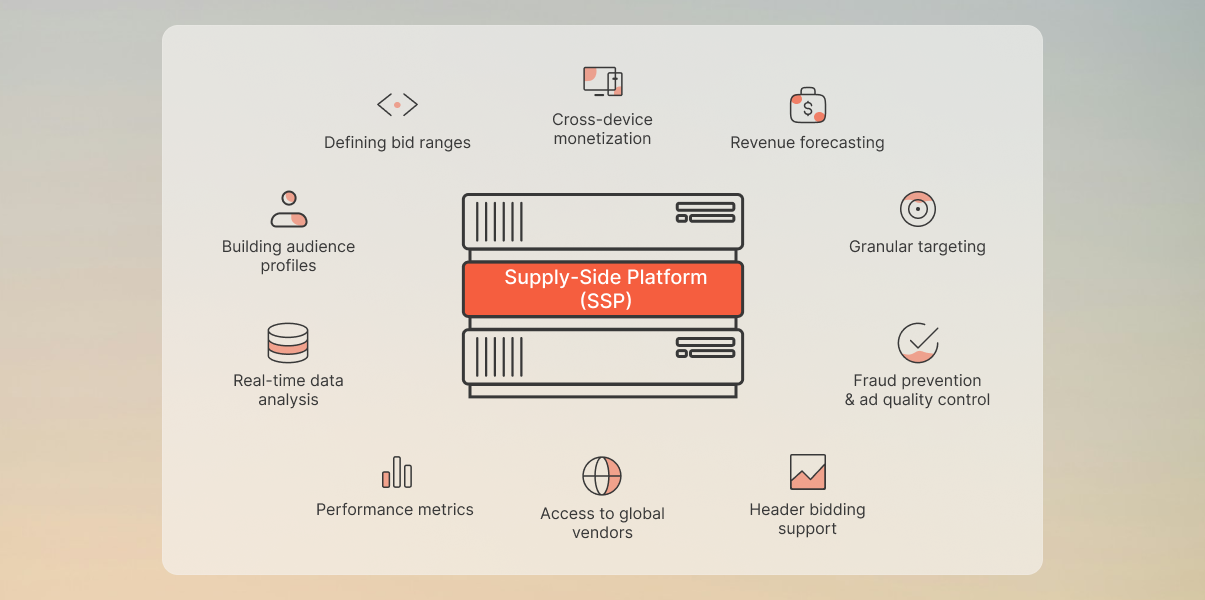
A modern tailor-made SSP typically handles much more than auctions. Depending on business needs, the platform may include:
Together, these capabilities help publishers increase inventory value, simplify campaign management, and gain better visibility into advertising performance.
Every publisher wants the same outcome: sell more inventory at the best possible price without making campaign management more complicated. An SSP automates auctions, connects publishers with multiple demand sources, and gives publishers more control over how inventory is monetized.
Selling inventory manually doesn’t scale. An SSP automates the entire auction process, from receiving bid requests to selecting the winning advertiser. Ad operations teams spend less time managing campaigns and more time improving monetization strategies.
Typical automation tasks include:
Every impression has a different value. A homepage takeover, a live sports stream, and a standard article page won’t attract the same buyers or command the same price. An SSP evaluates each impression independently, allowing publishers to capture more value from available demand.
Yield optimization typically combines:
Many enterprise SSPs also support Supply Path Optimization (SPO), reducing unnecessary intermediaries between publishers and buyers. A shorter supply path improves pricing transparency, lowers transaction costs, and helps publishers retain more revenue.
For example, a publisher may apply one pricing strategy to premium video inventory and another to standard display placements. Pricing decisions can also reflect audience segments, content categories, geographic markets, and time-of-day demand. Efficient auction execution allows advertisements to load quickly without delaying page rendering or video playback.
Publishers remain in control of how inventory is sold. They can prioritize preferred advertisers, configure private marketplace deals, define floor prices, create inventory-specific auction rules, and decide which buyers can access premium placements. This flexibility lets monetization strategies to change without breaking the underlying platform.
As inventory expands across websites, mobile apps, and connected TV, centralized controls make campaign management significantly easier and provide consistent governance across channels.
Revenue matters, but advertiser trust is equally important. Most enterprise SSPs integrate with technologies that verify inventory quality, detect fraudulent traffic, and protect brand safety throughout the auction process.
These capabilities often include:
Together, these technologies help publishers maintain a trustworthy advertising environment, protect advertiser budgets, and preserve inventory quality over time.
An SSP continues delivering value after every auction ends. Reporting and forecasting tools show which buyers perform best, how inventory is priced, where revenue opportunities exist, and how demand changes across channels.
Imagine a publisher operating both a news website and a connected TV app. A homepage banner, a live sports stream, and an article page all attract different buyers and generate different bidding activity. An SSP evaluates each impression independently and gives publishers a complete view of auction outcomes, buyer activity, and inventory performance from a single dashboard.

If your team spends more time processing requests than improving the platform, it may be time to rethink how advertisers interact with your AdTech ecosystem.
Every time someone opens a webpage, starts a video, or launches a mobile app, an auction begins almost instantly. The entire process usually finishes in a few hundred milliseconds, long before the user notices an advertisement loading.
Here’s a simplified view of what happens:
Take a streaming platform as an example. Before a video starts playing, the SSP receives information about the available ad slot, sends bid requests to connected buyers, compares responses, applies floor pricing, and returns the winning advertisement. All of this happens within milliseconds, allowing playback to begin without noticeable delay.
Although the workflow looks straightforward, several systems contribute to every decision. Auction logic, header bidding, pricing engines, identity services, consent management, and analytics all work together behind the scenes. A well-designed SSP coordinates these components without adding unnecessary latency, helping publishers maximize revenue and maintain a smooth user experience.

A digital advertising company partnered with Oxagile to build a supply-side platform that helps premium publishers increase ad revenue through real-time bidding, audience analytics, and automated yield optimization.
The platform was designed to handle enterprise traffic volumes and give publishers greater visibility into inventory performance.
Key results:
A supply-side platform is made up of several core components, each responsible for a different part of the auction process. Some decide who wins the auction, others manage inventory, connect buyers, process consent signals, or generate reporting. Together, these services determine how efficiently an SSP monetizes inventory and scales as traffic grows.

Every impression passes through the real-time bidding (RTB) engine before buyers compete for it. This component evaluates incoming bids, applies publisher rules, and determines which advertiser wins the auction. Since the entire process happens within milliseconds, even small delays can affect both revenue and user experience.
The RTB engine typically:
Suppose a publisher reserves premium homepage inventory for direct advertisers but sells standard placements through open auctions. The RTB engine applies those rules automatically for every impression, even during periods of heavy traffic.
Without header bidding, many buyers never compete for the same impression. A header bidding wrapper solves this by requesting bids from multiple demand partners simultaneously before the auction reaches the ad server.
Its responsibilities include:
For a publisher working with several SSPs, this approach usually creates stronger competition for inventory and improves the chances of securing the highest available bid.
Setting one fixed floor price may seem straightforward, but demand rarely behaves the same throughout the day. A placement attracting premium advertisers during a live sports event can perform very differently a few hours later.
The yield optimization engine continuously evaluates auction performance and adjusts pricing strategies based on market conditions. Depending on the platform, it can:
This gives publishers a practical way to balance fill rate and revenue without manually revising pricing rules throughout the day.
Winning auctions is only part of running an advertising business. Publishers also need a simple way to organize inventory, manage campaigns, and control who can buy premium placements.
Most SSPs provide tools for:
As inventory expands across websites, mobile applications, and connected TV, managing everything from one interface becomes far more practical than maintaining separate workflows.
Privacy rules have changed how advertising platforms exchange data. Every auction now depends on consent signals alongside bid prices, making identity and privacy services a standard part of SSP architecture.
A typical platform integrates with:
These integrations help publishers continue monetizing inventory while supporting evolving privacy requirements across different markets.
Every auction produces valuable operational data. The question is how quickly publishers can turn those numbers into decisions.
Reporting dashboards typically include metrics such as fill rate, eCPM, win rate, bid density, demand partner performance, and revenue by inventory segment. Forecasting tools build on this information by estimating future inventory availability and revenue trends.
For example, if reporting shows consistently low fill rates for video inventory during peak viewing hours, publishers can adjust floor prices, introduce new demand partners, or revisit campaign priorities before revenue begins to decline.
Publishers often search for the best supply side platforms, but choosing an SSP isn’t like picking the highest-rated app in a marketplace. Most publishers compare products based on inventory type, monetization goals, technical flexibility, and the SSP programmatic ecosystems they already use. A broadcaster serving connected TV audiences, for example, has different priorities than a news publisher focused on display advertising.
Having worked with both off-the-shelf and custom SSPs, we’ve seen where each platform performs best. Here are several of the industry’s leading options.
Google Ad Manager combines ad serving and programmatic monetization in one platform. Its integration with Google’s advertising ecosystem makes it a common choice for publishers managing display, video, mobile, and connected TV inventory.
A good fit for:
Magnite has built a strong position in connected TV and premium video advertising. Broadcasters and streaming providers often choose the platform for large-scale video monetization, private marketplaces, and programmatic direct transactions.
Across the main SSP features, PubMatic focuses on omnichannel monetization and supply path optimization. Publishers looking for greater visibility into auction performance and demand quality frequently include PubMatic among their primary SSP partners.
OpenX is known for premium inventory, privacy-focused advertising technologies, and identity solutions. Publishers working in regulated markets often consider the platform because of its emphasis on transparency and privacy compliance.
Index Exchange operates an independent advertising marketplace with strong support for header bidding and open programmatic standards. Enterprise publishers commonly use it to strengthen competition across demand sources.
Equativ supports display, video, native advertising, retail media, and connected TV through a unified monetization platform. Publishers expanding across multiple channels often adopt Equativ to manage diverse inventory from a single environment.
No single SSP leads every category. Some platforms excel in connected TV, others focus on premium publishing, retail media, or omnichannel advertising. Comparing auction capabilities, reporting, integrations, scalability, and privacy support will give you a much clearer picture than feature lists alone.
We’ll share our expertise on building or streamlining existing supply-side processes with smart automation, maximizing traffic monetization, and gaining more control over the traffic quality.
Most publishers begin with a straightforward setup: an ad server and a handful of direct campaigns. However, as the business grows, pricing becomes more complex, inventory spreads across platforms, and managing demand manually takes more time than it should.
How can you tell it’s time to move beyond a traditional ad server? Here are a few signs:
For example, a publisher may notice that premium homepage placements consistently sell out, while video inventory remains underutilized. An SSP helps balance demand across inventory, making auctions more competitive and giving publishers better visibility into where revenue opportunities exist.
There’s no one-size-fits-all approach to building an SSP. Some publishers get everything they need from an existing platform. Others combine several SSP platforms to expand demand, or invest in a custom solution built around their own monetization strategy. The right choice depends on your inventory, traffic, business goals, and how much control you want over your advertising stack.
At Oxagile, we’ve helped publishers integrate commercial SSPs, manage multi-SSP environments, and build custom advertising platforms from the ground up. Our teams develop auction engines, yield optimization capabilities, reporting tools, privacy features, and integrations with demand partners that fit the way each business operates.
If you’re deciding between commercial platforms, multiple SSPs, or a custom build, let’s compare the options together. We are eager to share our expertise, use cases, and insider knowledge on the latest best performing SSP tactics with you right away.

An SSP and a DSP serve opposite sides of the same programmatic advertising auction. Accodring to the classic supply side platform meaning, publishers sell available ad inventory with SSPs, whereas a DSP helps advertisers find and buy impressions that match their targeting criteria.
Every time a user loads a webpage or starts a video, the SSP sends a bid request, multiple DSPs compete for the impression, and the winning ad is served within milliseconds.
Yes, and many larger publishers do. Working with multiple supply side platform advertising options gives advertisers more opportunities to compete for inventory, which can improve fill rates and revenue. The key is managing those platforms efficiently through header bidding or a unified auction strategy. Without proper orchestration, additional SSPs can increase latency and make reporting harder to interpret.
An SSP increases revenue by evaluating every impression before it goes to auction. The process typically looks like this:
For example, a live sports stream may receive different pricing rules than a standard display banner because advertiser demand is significantly higher.
A modern SSP needs more than an auction engine. Publishers expect a platform that supports monetization, reporting, privacy, and long-term scalability.
Third-party cookie deprecation changes how SSPs identify users and target advertising. Publishers now rely more heavily on first-party data, consent signals, contextual targeting, and alternative identity frameworks such as Unified ID 2.0.
As a result, modern SSPs place greater emphasis on privacy compliance and identity integrations. Building these capabilities into the platform from the beginning makes adapting to new privacy requirements much easier.
Google Ad Manager, Magnite, PubMatic, OpenX, Index Exchange, and Equativ are among the best-known SSP advertising examples. Each platform serves a different audience. Magnite has a strong presence in connected TV, PubMatic focuses on omnichannel monetization, and OpenX is widely recognized for premium inventory and privacy-first advertising. The best choice depends on your inventory, monetization goals, and technical requirements.

