













This website uses cookies to help improve your user experience



AI development is often associated with massive budgets, long timelines, and complex infrastructure. And while large-scale enterprise systems can still require significant investment, that’s no longer the only scenario. Today, the answer to “how much does AI cost” depends heavily on the project scope, infrastructure choices, data complexity, and the level of customization required.
Open-source models, cloud services, and reusable AI components have made it much easier to launch production-ready AI systems without building everything from scratch. In many cases, the biggest challenge today is not access to AI itself, but making the right architectural, infrastructure, and data-related decisions early on.
As a result, AI development costs now vary much more widely than they did just a few years ago. In 2026, projects typically range from $20,000–$60,000 for smaller AI assistants, internal automation tools, or narrow proof-of-concepts to $250,000+ for enterprise platforms with customized or fine-tuned models, real-time processing, advanced integrations, compliance requirements, and large-scale infrastructure.
So what actually drives those costs? When does it make sense to use existing services instead of building custom systems? Which technical decisions reduce long-term expenses, and which ones quietly increase them over time? Let’s break it down.
Key takeaways:

The classic dilemma of budget-friendly, fast, and high-quality is addressed through a cocktail of factors: system design, models complexity, the effectiveness of data collection and processing pipelines, alongside a multitude of nuanced details we’ll explore further.
When we talk about system design, we’re basically figuring out how to structure the whole setup, outlining how a system’s architecture, components, modules, interfaces, and data flow will work together to hit the goals for speed, functionality, and reliability. It consists of multiple elements, and every single one of those pieces can impact the final price tag.
Selecting the right technology stack, such as programming languages, frameworks and cloud services is vital. Their ease of maintenance and integration capabilities can significantly influence the budget.
Additionally, choosing the appropriate database, relational, vector-enabled, or hybrid search, is a critical decision, as well.
Architectural choices also play a major role in long-term AI development costs, though the right approach depends heavily on the product’s scale and requirements. Monolithic architectures are often faster and cheaper to launch, making them suitable for early-stage products and smaller systems. However, as applications grow, scaling and maintaining a monolith can become increasingly difficult and expensive.
Microservices-based architectures require more effort upfront but make it easier to scale individual components, update services independently, and support larger workloads over time. Some developers also adopt modular monoliths or event-driven architectures as a middle ground between simplicity and scalability, especially for AI systems that rely on multiple services, models, or asynchronous workflows.
Serverless architectures can further reduce infrastructure management overhead and work well for applications with fluctuating demand or irregular workloads. At the same time, high-volume real-time AI processing still requires careful infrastructure planning, as inference costs can quickly become one of the largest long-term expenses in production AI systems.
A pivotal consideration in this process is also choosing the right third-party APIs or prebuilt models. Because although building or heavily customizing ML models may be the right option in unique solutions, still in many business cases, integration projects, where already existing APIs and models are used, provide a faster and more cost-efficient alternative.
Take, for example, a business-critical task requiring real-time data processing. One path is to adopt pre-built solutions. These deliver immediacy and precision but come with steep licensing costs, straining budgets. Alternatively, a modular approach splits the workflow into discrete stages: speech recognition, translation, retrieval, and response generation handled by separate services.
However, this approach also comes with the challenge of selecting the right combination of models, services, and infrastructure decisions. These choices can significantly affect both upfront development costs and long-term operational expenses.
This becomes especially important in modern AI systems built around large language models, retrieval pipelines, and voice, text, and image processing. Depending on the use case, engineers may need separate approaches for model customization, evaluation, inference, monitoring, security, and request routing. In many production systems, different providers, APIs, or deployment environments are used for different parts of the workflow.
For example, speech recognition may rely on providers such as Deepgram, OpenAI Realtime APIs, or cloud speech services, while response generation, translation, search, and voice synthesis may be handled by separate systems. Alternatively, companies can choose unified platforms that combine multiple capabilities within a single environment, simplifying integration but often increasing infrastructure requirements and operational costs.
As AI systems scale, infrastructure efficiency becomes just as important as model quality. In many production environments, inference costs now represent one of the largest long-term expenses, especially in systems that process large volumes of requests or rely on multi-step workflows.
As a result, long-term success depends not only on model performance, but also on infrastructure planning, efficient coordination between services, predictable scaling costs, data consistency, and the ability to adapt the system as technologies and pricing models continue to evolve rapidly.

Reach out to Oxagile’s experienced team. We’ll be glad to investigate your case and advise on the best scenario to move forward with.
Choosing an architecture, workflow, or model that aligns with your requirements and delivers an effective solution requires a thorough analysis of the available options. Let’s ground this in a real-life story.
We once collaborated with a client to build a language-learning assistant. The concept was to record conversations in a foreign language and, upon returning home, have the assistant identify errors and suggest corrections. This required robust speech-to-text and text-processing capabilities.
While text processing posed minimal challenges, implementing a cost-effective and scalable speech-to-text solution was more complex. The speech recognition market progresses rapidly, with new providers and pricing models appearing regularly, so we had to compare multiple services before making a decision.
We evaluated factors such as system load, including the estimated number of users per hour and daily activity fluctuations; geographic distribution of users, and service costs, comparing pricing models of different providers, including the cost per batch of requests or individual transactions.
Through this analysis, we concluded that batch speech-to-text was more cost-effective than real-time transcription. Although batch processing doesn’t provide immediate results and processing may take several minutes depending on workload size, it significantly reduces costs. By adapting the user experience to this slight delay, users still received a smooth experience. This approach allowed us to balance efficiency, cost, and functionality.
Deciding whether to host an application in the cloud or on local servers significantly impacts both costs and flexibility. Cloud services offer scalability and reduce initial infrastructure expenses but can lead to ongoing costs for resource usage.
Many organizations also adopt hybrid infrastructure approaches, combining cloud scalability with private or on-premises environments for sensitive workloads, compliance, or predictable long-term costs.
On-premises infrastructure in turn, while requiring a larger upfront investment, can be the right choice for several reasons. If privacy, regulatory compliance, or a proprietary business model are key concerns, keeping AI workloads in-house provides greater control. Additionally, if your workloads rely on smaller or optimized models, on-premises infrastructure may be sufficient.
Another significant benefit is independence from cloud providers, reducing reliance on third-party infrastructure and associated costs.
If you opt for cloud infrastructure, effective cloud engineering, which includes managing and optimizing cloud systems, can make operations run smoother and cuts unnecessary spending.

System optimization further enhances efficiency through:
Effective data management is the backbone of AI, and by optimizing how we handle data, we can significantly cut costs without compromising the insights we gain. Here’s how.
It plays a key role in optimizing AI costs by helping machine learning models make predictions without unnecessary resource consumption.
One of the biggest cost drivers in AI infrastructure is data movement, as transferring large datasets across storage systems, compute nodes, and cloud services can lead to high latency and expensive network fees.
To minimize these costs, organizations can deploy models closer to the data, such as using edge computing or localized processing architectures, reducing the need to move data externally. Optimizing data formats, caching frequently used features, and streamlining pipelines also help cut down on redundant transfers.
Additionally, selective data annotation using active learning techniques can significantly reduce expenses by prioritizing the labeling of only complex or high-value data samples instead of entire datasets.

Contextual understanding: Interprets news context to provide relevant and insightful content.
Semantic analysis: Performs deep semantic analysis to understand the underlying themes and sentiments of articles, enhancing the quality of recommendations.
Content summarization: Provides concise summaries of lengthy articles, allowing users to quickly grasp the main points.

Imagine launching an AI model only to realize later that in real life it’s slowly drifting off course — producing inaccurate results, consuming excess resources, or making decisions based on outdated data. Fixing these issues after they’ve impacted performance can be time-consuming (and expensive).
That’s why model observability is crucial. By setting up monitoring mechanisms that track both infrastructure metrics (like CPU/GPU usage and memory allocation) and model-specific indicators (like metrics such as response accuracy, fact consistency, latency, and cost per request), you can catch inefficiencies before they escalate.
In general, we can categorize observability metrics into two main groups:
Closely related to this is concept and data drift analysis (identifying shifts in data patterns that could lead to model degradation if left unaddressed). To maintain high performance, continuous monitoring of key metrics such as accuracy is essential as well, with automated alerts triggering when performance declines.
Another critical component is bias and fairness monitoring, which helps identify and mitigate unintended biases in predictions, promoting ethical AI deployment. Additionally, data validation helps detect missing values, inconsistencies, and unexpected variations before they affect model outputs.
Another aspect is experiment tracking, which involves systematically logging model versions, hyperparameters, datasets, and evaluation metrics. This prevents redundant work, accelerates debugging, and provides reproducibility, reducing wasted compute resources.
Large models require substantial computational power, leading to higher operational costs. However, techniques for model compression enable the reduction of model size while preserving accuracy.
Nonetheless, it’s important to acknowledge that this process involves a trade-off. Achieving identical results to the original model might be impossible, but in certain cases benefits can make the effort worthwhile.
When it comes to AI inference (i.e., running predictions in real-time), milliseconds matter. The longer it takes for a model to process data, the higher the operational costs, especially when running AI at scale. Weight conversion and quantization help address this by:
Leave your details and talk to an expert about your project, goals, and possible next steps.
Off-the-shelf AI solutions, such as models from OpenAI, Meta, Anthropic, Google, or open-source repositories like Hugging Face, provide quick and accessible ways to introduce AI into your business processes. However, you must be prepared that integrating even these ready-made tools can be complex. Besides, while they work well for straightforward needs, most of real-world challenges often require more flexibility and customization.
For example, let’s say you need to gather competitor data across different regions and industries. You’ll likely end up with vast amounts of unstructured information from websites, LinkedIn, Glassdoor, and other sources — each presenting data in different formats. One might focus on technical details while another highlights key personnel. A one-size-fits-all scraper won’t be enough to unify this information.
Instead, you need an intelligent system that understands and categorizes data dynamically. This type of AI workflow should be able to parse text, recognize key details, and adapt to different contexts. Unlike a simple prompt-based approach, it requires real-time data access and multiple processing layers to extract and compile relevant insights effectively.
This complexity brings its own challenges, such as data normalization and consistency. That’s why integrating AI isn’t just about plugging in, it requires a well-structured system to handle diverse data efficiently.
On the other hand, custom solutions provide a perfect fit but come at a higher cost in terms of time, resources, and expertise.
So, which path offers the best ROI? Here’s a handy comparison chart to help you navigate the decision without getting lost in choices.
| Criterion | Custom development | Ready-made solutions |
| When it’s relevant | When a company has accumulated a large amount of specific data that cannot be processed with standard models or has unique business needs. | In the early stages, when the company wants to quickly test a hypothesis and assess economic feasibility. |
| Costs | High initial investment: development, testing, infrastructure. In the long run, it can be cost-effective due to less recurring costs, although resources for maintenance, long-term updates and scaling still require investments and expertise. | Lower initial costs, but potential expenses for API access, licensing, integration. |
| Flexibility | Fully tailored to business needs, able to process unique data, supports custom models and multi-step AI workflows. | Limited customization: designed for the mass market and may not consider the company’s specific requirements. |
| Implementation speed | Long development cycle: architecture creation, data preparation, testing, multiple iterations. | Can be used immediately via API or pre-trained open-source models, minimizing launch time. |
| Control | Full control over architecture, data processing, security, and system logic. | Dependence on the provider, limited access to the model, possible API changes, and updates that may disrupt current workflows. |
| Integration complexity | Requires a complex architecture multi-step workflows, orchestration layers, and data quality control mechanisms. | Integration can still be complex, often requiring structured and unstructured data processing, scenario configuration, and workflow alignment. |
| Complex tasks | Custom solutions are needed when data is scattered (websites, social media, reports) and require intelligent processing rather than simple parsing. | Ready-made APIs may struggle with complex tasks like working with heterogeneous data from multiple sources and addressing specific tasks. |
| Risks | Risk of development errors, the need for a strong team, risks of factual inconsistencies, prompt injection, unauthorized access risks, and quality control challenges. Maintaining data quality and regulatory compliance (e.g., GDPR, HIPAA) can be complex. | Off-the-shelf models may lack advanced domain-specific understanding and may not fully align with specific business needs, missing critical data insights. Vendor lock-in, unexpected pricing changes, or discontinued support can affect long-term usability. |
| When to choose | When existing solutions no longer meet accuracy, speed, or customization needs, or cannot effectively process complex scenarios. When scalability and long-term flexibility are essential for business growth. When regulatory compliance or data security requires in-house control over AI models. | When you need a quick, cost-effective way to test ideas. When measuring the economic viability of AI before investing in custom development. When generic AI capabilities (e.g., chatbots, image recognition, sentiment analysis) are sufficient for business needs. When planning to transition to a custom model later, after accumulating sufficient data and experience. |

Oxagile helped develop an AI-powered browser extension that delivers instant answers, content generation, and web-aware responses directly inside the browser experience across desktop and mobile. The team also improved the product architecture to reduce ownership costs and speed up feature delivery.
AI development costs vary significantly depending on the type of product, workflow complexity, infrastructure requirements, integrations, and the amount of custom model work involved. While lightweight AI tools can often be launched quickly using existing APIs and open-source models, enterprise-grade systems with real-time processing, proprietary data pipelines, or compliance requirements usually require much larger investments.
Simple AI assistants, internal copilots, and chatbot MVPs are usually the most affordable category. These include customer support bots, internal knowledge assistants, document search systems, meeting summarization tools, and basic workflow assistants built on top of existing large language models.
The final cost typically depends on:
In many cases, infrastructure costs remain relatively manageable because these systems rely heavily on existing APIs and pre-trained models instead of custom AI training.
AI automation platforms designed for document processing, classification, extraction, and operational workflows usually require more engineering effort. These systems often combine OCR, LLMs, workflow orchestration, APIs, and business logic into a single pipeline.
Common examples include:
Costs increase significantly when dealing with unstructured data, legacy systems, or complex approval workflows. Monitoring, observability, and infrastructure optimization also become more important at this stage.
Computer vision platforms, recommendation engines, predictive analytics systems, and real-time AI applications are typically more infrastructure-intensive. These projects often require GPU infrastructure, model optimization, high-throughput pipelines, and continuous monitoring.
Examples include:
Real-time processing requirements can dramatically increase long-term operational expenses because inference workloads scale directly with usage volume.
The most expensive category usually includes large-scale enterprise AI systems with custom architectures, proprietary models, advanced security requirements, or multi-agent workflows. These projects often involve multiple AI services working together across large infrastructures and business-critical environments.
Typical examples include:
These projects commonly require:
In enterprise environments, ongoing infrastructure and operational costs often become just as important as the initial development budget.
Many companies no longer begin with large, fully custom AI platforms. Instead, they begin with smaller AI implementations using cloud APIs, open-source models, and modular architectures to validate business value first.
Once usage grows and requirements become clearer, companies gradually invest in custom infrastructure, model optimization, fine-tuning, and more advanced AI workflows. This phased approach helps reduce upfront risk while keeping long-term scaling options open.
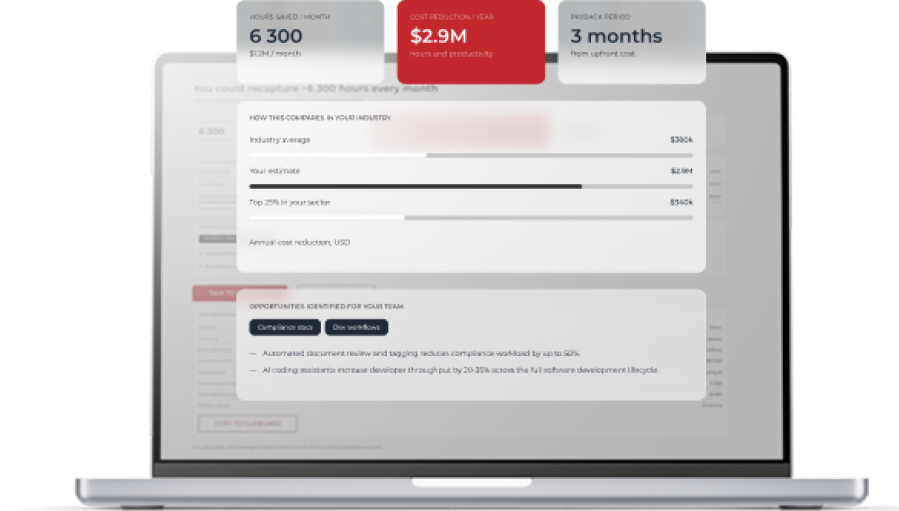
Use Oxagile’s AI ROI Calculator to estimate expected gains, costs, and payback before making a decision.
Chatbots are indeed a hot topic. Large language models have enabled chatbots to understand context, nuances, and emotions with unprecedented accuracy, leading to more human-like interactions. Companies are exploring diverse roles for chatbots, including healthcare assistants, financial advisors, e-commerce personal shoppers, travel assistants, and tools for employee training and onboarding, and so much more.
Well, actually you don’t have to look far. Here at Oxagile, we’ve also embraced AI in several small yet impactful ways to make life easier for our team.
One example is the internal retriever-augmented generation (RAG) system with a chatbot we built for the public section of our wiki.
Imagine a team member needs to quickly resolve an issue, say, setting up a VPN. Instead of sifting through pages of documentation, they simply query the bot. Within seconds, it surfaces a concise, step-by-step answer, like reminding you to download a specific tool or toggle a setting. It’s a simple but powerful tool that saves time and cuts down on frustration.
Given the wide range of applications, it’s no surprise we frequently get fascinating questions about chatbots and their development. Let’s answer a couple of them.

The timeline depends largely on the chatbot’s complexity:
As for the question, “How much does it cost to develop an AI chatbot?” the answer is more straightforward: data preparation, integrations, and infrastructure often account for the largest share of costs, while the remaining covers everything else. The biggest challenge? Data management. High-quality data leads to a high-performing chatbot, while poor-quality data can turn the setup process into a lengthy and costly endeavour.
When it comes to developing AI solutions, cost-effectiveness is always top of mind. Yet, no two AI initiatives are the same. Striking the right balance between budget efficiency and long-term success demands a thoughtful blend of strategy and a deep dive into a multitude of factors that directly influence the cost of AI. The key here is that this delicate balancing act doesn’t equate to sacrificing performance or putting your business at risk just to save a few dollars.
If that sounds like a bold statement — well, at Oxagile, we’ve witnessed this play out time and time again.
Our AI expertise stretches across industries like AdTech, where we’ve built AI-powered ad generation tool that optimizes creative production. In sports, we’ve developed real-time highlight compilation solution that transforms the fan experience. And in public safety, our next-gen computer vision platform helps enhance security through advanced video analysis.
The possibilities are virtually endless. AI development and integration are anything but monotonous, offering the flexibility to design, tweak, and customize solutions and models to meet precise objectives. With a wealth of examples across countless sectors, we can always arm any business with the right tricks, tools, and strategies on how AI can work its magic for the specific case, delivering solutions that are both efficient and transformative.
There are numerous parts, each vital to the result, yet it’s unclear where to begin and the instructions are vague, right? Let us navigate you through this every step and help you make it all click.

The answer to “how much does it cost to build an AI solution” depends on the complexity of the solution, integrations, and infrastructure requirements. Simple AI features can be relatively affordable, while enterprise-grade systems with real-time processing and custom workflows require much larger investments.
Many companies ask “is AI expensive” only to discover that hidden costs often come from data preparation, cloud infrastructure, monitoring, API usage, and ongoing optimization. In large-scale systems, operational expenses can eventually exceed the initial development cost.
Turning a prototype into a production-ready AI product usually requires additional investment in scalability, security, observability, infrastructure optimization, and compliance. Production systems also need more stable architectures and continuous maintenance.
Companies typically allocate around 15–25% of the original AI development budget annually for maintenance. This usually covers infrastructure, monitoring, performance optimization, security updates, and model improvements.

