Success story
Real-Time Video Relay System for On-Demand ASL Interpreting
5 quick facts about the project

Client
FCC-licensed Video Relay Service (VRS) provider

Use case
Users access live ASL interpretation in any real-time video call without coordination steps or extra hardware.

Team
Media technology engineers, IT architect, and delivery managers

Solution
FCC-certified VRS platform bridging WebRTC and SIP PSTN infrastructures with real-time media processing and call recording

Messaging and integrations
Supports Zoom, Google Meet
What success looks like
< 300 ms
Audio latency across WebRTC to SIP bridge for natural conversation flow
5+
VRS carrier and PSTN integrations through a single platform
FCC
Certified and compliant from first production release
The use case that started it all
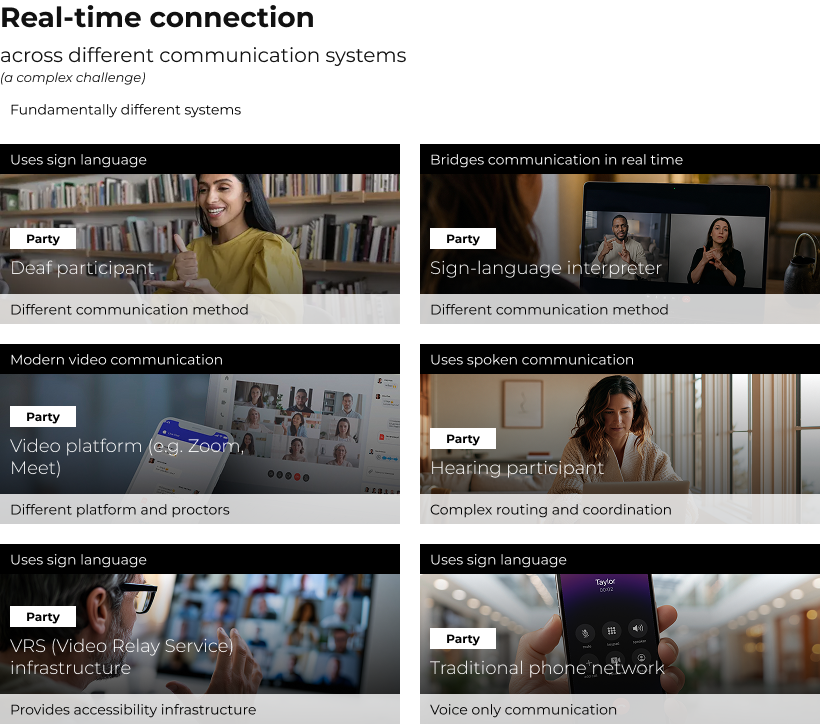

Defining the system requirements
Our job was to deliver video calls with low enough latency for real-time interpreting, even though each provider behaves slightly differently. We also had to account for the fact that calls take place in a tightly regulated, privacy-sensitive environment.
From day one, we brought in senior WebRTC and media technology experts to streamline delivery and avoid a learning curve on the client’s side.”
— Oxagile’s Delivery Manager

Easy access
One-click joining for video calls with an interpreter
No extra hardware
Works with existing VRS and phone infrastructure
Compliant by design
Built to meet FCC requirements
Low latency
Real-time, no-lag communication for live sign-language interpreting
The VRS solution in a nutshell
Real-time WebRTC – SIP/PSTN connector
- Connects online video conferencing apps with interpreters on traditional phone, PSTN, and VRS networks
- Enables calls to smoothly operate in both ecosystems
VRS workflow support
- Relay-specific functionality missing from mainstream platforms
- Includes interpreter relay handoff and Voice Carryover
- Supports DTMF menu navigation and compliant call recording workflows
VRS workflow support
- High-performance media layer built with Go and GStreamer
- Real-time transcoding and mixing of audio/video streams
- Supports Opus, G.722, G.711, VP8, and H.264 codecs
Cloud-native infrastructure
- Deployed on AWS ECS/Fargate
- Infrastructure provisioned as code using OpenTofu
- Built-in secrets management, multi-AZ resilience, and HIPAA-grade security controls
Tech obstacles we went through
Codec fragmentation across endpoints
A real-time transcoding pipeline decodes, resamples, and re-encodes audio and video per session so every participant receives a compatible format with no perceptible delay.
Inconsistent SIP behavior across VRS carriers
A carrier-aware SIP layer with domain whitelisting and structured interoperability testing isolates provider-specific quirks so one carrier cannot destabilize the platform.
Cross-protocol orchestration
A central orchestration service coordinates WebRTC and SIP components as a unified state machine to provide deterministic call lifecycle management and eliminate race conditions.
Tech stack
NestJS • TypeScript • Node.js
Go • GStreamer
Janus SIP signaling Drachtio Cloud & runtime AWS ECS / Fargate (multi-AZ) Infrastructure as code OpenTofu
AWS Secrets Manager • TLS everywhere
CloudWatch • Prometheus • Grafana • Sentry
PSTN and multiple US VRS providers
What each party gains

End users
Get on-demand sign-language interpreting directly within the tools and workflows they typically use.
Interpreters
Connect through familiar, existing infrastructure with no extra hardware required.
Software provider
Delivers a scalable, FCC-compliant platform that replaces fragmented, manual relay processes with a unified, multi-provider solution.
Some more web conferencing projects