


Story highlights

The client

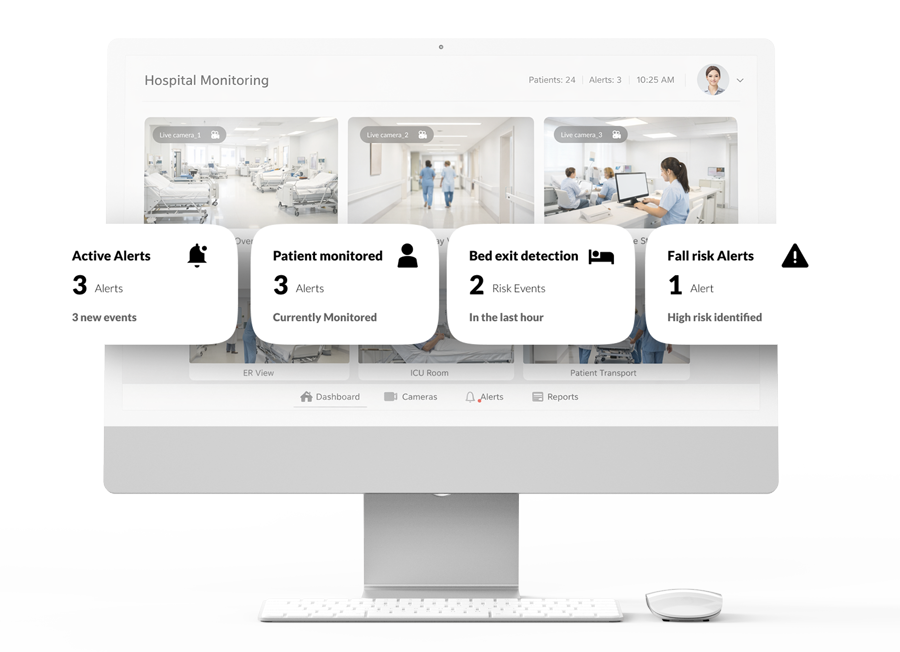
A U.S.-based HealthTech company delivering hospital-grade monitoring systems that combine real-time video and computer vision.

The request

As usage scaled, the platform hit practical Chrome WebRTC limits, requiring a strategy to sustain performance without disrupting hospital operations.

The solution

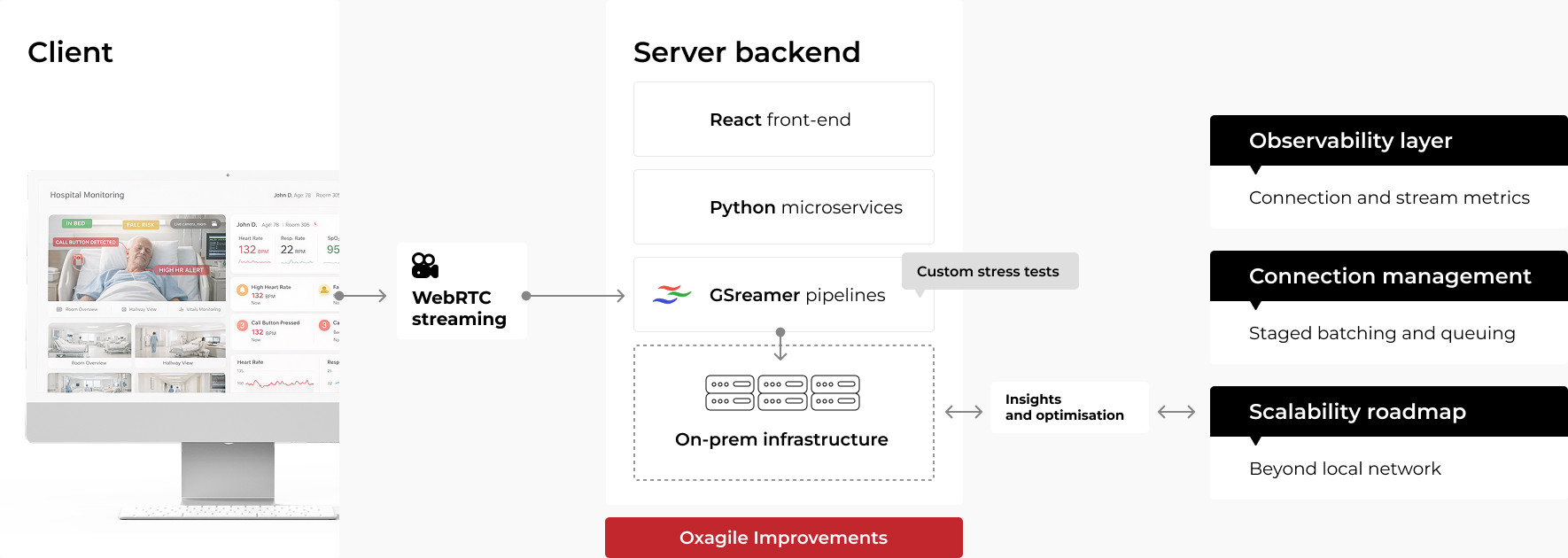
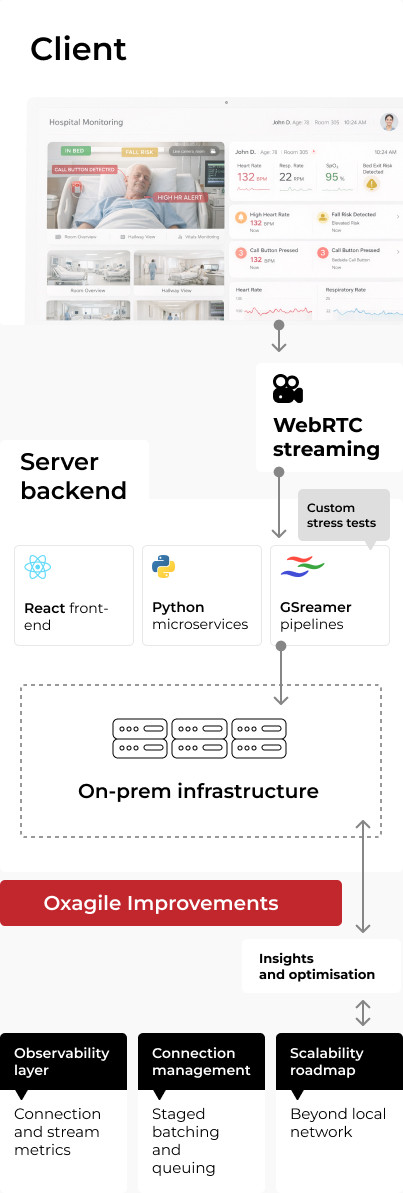
The task force audited the frontend, Python microservices, GStreamer pipelines, and Janus routing, combining a custom mini-app and stress testing to uncover scaling limits and establish a sustainable operating model.
Project timeline

Phase 1: System audit

The team confirmed a mature codebase and architecture, highlighting targeted improvements to boost scalability and system observability.

Phase 2: Load profiling

A custom test harness simulated up to 500 concurrent streams, allowing controlled analysis of Chrome WebRTC behavior under sustained load.

Phase 3: Analysis and mitigation

The team identified Chrome WebRTC’s connection ceiling and implemented staged connection batching with an observability layer to sustain scalable streaming.

The audit impact


1 week

Average audit turnaround


400+

Entities audited across client systems


500

Concurrent streams tested in controlled load

From insights to action:
Restored video reliability

The approach combined a technical audit, stress-testing, and prototyping to uncover system limits and validate mitigation strategies. Insights guided optimization and performance improvements.

Audit highlights
  • Robust React front-end and Python microservices architecture
  • GStreamer pipelines with targeted observability improvements
  • Security aligned to on-prem deployment, guided for future networked use
  • Edge-case load testing via a custom stress-test application
Validated solution directions
  • Chrome WebRTC connection limits quantified at about five hundred
  • Staged connection creation and queueing for high-concurrency streams
  • Monitoring layer to track connection health, stream quality, and usage metrics

Under the hood

The platform runs distributed microservices for video streaming, media routing, and AI monitoring. Oxagile added stress testing, staged connection management, and an observability layer to maintain scalable, high-performance streaming.

Expert perspective

“We were genuinely impressed by the quality of the client’s system. The architecture was clean, the codebase well-structured, and the design decisions clearly made by a seasoned engineering team. Our work focused on helping a strong platform operate predictably at even higher scale.”

— Amal Kabulov, Chief Software Engineer, Oxagile

Next steps: Monitoring management system

Following the audit and stress-testing, a lightweight monitoring solution was proposed to help the client maintain reliable, high-volume video streaming.
  • Real-time observability of connection counts and stream quality

  • Staged connection management and queueing to sustain performance

  • Automated alerts and analytics for proactive decision-making

  • Roadmap for scaling reliably beyond the local network

Used stack

Frontend and UI

React • Vanilla JS • Chromium WebRTC • Custom performance profiling toolkit

Backend and data

Python microservices • GStreamer pipelines • Janus (Go) • REST APIs

Cloud and infrastructure

Distributed microservices architecture • Custom stress-test application • Load simulation framework • Observability tooling

Optimizing real-time video streaming for critical applications?

Let’s talk about making your video streams consistent, reliable, and future-proof.

BOOK A CALL