













This website uses cookies to help improve your user experience




The term “team extension” is one of those phrases that sounds clear until you try to act on it. Google it, and you’ll find a hundred articles that all define it slightly differently. One vendor means staff augmentation, another means a dedicated squad, and a third is really just selling freelancers with better marketing. Meanwhile, you’re trying to figure out how to ship a product faster with the team you have, and none of these definitions are helping you make a decision.
We’ve spent 20+ years at Oxagile helping clients figure this out, from adding a couple of engineers to a sprint all the way to standing up full autonomous squads. And if there’s one lesson that keeps repeating, it’s that choosing the wrong model costs more than being short-staffed in the first place.
So we put together a guide that skips the generic definitions and focuses on what actually matters: which model fits which situation, how to set it up so it works, and where most companies trip up.
Key takeaways:

Most articles on this topic present team extension as a single, defined model. It’s more useful to see it as a range of strategies, each sitting at a different point between “you run everything” and “the partner runs everything”. Here’s how they break down.
The most direct approach, and often the most expensive. You hire permanent engineers, onboard them into your culture, and give them full ownership of your codebase and product decisions.

External developers plug into your existing team, work within your processes, and execute tasks under your management. You’re adding capacity, not adding decision-makers.
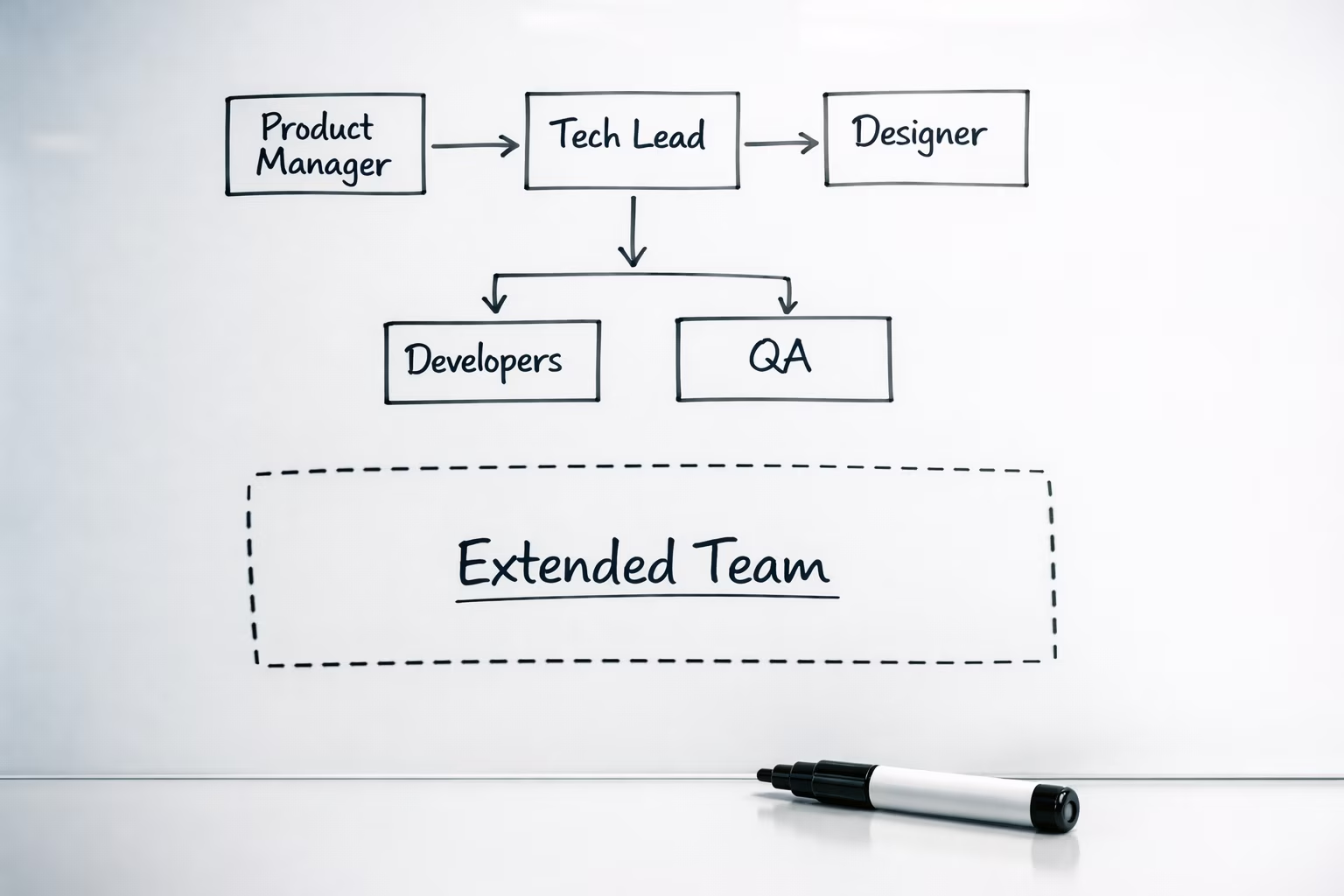
A self-contained team, often including a tech lead, developers, QA, and sometimes a Project Manager or Business Analyst, that takes ownership of a defined product area or capability. Unlike staff augmentation, a dedicated development team operates with enough autonomy to decompose requirements, propose solutions, and manage its own delivery rhythm.
The lightest-touch option. You engage an individual specialist for a defined task, typically with minimal integration into your internal processes.
The opposite end of the spectrum from augmentation. You hand an entire project or product to an external partner who handles delivery from discovery through architecture, development, QA, and deployment.
Most mature organizations don’t land on one model and stick with it, they combine several: an in-house core handling product strategy and key architecture decisions, augmented engineers adding capacity during heavy delivery phases, a dedicated external squad owning a specific vertical or platform component, and consulting engagements providing guidance on architecture or technology selection when needed.
Examples:
Most of our client relationships live in this hybrid space. A telecom company extending its core offering with an OTT streaming product, for instance, might engage us first for OTT consulting to define platform architecture, then move into a dedicated team model for the build, with specific augmented roles like performance testing and CDN optimization brought in during load-testing phases.
| Model | Speed to start | Cost | Your control | Team ownership | Best for |
| Expand in-house | Slow (months) | High | Full | Full | Long-term core product |
| Staff augmentation | Fast (2-3 weeks) | Medium | High | Low | Filling skill gaps quickly |
| Dedicated team | Medium (4-6 weeks) | Medium-high | Shared | Medium-high | Owning a product area |
| Freelancers | Very fast | Variable | High | None | Point tasks, short projects |
| Full-cycle outsourcing | Medium | Medium-high | Low | Full (vendor) | End-to-end delivery |
| Hybrid | Varies | Varies | Flexible | Flexible | Complex, multi-team programs |
Not every scaling challenge calls for external help. Sometimes you just need to hire. Sometimes you need to cut scope. But there are specific patterns where team extension is the right response.
The most common trigger. The product has traction, the backlog is growing, and leadership has committed to a delivery timeline that the current engineering org can’t hit. Hiring is underway, but the pipeline is slow, the market is competitive, and features are due before new people will be up to speed. Extension buys capacity without the months-long lag of recruitment.
Not every product requires a full-time machine learning engineer, or a video transcoding specialist, or someone who’s integrated half a dozen ad servers. But there are development phases where that kind of expertise is the difference between shipping something solid and something that falls apart under real usage. Building an OTT platform, for example, demands knowledge of adaptive bitrate streaming, DRM integration, and CDN architecture, and a general-purpose web team simply won’t have those skills.
Early-stage companies and new product lines hit this constantly. You might need five frontend engineers this quarter and three data engineers next quarter. Permanent headcount doesn’t flex that way. Augmentation and project-based extension let you reshape team composition as the product pivots, without carrying salaries through the transitions.
There’s a gap between “we’d like to ship faster” and “if we miss Q3, a competitor locks up this market”. The second scenario needs a response that internal hiring can’t produce in time. A dedicated external team that’s staffed and ready to engage in weeks, not months, can be the difference between capturing a window and watching it close.
Overloaded teams deliver slower, and they hemorrhage their best people in the process. Haystack Analytics research found that 83% of developers report experiencing burnout4, with excessive workload cited as the main cause. Distributing load and choosing to hire an extended software team protects the engineers your product depends on most.
That covers the concepts. Here are the decisions you’ll actually face when setting things up.
Before talking to vendors, do an honest capacity audit. “We need more developers” is a symptom, not a diagnosis.
Adding engineers to a project that’s struggling because of poor technical leadership will make things worse, not better.
Be specific. “Three senior backend engineers with experience in event-driven architectures and video processing, needed for approximately eight months” is a brief a vendor can work with. “We need to scale our backend team” gives them nothing to qualify against.
If you need people to execute tickets under your management, that’s augmentation. If you need a team that can own a workstream from planning to deployment, that’s a dedicated team. If you need strategic guidance alongside hands-on delivery, you’re looking at a hybrid model or full-cycle software development services.
Getting this wrong is expensive. Hire an augmented team when you actually need a dedicated one, and you’re stuck micromanaging a workstream you meant to delegate. Hire a dedicated team when you only need a few extra pairs of hands, and you’re paying for coordination overhead that adds nothing.
Freelancers are fast to engage, but vendors bring infrastructure around the people they place. For short, well-scoped tasks with clear deliverables, a strong freelancer is often the most efficient option. For anything involving multiple people, lasting more than a couple of months, or touching critical systems, you want a vendor with a bench, a management layer, and the ability to swap people in without killing your timeline.
The hidden cost of freelancer turnover, the knowledge loss, the re-onboarding, the context that evaporates when someone moves to their next gig, is almost always bigger than people expect.
Getting external engineers access to your repo and Jira board is mechanical. Making them productive contributors who understand the reasoning behind past decisions, not just the current state of the code, is the actual challenge.
What good integration looks like:
An extended team that operates in its own bubble isn’t really an extension of anything — it’s a parallel organization with a shared codebase.
Who approves architectural decisions? Who resolves disagreements between internal and external engineers? How do you measure whether the engagement is working?
Sort this out before the first sprint, not after the first conflict. It doesn’t have to be heavy. A lightweight agreement on decision rights, escalation paths, and regular check-in cadence is usually enough. But if you skip it, you’ll spend the first few months of the engagement untangling politics instead of shipping.
There’s a persistent assumption behind most team extension conversations: the core problem is always “not enough people”. Sometimes it is. But often, the real constraint is something headcount can’t address: unclear product direction, accumulated architectural debt that makes every change feel risky, and nobody in the room who can connect business goals to technical decisions.
Understanding which of those you’re dealing with changes the kind of help you should be looking for.
What separates a team that completes tasks from one that moves a product forward is ownership. Augmented engineers build what you specify. Product-minded teams question whether the thing you specified is the right thing to build, suggest alternatives when they spot a better path, and tie their daily work back to what the business needs.

A food delivery client came to us with what looked like a straightforward e-commerce build: an ordering platform, delivery logistics, and the usual stack of features you’d expect. The kind of project where most teams would take the spec, estimate the hours, and start coding. We did something else.
We started poking at the brief. How do people actually browse food when they’re hungry? Which steps in the ordering flow will cause drop-offs once traffic scales? What does version two of this product look like, and are we building version one in a way that doesn’t block it?
These weren’t questions the client expected from a development partner, but they changed the shape of the final product. Features got reprioritized, some got cut, others got added that weren’t in the original scope. By the end, the client had something they couldn’t have specced on their own, because the team building it was thinking about the product, not just the tickets.
There’s a blind spot in many team extension setups. The client knows what they want built. The extended team knows how to build it. But nobody is asking whether the architecture will hold up eighteen months from now, or whether a technology choice is creating a dependency that’ll be painful to reverse.
Good teams think about structure, validate assumptions, and optimize as they go, not just write code. We pair delivery with consulting in domains like quality engineering because of this: a performance testing strategy designed alongside the development process catches things that testing after the fact never will.
Engagements have a way of growing beyond their original scope. The team brought in for backend development finds that the frontend needs significant work too. Performance testing reveals infrastructure problems. A planned MVP turns into a multi-platform product spanning mobile, smart TV, and web.
Working with a partner who can cover the full development lifecycle, from discovery and architecture through QA and scaling, means you spend less time re-procuring and re-onboarding when things expand. You don’t have to use all of those capabilities from day one but having them available when you need them beats starting a new vendor search mid-project.

Team extension addresses capacity, speed, and expertise gaps, but some challenges are structural enough that adding people won’t help.
Every vendor will tell you they have deep expertise and flexible engagement models. A few questions that help cut through that.
Generalist engineers can build most things given enough time and direction. But in specialized areas, such as video streaming, advertising technology, AI, and financial services compliance, the gap between “technically capable” and “has shipped this before” shows up directly in how fast they move and how sound their architecture is.
Don’t ask for portfolio pages. Ask how many OTT platforms they’ve built, which DRM vendors they’ve integrated, and which ad server protocols they support natively.
Less experienced teams need everything spelled out before they can move. Mature teams can work from a rough requirement, ask the right questions, shape an approach, and catch risks early.
We’ve been doing this for 20+ years across custom software development, and our team includes solution architects, developers, designers, QA, and performance testing specialists. That breadth matters because on complex projects, the people building the frontend need to understand what the architect decided and why QA is pushing back on a deadline. Disciplines don’t work in isolation, and neither should the team.
Flexibility in pricing matters less than flexibility in structure. You need a partner who can begin with consulting, transition into a dedicated team, bring in augmented specialists as the project grows, and wind down cleanly when the work is done. If every scope change requires renegotiating the entire engagement structure, you’ll spend more time on procurement than on product.
“Development team extension” will probably keep getting broader as a term: new hybrid models will emerge, and the lines between augmentation, dedicated teams, and outsourcing will keep blurring. AI is already shifting the math on team composition, making individual engineers more productive and moving the bottleneck from raw coding capacity toward architecture, integration, and product judgment.
But the underlying question won’t change. You need to match the model to the problem. The organizations that scale engineering well aren’t always the ones with the biggest teams. More often, they’re the ones that figured out what kind of help they actually needed, found a partner with the right depth, and put in enough work on the relationship that the line between “internal” and “external” engineers gradually stopped mattering.
The right answer depends on what you’re solving for — capacity, expertise, ownership, or all three. Oxagile works across the full spectrum: consulting, staff augmentation, dedicated teams, and end-to-end delivery. The first conversation is about your specifics, not a sales pitch.
1. IT Outsourcing (ITO) — Market Share Analysis, Industry Trends — Statistics, Growth Forecasts (2026–2031) — Mordor Intelligence / ResearchAndMarkets.com
2. Computer and Information Technology Occupations: Occupational Outlook Handbook — US Bureau of Labor Statistics
3. Software Developer Shortage in the US — Grid Dynamics
4. Developer Burnout Survey — Haystack Analytics

Start with specifics: which skills, at what seniority, for how long. Then pick the model, whether that’s augmentation, a dedicated team, or something hybrid. When evaluating vendors, prioritize domain experience and engineering maturity over price. A sharply defined brief (“three senior Python engineers with fintech experience for eight months”) produces better candidates faster than a general request for more developers.
The term covers the range of ways an external partner adds engineering capacity to your organization. That includes:
The service typically includes recruitment, vetting, onboarding support, and ongoing management alongside the engineers themselves.
Most engagements that go wrong don’t fail because of bad engineers. They fail because the integration was treated as an afterthought.
Staff augmentation adds individual engineers to your team under your direct management. You assign tasks, set priorities, make technical calls.
A dedicated team is a self-contained unit, typically with a tech lead, developers, and QA, that takes ownership of a defined scope and manages its own delivery. The dedicated model costs more, but it brings architectural input, proactive problem-solving, and a degree of accountability for business outcomes that individual augmented engineers usually don’t carry.
Augmentation engagements can place engineers in your workflow within two to three weeks. Dedicated teams typically take four to six weeks to assemble, accounting for composition planning, internal alignment, and a more thorough onboarding process.
Full-cycle outsourcing often starts with a discovery phase that adds another two to four weeks before development begins. These timelines depend heavily on the vendor, project complexity, and how well-defined your requirements are coming in.
Often more so than for larger companies. Startups face a particular mix of tight timelines, limited budgets, and shifting requirements that makes permanent headcount risky. Extension gives you access to senior talent you couldn’t afford to hire full-time, the ability to scale capacity around milestones like MVP launch or a funding round, and the flexibility to reshape your team as the product evolves. The overhead and long-term commitment of permanent hires is exactly what most early-stage companies can’t take on.

