













This website uses cookies to help improve your user experience




Every AI company seems to be considering hiring forward deployed engineers (FDEs). Yet the title often describes very different roles with various responsibilities, reporting structures, and business goals. In one company, an FDE owns enterprise deployments from pilot to production. In another, the same title describes an implementation specialist or a product engineer embedded with strategic customers.
The growing overlap between engineering titles reflects more than changing job descriptions. It reflects different operating models. This confusion leaves leaders struggling to define hiring plans, candidates finding similar job descriptions with very distinct expectations, and teams inheriting overlapping responsibilities without clear ownership.
The term FDE adds another layer of ambiguity. In many job descriptions, it refers to the same hybrid role, which is why a forward deployed software engineer vs software engineer is usually evaluated through ownership, implementation scope, and customer deployment responsibilities.
This guide won’t be defining the position again, we look at a different question: when does an organization benefit more from hiring an FDE than another software engineer, or another adjacent role altogether? We explore the comparison through the lens of organizational design, explaining why companies create these roles, where their responsibilities intersect, and which role fits the stages of product growth.
Key takeaways:
At first glance, forward deployed software engineer vs software engineer may seem like a comparison between two similar engineering roles. Both build production software, solve complex technical problems, and collaborate with cross-functional teams. Those similarities often make the two roles appear interchangeable.
But the real purpose of the work clears things up. The distinction isn’t technical ability, it’s where engineering effort creates the most value.

As a result, each role is evaluated against its own set of outcomes, and success is measured differently as well. Product quality, engineering velocity, and platform scalability matter most for software engineers. For FDEs, effectiveness is closely tied to implementation quality, time-to-value, customer adoption, and the ability to solve implementation challenges without creating unnecessary product debt.
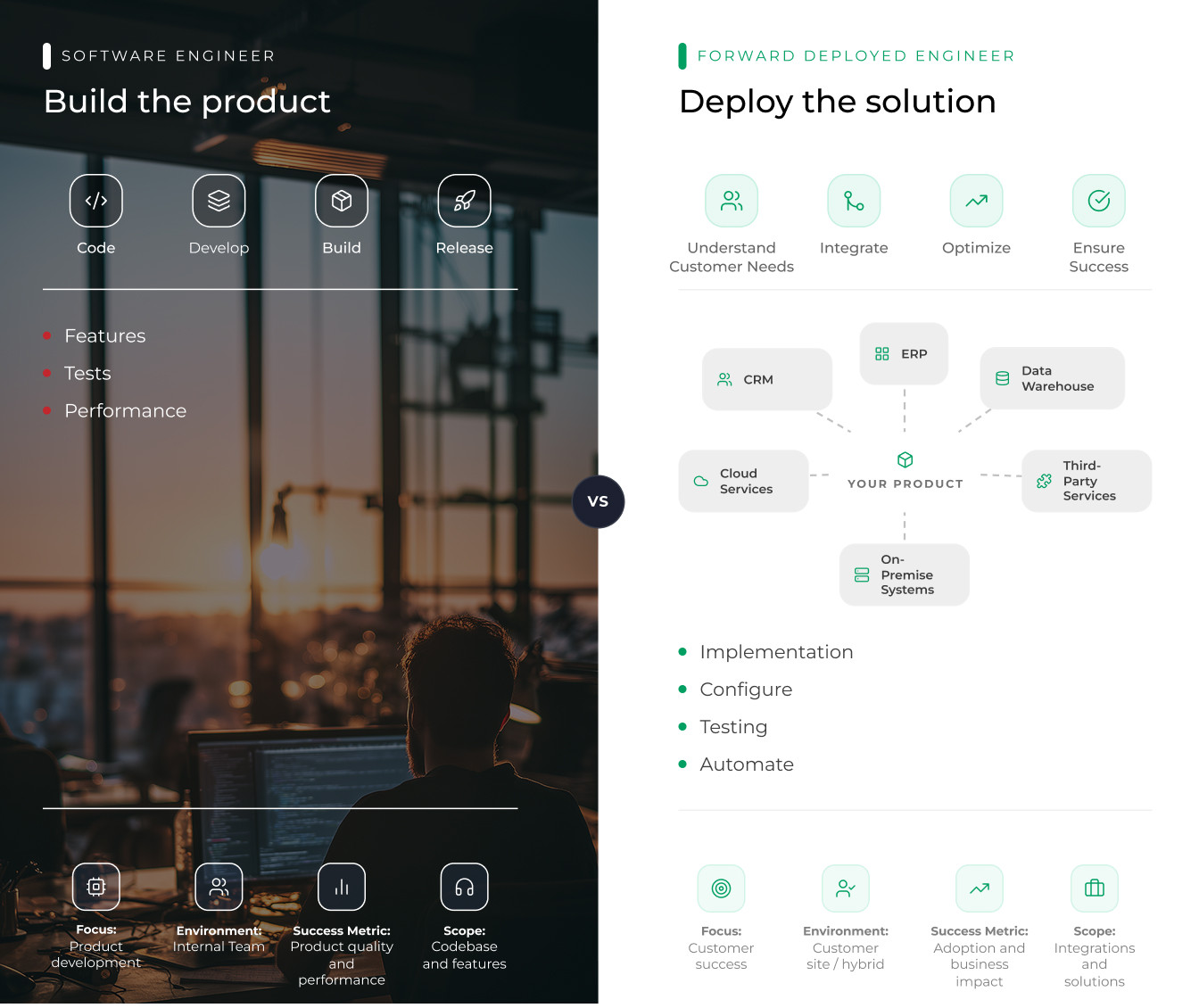
The feedback loops and day-to-day collaborations differ just as much. Software engineers spend most of their time inside product and engineering teams. FDEs regularly work much closer to live customer implementations, teams, customer success, product, and customer engineering teams to move deployments into production.
Their work includes creating production integration code, developing deployment tooling, and solving specific technical challenges. That involvement often continues throughout the entire deployment lifecycle, and the lessons learned often flow back into the product roadmap, helping engineering teams identify which customer requests should become reusable capabilities.
Companies building enterprise platforms with lengthy implementation cycles frequently benefit from adding forward deployed engineers, allowing customer deployments and product development to advance in parallel.
Neither role replaces the other. Organizations with straightforward, self-service products can often scale successfully with software engineers alone.
Organizations introduce FDEs when enterprise deployments begin competing with core product development for the same engineering capacity. Separating those responsibilities allows software engineers to keep improving the platform while FDEs remove the technical obstacles preventing customers from realizing its value.
The goal isn’t to create two classes of engineers. Preventing two fundamentally different types of work from slowing each other down is.
As the FDE role has spread beyond companies like Palantir, it has evolved in multiple directions. Much of the interest in Palantir forward deployed engineer vs software engineer comparisons comes from the company’s unique approach to enterprise software delivery. But many organizations have since adapted the role to fit their own products and implementation models.
Some organizations use FDEs as engineers embedded with enterprise customers. Others assign similar responsibilities to solutions engineers, solutions architects, or implementation teams. Similar titles can represent contrasting operating models.
The boundary between these roles usually appears when a project moves from planning to implementation. Those comparing a forward deployed engineer vs solutions engineer often discover that responsibilities overlap far more than job titles suggest, especially during enterprise implementations.
Large enterprise projects often require both roles because architectural decisions alone don’t guarantee a successful deployment. Someone still has to solve the engineering challenges that emerge once production implementation begins.
It’s common for product managers and forward deployed engineers to hear the same customer requests, but they act on them differently.
Separating those responsibilities helps organizations avoid two common pitfalls: turning the roadmap into a collection of one-off requests or forcing implementation teams to solve problems the product should eventually solve itself. That continuous feedback loop helps companies refine the product, improve future deployments, which gives both roles a direct influence on customer success, each in its own way.
The biggest difference isn’t billing models. Long-term incentives is what matters.
That changes engineering decisions. An FDE looks for implementation approaches that can be repeated, supported, and eventually incorporated into the product. It doesn’t go down to delivering a solution that only works for a single project.
That long-term ownership also creates a feedback loop between customer deployments and product development, allowing implementation experience to shape future solution improvements. This approach is particularly valuable in industries such as fintech, healthcare, and enterprise SaaS, where production environments often vary significantly from one customer to another.
These overlaps explain why hiring discussions around FDEs often become confusing. The role borrows elements from architecture, consulting, product, and engineering, but its purpose is different.
Organizations create forward deployed engineering teams when enterprise software needs continuous technical ownership between the core product and actual customer environments.

Every product eventually reaches a point where team structure becomes as important as technology. The right mix of engineering expertise helps deployments succeed and teams scale without creating unnecessary bottlenecks.
Hiring a strong forward deployed engineer is one of the toughest challenges in technical recruitment. Companies aren’t looking for a specialist who excels in a single area.
Companies need engineers who can build production software, deal with tough cases, and communicate effectively with multiple stakeholders. That combination of skills is difficult to find in one person.
| Core competency | Why it matters |
| Software engineering | Build and maintain production-grade integration code that meets the same quality standards as the core product. |
| Systems thinking | Understand APIs, cloud platforms, distributed systems, enterprise architectures, and integration patterns. |
| Customer communication | Work effectively with engineering teams, technical stakeholders, and business users throughout implementation. |
| Problem-solving | Diagnose issues in unfamiliar environments, adapt quickly, and make sound engineering decisions under uncertainty. |
| Business understanding | Connect technical decisions with customer goals, product capabilities, and long-term maintainability. |
Compensation reflects the scope of the role as much as its technical requirements. In many organizations, forward deployed engineers earn salaries comparable to senior software engineers. Bonuses, equity, or other incentives may also be linked to deployment milestones, customer adoption, or implementation success.
Finding great FDEs takes time because the role draws on experience that is rarely built in a single position. Writing production software, working directly with enterprise customers, and solving implementation challenges often develop through different career paths.
Not every product needs a dedicated forward deployed engineering function. The role becomes valuable when customer deployments require sustained engineering effort beyond the core product team.
Solutions with self-service onboarding, standardized integrations, and predictable deployment paths typically benefit from investing in the core product team. As adoption grows, companies often expand engineering capacity through a dedicated development team model before introducing specialized customer-facing engineering roles.
Products with long implementation cycles, complex enterprise integrations, or customer-specific deployment requirements often reach a different stage of growth. This is common in industries such as video software development, enterprise AI, cybersecurity, and data platforms, where sustained engineering effort that pulls core product teams into implementation work and slows roadmap delivery is necessary.
| If your product… | Consider investing in… |
| Supports self-service onboarding | Software engineering team growth |
| Uses standardized integrations | Software engineering team growth |
| Requires extensive customer-specific integrations | Forward deployed engineers |
| Depends on legacy systems or complex enterprise infrastructure | Forward deployed engineers |
| Has long implementation cycles | Forward deployed engineers |
| Frequently pulls product engineers into customer deployments | Forward deployed engineers |
Usually, strong FDEs are comfortable working without complete information. They often encounter unfamiliar infrastructure, requirement shifts, and constraints that only become visible during implementation. Success depends on making sound technical decisions before every variable is known.
And this is where it gets tough. Hiring forward deployed engineers is tricky due to reasons that don’t show up in coding interviews. Most companies can evaluate technical ability. The harder question is whether an engineer can make good decisions when customer expectations, product strategy, and technical constraints all pull in different directions.
The role demands engineering judgment as much as engineering skill. Every deployment involves trade-offs between solving today’s customer problem and preserving a product that can scale tomorrow.
Equally important is knowing what not to build. Every enterprise customer has unique requests, but not every request belongs in the product. Effective FDEs recognize when it’s a one-off customization or a recurring problem that deserves a reusable feature.
Experienced FDEs are relatively rare. Few careers naturally combine product engineering, enterprise implementation, and customer collaboration.
Many companies first think about forward deployed engineers when their product team starts spending too much time outside the product itself. Engineers are pulled into customer calls, strategic accounts need custom technical work, and implementation issues begin to compete with the roadmap. At that point, hiring more software engineers can help, but it may not solve the real source of friction.
The underlying question is where engineering ownership should sit. If most challenges come from missing product capabilities, the core engineering team needs more capacity. If the product is strong but every enterprise deployment requires deep integration work, customer-specific configuration, and production troubleshooting, the company may need a dedicated FDE function.
This is why the forward deployment engineer vs software engineer choice is ultimately a team design question. Software engineers keep the product moving forward. Forward deployed engineers make sure complex customers can actually use that product in their own environments. The strongest setup is rarely based on titles alone. It depends on how the product is sold, deployed, supported, and improved over time.
Every product has different engineering demands. If you’re evaluating how to structure your team or add specialized expertise, Oxagile can help you choose an engagement model that fits your product, customers, and growth plans.

A forward deployed engineer vs software engineer comparison usually begins with technical skills because both roles involve writing production code and solving complex engineering problems. The difference lies in where that engineering work happens and how success is measured.
This comparison also helps explain why organizations often evaluate a solutions engineer vs forward deployed engineer when defining customer-facing roles. While both positions work closely with customers, solutions engineers typically support solution design and technical validation before deployment, whereas FDEs remain responsible for engineering work after implementation begins.
There isn’t a universal salary gap between the two roles. Compensation depends on seniority, company, industry, and the complexity of customer environments.
Organizations that expect forward deployed engineers to combine senior software engineering expertise with customer ownership often compensate them at a level comparable to (or above) software engineers. Bonuses or equity may also reflect deployment outcomes, customer adoption, or implementation success.
Neither. Forward deployed engineering is generally viewed as a different specialization rather than a higher or lower level on the engineering ladder. Engineers who enjoy customer interaction, production deployments, and solving implementation challenges often choose the FDE path because it matches the type of work they find most rewarding.
The same principle applies when comparing forward deployed engineer vs sales engineer or deployment strategist vs forward deployed engineer. These roles support separate stages of the customer lifecycle and serve complementary functions, so they shouldn’t be viewed as junior or senior versions of one another.

